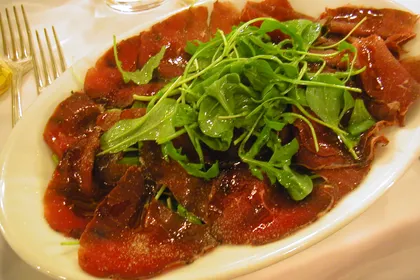
Italian cured meats
Salting and drying pork is Italy's oldest preservation technology. Each province adapted it to its own weather: where the wind blows, you air-dry; where it is damp, you smoke it or make it spreadable.
For centuries the pig was the family food bank: killed in winter, it had to last a year. The whole repertoire comes from that constraint. Prime cuts became prosciutto and culatello, fatty cuts became lardo, guanciale and pancetta, and the trimmings went into sausages.
Climate decides the outcome. Dry hill breezes make the hams of Parma and San Daniele. The damp lowland air that would ruin them makes culatello instead, protected inside a bladder. In Calabria chilli replaces some of the salt and gives you 'nduja, spreadable because the fat never firms up. In South Tyrol they smoke, because the cold damp valleys will not dry meat on their own.
Almost all of these are pork. Where a beef, goose or boar version exists (bresaola, mortadella di fegato, salame d'oca) we say so, because that is what readers who avoid pork are looking for.
Italian cured meats: what you are actually buying
A deli counter in London, Brooklyn or Melbourne hands you six Italian words and no context: prosciutto, pancetta, salami, mortadella, speck, capicola. They are not brands, not grades of one thing, and not interchangeable.
The names describe body parts and methods. Once you know which muscle you are buying, and whether it was aged whole or ground into a casing, the rest follows: cost, slice thickness, cooking.
Pronunciation is the other barrier and it is a small one. It is pro-SHOO-toh, and nobody behind a counter minds an attempt.
Three numbers do most of the work: how many months it aged, how much weight it lost getting there, and how much salt is left in it. The first you ask for at the counter, the second explains the price per pound, the third explains why one product needs preservatives and another carries none.
What follows is the counter conversation rather than the history: what to ask for, how thick to have it cut, how long it actually keeps once it is in your fridge, and which of the marks stamped on it mean something.
Whole muscles, sausages, spreadables
Family one is whole cuts, salted and air-dried. Prosciutto is the hind leg, culatello (koo-la-TELL-oh) the inner core of that leg, coppa or capocollo the neck (the deli “capicola”), lardo the back fat, guanciale (gwan-CHAH-leh) the cheek, bresaola beef. Salt migrates inward slowly: twelve to thirty-six months for a leg, three for a cheek.
Family two is ground meat in a casing: salame, mortadella, cotechino, zampone. The inside is airless and no rind acts as a barrier, so safety comes from salt, nitrite, fermentation or cooking. Dried salami and mortadella are ready to eat; cotechino and zampone must be boiled.
Then the odd ones, ground but not sliceable: 'nduja (en-DOO-yah), kept spreadable by chilli and soft belly fat, and ciauscolo (chow-SKOH-loh). Whole pieces cost more per kilo, a quarter of their weight lost over a year, but keep for months intact; sausages dry fast once cut; spreadables are condiments.
Months are the technology, not the marketing. Prosciutto di Parma PDO cannot leave the cellar before fourteen months from the start of salting, San Daniele PDO before thirteen; Culatello di Zibello PDO needs at least ten, Coppa Piacentina PDO six, Lardo di Colonnata PGI six in the marble troughs. Speck Alto Adige PGI has no single figure: the rulebook ties the minimum to the weight of the piece, from twenty weeks for the lightest (3.4-4.3 kg) up through twenty-two, twenty-four, twenty-six, twenty-eight and thirty to thirty-two weeks for the heaviest (7.0-7.5 kg). Bresaola runs four to eight weeks, guanciale about three months, a mid-sized salami four to ten weeks.
Weight loss is why the price per pound looks the way it does. A hundred kilos of trimmed fresh legs come out at roughly seventy once cured, and fifty-five to sixty once boned; only the hard trimming that prepares a piece for slicing takes it near fifty. Salami sheds a third. Salt does the parallel job: the Parma rulebook pins the finished ham between 4.2 and 6.0 per cent salt, 58.0 to 63.0 per cent moisture and a proteolysis index of 25.0 to 32.0 per cent. Once free water falls far enough, pathogens stop of their own accord, which is why a year-aged whole muscle carries no additives and a fresh ground sausage does.
Reading the label in a foreign deli
PDO (DOP in Italian) and PGI (IGP) are not two grades of one thing. PDO means birth, rearing, slaughter and processing all happened in the named area; PGI means at least one stage did, often only the processing. That is why Bresaola della Valtellina PGI, Mortadella Bologna PGI and Speck Alto Adige PGI can start from non-Italian meat, though not in the same way: bresaola is largely made from South American beef and mortadella carries no origin constraint, while speck may only use pigs born on farms inside the European Union.
“Product of Italy” tells you where the last processing happened, not where the pig lived. Since April 2020, EU rules require that when a label claims an origin and the main ingredient comes from elsewhere, the label says so: look for the small line naming the pork's origin. “Italian style” is protected nowhere.
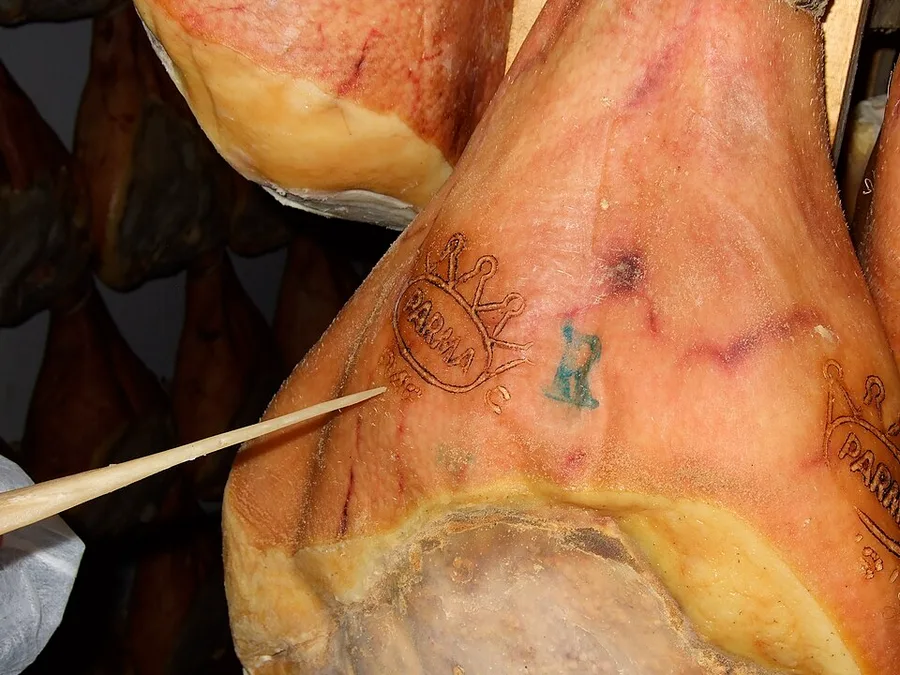
On Prosciutto di Parma the mark that counts is the five-pointed ducal crown fire-branded into the rind, applied only after a final inspection once at least fourteen months have passed since production began; the ingredients are pork and sea salt. One trap: prosciutto in Italian just means ham, cotto or crudo. And “pepperoni” is American: peperoni means bell peppers.
That crown is not decoration: it carries a number identifying the individual curing house, and it is the last mark to go on, branded only after the final inspection. Others come before it: the farm's origin tattoo, then the slaughterhouse stamp, then the consortium's seal (a round metal crown with a hole in the middle, fixed to the leg at the start of salting, carrying the first three letters of the month, two digits of the year and the letters C.P.P.). That is where a real age comes from, not from the shelf card.
Stagionato is the time the producer held it before release. Affinato is time added afterwards by someone else, in their cellars, outside the consortium's control. On cooked ham the three tiers (cotto, scelto, alta qualità) are set by an interministerial decree: the one of 21 September 2005 was repealed and replaced by the interministerial decree of 8 August 2025, in force since 24 August 2025, which keeps the three categories and separates them by maximum moisture, 82 per cent for cotto, 79.5 for scelto, 76.5 for alta qualità. Alta qualità remains the tier with the tightest ingredient rules, with no added polyphosphates or non-meat proteins.
Supermarket own-label tells you nothing on the front. In the EU the oval health mark (IT, a number, CE, under Regulation 853/2004) names the plant that carried out the last processing or the packing, not whoever cured the meat: on a pre-sliced pack it is usually the slicing room. In the US the establishment number on the inspection mark does the same job. It is frequently the same plant as the branded pack beside it.
Price closes the argument. A pound of sliced crudo starts from roughly two pounds of fresh leg, plus a year of cellar space and capital standing still. Priced near cooked ham, the months on the label are not there.
Nitrites and nitrates, honestly
Nitrite and nitrate (E249 to E252 in Europe, US curing salt or “pink salt”) suppress Clostridium botulinum, which finds an airless sausage interior ideal. They also fix the pink colour and build the cured flavour: genuine safety work, not cosmetics.
In 2015 the WHO's IARC classified processed meat as Group 1, carcinogenic to humans, on sufficient evidence for colorectal cancer. What the headlines got wrong: the group says how strong the evidence is, not how large the risk is. Tobacco smoke sits in the same group, with a far bigger effect. The figure was about 18% higher relative risk per 50 g eaten daily, on a modest baseline.
The American “uncured — no nitrates added” label is a labelling rule, not a chemistry claim: those products use celery powder, a nitrate that cultures turn into nitrite. Parma PDO and San Daniele PDO genuinely have none: a muscle dried a year holds too little water for botulinum. Advice parts company from there: the IARC/WHO framing supports limiting processed meat rather than eliminating it, while the World Cancer Research Fund and the American Institute for Cancer Research go further, recommending that people eat very little processed meat, if any.
The codes as they appear: E249 potassium nitrite, E250 sodium nitrite, E251 sodium nitrate, E252 potassium nitrate. Regulation (EU) 2023/2108 cut the maximum added nitrite (now expressed as the NO₂⁻ ion and paired with a limit on residual nitrite in the finished product) from 150 to 80 mg per kg across most meat products: for cured meats the changeover fell on 9 October 2025, while ripened cheeses have until 9 October 2026. Derogations for traditional specialities do exist, but no Italian product is on the list, which names Wiltshire bacon, jamón and paleta curada, presunto, Rohschinken and jambon sec. American limits are written instead as ingoing parts per million: sodium nitrite for comminuted products capped at a quarter of an ounce per 100 lb under 9 CFR 424.21(c), which works out to about 156 ppm, and 120 ppm for pumped or massaged bacon alongside 550 ppm of ascorbate or erythorbate under 9 CFR 424.22(b).
Why long ageing needs less of it: the risk sits in the window when the meat is still moist and airless. In a whole muscle, salt moves in from the surface, free water drops below the level at which botulinum can multiply, and contamination stays on the outside. In ground meat it is distributed through the whole mass and drying takes weeks. The wetter, softer and more finely ground the product, the more real work the nitrite is doing.
One figure keeps the target straight: most of the nitrate people eat comes from leafy vegetables, not from the deli counter.
Slice thickness is part of the recipe
Prosciutto goes as thin as the machine will cut, near enough to see through. The reason is mechanical: fibres in a leg aged a year are long and tough, so a thick slice is chewy. Culatello wants a hair more: veil-thin slices dry out between board and table.
Mortadella should never be thin: fine slices turn slippery and stick together. Ask for it three to five millimetres thick, or cubed. Salami is cut on the bias at about forty-five degrees, so the slice comes out wider than the casing and more surface releases aroma.
Knife versus machine is a false argument: the variable is heat. A fast motorised blade warms the fat, which smears and oxidises; a flywheel slicer turns slowly and heats nothing. If the counter has only a fast blade, ask for the fatty cuts by knife.
In millimetres, since slicer dials are numbered and mean nothing: prosciutto and bresaola under 1 mm, close to transparent, the thinnest setting the machine has; culatello and coppa 1-2 mm; salami 2-3 mm on the bias; speck 1-2 mm; lardo shaved. Pancetta and guanciale bound for a pan go the other way: 5-8 mm, or cut into lardons, or the lean scorches before the fat renders.
Temperature is two separate things. The piece is sliced cold, 4-8 °C, so firm fat leaves the blade cleanly instead of smearing along it. The slice is eaten at 18-20 °C, roughly 64-68 °F, because below 15 °C the aromatics stay locked inside solid fat.
Slicing multiplies the exposed surface: what takes months to oxidise on a whole piece takes minutes on a plate. Lay slices out loose rather than stacked, cover the plate, and bring it straight to the table. A board assembled half an hour early already has dull, curled edges, and the smell has gone into the room.
Fat, storage and shelf life
Do not trim the white rim. Nearly all the aroma compounds are fat-soluble, so the fat is where the flavour lives, and it buffers the salt. Trimmed, the lean is saltier and drier than the producer intended.
Vacuum packs need twenty minutes before serving: the vacuum presses slices together and traps volatiles, the “plastic” smell on opening. Separate them and let them reach 18-20 °C, since below 15 °C the fat is solid and releases almost nothing.
A started whole piece is covered on the cut face with its own trimmed fat or greaseproof paper, kept cool and ventilated. The face darkens within hours: oxidation, not spoilage. Remove the first slice. Sliced meat is best the same day; an opened pack is a fresh food again, two or three days whatever the date says.
The days, in order: sliced at the counter it is best that day and holds one or two wrapped in paper, low in the fridge. A sealed vacuum pack is good for its printed date, usually weeks out. Once opened, that date is void: two or three days, like any fresh food, regardless of what is stamped on the film.
A whole piece is managed at its cut face. A started ham gets sugna, the traditional lard-and-salt paste, or simply a slice of its own trimmed fat laid back over the opening; a salami needs greaseproof paper on the face only, because the rest of the casing has to breathe. Each time you start again, take off the first 2-3 mm: that slice has been working as the lid.
Oxidation shows in the eye before the nose. Fat moves from ivory to amber and turns oily and translucent; lean goes from ruby to brick to grey; the slice loses its sheen and sits flat. The smell arrives late, like stale walnut. Do not confuse any of it with the white crystals inside a long-aged prosciutto: that is tyrosine released by proteolysis, a marker of age rather than a fault.
How to choose
- 1Say how you will use it, not just the name: a board and a pasta sauce want different products.
- 2Ask how long it was aged, and ask for it sliced now: ham loses more in four hours in a fridge than in four months on the bone.
- 3Look at the fat before the lean: ivory-white and firm. Yellow or oily means oxidation, and no ageing fixes it.
- 4Check whether it needs cooking: prosciutto, culatello, bresaola, speck, salami and mortadella do not; pancetta, guanciale, cotechino and zampone do.
- 5Buy less, more often. Two portions sliced today beat half a kilo sliced last Tuesday.
- 6If the label says “Italian style”, read the pork origin line: style is protected nowhere, PDO and PGI marks are.
What almost everyone gets wrong
Pancetta is Italian bacon.
Same cut, pork belly, but pancetta is salt-cured and air-dried rather than smoked. American bacon is smoked belly; British back bacon comes from the loin. For carbonara the right meat is neither: guanciale, cheek.
“Salamis” is the plural of salami.
In Italian, salame is one and salami is already the plural. English borrowed the plural as a singular, so “a salami” is normal English, but in an Italian shop, ask for un salame.
Prosciutto means Parma ham.
Prosciutto is Italian for ham of any kind, cooked or cured. Parma is one PDO among several: San Daniele, Modena, Toscano, Carpegna, Crudo di Cuneo, plus crudo with no denomination.
Trim the white fat off before serving.
The aroma compounds are fat-soluble and live in that rim, which also softens the salt. Trimmed, a slice tastes saltier and of much less. If the texture bothers you, serve it warmer.
A vacuum pack lasts for months after you open it.
The vacuum halts oxidation only while sealed. Once air is in, it is a fresh food: two to three days in the fridge, wrapped in paper. The printed date belongs to the unopened pack.
Where to start
The pages worth opening first.
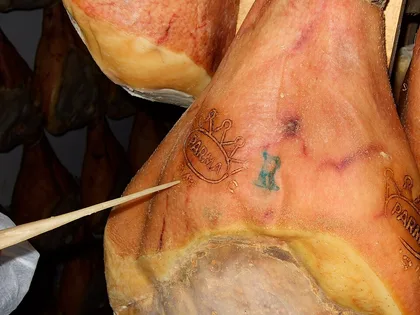 DOPProsciutto di Parmapro-SHOO-toh. Pork and sea salt, fourteen months minimum, a five-pointed crown burned into the rind.
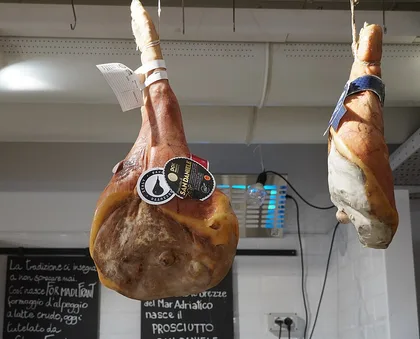 DOPProsciutto di San DanieleSweeter and softer than Parma, aged in Friuli, sold with the trotter attached.
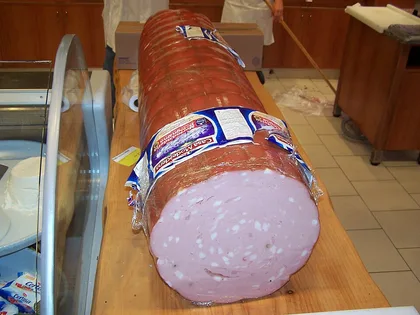 IGPMortadellaThe original American bologna descends from, and nothing like it. Thick or cubed.
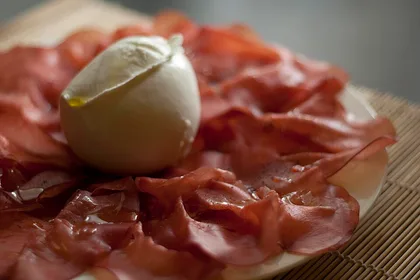 IGPBresaolabreh-zah-OH-lah. Air-dried beef, not pork: the answer for anyone avoiding pork.
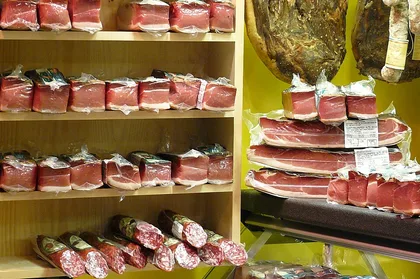 IGPSpeck Alto Adige IGPBoned, lightly smoked, cold-air-dried leg from Alto Adige: the one that tastes of woodsmoke.DOPPancettaCured pork belly, unsmoked. Buy it to understand how it is not bacon.
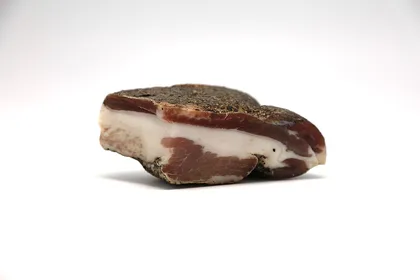 PATGuancialegwan-CHAH-leh. Pig's cheek, the correct fat for carbonara: it melts clear, not crisp.
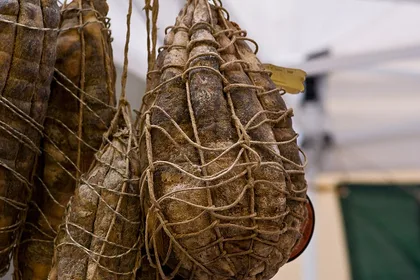 DOPCulatello di ZibelloThe core of the leg, aged in a bladder in damp cellars. Expensive for real reasons.
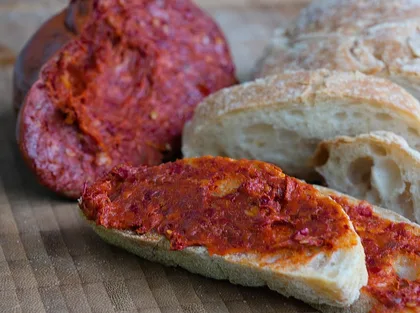 PAT'Ndujaen-DOO-yah. Spreadable and chilli-heavy: a spoonful into a sauce, never sliced.
Frequently asked
How do you pronounce prosciutto, bresaola and 'nduja?
Pro-SHOO-toh, where “sci” is a “sh” and the double t is held. Breh-zah-OH-lah. En-DOO-yah, the apostrophe standing for a swallowed i. And capocollo (the deli's “capicola”) is kah-poh-KOH-loh.
Is prosciutto safe to eat without cooking?
Yes: it is preserved by salt and twelve months or more of drying, not by refrigeration. The ones meant to be cooked are pancetta, guanciale, cotechino and zampone. If pregnant, follow your local guidance on raw-cured meats.
What is the difference between prosciutto and serrano ham?
Both are dry-cured hind legs, but from different pig breeds on different feed, aged in different climates. Italian prosciutto is generally sweeter and moister, serrano drier and more savoury.
Why does deli prosciutto taste better than the packet?
Surface and temperature. Freshly sliced meat has not spent days compressed in a vacuum losing aroma, and it reaches you warmer. Open a pack, separate the slices and leave them out twenty minutes first.
Should I worry about nitrites in cured meat?
In 2015 IARC placed processed meat in Group 1 on the strength of the evidence for colorectal cancer, not the size of the risk: about 18% higher relative risk per 50 g daily, on a modest baseline. Advice then splits: the IARC/WHO framing supports limiting it rather than cutting it out, while WCRF and AICR recommend eating very little processed meat, if any. And “uncured” American labels usually mean celery powder: nitrate under another name.
Can I bring prosciutto home from Italy?
Within the EU, and from Italy into the UK, yes. Into the United States, commercially packaged pork from approved Italian establishments is generally permitted, but rules change and meat in luggage is often refused: check current USDA and CBP guidance and declare it.
Sources
Where to check what you just read.
- 1
Whether the name on the pack is a registered PDO or PGI at all, and which one: that is the difference that decides whether the meat had to be Italian.
- 2
What Group 1 actually means (strength of evidence, not size of risk) and the source of the 18% per 50 g a day figure the headlines flattened.
- 3
The working definition of processed meat, which is broader than most readers assume, and the compounds the evaluation actually points at.
- 4InstitutionWCRF/AICR — limit red and processed meat
The stricter position that diverges from the WHO framing: very little processed meat if any, on the basis that no threshold has been identified.
- 5
The lowered added-nitrite maxima and the residual limit, the changeover dates of 9 October 2025 and 2026, and the list of traditional products granted derogations.
- 6
How US limits are written, as ingoing ppm rather than residue, including the 120 ppm sodium nitrite and 550 ppm ascorbate or erythorbate required in pumped bacon.
- 7
What the oval stamp on an EU pack certifies: the establishment that last handled or packed the lot, which on pre-sliced meat is the slicing room.
Every cured meats page
43IGPMortadellaThe white cubes are not just any fat: they are jowl, the firmest part of the pig, and they stay…DOPPancettaPancetta is Italian cured pork belly: salt, pepper and warm spices, dried for months, never smoked.PATGuancialeGuanciale is cured pork jowl: unsmoked, rubbed with salt and pepper, aged for one to three months.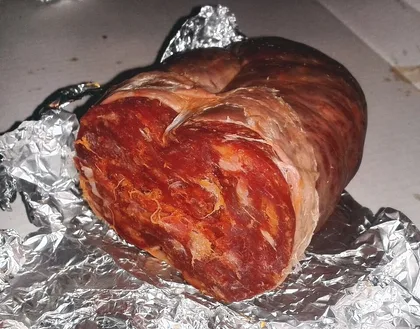 DOPSoppressataSoppressata is a coarse-ground dry salami from southern Italy, pressed flat between boards while it…PAT'Nduja'Nduja is a soft, spreadable Calabrian pork salume that is up to 40% chilli.IGPSpeck Alto Adige IGPA little salt, a little smoke, plenty of air: the South Tyrolean saying describes a method rather…DOPProsciutto di ParmaProsciutto di Parma DOP is Italian ham made from three things only: pork, sea salt and at least 400…
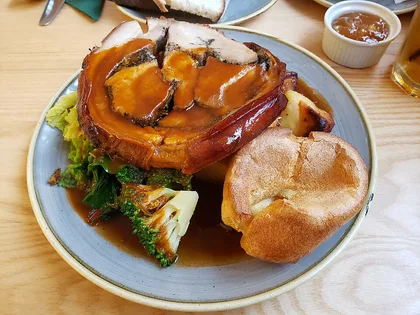 IGPPorchettaSix to eight hours in a wood oven to reach two opposite textures in one piece of meat: skin that…IGPBresaolaOne lean muscle from the hind leg, dry-cured with salt, pepper, juniper and cinnamon, then left in…
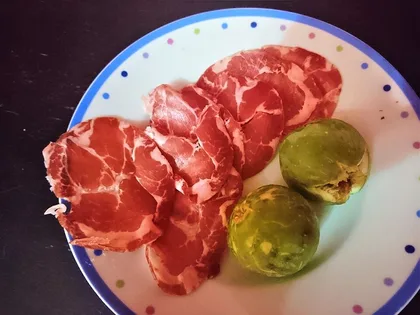 ApuliaCapocolloCapocollo is the pork neck muscle, salted whole and aged in casing.
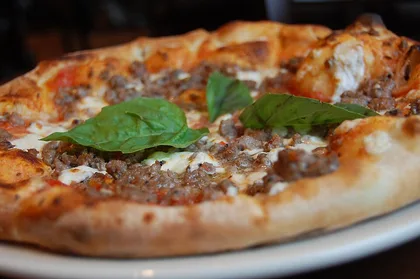 LombardySalsicciaCoarsely ground pork, salt, pepper, wine and usually garlic, packed into natural hog casing and…DOPProsciutto di San DanieleProsciutto di San Daniele DOP is made in one town in Friuli from two ingredients: pork leg and sea…
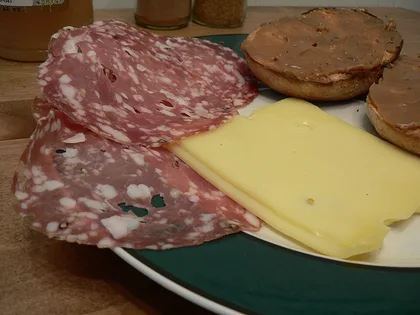 IGPFinocchionaFinocchiona is Tuscany's fennel salami: coarsely ground pork seasoned with wild fennel seeds and…
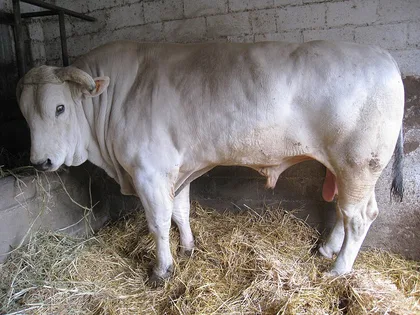 IGPChianina BeefChianina is the largest cattle breed in the world: porcelain-white, bulls over 1,700 kg, from the…
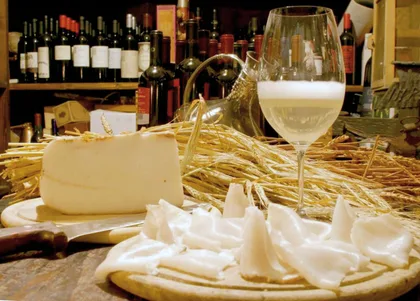 IGPLardo di ColonnataLardo di Colonnata IGP is cured pork back fat, aged at least six months inside vats carved from…LombardySalame MilanoSalame Milano is the salami most of the world pictures when it hears the word: large diameter…CampaniaSalame NapoliSalame Napoli is long, narrow and smoked: five centimetres across, half a metre long, chilli in the…
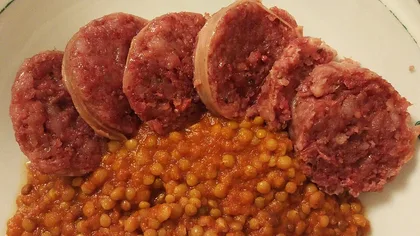 IGPCotechinoCotechino is a large fresh pork sausage from Emilia-Romagna, made with pork meat, fat and rind, and…
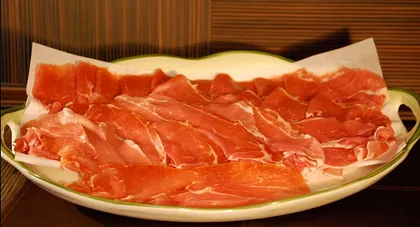 DOPProsciutto ToscanoProsciutto Toscano DOP is the savoury one. It is salted harder than Parma ham and rubbed with…
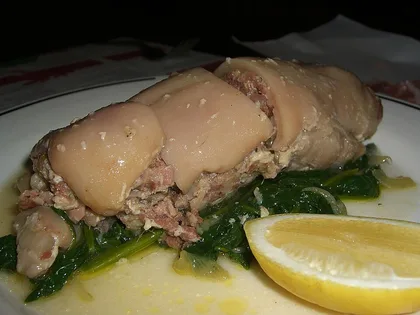 IGPZamponeZampone Modena IGP is spiced pork and rind forcemeat stuffed into a boned pig's trotter: same…DOPCulatello di ZibelloCulatello di Zibello is the heart muscle of a pork leg, boned out, sewn into a pig's bladder, tied…
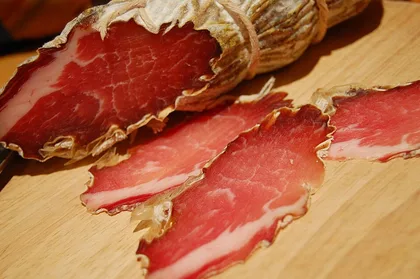 MarcheLonzinoLonzino is whole pork loin, dry-salted and air-cured for two to four months: the leanest cut on the…SardiniaSardinian Suckling PigSardinian suckling pig (porceddu, or porcheddu depending on the village) is a four to six kilo…
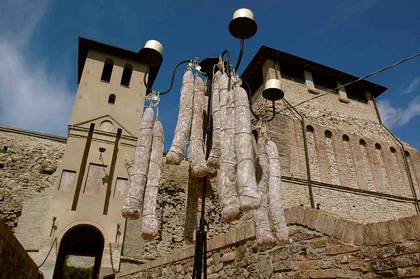 IGPSalame FelinoSalame Felino IGP comes from a village of four thousand people in the hills above Parma.
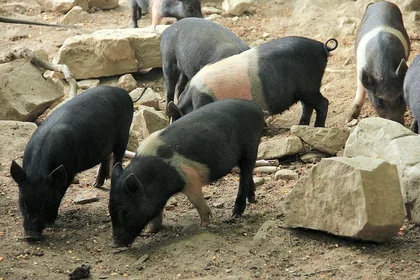 DOPCinta Senese PorkCinta Senese is the black pig with a white belt across its shoulders, raised semi-wild in the oak…
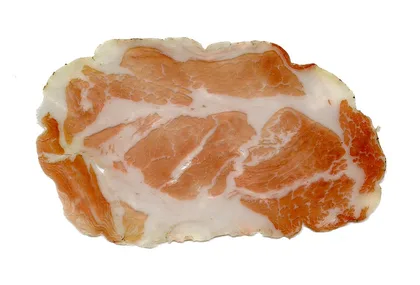 DOPCoppa PiacentinaCoppa Piacentina is dry-cured pork neck from the province of Piacenza, seasoned with cloves…
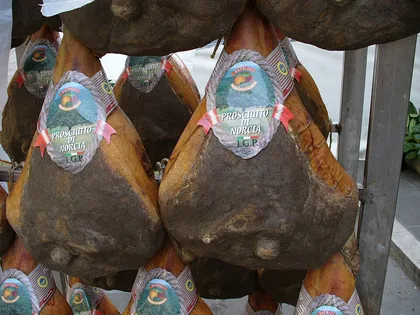 IGPProsciutto di Norcia IGPProsciutto di Norcia IGP is Italy's mountain dry-cured ham, aged for at least twelve months between…
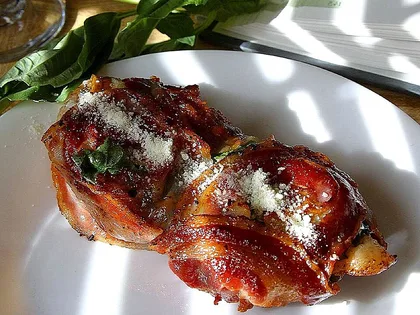 DOPPancetta PiacentinaPancetta Piacentina is pork belly dry-cured with cloves and nutmeg, rolled tightly on itself, cased…
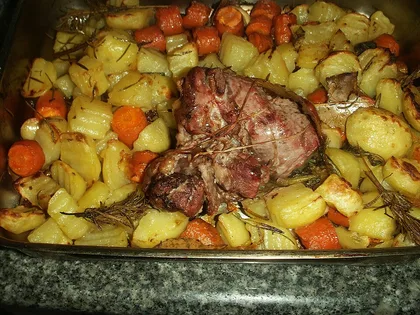 IGPSardinian LambAgnello di Sardegna IGP is milk-fed lamb from the Sarda dairy sheep, slaughtered young and sold in…
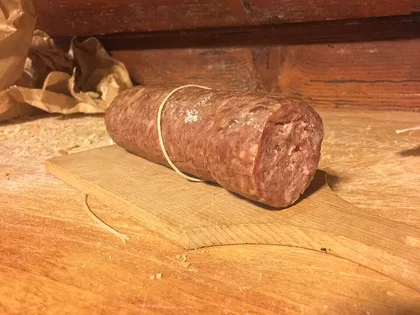 IGPCiauscoloCiauscolo is the Italian salami you spread with a knife. From Le Marche, IGP since 2009, ground…BasilicataPodolica BeefPodolica is the grey, lyre-horned cattle breed that lives outdoors year-round in the southern…BasilicataSalsiccia di FegatoSalsiccia di fegato is Italian pork liver sausage: coarsely chopped liver, pork fat, salt and…DOPSoppressa VicentinaSoppressa Vicentina is a large, coarse-grained Veneto salami made from heavy pigs born and raised…LombardySalame d'Oca di MortaraGoose salami from Mortara began in the Jewish communities of the Lombard rice plains as a cured…
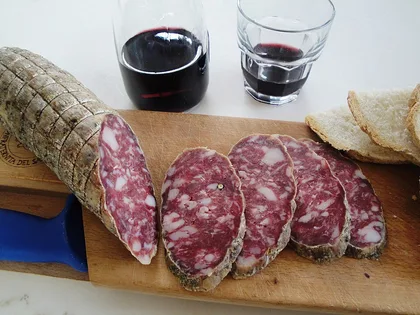 DOPSalame di VarziSalame di Varzi is a DOP salami from the Staffora valley in Lombardy's Oltrepò Pavese.PATTesta in CassettaTesta in cassetta is pig's head simmered until tender, boned while hot, seasoned with spices and…PiedmontPiedmontese Fattened OxBue grasso is a castrated Piedmontese ox, fattened slowly for three or four years to well over a…
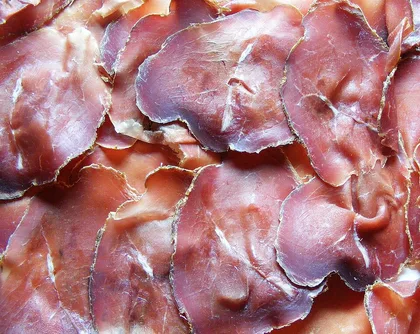 PATMocettaMocetta is an Alpine cured meat from Valle d'Aosta: a lean leg muscle dry-salted with juniper, sage…
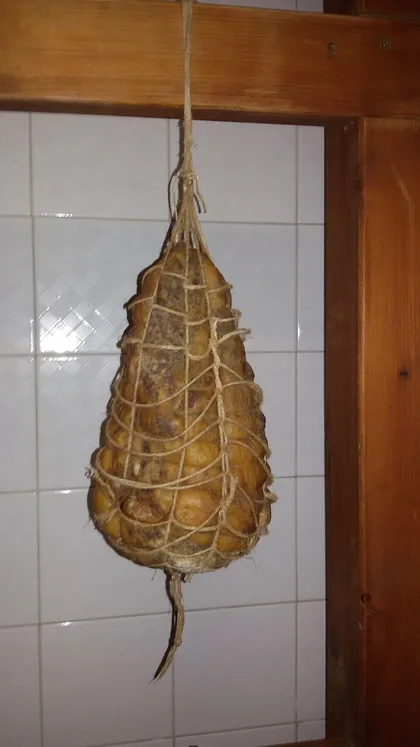 Emilia-RomagnaSpalla CrudaSpalla cruda is the pig's shoulder cured the way culatello is cured, in the foggy lowlands north of…
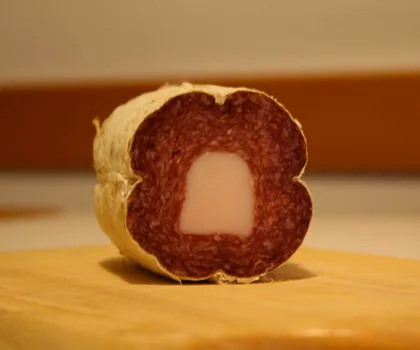 AbruzzoMortadella di CampotostoMortadella di Campotosto is a small, air-dried, lightly smoked salume from the Laga mountains of…Presidio Slow FoodViolino di CapraViolino di capra is a goat leg cured like a ham in the natural rock cellars of Valchiavenna, in the…
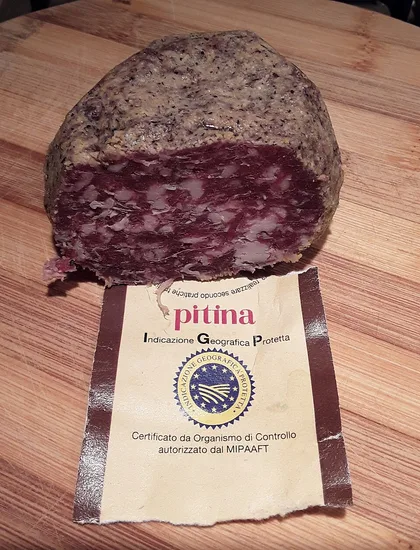 Presidio Slow FoodPitinaPitina is a smoked, cured meatball from the Friulian Dolomites: minced game or mutton bound with…
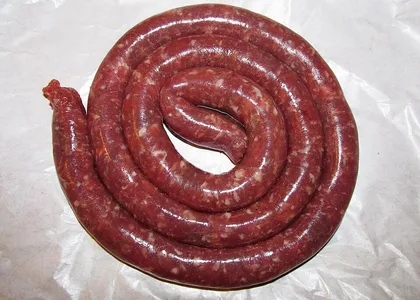 PiedmontSalsiccia di BraSalsiccia di Bra is the only Italian sausage made from veal instead of pork.