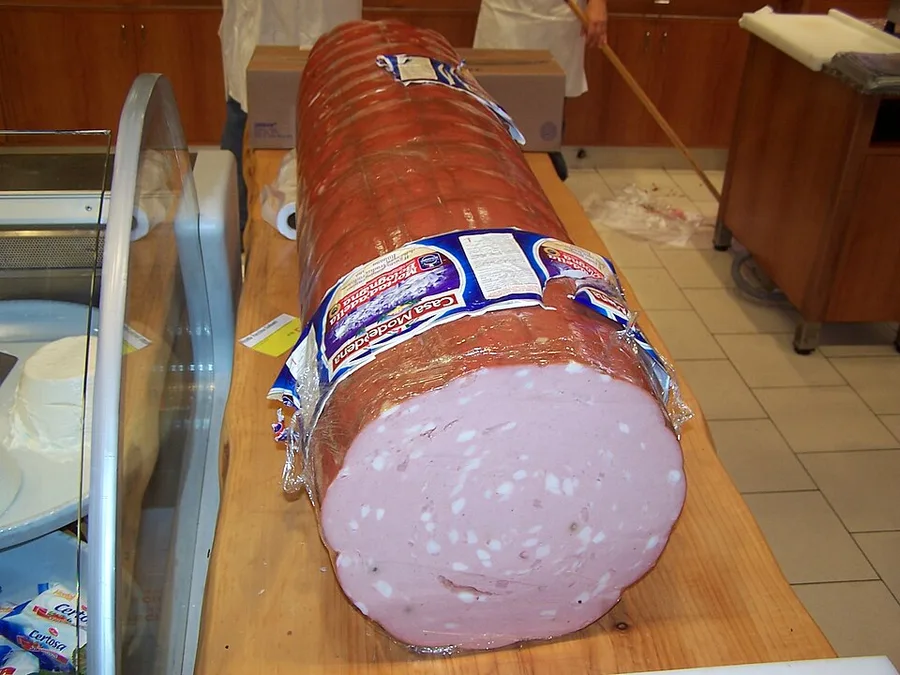
What is Mortadella?
Mortadella is a cooked salume. Lean pork is ground until it becomes a completely smooth emulsion, then folded together with cubes of hard fat taken specifically from the pig's jowl, plus salt, pepper and spices. The mix is stuffed into a casing and cooked slowly in dry-air ovens until the core reaches at least 70°C (158°F).
The fat cubes are the visual signature and are not decoration. Jowl fat has a high melting point, which is why it stays white and distinct instead of dissolving into the paste during the bake. In Mortadella Bologna IGP the visible fat must make up at least 15% of the slice.
That IGP, granted in 1998, is the line worth caring about. Its rules allow pork only, ban polyphosphates and mechanically separated meat, and list the permitted ingredients in full: starch and milk proteins are not on that list. The production zone is wider than most people assume, covering Emilia-Romagna, six other regions and the province of Trento.
What does it taste like?
Delicate and surprisingly mild. The dominant note is clean pork sweetness, with black pepper and a warm background of spice: coriander, a little anise, sometimes myrtle. There is no smoke, no tang, and nothing sharp.
The texture is the real experience. Sliced properly, paper thin and almost translucent, it collapses on the tongue, and the fat cubes melt a half-second behind the meat, which gives it a two-stage richness. Sliced thick it is a completely different and much worse product: heavy, rubbery and bland.
Anyone approaching it from American bologna will find it more perfumed, less salty and far less uniform, with a texture closer to a very fine pâté than to a deli slice. Anyone approaching it from prosciutto will find it much milder and much softer.
How to use it
Slice it as thin as the machine will go, thin enough to see light through. This single decision separates good mortadella from bad more reliably than the price does. Thick slices are rubbery and dull; paper-thin slices dissolve.
Bring it to room temperature. Twenty minutes out of the fridge unlocks the fat and the aromatics. Cold from the refrigerator it tastes of almost nothing.
In Bologna it goes into tigelle and crescentine, alongside gnocco fritto, or into a plain rosetta roll with nothing else. It is also one of the three meats in the classic tortellini filling, with pork loin and prosciutto.
Modern uses that work: mortadella mousse (blitzed with ricotta and cream, spread on crostini); diced into a frittata; draped over a just-baked pizza with stracciatella and crushed pistachios; rolled around a grissino. In the US it has become the defining sandwich meat of a wave of Italian delis, usually piled high with provolone and hot peppers.
Do not cook it for long. It is already a cooked product, and sustained heat dries out the fat cubes and kills the texture.
How long it keeps
Whole and uncut, casing intact, mortadella holds for months in a cold display or a fridge at about 4°C (39°F); the printed date on the piece or the producer is the reference for how long. Once you cut into it, the exposed face is what changes. Press baking paper or film directly against that face, and expect it to darken a shade within a day or two as the surface fat and meat meet air.
Sliced mortadella moves fastest of all. Aroma thins and the pink dulls over two or three days. Wrap slices in deli paper rather than cling film, which traps moisture against them, and keep them in the least cold part of the fridge rather than the coldest shelf. Freezing sliced mortadella breaks the emulsion: it thaws watery and the slice goes loose and slack. A whole piece freezes better but still loses some spring. Vacuum-packed trays carry their own date; once opened they behave like freshly cut slices.
Spot the real thing
Colour comes first. Mortadella Bologna IGP is a pale, matte pink, even from edge to edge, and its rules ban substances that affect colour. A greyish cast on the cut face means the surface has been sitting in air. The fat cubes should be white, roughly even in size and scattered evenly rather than clumped along one side. They are cut from hard jowl fat, which is why they stay defined instead of smearing into the paste.
A slice should be elastic and velvety: fold it and it springs back. On the label, the registered name is «Mortadella Bologna», with the EU IGP logo. The lookalike abroad is American bologna or baloney, a smooth, uniform pink loaf with no visible fat cubes, made under a different federal standard. Price separates them too: IGP mortadella sits well above the deli-bologna rate per pound.
How to pronounce Mortadella
mor-tah-DEL-lah
Four syllables, stress on the third. The 'e' in DEL is short, as in 'bell', not 'DAY-la'. Both 'a' sounds are open 'ah', not the flat American 'a' of 'cat'. The double 'l' is held slightly. Two common errors: stressing the first syllable ('MOR-ta-della'), and swallowing the final vowel into 'mortadell'. That last one is actually correct in Italian-American dialect, where you will hear 'mor-ta-DELL', regionally authentic but not standard Italian.
Mortadella compared
vsAmerican bologna
Bologna descends from mortadella but is made under a different rulebook, the US federal standard for cooked sausages. It is emulsified so finely that no fat cubes remain, may be made from more than one species, including poultry and mechanically separated pork within set limits, and may contain up to 3.5% declared binders. Mortadella Bologna IGP is pork only, shows visible jowl-fat cubes and admits only the ingredients on a closed list.
| This | American bologna | |
|---|---|---|
| Fat cubes | Visible, min. 15%, from jowl | None, fully emulsified |
| Meat | Pork only | One or more species; poultry up to 15%, mechanically separated pork up to 20% of the meat |
| Fillers | Not on the permitted list | Binders up to 3.5% (starch, dry milk, cereal), declared on the label |
| Spices | Pepper, plus spices at the maker's choice | Not specified by the federal standard |
| Cook | Dry-air ovens, up to 24 hours | Steam or water bath, under 2 hours |
| Slice thickness | Paper thin | Thick, 2-3mm sandwich slices |
| Texture | Silky, melting, two-stage | Uniform, springy, rubbery |
| Price (US) | $12-22 per lb | $3-6 per lb |
vsProsciutto
The two Italian pork products most likely to end up on the same board, and structurally opposite. Prosciutto is a whole muscle, salted and air-dried raw for one to three years. Mortadella is ground meat and fat, emulsified and cooked in under a day. Prosciutto is salty, complex and slightly nutty; mortadella is sweet, mild and creamy. On an antipasto plate they are complements, not alternatives.
| This | Prosciutto | |
|---|---|---|
| Preparation | Ground, emulsified, cooked | Whole muscle, salted, air-dried raw |
| Cured or cooked | Cooked | Raw-cured |
| Time to make | Hours to a day | 12-36 months |
| Salt level | Low to moderate | High |
| Flavour | Sweet, mild, spiced | Salty, nutty, complex |
| Texture | Soft, melting | Silky but firm, slight chew |
| Price (US) | $12-22 per lb | $25-50 per lb |
vsSalami
Both are ground pork in a casing, and that is where the similarity ends. Salami is raw-cured and fermented, so it is tangy, firm and dry; mortadella is cooked and never fermented, so it is sweet, soft and moist. Salami is sliced thin but holds its shape; mortadella is sliced thinner and does not. If a recipe wants a savoury, chewy bite, salami. If it wants richness that dissolves, mortadella.
| This | Salami | |
|---|---|---|
| Process | Cooked, never fermented | Raw, fermented and air-dried |
| Grind | Ultra-fine paste plus fat cubes | Coarse, visible meat and fat |
| Moisture | High, stays soft | Low, dries and firms |
| Flavour | Sweet, mild, spiced | Tangy, savoury, sometimes garlicky |
| Shelf life once cut | Days | Weeks |
| Serve at | Room temperature, sliced paper thin | Room temperature, sliced thin |
Mortadella substitutes
- Prosciutto cotto (Italian cooked ham)
The closest thing in flavour register, mild and sweet cooked pork, without the fat cubes or the fine grind. Best where mortadella is a sandwich filling rather than the point of the dish.
1:1 - Good deli bologna, thinly sliced
An honest downgrade rather than a real substitute, but German-style fleischwurst or a premium all-pork bologna gets closer than the supermarket default. Ask for it sliced as thin as the machine will go, which changes it more than you would think.
1:1 - Lyon sausage (saucisson de Lyon cuit)
French cooked sausage with visible fat and often pistachios, arguably mortadella's nearest European cousin. Firmer and more garlicky, but the structure and the role on a plate are the same.
1:1 - Galantina or pork terrine
For recipes where mortadella is being blitzed into a mousse or a tortellini filling rather than served in slices, a fine pork terrine does the job. Reduce added salt, as terrines are usually seasoned harder.
1:1 by weight in fillings - Halal: turkey or beef mortadella
Turkey mortadella (mortadella di tacchino) is a standard Italian supermarket product and has the same fine grind and pale colour, with less fat and a leaner flavour. Beef mortadella is widely made across the Levant and Egypt and is closer in richness. Both are sold halal-certified, so check the mark rather than assuming.
1:1 - Vegetarian: mortadella vegana or smoked tofu terrine
Several Italian producers now make a plant-based mortadella from soy or chickpea protein with vegetable-fat cubes; the texture is credible, the sweetness is not quite there. A home version (firm smoked tofu blitzed with white beans, oil, pepper and coriander, set in a mould) works for spreads and fillings.
1:1
Where to buy it
In the US, look for the name Mortadella Bologna and the IGP seal on the label: Italian delis and specialty grocers import it. Mortadella made in the United States is a different product, made under US rules, and its label says what it contains.
In the UK, supermarkets stock mortadella in pre-sliced packs, and Italian delis carry IGP producers at the counter.
Wherever you buy, a counter lets you choose the thickness of the slice. Then read the ingredients: polyphosphates (E450-452) are banned under the IGP, and starch and milk proteins are not among its permitted ingredients, so their presence tells you which product you are holding.
Where to eat it in Italy
Bologna, and specifically the Quadrilatero, the grid of food streets behind Piazza Maggiore. The historic salumerie on Via Drapperie and Via Pescherie Vecchie slice to order in front of you. Tamburini and Simoni are the names everyone repeats, and in this case the reputation is earned.
MortadellaBò, the festival dedicated to the product, takes over Piazza Maggiore and Piazza Re Enzo in October, with producers, tastings and a ceremonial giant mortadella cut in the square.
In the province, Zola Predosa and Crevalcore hold the historic factories. Around Modena, mortadella is eaten inside crescentine in every country trattoria.
Rome is mortadella's second home: the rosetta con la mortadella is one of the city's defining sandwiches, and the counters at Mercato Trionfale and in Testaccio take it seriously. In the US, the Italian-American delis of New York, Philadelphia and Chicago have made it a signature.
Recipes with it
Further reading
Frequently asked questions
What is mortadella?
A large cooked pork sausage from Bologna. The meat is ground to a completely smooth paste, mixed with cubes of hard jowl fat and spices, and baked slowly in dry-air ovens. It is sliced paper-thin and eaten cold.
Is mortadella the same as bologna?
No, though American bologna descends from it. Bologna is made under a US federal standard that allows more than one species, up to 30% fat and declared binders, and it has no visible fat cubes. Mortadella Bologna IGP is pork only, must show at least 15% visible jowl fat in the slice, bans polyphosphates and does not permit starch or milk proteins.
How do you pronounce mortadella?
mor-tah-DEL-lah, with the stress on the third syllable and a short 'e' as in 'bell'. Italian-Americans often drop the final vowel, saying 'mor-ta-DELL', which is dialect rather than an error.
Why does mortadella have white cubes in it?
They are cubes of hard fat taken from the pig's jowl, blanched and folded into the meat paste. Jowl fat has a high melting point, so it survives the long slow bake intact instead of dissolving.
Does mortadella always have pistachios?
No. The IGP allows them but does not require them. Pistachio mortadella costs a couple of euros more per kilo.
Sources
Where to check what you just read.
- 1
Il regolamento del 17 luglio 1998 che registra «Mortadella Bologna» come IGP: è l'unica denominazione italiana dell'allegato.
- 2
I parametri che separano la IGP dalla mortadella qualsiasi: proteine minime, grassi massimi e rapporto collagene/proteine, oltre alle regioni ammesse.
- 3Consortium · interested partyConsorzio Italiano Tutela Mortadella Bologna
Il consorzio costituito nel 2001: elenco delle aziende autorizzate, testo del disciplinare e dati di produzione dichiarati.
Related foods
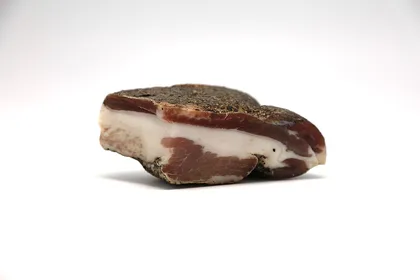 Cured meatsGuancialeGuanciale is cured pork jowl: unsmoked, rubbed with salt and pepper, aged for one to three months.Cured meatsPancettaPancetta is Italian cured pork belly: salt, pepper and warm spices, dried for months, never smoked.
 CheeseParmigiano ReggianoThree ingredients and no additives of any kind are permitted: raw cow's milk, salt and calf rennet, from five…
 Cured meatsProsciutto di ParmaProsciutto di Parma DOP is Italian ham made from three things only: pork, sea salt and at least 400 days.
 Cured meatsCotechinoCotechino is a large fresh pork sausage from Emilia-Romagna, made with pork meat, fat and rind, and always…
 Cured meatsZamponeZampone Modena IGP is spiced pork and rind forcemeat stuffed into a boned pig's trotter: same filling as…
 Cured meatsCulatello di ZibelloCulatello di Zibello is the heart muscle of a pork leg, boned out, sewn into a pig's bladder, tied by hand…
 Cured meatsSalame FelinoSalame Felino IGP comes from a village of four thousand people in the hills above Parma.