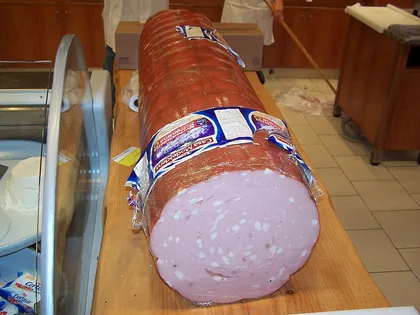
Mortadella and American bologna are not the same thing: the two rulebooks, line by line
Mortadella Bologna IGP allows pork only and a closed list of ingredients. The US federal standard for bologna allows several species, more fat and declared binders.
By the Agrofood.it editorial team · 26 September 2026 · 6 min read · 12 sources
A closed list, and what is not on it
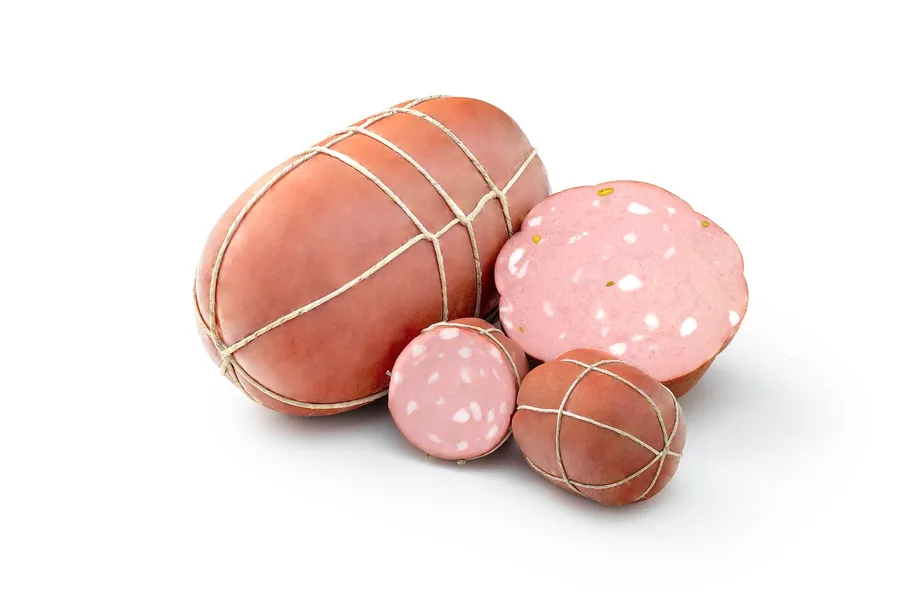
The specification in force, published in Italy's Official Journal on 22 June 2022, starts from four things: pork from striated muscle, cubes of jowl fat, salt and pepper. Everything else sits on a list of optional ingredients, and the list is closed.
It covers pork tripe, hard pork fat, water «according to good industrial practice», natural flavourings up to 0.3% of the mix, spices and aromatic herbs, pistachios, sugar up to 0.5%, sodium or potassium nitrite up to 140 ppm, and ascorbic acid with its sodium salt. Pistachios, in other words, are allowed and not required: mortadella with or without them can be IGP just the same.
Then come the written bans: smoke flavourings, polyphosphates, processing aids, anything that affects colour even as a side effect, and mechanically separated meat. And there is what the text simply does not mention, such as starch, milk proteins, caseinates or soy. No line bans them one by one. They are not provided for, and on a closed list that amounts to the same thing.
One detail even labels get wrong: the registered name is «Mortadella Bologna», with no «di».
How it is made, and where
The processing rules are few and precise. The meat goes through a grinder with at least one plate whose holes are no wider than 0.9 mm, which is where the fine texture comes from. The fat cubes are heated, washed and drained before going into the mix.
Cooking happens in dry-air ovens, and the specification fixes the temperature of the product rather than the oven: the core must reach at least 70 °C. Rapid cooling to below 10 °C at the core follows, and total weight loss must be at least 3%.
The finished product is held to analytical limits: at least 14.5% protein, at most 2.8% salt, a pH of at least 6, and three ratios, namely collagen to protein no higher than 0.18, water to protein no higher than 4.10 and fat to protein no higher than 2. In the slice, the fat cubes must make up at least 15% of the mass. There is no absolute cap on fat: the limit is its ratio to protein.
As for geography, the name misleads. The zone covers Emilia-Romagna, Piedmont, Lombardy, Veneto, Tuscany, Marche, Lazio and the province of Trento, and every stage must happen inside it, slicing and packing included. The consortium reports 40.7 million kilos produced in 2025, with about a quarter of sales abroad; for 2024, against the roughly 39 million the consortium cites, the Ismea-Qualivita report records 35,533 tonnes of certified production. They measure different things and should be quoted by name.
Nitrite: two ceilings, and the lower one counts
The 2022 specification allows sodium or potassium nitrite up to 140 ppm. Since 9 October 2025, however, the EU additives regulation has lowered the limit for heat-treated meat products to 80 mg per kilo added, expressed as nitrite ion, down from 150 expressed as sodium nitrite. The regulation makes no exception for mortadella.
A product has to comply with both rules, so the stricter one applies. The specification does not say in what form its ceiling is expressed, and an exact comparison between the two numbers depends on precisely that: it is an open question worth putting to the consortium.
Bologna, according to US law
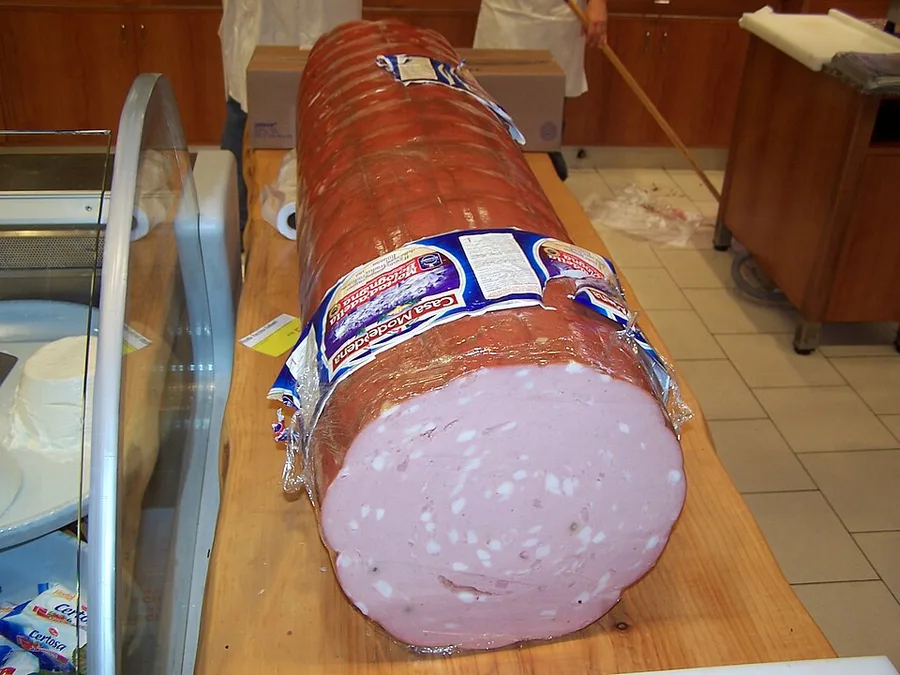
In the United States bologna has no consortium specification. It has a federal standard of identity, 9 CFR 319.180, the same one that covers frankfurters and hot dogs. It defines bologna as a cooked, comminuted sausage made from one or more skeletal muscle meats, to which poultry may be added, smoked or not.
The numbers that matter are these. Fat at most 30%, and fat plus added water at most 40%. Poultry, including mechanically separated poultry, up to 15% of the ingredients, excluding water. Binders and extenders such as cereal, soy flour, dry milk, starch or whey up to 3.5%, declared on the label; isolated soy protein and sodium caseinate up to 2%. Phosphates up to 0.5%, nitrite up to 200 ppm in the finished product, and mechanically separated pork up to 20% of the meat portion.
There is also a «with byproducts» or «with variety meats» version, in which skeletal muscle meat can drop to 15% and the rest can come from hearts, tongues, stomachs, tripe, spleens and other parts the rule lists. Here the law asks for transparency: the phrase must sit next to the name, and each byproduct must be named. If the meat comes from a single species, the species goes into the name, as in «beef bologna».
The standard sets no cooking temperature and no production zone. It is simply a different way of regulating a product: instead of a closed list, a set of limits plus the duty to declare on the label what is inside.
| Item | Mortadella Bologna IGP | Bologna in the United States |
|---|---|---|
| Species | Pork only | One or more species; poultry up to 15%; a single species goes in the name |
| Fat | No absolute cap: fat to protein at most 2; visible fat at least 15% of the slice | At most 30% |
| Water | «According to good industrial practice»; water to protein at most 4.10 | Fat plus added water at most 40% |
| Binders and phosphates | Not permitted; polyphosphates banned | Binders up to 3.5%, declared; phosphates up to 0.5% |
| Mechanically separated meat | Banned | Pork up to 20% of the meat; poultry within the 15% |
| Offal | Only pork tripe, optional | Allowed in the «with byproducts» version, each one named on the label |
| Nitrite | Up to 140 ppm; since 9 October 2025 the EU rule sets 80 mg/kg added, as nitrite ion | Up to 200 ppm in the finished product |
| Cooking and zone | At least 70 °C at the core; seven regions and the province of Trento, slicing included | The standard sets neither temperature nor zone |
Why Americans say bologna, and then baloney
The city's name entered English through the sausage. «Bologna sausage» appears around 1590, «bologna» on its own is recorded from 1849, and «baloney», the spelling of the popular pronunciation, from 1894. Since 1922 the word has also meant nonsense, a sense popularised in the early 1930s by former New York governor Al Smith.
In Bologna, meanwhile, the rule on the meat had been written down for centuries. On 24 October 1661 Cardinal Farnese, the papal legate, issued a decree on the making of mortadella and salami that banned any meat other than pork and reserved the trade to the salt-curers' guild, with inspections, a seal and a tally of quantities sold. The pork-only rule in the current specification has more than three and a half centuries behind it.
Why Italian mortadella was missing from US shelves for decades
For many years Italian mortadella could not enter the United States, and the reason was veterinary. For pork from regions affected by swine vesicular disease, US authorities required a moist-heat treatment at 69 °C, which mortadella, cooked in dry air, does not use.
The turning point was a US Department of Agriculture rule published on 10 January 2000 and in force from 9 February. It introduced a dry-cooking method, with boneless meat baked for at least ten hours to a core temperature of at least 65 °C, and it names Italian mortadella producers explicitly. The request, according to the proposal published the year before, came from the Italian government. According to NPR, which reported the change, the ban had been in place since 1967.
In 2013 the United States went on to recognise Lombardy, Emilia-Romagna, Veneto, Piedmont and the provinces of Trento and Bolzano as free of the disease. Another version circulates widely, blaming the ban on African swine fever: the federal documents of those years name a different disease.
There is more than one mortadella
In Italy the word covers very different products. Mortadella di Prato is itself an IGP, registered in 2016, with a specification that calls for alchermes liqueur, between 0.3 and 0.6%, and garlic, and steam cooking for nine to thirteen hours to a core of 70-72 °C.
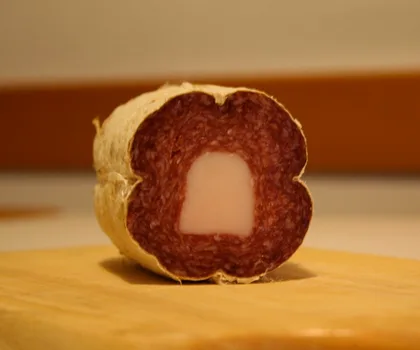
Mortadella di Campotosto, from Abruzzo, is not even cooked: it is a raw cured salume with a strip of lard at its centre, smoked for about fifteen days and aged for at least two months. It is a Slow Food Presidium with only two producers, and on Italy's national list of traditional products it also appears under a far earthier folk name. Mortadella di Amatrice, known as marotta, is something else again: loin and shoulder with lard, aged four to five months.
The same list records buffalo, horse and Maremma beef mortadellas in Lazio, and liver mortadellas in Lombardy and Piedmont. «Mortadella is pork» holds for the two IGPs, not for everything that carries the name.
Telling them apart, label in hand
In Italy the first check is the name, «Mortadella Bologna», with the EU IGP logo. The second is the ingredient list, which for the IGP can only contain the permitted items. If starch, milk proteins, soy or polyphosphates appear, the product is generic mortadella: legitimate, but different.
In the United States, bologna can be read entirely from its label. The species, if there is only one, is in the name; binders are declared; «with byproducts» or «with variety meats» tells you there is offal, and which. US law requires those details to be printed, and they make the comparison possible for anyone.
The short of it
- The registered name is «Mortadella Bologna», with no «di», and the zone covers seven Italian regions plus the province of Trento.
- Ingredients come from a closed list: pork, jowl fat, salt and pepper, plus spices, natural flavourings up to 0.3%, sugar up to 0.5%, pistachios, nitrite and ascorbic acid.
- Polyphosphates, smoke flavourings and mechanically separated meat are banned; starch and milk proteins are not permitted.
- The core must reach at least 70 °C (158 °F), and visible fat must make up at least 15% of the slice.
- American bologna follows 9 CFR 319.180: several species allowed, fat up to 30%, declared binders up to 3.5%.
- Italian mortadella reached US shelves thanks to a 2000 rule that introduced a dry-cooking method.
Frequently asked questions
Is mortadella the same as bologna?
No. They follow different rules. Mortadella Bologna IGP is pork only, with visible jowl fat and a closed list of ingredients. American bologna is made under a federal standard that allows more than one species, up to 30% fat and declared binders, and it has no visible fat cubes.
Does mortadella always have pistachios?
No. The Mortadella Bologna IGP specification lists pistachios as optional, so mortadella with or without them can be IGP.
Is Mortadella Bologna only made in Bologna?
No. The zone covers Emilia-Romagna, Piedmont, Lombardy, Veneto, Tuscany, Marche, Lazio and the province of Trento, and every stage, including slicing and packing, must happen inside it.
What is mortadella made of?
Pork from striated muscle, cubes of jowl fat, salt and pepper, plus optional spices, natural flavourings, sugar, pistachios, nitrite and ascorbic acid. Polyphosphates, smoke flavourings and mechanically separated meat are banned.
Why do Americans call it bologna?
The city's name entered English with the sausage: «bologna sausage» is recorded around 1590 and «bologna» on its own from 1849. «Baloney» is the spelling of the popular pronunciation, from 1894.
Was Italian mortadella banned in the US?
For decades it could not be imported, for veterinary reasons linked to swine vesicular disease. A USDA rule in force from 9 February 2000 introduced a dry-cooking method that named Italian mortadella producers explicitly.
Sources
Where to check what you just read.
- 1
Il testo in vigore: ingredienti ammessi e vietati, lavorazione, cottura, parametri del prodotto finito e zona.
- 2
L'atto del 17 luglio 1998 che iscrive la denominazione fra le indicazioni geografiche protette.
- 3
Il limite di 80 mg/kg, come ione nitrito, per i prodotti a base di carne trattati termicamente, dal 9 ottobre 2025.
- 4
Grasso, acqua aggiunta, pollame, versione «with byproducts» e regole sul nome.
- 5
I limiti per leganti, fosfati e nitrito.
- 6
La cottura a secco per la carne suina da zone con malattia vescicolare suina, con il riferimento ai produttori italiani di mortadella.
- 7
Lombardia, Emilia-Romagna, Veneto, Piemonte, Trento e Bolzano riconosciute indenni dalla malattia vescicolare suina.
- 8
Il bando del 24 ottobre 1661 sulla fabbrica delle mortadelle.
- 9
Alchermes, aglio e cottura a vapore della seconda mortadella IGP.
- 10
Il salume crudo e affumicato dell'Abruzzo e i suoi due produttori.
- 11
I dati di produzione 2025 dichiarati dal consorzio.
- 12ReferenceEtymonline, «bologna»
Le date di attestazione di «bologna sausage», «bologna» e «baloney».