Panettone has had a law since 2005, and the percentages everyone quotes cannot be read off the label
16% butter, 20% raisins and candied peel, sourdough compulsory. The 2005 decree also says where those percentages are measured, and it is not the finished cake.
By the Agrofood.it editorial team · 3 November 2026 · 5 min read · 3 sources
A law almost nobody has read
Panettone is not a free-for-all recipe. A decree issued jointly by the Italian ministry of productive activities and the ministry of agriculture on 22 July 2005, published in the Gazzetta Ufficiale on 1 August 2005, governs the making and sale of six baked sweets: panettone, pandoro, colomba, savoiardo and two kinds of amaretto. It took effect on the 180th day after publication, at the end of January 2006.
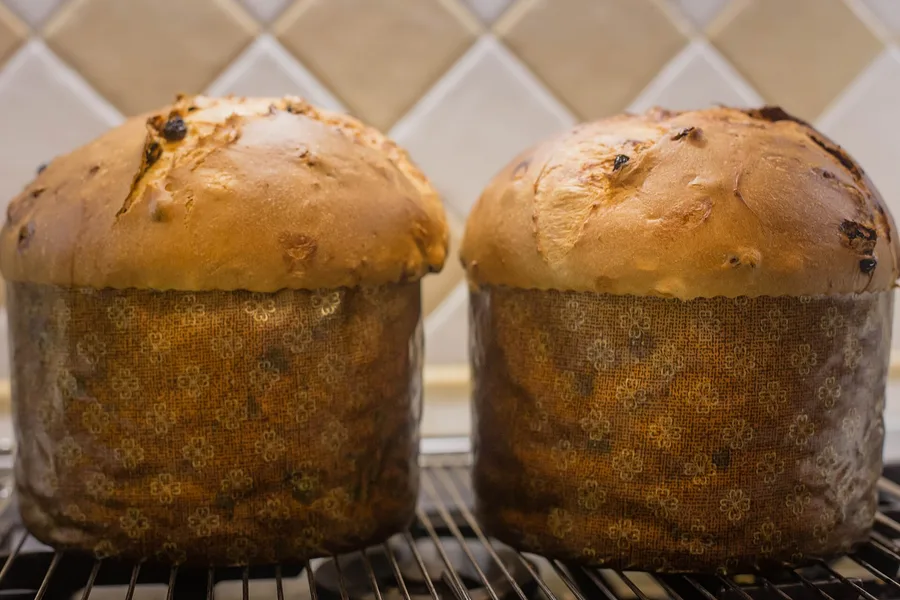
What the decree does is reserve the names. «Panettone» belongs to the «soft-dough baked confectionery product, obtained by natural fermentation from sourdough, round-based in shape with a cracked upper crust cut in a characteristic way, soft in structure with an elongated crumb and the typical aroma of sourdough leavening».
Two constraints are already inside that sentence: the leavening has to come from sourdough, and the shape has to be that one. Ingredients and minimum quantities follow in the next paragraphs, and an annex explains how they are counted. That annex changes the meaning of every percentage quoted about panettone.
The compulsory ingredients, one by one
Article 1 lists what the dough has to contain: wheat flour, sugar, category A hen eggs or egg yolk in quantities ensuring no less than 4% yolk, butterfat no lower than 16%, raisins and candied citrus peel no lower than 20%, natural leaven made of sourdough, and salt.
Two details deserve care. Butterfat means butter: the decree allows no other fat in its place in the base dough. And raisins and candied peel share a single 20% threshold rather than having one each.
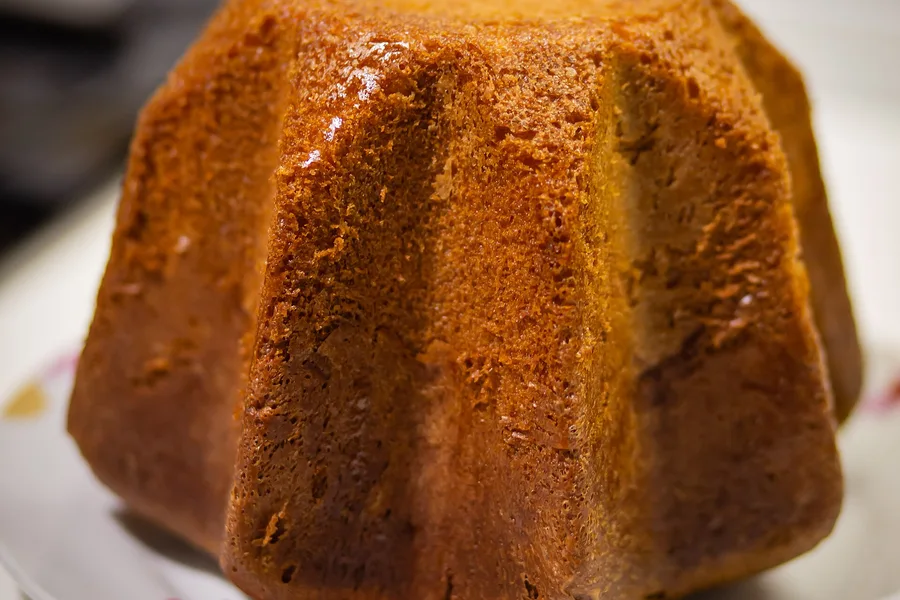
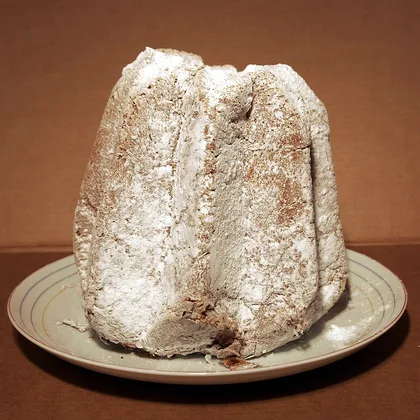
Pandoro follows the same pattern with different numbers: no less than 4% yolk, no less than 20% butterfat, sourdough, vanilla or vanillin flavouring, salt. No raisins, no candied peel. Colomba adds a rule about the topping: sugar grains and at least 2% almonds, measured on the finished product at the moment of decoration.
| Requirement | Panettone | Pandoro |
|---|---|---|
| Leavening | Natural leaven from sourdough | Natural leaven from sourdough |
| Egg yolk | No less than 4% | No less than 4% |
| Butterfat | No less than 16% | No less than 20% |
| Raisins and candied citrus peel | No less than 20% | Not provided for |
| Baker's yeast | Optional, up to 1% | Optional, up to 1% |
| Preservatives | Sorbic acid and potassium sorbate, optional | Sorbic acid and potassium sorbate, optional |
| Where the percentages are measured | On the dough ready to be divided, on dry matter, net of inert ingredients | On the dough ready to be divided, on dry matter, net of inert ingredients |
| Without raisins or candied peel | Allowed, but the sales name has to say so | Does not arise |
| Fillings, glazes and coatings | Allowed, with at least 50% base dough by finished weight and no fat other than butter | Allowed, on the same terms |
The line that changes every percentage
Annex I sets out where those quantities are measured, and it is the part that almost never gets quoted. The minimum percentages of egg yolk and butterfat «expressed on a dry basis, refer to the dough, ready to be divided, expressed on dry matter, net of inert ingredients».
Three qualifications in a single line. First, the measurement is on the base dough, not on the finished cake. Second, it is on dry matter, with the water taken out. Third, inert ingredients come out of the calculation, and in a panettone those are precisely the raisins and the candied peel.
For egg yolk the annex even fixes the conversion parameters: a yolk to white ratio of 35 to 65, dry residue of the mixture 0.235, dry residue of the yolk 0.43. For raisins and peel, the minimum percentages are likewise taken on a dry basis and referred to the dough ready to be divided.
The practical consequence comes round every December: an ingredient list on a box will not tell you whether that panettone meets the 16% butter rule. The two numbers are not measuring the same thing, and comparing them is a measurement error rather than a matter of opinion.
Panettone without candied peel is in the law
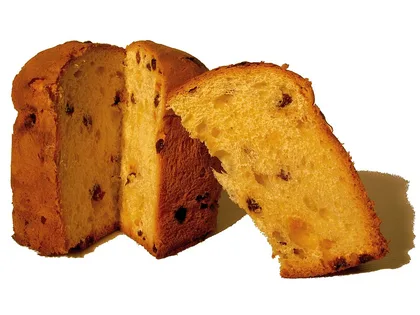
Article 7 is headed «special and enriched products» and opens with an explicit derogation: by way of derogation from article 1, the base dough of panettone «may be characterised by the absence of raisins or candied citrus peel or of both».
So a panettone without candied peel is not a tolerated exception: it is a possibility written into the decree, and the same holds for colomba. Without the raisins, or without either, it is still panettone.
There is a transparency duty attached that few people know about. Article 8 provides that in those cases «the sales name of the product must contain an indication of the absence of raisins or candied citrus peel or of both». Seeing it when you cut the cake is not enough: it has to be in the name.
In the same spirit the decree allows diminutives for small formats: «panettoncino» and «pandorino» are legitimate sales names for small-size products.
Fillings and glazes, and the fifty per cent rule
Article 7 then opens the door to invention and narrows it in the same sentence. A maker may add to panettone, pandoro and colomba «fillings, syrups, coatings, glazes, decorations and fruit, as well as other characterising ingredients, with the exception of fats other than butter».
That exception is the part that matters: added ingredients cannot bring in fats other than butter. It is the line between a filled panettone and a product built around some other cream.
Then comes the threshold. The finished product «shall contain at least fifty per cent of the base dough», calculated on the weight of the finished product. At least half of what you buy has to be the panettone itself.
The decree adds two labelling rules: additions may be listed separately from the dough ingredients, and article 7 products may take fancy shapes other than the prescribed one, provided the label says so or shows it. A panettone that is not round, in other words, has to flag it.
Baker's yeast, emulsifiers, preservatives: what is allowed
The list of optional ingredients is long and worth reading, because it dismantles a few assumptions. The decree allows milk and milk products, malt, cocoa butter, sugars, icing sugar, natural and nature-identical flavourings, emulsifiers, the preservative sorbic acid and the preservative potassium sorbate.
It also allows baker's yeast, with two limits: it has to meet the requirements of article 8 of presidential decree 502 of 1998, and it cannot exceed 1%. Sourdough stays compulsory: baker's yeast can sit alongside it, not replace it.
That tells you how to read the wording on a box. «No preservatives» is a producer's choice rather than a legal requirement, because the two preservatives above are expressly permitted. By the same token, finding emulsifiers on a label does not put the product outside the decree.
This site does not rank panettoni and does not tell you which one to buy: it sets out what the rule demands and what it permits, and leaves the rest to the reader's taste.
Panettone made outside Italy
Article 9 of the decree is headed «mutual recognition» and deserves quoting in full, because it explains part of the market: the provisions of the decree «do not apply to products lawfully obtained and/or marketed in other member states or in Turkey, or lawfully manufactured in an EFTA state that is a contracting party to the European Economic Area agreement».
A cake lawfully made in another EU country and sold in Italy as panettone, in other words, does not have to meet the 16% butter rule or the 20% of raisins and peel. It has to meet the rules of the country where it was made.
This is why the decree, although it is the only text that defines panettone, is not name protection in the sense of a PDO or a PGI: it binds those who produce in Italy, and the name itself is not reserved to a territory.
For anyone reading labels the consequence is practical. The place of manufacture is on the box, and on a panettone sold in Italy but made elsewhere the decree's percentages are not an applicable yardstick.
The short of it
- Panettone is defined by an Italian decree of 22 July 2005, in force since late January 2006.
- It requires sourdough leavening, at least 4% egg yolk, 16% butterfat and 20% of raisins and candied peel together.
- Those percentages are measured on the dough ready to be divided, on dry matter and net of inert ingredients, so a label cannot show them.
- Panettone without raisins or without candied peel is allowed, but the absence has to appear in the sales name.
- Fillings and coatings are allowed with no fats other than butter, and the base dough must stay at least 50% of the finished weight.
- Baker's yeast up to 1%, emulsifiers, sorbic acid and potassium sorbate are expressly permitted: «no preservatives» is a choice.
- Under mutual recognition the decree does not apply to products lawfully made in another EU state, in Turkey or in the EFTA area.
Frequently asked questions
Is there a law defining panettone?
Yes, the Italian ministerial decree of 22 July 2005, published in the Gazzetta Ufficiale of 1 August 2005. It governs panettone, pandoro, colomba, savoiardo and two kinds of amaretto, and took effect 180 days after publication.
Can a panettone without candied peel still be called panettone?
Yes. Article 7 expressly allows the base dough to be characterised by the absence of raisins or candied citrus peel or of both. In that case the absence has to appear in the sales name.
How can I tell whether a panettone has 16% butter?
You cannot tell from the label. The decree measures that percentage on the dough ready to be divided, expressed on dry matter and net of inert ingredients, while the ingredient list on a box follows different rules. The two figures are not comparable.
Can panettone contain preservatives?
Yes. Among the optional ingredients the decree expressly allows sorbic acid and potassium sorbate, along with emulsifiers. A «no preservatives» claim reflects the producer's choice, not a legal duty.
Is baker's yeast allowed in panettone?
Yes, but only in addition and up to 1%, and it must meet the requirements of article 8 of presidential decree 502 of 1998. Natural leaven from sourdough stays compulsory and cannot be replaced.
Does a panettone made abroad have to follow the Italian decree?
No. Article 9 excludes products lawfully obtained or marketed in another member state, in Turkey or in an EFTA state party to the European Economic Area agreement.
Sources
Where to check what you just read.
- 1
Il testo integrale con gli articoli 1, 2, 3, 7, 8, 9 e 10 e i due allegati: ingredienti e soglie, deroghe per i prodotti speciali, obblighi di etichetta, mutuo riconoscimento e processi tecnologici.
- 2
La pagina del singolo decreto, utile per citarlo senza scaricare l'intero fascicolo.
- 3
L'articolo 8 di questo decreto fissa i requisiti del lievito che il decreto del 2005 ammette fino all'1% accanto alla pasta acida.
The foods behind this
 SweetsPanettonePanettone is Milan's Christmas bread: a tall, domed sourdough cake with butter, egg yolk, sultanas and…
 SweetsPandoroPandoro is Verona's Christmas cake: a tall eight-pointed star, at least 20% butter, no candied fruit at all…SweetsColomba (Italian Easter Cake)Colomba is Italy's Easter cake: the same slow-leavened, butter-rich dough as panettone, baked in the shape of…