Why saffron costs what it costs: the arithmetic, not the adjective
Four hundred hours of human labour per kilo, and no machine that can replace them. Set out in order, the price of saffron stops looking absurd and becomes arithmetic.
By the Agrofood.it editorial team · 1 September 2026 · 3 min read · 4 sources
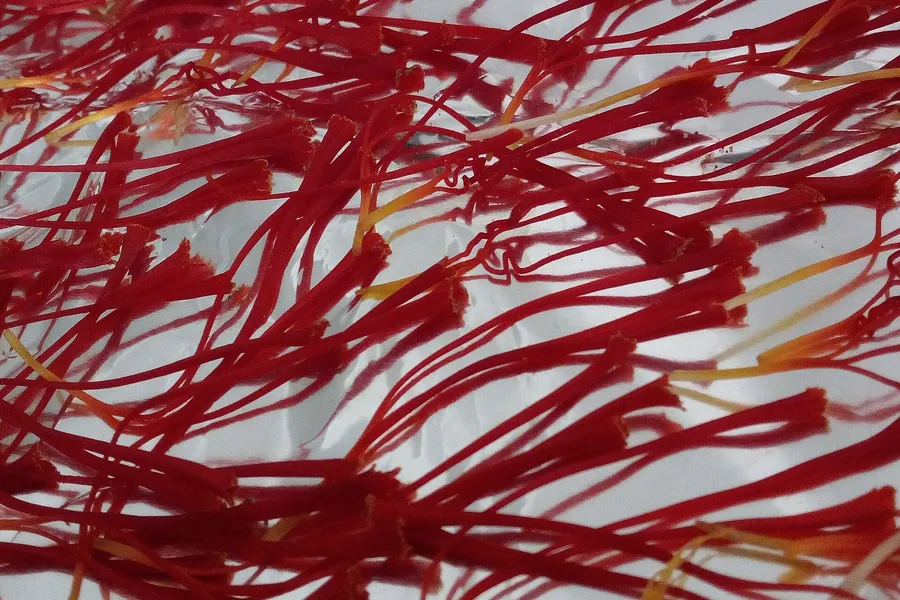
The constraint is the flower, and there is no way round it
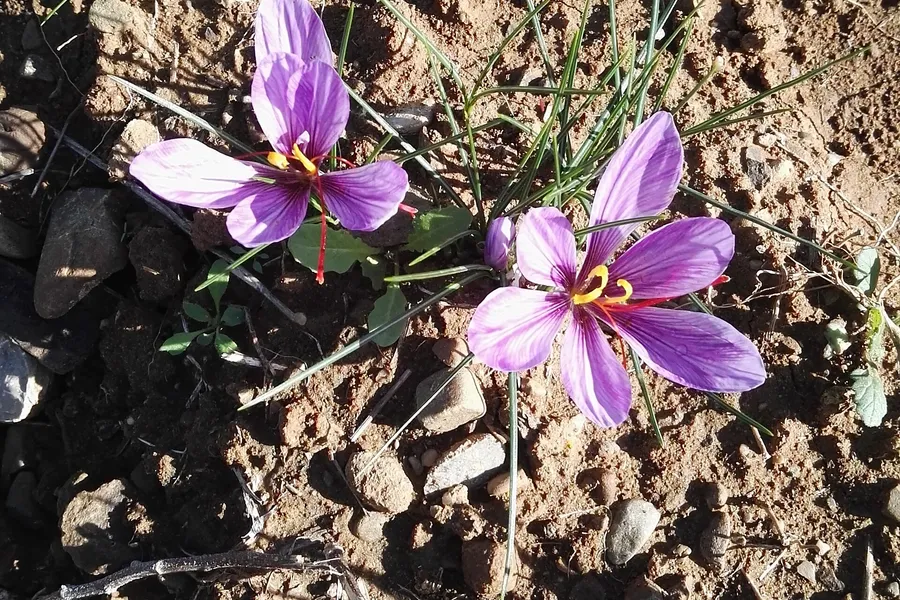
Crocus sativus flowers in late October and the bloom lasts barely three weeks. Each corm gives one to three flowers, and each flower holds three red stigmas. That, and only that, is saffron.
The flower has to be picked while still closed, at dawn or just after, because sun that opens it dries the stigmas out and dusts them with pollen. This is not an aesthetic rule: it is the difference between an aromatic product and a mediocre one.
From which follows the constraint that decides everything else. Picking has to happen in a few hours of each morning, for twenty consecutive days, weekends included, because the flower does not wait. And it has to happen by hand, bent over, flower by flower.
The arithmetic, with the numbers that exist
Worth saying immediately that sources disagree on the flower count. Hand counts report 150 to 170 flowers for one dried gram, which puts a kilo at 150,000 to 170,000. A New Zealand study, on modern plantings, gives a wider range, between 70,000 and 200,000. The variation comes from soil, the age of the planting and the size of the corms.
On labour the consensus is tighter: between 370 and 470 hours to produce a kilo of dried saffron, counting picking and separation.
From there the arithmetic is trivial and nobody ever does it. Four hundred hours for a thousand grams is 0.4 hours per gram, which is roughly twenty-four minutes of human work for every gram that ends up in a sachet.
Twenty-odd minutes of agricultural labour in Italy, at the gross cost of a properly paid day, is worth several euro on its own. And that is only the labour: it does not yet include corms, land, drying, packing, inspection, or the margin of whoever sells it.
| Item | Quantity |
|---|---|
| Flowers needed for one dry gram | about 150-170 |
| Stigmas in one gram (three per flower) | about 450-510 |
| Flowers per kilo | 150,000-200,000, depending on the source |
| Hours of work per kilo | 370-470 |
| Hours of work per gram | about 0.4, that is twenty-four minutes |
| Harvest window | barely three weeks, at dawn |
| Retail price of Italian saffron | €15-40 per gram |
Separation: the step no machine does
Picking is hard but conceptually simple. The real bottleneck is the separation, done the same day: sitting at a table, each flower is opened one by one and the three red stigmas are pulled from the white style that joins them.
It is a movement requiring eyes, fingertips and attention, repeated a hundred and fifty thousand times per kilo. Machines and optical systems have been tried, and something exists for large volumes, but on quality production the separation stays manual, because a machine that neither damages the stigma nor carries off pieces of style costs more than it saves.
This is the substantial difference from almost every other agricultural product. Wheat, grapes and tomatoes have all seen mechanisation collapse the unit cost. Saffron has not: in hours of labour, the cost per gram today is essentially what it was two centuries ago.
Why the Iranian one costs less, and what that means
Iran produces the great majority of the world's saffron, and good-grade Iranian thread saffron sells in Europe at 3 to 8 euro a gram against 15 to 40 for Italian designated product.
The gap is not all quality. It is mostly labour cost and scale: the same four hundred hours, paid at different rates, produce different prices. An Iranian flower and an Abruzzese one hold the same three stigmas.
What genuinely differs, and can be checked, is traceability: Italian designations impose zone, method and inspection, and allow you to know which field a gram came from. That is a different guarantee from intrinsic quality, and should be valued for what it is.
A last observation on numbers that mislead. Supermarket powder sachets weigh 0.125 grams and cost 1.20 to 2.20 euro: they look cheap, but that is 10 to 18 euro a gram, close to Italian thread saffron. The low price is on the packet, not on the product.
How much you actually need, which is the useful question
For anyone cooking, the number that matters is not the price per kilo but the price per serving, and there saffron changes character.
A risotto alla milanese for four wants between 0.1 and 0.2 grams. Even taking the most expensive Italian saffron, that is a few euro for the whole dish, under a euro a head. It sits somewhere between a good parmesan and a modest bottle of wine.
The real economic mistake is not buying expensive saffron: it is buying too much and leaving it open. Stigmas lose aroma to light and air, and a jar started two years ago is worth less than a fresh one-euro sachet.
The short of it
- A kilo of saffron takes 150,000 to 200,000 flowers, hand-picked across barely three weeks.
- Sources disagree on the flower count, but agree on labour: 370 to 470 hours per kilo.
- That is roughly twenty-four minutes of human work for every single gram.
- The bottleneck is the separation, which on quality production stays manual.
- Iranian saffron costs less mainly through labour cost and scale, not because the flower differs.
- Supermarket powder sachets work out at 10 to 18 euro a gram: the low price is on the packet.
Frequently asked questions
How many flowers does one gram of saffron take?
Around 150 to 170 flowers, giving 450 to 510 stigmas. Estimates per kilo range from 150,000 to 200,000 depending on the source, because they vary with soil, the age of the planting and corm size.
Why is it not machine harvested?
Picking has to happen with the flower still closed, at dawn, and separating the three stigmas from the white style needs eyes and fingertips. Mechanical and optical systems exist for large volumes, but on quality production they cost more than they save.
Why is Iranian saffron so much cheaper?
Labour cost and scale, not a different flower: the hours are the same, paid at different rates. What genuinely differs is traceability, which Italian designations impose through their specifications.
Are supermarket powder sachets good value?
On absolute price yes, per gram no: 0.125 grams at 1.20 to 2.20 euro works out at 10 to 18 euro a gram, close to Italian thread saffron. And powder makes it impossible to check what is in it.
How much saffron does a risotto need?
Between 0.1 and 0.2 grams for four people. Even with the most expensive Italian product that stays under a euro a head: on the finished dish, saffron is not the cost people assume.
Why has the price per gram not fallen like other crops?
Because wheat, grapes and tomatoes saw mechanisation collapse the unit cost, and saffron did not. In hours of labour per gram, today's cost is essentially that of two centuries ago.
Sources
Where to check what you just read.
- 1
Da qui vengono i conteggi su fiori e stimmi e l'ordine di grandezza delle ore di lavoro per chilo.
- 2ReferenceFoodUnfolded, How saffron is grown
Riporta l'intervallo più largo sui fiori per chilo, compreso lo studio neozelandese su impianti moderni: è il motivo per cui in tabella diamo un intervallo e non un numero secco.
- 3
Il registro da cui risalire ai disciplinari degli zafferani italiani a denominazione, con zona e metodo di raccolta imposti.
- 4
Il regolamento applicabile dal 13 maggio 2024, che ha sostituito il 1151/2012: rende vincolanti zona e metodo per un prodotto a denominazione, e quindi verificabile la tracciabilità di cui si parla qui.
The foods behind this
 Oil and preservesSaffronOne kilo takes between 150,000 and 200,000 flowers, and every flower gives up three stigmas that have to be…
 Vegetables and fruitCarnaroli RiceCarnaroli is the risotto rice with the highest amylose content: it sheds enough starch to build a creamy…
 Vegetables and fruitWhite truffleThe Italian white truffle, Tuber magnatum Pico, is the most expensive of Italy's truffles: in 2025 the Alba…