Bronze-cut pasta really is rougher. That it holds more sauce is a claim, not a measurement
Studies confirm that bronze dies make pasta rougher. None of those we found measured whether it holds more sauce.
By the Agrofood.it editorial team · 29 September 2026 · 6 min read · 11 sources
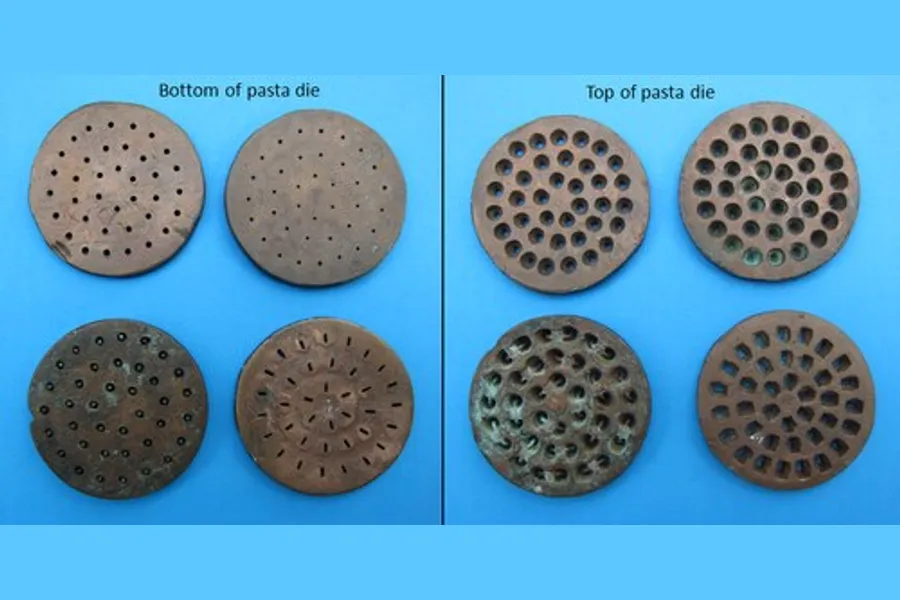
A perforated plate, and the metal the dough touches
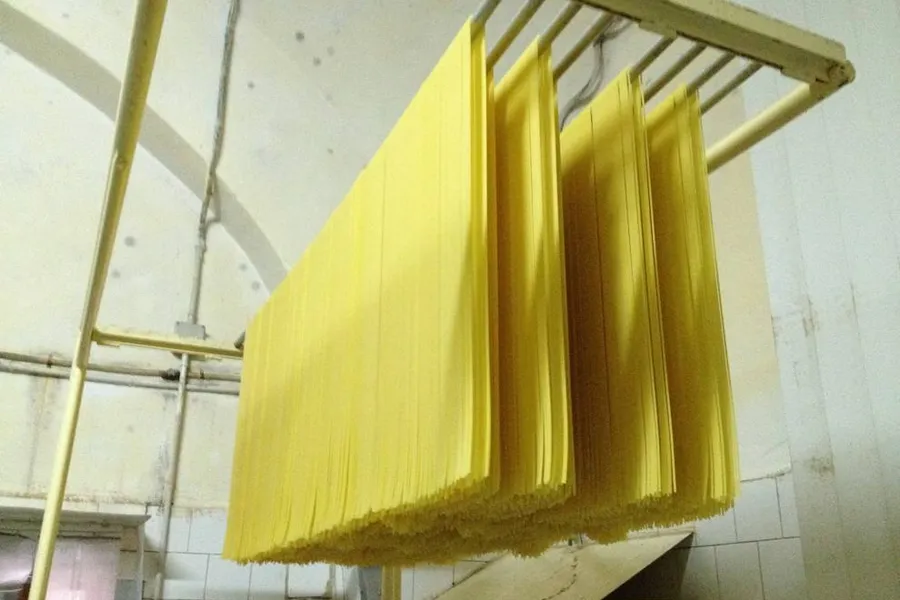
Dried pasta starts as a dough of durum wheat semolina and water, forced under pressure through a die: a plate with shaped holes that turns out spaghetti, rigatoni or paccheri. Dies differ in the material the dough touches on its way out, and the two in question are bronze and Teflon. Dough slides through Teflon faster and comes out smooth; bronze slows it down and leaves the surface rough.
That difference underpins the most repeated claim on the subject, that rougher pasta holds sauce better. These are two separate statements. Roughness has been measured in the lab. Sauce retention by die type, in the studies we found, has not.
What the labs actually measured
The most direct comparison is a 2008 study by Lucisano, Pagani, Mariotti and Locatelli in Food Research International: spaghetti made with Teflon and bronze dies, dried at 92 °C and at 70 °C. With bronze, porosity was higher and breaking strength was 20-30% lower. Dry bronze-cut pasta, in other words, was more brittle, not sturdier.
In 2013 Yoshino, Ogawa and Adachi, in the Journal of Food Science, compared dies made of five materials, with roughness rising in this order: Teflon, polypropylene, polycarbonate, aluminium, bronze. The smoother the surface, the faster the extrusion and the denser and stronger the pasta. Gelatinisation temperature did not change, while in the first 60 seconds in boiling water the rougher pasta absorbed more water.
In 2011 Mercier and colleagues, drying pasta for 20 hours at 40 °C or 80 °C, found that bronze gave a more porous, less dense product with the same shrinkage, which lost moisture faster. A 2022 review in Foods by Bresciani, Pagani and Marti adds that Teflon gives a smooth, bright yellow surface, while bronze slows extrusion and wears out sooner.
On extrusion pressure the sources disagree: the review says bronze lowers it, while an Italian consumer association, CTCU, wrote in 2024 that it raises it.
| Measure | Bronze | Teflon |
|---|---|---|
| Surface | Roughest of five die materials tested (Yoshino 2013) | Smoothest of five die materials tested (Yoshino 2013), bright yellow (Bresciani 2022 review) |
| Porosity | Higher (Lucisano 2008; Mercier 2011) | Lower |
| Density | Lower (Mercier 2011; Yoshino 2013) | Higher |
| Breaking strength, dry | 20-30% lower (Lucisano 2008) | Higher (Lucisano 2008; Yoshino 2013) |
| Extrusion speed | Slower (Yoshino 2013; Bresciani 2022 review) | Faster |
| Drying | Moisture leaves faster; same shrinkage (Mercier 2011) | Moisture leaves more slowly; same shrinkage |
| First 60 seconds in boiling water | Absorbs more water (Yoshino 2013) | Absorbs less water |
| Gelatinisation temperature | Unchanged (Yoshino 2013) | Unchanged |
| Sauce retention | Not measured by die type in the studies we found | Not measured by die type in the studies we found |
Sauce that clings: the missing measurement
Even the Pasta di Gragnano PGI specification makes the claim: its Article 6 credits bronze with micro-roughness that holds sauce, and says Teflon does not fit with tradition. That article exists to justify the product's reputation, and it reports no measurement.
We found no measurement in the scientific literature either. Our search was limited to two databases, Europe PMC and Crossref, and none of the peer-reviewed studies we found measured sauce retention by die type: the 2008 study mentions sauce only as background, and the 2022 review has no data on cooking loss or on sauce. A 2023 study by Samson and colleagues compared bronze and 37 °C drying with Teflon and 90 °C, changing the wheat at the same time, so its differences cannot be pinned on the die.
The only measurement of sauce retention we found, by Ogawa and colleagues in 2015, concerns drying temperature, with maximums of 50, 70 or 85 °C. Using a simulated sauce made with dextran, pasta dried at 50 °C (122 °F) held significantly less of it; high-temperature drying produced a rougher surface, and cooked hardness did not change. The result runs against the idea that low-temperature drying holds more sauce, and it shows that roughness does not depend on the die alone.
On the other side sits a test by America's Test Kitchen, which reported that bronze-cut pasta held sauce much better. It is a kitchen test, not a peer-reviewed study, and its protocol has not been published.
Our own pages presented it as proven
This check applies to agrofood.it as well. Several of our pasta shape pages said that the rough surface left by bronze helps sauce cling, as if it were a measured fact. The same claim appeared in our glossary, under «Trafilatura al bronzo» and «Bronze-die pasta, explained», and in the pasta and bread category guide, and one English page went as far as calling roughness «the only reason sauce clings».
The editorial team has corrected the product pages, the glossary and the guide. They now separate surface roughness, which has been measured, from sauce retention by die type, which has not.
A label no law defines
In the United States, the federal standard for dried pasta is 21 CFR 139.110. It defines «macaroni products» as shaped and dried units of dough with at least 87% solids, and it says nothing about dies, bronze, Teflon or drying temperatures. We found no federal definition of «bronze cut» or «bronze die».
Italy's pasta law, Presidential Decree 187 of 2001, describes durum wheat semolina pasta as made by extrusion, sheeting and drying of semolina and water alone, with at most 12.5% moisture and, on dry matter, at most 0.90% ash and at least 10.5% protein. Its 13 pages, as published in 2001, never mention bronze, Teflon, die materials or drying temperatures; we did not consult the version updated to 2018.
In Italy, and under EU law, the phrase is therefore voluntary and falls under the general rules of Regulation 1169/2011. Article 7 bans information that misleads, including about the method of manufacture, and Article 36 requires voluntary information to be unambiguous and, where appropriate, based on scientific data.
The claim is common on Italian shelves. According to the Osservatorio Immagino, which tracks what Italian food labels say, between June 2024 and June 2025 «trafilato al bronzo» appeared on 1,427 products with more than €310 million in sales, a count that includes egg pasta, gluten-free pasta, ready meals and biscuits. There is no figure for the share of pasta actually made with bronze dies: the Osservatorio counts packs carrying the claim, not production.
What Pasta di Gragnano PGI requires
Of the rules we read, only the specification for Pasta di Gragnano, a Protected Geographical Indication (IGP in Italian), makes bronze compulsory. The name was registered by Implementing Regulation (EU) No 969/2013 of 2 October 2013. Another number, 1011/2013, also circulates, and it is wrong: that regulation deals with rules of origin under the EU's agreement with Central America.
Article 5 requires dies made with «tools exclusively in bronze». The rest, in short: production and packing within the municipality of Gragnano, in the province of Naples; semolina with at most 15% moisture, at least 13% protein and at most 0.86% ash on dry matter; water from the local aquifer, up to 30% of the dough; drying at 40-85 °C (104-185 °F) for 4 to 60 hours; finished pasta with at most 12.5% moisture, packed on site within 24 hours.
Those limits are tighter than for ordinary Italian semolina pasta: 13% protein against 10.5%, 0.86% ash against 0.90%. The origin of the wheat, on the other hand, is not restricted. Gragnano tells you where the pasta is made, not where the wheat is grown.
A list updated in May 2021 counted five PGI pastas: Gragnano, Maccheroncini di Campofilone, Cappellacci di zucca ferraresi, Culurgionis d'Ogliastra and Pizzoccheri della Valtellina. No pasta held a PDO or TSG. We have not checked later registrations, or what the other four specifications say about dies.
2020, 85 °C and «low-temperature» drying
Implementing Regulation (EU) 2020/185 of 7 February 2020 approved a «non-minor» amendment, following an application published in the EU's Official Journal on 30 September 2019. Drying, previously 40-80 °C over 6 to 60 hours, can now reach 85 °C (185 °F) and take as little as 4 hours. The stated reason was that pasta makers struggled to stay below 80 °C (176 °F). The same amendment moved inspections from Certiquality to CSQA.
So the PGI does not guarantee slow, low-temperature drying, a phrase with no legal definition: in studies it can mean a maximum of 50 °C or 37 °C. In 2016 Il Fatto Alimentare gathered drying temperatures declared by some pasta makers: between 48 and 75 °C, in cycles of four and a half to ten hours, against the 90-115 °C it cited for fast industrial cycles.
Nor is Gragnano PGI a cottage industry. The protection consortium, with 15 members, reports certified production above 100,000 tonnes for 2024. In September 2025 Il Sole 24 Ore, Italy's business daily, gave the same figure and counted 23 certified pasta makers, about €400 million in turnover and exports above 50%. GIFT, another publication, citing the Ismea-Qualivita report, gives more than 303,000 tonnes instead. The figures do not square, and without the original report we cannot say what each one measures.
The short of it
- Bronze dies make pasta rougher, more porous and less dense: studies published between 2008 and 2013 measured it.
- Dry bronze-cut pasta is more brittle: in a 2008 study its breaking strength was 20-30% lower.
- None of the peer-reviewed studies we found measured sauce retention by die type; the only sauce measurement concerns drying temperature, and pasta dried at 50 °C (122 °F) held less.
- Our own pasta shape pages, glossary and pasta and bread guide presented better sauce grip as proven; the editorial team has corrected them.
- «Bronze-cut» has no legal definition in the US or in Italy; in the EU, the general rules against misleading labels apply.
- Pasta di Gragnano PGI requires bronze dies, but since 2020 it allows drying at up to 85 °C (185 °F) in as little as 4 hours, and it sets no origin for the wheat.
Frequently asked questions
What does bronze-cut mean on pasta?
It means the dough was pushed through a bronze die rather than a Teflon one. Studies have measured the effect: a rougher, more porous and less dense pasta.
Does sauce really cling better to bronze-cut pasta?
That has not been shown. None of the peer-reviewed studies we found measured sauce retention by die type. The only measurement we found concerns drying temperature: in a 2015 study, pasta dried at 50 °C held significantly less simulated sauce than pasta dried at 70 or 85 °C.
Is «bronze-cut» a regulated term?
No. The US standard for dried pasta, 21 CFR 139.110, says nothing about dies, and we found no federal definition. Italian pasta law does not mention die materials either; in the EU the claim is voluntary and must not mislead about how the pasta was made. Among the rules we read, only the Pasta di Gragnano PGI specification requires bronze.
Does bronze-cut pasta cook differently?
The studies we found did not measure cooking time by die type. They measured a more porous, less dense pasta that absorbs more water in its first 60 seconds in boiling water, with the same gelatinisation temperature. Those differences fit with different behaviour in the pot; they are not a measurement of cooking time.
Why isn't all pasta bronze-cut?
The studies we found do not answer that directly. They do measure two production differences: dough passes through Teflon dies faster, and bronze dies wear out sooner, according to a 2022 review. None of them puts a cost on either.
Does Pasta di Gragnano PGI mean slow drying and Italian wheat?
Neither. Since 2020 the specification allows drying at up to 85 °C (185 °F) in as little as 4 hours, and it sets no origin for the wheat. It does require bronze dies, water from the local aquifer, semolina with at least 13% protein on dry matter, and production and packing in Gragnano.
Sources
Where to check what you just read.
- 1
Le trafile con «utensili esclusivamente in bronzo» all'articolo 5, i requisiti di semola, acqua ed essiccazione, l'assenza di vincoli sull'origine del grano e la motivazione sul sugo all'articolo 6.
- 2
L'atto del 2 ottobre 2013, pubblicato nella GU L 270 dell'11 ottobre 2013, che registra la denominazione. Il numero 1011/2013, che circola, corrisponde a un altro regolamento.
- 3
Le modifiche poi approvate con il Reg. di esecuzione (UE) 2020/185: essiccazione da 40-80 °C in 6-60 ore a 40-85 °C in 4-60 ore, con la motivazione, e controlli da Certiquality a CSQA.
- 4
L'articolo 6 sulla pasta di semola di grano duro e i suoi requisiti; nel testo del 2001 non compaiono trafile, bronzo, Teflon o temperature di essiccazione.
- 5
L'articolo 7 sulle informazioni che non devono indurre in errore, anche sul metodo di fabbricazione, e l'articolo 36 sulle informazioni volontarie.
- 6
La definizione della pasta secca negli Stati Uniti, con almeno l'87% di sostanza secca; nessun riferimento a trafile, materiali o temperature.
- 7
Le 1.427 referenze con il claim «trafilato al bronzo» e le loro vendite fra giugno 2024 e giugno 2025.
- 8
Porosità maggiore e resistenza alla rottura più bassa del 20-30% negli spaghetti al bronzo; il sugo compare solo come premessa, senza essere misurato.
- 9
La rugosità di cinque materiali, dal Teflon al bronzo, e i suoi effetti su estrusione, densità, resistenza e acqua assorbita nel primo minuto di cottura.
- 10
L'unica misura della tenuta di una salsa che abbiamo trovato: riguarda la temperatura di essiccazione, non la trafila.
- 11
Superficie, pressione e velocità di estrusione, usura delle trafile; nessun dato su perdite di cottura o sugo.
The foods behind this
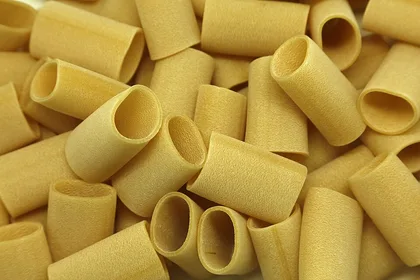 Pasta and breadPaccheriPaccheri are large smooth tubes of durum wheat pasta from Campania: 4-5 cm long, 3-4 cm across, with a thick…
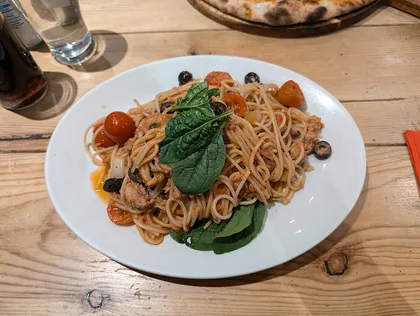 Pasta and breadSpaghettiA solid round strand of durum semolina and water, 1.7 to 2.0mm across. It looks like the most neutral pasta…
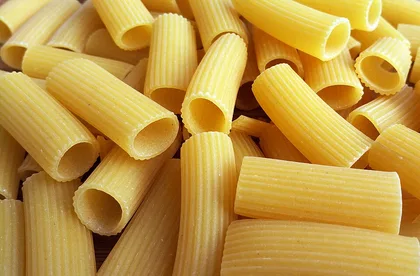 Pasta and breadRigatoniWide ridged tubes of durum semolina, cut straight across. The ridges and the square cut are engineering, not…
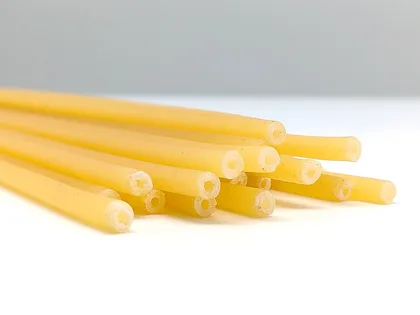 Pasta and breadBucatiniBucatini are thick spaghetti with a hole running through the middle.
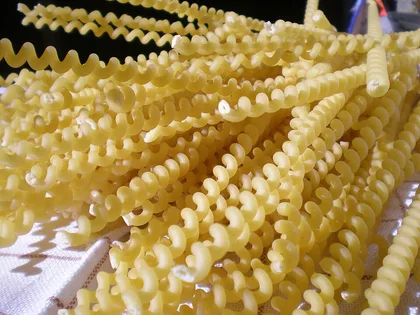 Pasta and breadFusilliTwo different pastas share this name. The industrial spiral is solid and holds sauce on its outside surface…
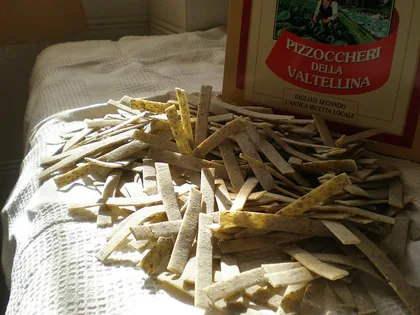 Pasta and breadPizzoccheriBuckwheat rather than wheat, which is where the dark colour and the nutty taste come from.