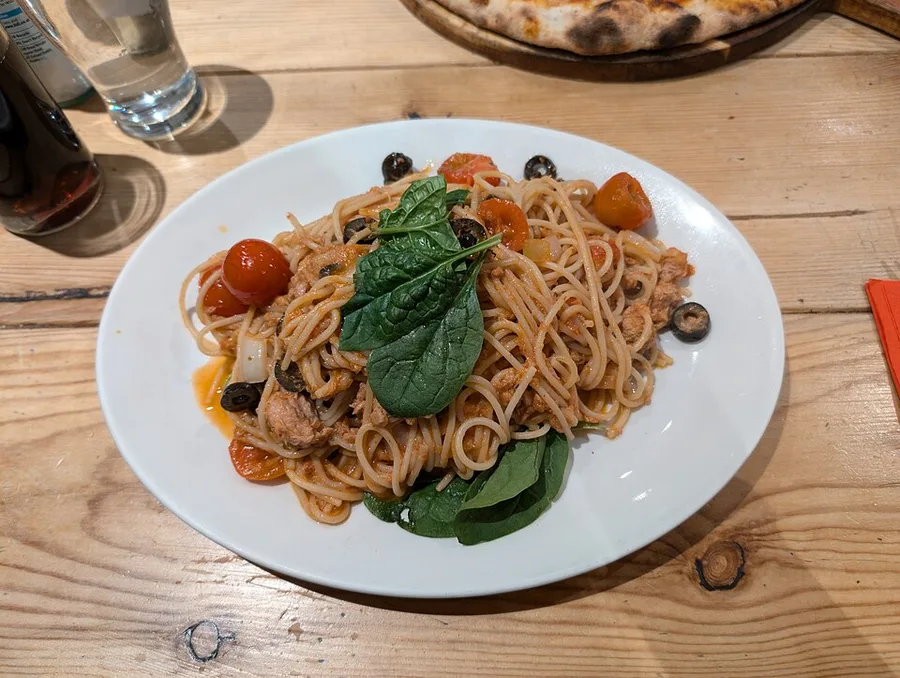
What is Spaghetti?
Spaghetti is dried pasta made from durum wheat semolina and water, extruded as a solid round strand and cut to a standard 25-26cm. The usual gauge sits between 1.7 and 2.0mm: Barilla's no. 5 is 1.75mm, De Cecco's no. 12 is 1.9mm. Those numbers are not an industry standard: each factory has its own scale, so one brand's no. 5 can be thicker than another's no. 7. Read the millimetres, ignore the number.
The name is the diminutive of spago, string. Before the nineteenth century the shape was called vermicelli, and in southern Italy it still is; when northern factories standardised their catalogues, spaghetti won and vermicelli slid sideways to mean a slightly thicker gauge.
What matters is the cross-section. A round solid strand has little surface per unit of weight compared with a ridged short shape, but an enormous number of strand-on-strand contact points. So the sauces that work are the ones that form a continuous film binding the tangle: an emulsion of oil and starch, a bond of egg and cheese, a finely passed tomato. A chunky meat ragù or a sauce of diced vegetables has nothing to grip and ends up at the bottom of the bowl with bare pasta on top. That is not tradition talking. It is geometry: the shape is engineering for the sauce.
What does it taste like?
Good spaghetti tastes distinctly of wheat: nutty, faintly sweet, occasionally like fresh toast. Bad spaghetti tastes of almost nothing and functions as a delivery system for whatever is on it. The difference is not the brand's marketing but the drying: slow-dried pasta keeps volatile aromatics that a four-hour, 95-degree industrial dryer burns off.
Texture is where the real argument happens. Properly cooked, the strand should offer resistance without being hard, and a cut cross-section should still show a faint chalky dot at the centre. Bronze-die pasta feels rougher on the tongue; Teflon-die pasta feels slick.
How to use it
Four quarts of water per pound, salted once it boils, about a tablespoon and a half of coarse salt. No oil in the water: it floats, never touches the pasta and only helps the sauce slide off later. Do not break the strands; drop them in whole and push them under as they soften.
Now the part almost no box explains. The printed cook time assumes water boiling at sea level, at 100°C. At 1,000 metres water boils at roughly 96.7°C, at 2,000 metres at 93°C, and starch gelatinises proportionally more slowly, so you need one to three extra minutes. If you cook in Denver, Mexico City or the Alps and the pasta is raw on the timer, the pasta is fine and the physics is not.
And 'al dente' is not a preference. It is a state of the starch. As the strand cooks, water moves inward and the granules gelatinise along a front advancing towards the centre; al dente means that front has not yet reached the core, which is the chalky white dot you see in a cut strand. At that moment the gluten network is intact, the strand survives being tossed in a pan, and it releases amylose into the sauce where it belongs. Past that point the network fails, the starch leaves into the water instead, and you get pasta that is gluey outside and slack inside. It is also why al dente pasta has a lower glycemic index.
So: drain two minutes short of the box time, finish in the pan with a ladle of pasta water, and move the pan rather than stirring. That last two minutes is where the dish is made.
Use it for sauces that form a film: aglio e olio, where the emulsion is the entire dish; vongole, where clam liquor and pasta starch make the cream; finely passed tomato with basil; carbonara, off the heat before the eggs go in. Regional exceptions worth knowing are spaghetti alla Nerano with fried courgettes and provolone del Monaco, spaghetti all'assassina from Bari cooked risotto-style until the strands char, and spaghetti with colatura di alici from Cetara: oil, anchovy sauce, garlic, parsley, nothing to hide behind.
How long it keeps
Unopened, dried spaghetti wants a cupboard that is cool, dark and above all dry, and the best-before date printed by the producer is the reference point; it is normally set two to three years from packaging. The fridge is the wrong place for it because it is humid. Once the bag is open, move what is left into an airtight jar or clip the bag closed, because semolina takes moisture from the air: pasta that has picked up humidity cooks softer, loses its bite sooner and can develop hairline cracks along the strands.
Over long storage the small amount of fat in the wheat germ oxidises and the smell shifts from faintly sweet to flat and papery; wholemeal spaghetti, which keeps more of the germ, gets there in months rather than years. Cooked spaghetti behaves differently: in a lidded container in the fridge it keeps two or three days, going firmer and drier as the starch retrogrades, and any sauce on it keeps being absorbed, so it softens where it is wet and stiffens where it is not.
Spot the real thing
Turn the packet over first. The ingredient list should read durum wheat semolina and water, nothing else. Then look at the strands through the window: bronze-die pasta (trafilata al bronzo) is pale straw rather than golden, matte, faintly chalky, with visible flour dust in the bag and a slightly rough surface. Teflon-extruded pasta is smooth, glassy and a deeper uniform yellow. Some makers print the drying time and temperature on the pack; industrial lines dry at high temperature in a few hours, and no law defines slow drying.
What gets confused with it on the shelf: spaghettini, vermicelli and capellini are thinner, bucatini are hollow, and brand numbering is not standard, so read the millimetre gauge rather than the number. Fresh egg spaghetti and spaghetti alla chitarra are a different product entirely. Whole wheat and gluten-free versions sit in the same bags. Price is a fair signal here: supermarket own-brand runs about £1 or $1.50 for 500g, while Gragnano IGP and named artisan mills run $5 to $9 or £3 to £6 for the same weight.
How to pronounce Spaghetti
spa-GHET-tee
Three syllables, stress on the second. The 'gh' is a hard g as in 'get', and the h exists precisely to stop the g going soft. The first syllable is a clean 'spah', not the 'spuh' English speakers default to, and the double t is held slightly longer than an English t: that is what separates 'spa-GHET-tee' from 'spuh-GEDD-ee'. It is already plural: one strand is a spaghetto.
Spaghetti compared
vsSpaghettoni, vermicelli and capellini
The same round solid strand at four gauges, and the gauge is the whole decision. Thicker strands cook longer, hold their bite under heavier sauces and give more chew; thinner ones cook fast, overcook faster and collapse under anything with weight to it. The names are not standardised across producers: southern brands use vermicelli for what northern brands call spaghetti, so read the millimetre figure, not the word.
| This | Spaghettoni, vermicelli and capellini | |
|---|---|---|
| Diameter | 1.7-2.0mm | Spaghettoni 2.2-2.6mm · Vermicelli 2.1-2.3mm · Capellini 0.85-1.0mm |
| Cook time | 9-11 minutes | Spaghettoni 12-14 · Vermicelli 10-13 · Capellini 2-3 |
| Margin for error | About 60 seconds | Spaghettoni 90 seconds · Capellini 15 seconds |
| Sauce it carries | Emulsions, seafood, light tomato, egg | Spaghettoni: guanciale, heavy tomato, ragù napoletano |
| Where it fails | Chunky sauces slide off | Capellini turns to mush outside broth or oil |
vsTeflon-die spaghetti
Same two ingredients, different products, because the die decides the surface. Bronze drags on the dough as it passes and leaves a microscopically rough, matte strand; Teflon lets it slide and produces a smoother, glossier one. That the rough strand holds more sauce is the usual selling point, but the studies we found did not measure it. Bronze extrusion is slower and the dies wear out and need remaking, which is part of why bronze-cut pasta costs more. The die tells you about the surface, not about the wheat.
| This | Teflon-die spaghetti | |
|---|---|---|
| Surface | Rough, matte, chalky to the touch | Smooth, glossy, slick |
| Colour | Pale ivory-yellow | Bright, uniform yellow |
| Porosity | Higher | Lower |
| Dry strand | More fragile, snaps more easily | Denser and stronger |
| Extrusion | Slower | Faster |
| Price | $4-12 per lb | $1.50-3 per lb |
Spaghetti substitutes
- Vermicelli
In Italian usage this is the same strand a fraction thicker, and in the south simply the older name for spaghetti. Add a minute to the cook time. Not to be confused with the rice vermicelli in Asian groceries, an unrelated product.
1:1 - Spaghettoni (thick spaghetti, no. 7 or 8)
The upgrade rather than the substitute. At 2.2-2.6mm it gives you more chew and holds heavier, fattier sauces without going limp. Cook two to three minutes longer and use slightly more sauce, since there is more pasta per strand to coat.
1:1 by weight - Linguine
A flattened oval strand with more clinging surface and less chew. Better than spaghetti for thin, emulsified seafood sauces and pesto; worse for anything that needs the strand to hold its own. Same cook time, give or take thirty seconds.
1:1 - Gluten-free spaghetti
Jovial's brown rice spaghetti and Rummo Senza Glutine hold their shape better than most; corn-and-rice blends from Garofalo and Barilla are widely stocked. Salt the water more heavily, stir in the first minute to stop clumping, and stop a full minute early, because with no gluten network to fail gradually, these strands go from firm to disintegrating with no warning.
1:1 - Fresh spaghetti alla chitarra
Square-section fresh egg pasta from Abruzzo. Cooks in two to four minutes and behaves quite differently: softer, richer, and much better with meat ragù than the dried round strand. Buy 50% more by weight, since fresh pasta already contains water.
1.5:1 by weight
Where to buy it
In the US, Barilla and De Cecco are in every supermarket at $1.50 to $3 a pound and make a perfectly good dinner. The meaningful step up is Rummo, Garofalo and Mancini at $4 to $6. Bronze-cut Gragnano IGP and small artisan producers (Faella, Setaro, Gentile, Afeltra, Martelli, Verrigni, Rustichella d'Abruzzo) run $7 to $14 a pound at Eataly, Gustiamo, Market Hall Foods and Amazon.
In the UK, Waitrose, Ocado and Sainsbury's stock De Cecco and Garofalo at £2 to £4.50 per 500g, which is £4 to £9 per kilo; Natoora, Vorrei, Vallebona and Seggiano ship bronze-cut Gragnano nationwide at £8 to £18 per kilo. In Italy the same artisan pasta costs €6 to €14 per kilo and supermarket brands €1 to €2.20.
Check the pack in this order: 'trafilata al bronzo' or 'bronze cut' if you want the rougher surface; protein content, since higher protein generally keeps the strand firmer in the pot; and the IGP mark if you want Gragnano specifically. Pale and matte is right, glossy and bright yellow is not, and semolina dust in the bag is a good sign rather than a defect.
Where to eat it in Italy
Gragnano, half an hour from Naples, is the pilgrimage. The historic factories along Via Roma, a street deliberately aligned with the wind that once dried the pasta in the open air, run tours and sell direct, and the town holds a pasta festival in September. Torre Annunziata, a few kilometres away, shares the same history and the same wind.
In Naples, spaghetti alle vongole belongs to Borgo Marinari and Santa Lucia, on the water. In Cetara on the Amalfi Coast, colatura di alici is the local anchovy sauce and spaghetti is the only dish that carries it properly. In Nerano, a hamlet of Massa Lubrense, the courgette-and-provolone version carries the village's name.
Bari does the heretical one: spaghetti all'assassina, cooked dry in the pan like risotto until the strands scorch. Rome is where spaghetti meets carbonara, gricia and cacio e pepe, in the trattorie of Testaccio and Pigneto, whether carbonara belongs on spaghetti or rigatoni is a live local dispute with no resolution in sight.
Frequently asked questions
How much spaghetti per person?
80g dried for a first course within a full meal, 100g if it is the main dish. Dried pasta roughly triples in weight as it cooks, so 100g dried becomes about 300g on the plate.
Why should you never break spaghetti?
Because the length does work: whole strands wind around each other and hold sauce inside the tangle, while short pieces slide apart and let the sauce drop to the bottom. If the pot is too small, lower them in whole and push them under as they soften: ten seconds and they are in.
Why is my spaghetti still hard at the time on the packet?
Most likely altitude. Packet times assume water boiling at 100°C at sea level; at 1,000 metres water boils at about 96.7°C and at 2,000 metres at 93°C, so the starch gelatinises more slowly and you need one to three minutes longer. Very hard water slows hydration too. Taste, do not trust the timer.
What does al dente actually mean?
That the gelatinisation front has not yet reached the centre of the strand: cut one and you still see a white chalky dot of crystalline starch. It is a physical state, not a taste preference. At that point the gluten holds, the pasta survives tossing in the pan, and it gives its starch to the sauce instead of the water.
Related foods
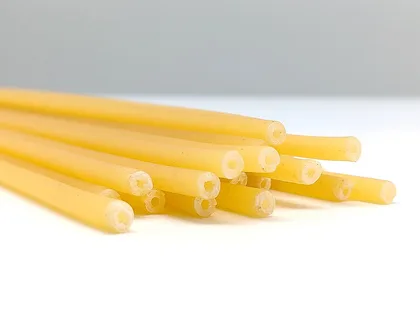 Pasta and breadBucatiniBucatini are thick spaghetti with a hole running through the middle.
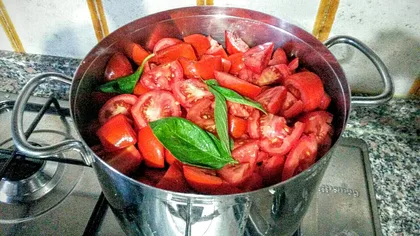 Vegetables and fruitSan Marzano TomatoesSan Marzano is a long, thin-skinned plum tomato grown in the volcanic plain between Naples and Salerno, and…
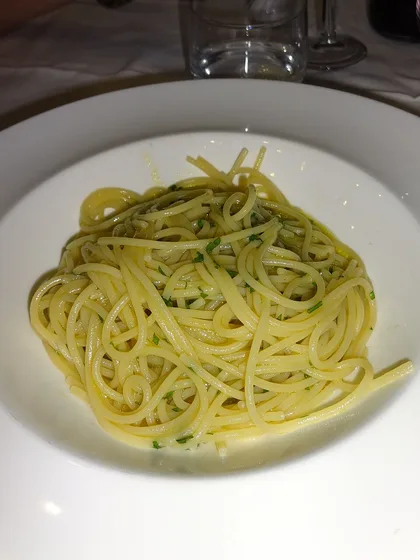 Fish and seafoodColatura di Alici (Italian Anchovy Sauce)Colatura di alici is the amber liquid that drains from anchovies packed in salt in chestnut barrels at…
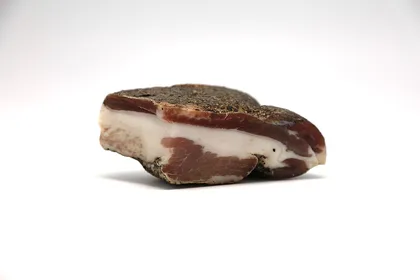 Cured meatsGuancialeGuanciale is cured pork jowl: unsmoked, rubbed with salt and pepper, aged for one to three months.
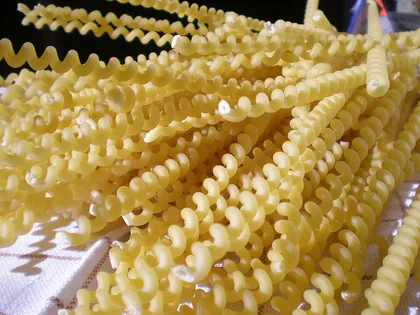 Pasta and breadFusilliTwo different pastas share this name. The industrial spiral is solid and holds sauce on its outside surface…
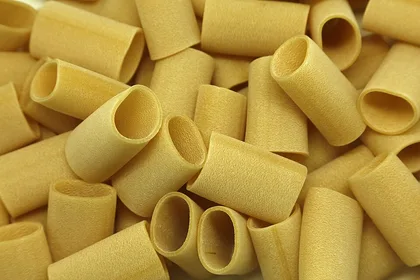 Pasta and breadPaccheriPaccheri are large smooth tubes of durum wheat pasta from Campania: 4-5 cm long, 3-4 cm across, with a thick…
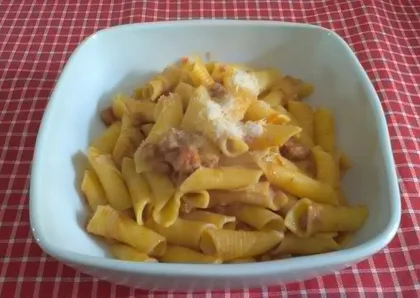 Pasta and breadMaccheroniThe most misunderstood name in Italian pasta. In Naples it means dried semolina pasta in general, in Abruzzo…
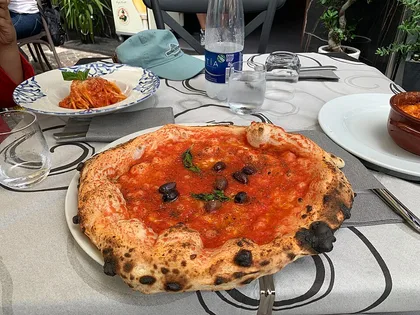 Pasta and breadNeapolitan PizzaNeapolitan pizza has been an EU-registered Traditional Speciality Guaranteed since 2010: four ingredients in…