What is Fusilli?
Fusilli takes its name from the fuso, the spindle used in hand spinning. The gesture, winding dough around an axis, produced two shapes that share a name and almost nothing else.
The hand-rolled version is made by wrapping a small rope of semolina dough around a square-section iron rod, the ferretto, which is literally a knitting needle. The result is a hollow, twisted tube five to eight centimetres long with a thin wall and an open channel at both ends. This is the fusillo of Irpinia, Molise, Basilicata and Cilento, and its entire purpose is to collect sauce inside that channel.
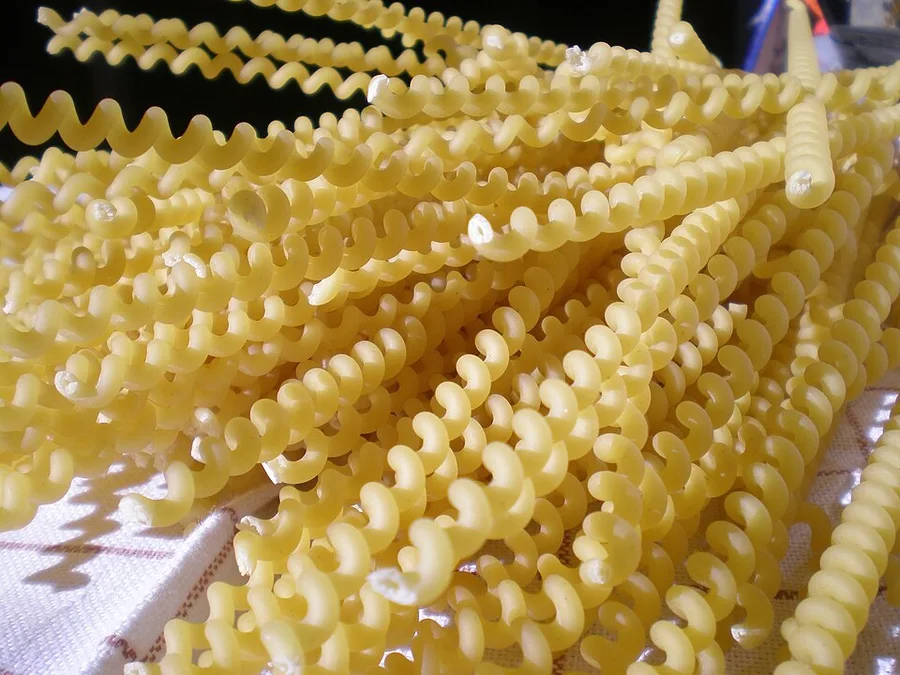
The industrial version is something else: a solid helix of two or three turns, three to four centimetres long, extruded through a shaped die or cut with helical blades. It has no cavity and nothing to fill. It works by surface area: the spiral offers close to twice the usable surface of a smooth cylinder of the same weight, and the grooves between the turns act as traps where sauce stops moving.
That is the engineering, and it dictates everything downstream. The hollow one wants long-cooked meat sauces that run into the channel: Neapolitan ragù, lamb, mutton. The solid helix wants sauces that are already creamy or chopped very fine and cling to the turns: pesto, ricotta, minced vegetables. Put a chunky ragù on a helix and it slides to the bottom of the bowl; put a thin pesto on a ferretto fusillo and it finds nothing to hold on to.
What does it taste like?
The spiral changes the eating more than the flavour. Because sauce sits in the grooves rather than on a flat surface, each forkful delivers a burst rather than a coating, and the pasta itself stays distinct: you taste the wheat between the hits of sauce, which is not true of a thin strand drowned in oil.
Good bronze-cut fusilli tastes nutty and faintly sweet, with a chalky centre when properly al dente and a chew that comes from the doubled thickness at the core of the twist. Cheap fast-dried helices taste of almost nothing and, more tellingly, unwind slightly in the pot, losing the grooves that were the point.
The hand-rolled version tastes rougher and more rustic, closer to fresh pasta than to dried: the wall is thin and slightly uneven, so parts of it go soft while the seam stays firm. That unevenness is the appeal, not a defect.
How to use it
Plenty of water, salted once it boils, and one firm stir in the first thirty seconds, because helices nest inside each other if you let them settle.
Drain two minutes short of the box time and finish in the pan with a ladle of pasta water. On the industrial helix this is what drives sauce into the grooves; on the hand-rolled version it fills the channel, and it should be done gently because the wall is thin.
For the solid helix, use sauces that are creamy or chopped small: pesto genovese, pesto alla trapanese, ricotta loosened with pasta water, aubergine in small dice, minced vegetable ragù, crumbled sausage. It is also the best shape for cold pasta salad: the twist holds dressing and the pieces do not compact in the fridge the way strands do.
For the hollow ferretto version, use long-simmered meat sauces: Neapolitan ragù, Molisan mutton or lamb ragù, Cilentan goat. Anything with a savoury liquid component that can run into the channel.
What fails on both is a coarsely chunky sauce. The pieces neither enter the channel nor sit in the grooves, and they end up at the bottom of the bowl.
How long it keeps
Sealed in a cupboard away from light, heat and damp, dried fusilli holds two to three years, and the date on the box is the reference. Once the pack is open, tip it into an airtight jar. Humid air is what changes the pasta: it takes up moisture, the surface softens and the pieces then cook unevenly, and open bags left in a warm kitchen are where pantry moths turn up. The wheat smell fades gradually over those months.
Fresh fusilli col ferretto behaves differently. It sits in the fridge for two days on a floured tray under a cloth, never in a sealed box, where it sweats and the pieces fuse together. To freeze, spread the raw pieces apart on a tray and bag them once solid: two months, cooked straight from frozen with an extra minute. Cooked fusilli keeps two days in the fridge, and this shape survives cold better than most, because the twist holds oil and does not compact into a block.
Spot the real thing
On a machine-made spiral, look at how deep the grooves run and how sharp the ridges stand. Flattened, shallow turns hold nothing: you want at least two and a half twists, ideally three, and the same pitch from piece to piece across the bag. The colour should be matte ivory with a faintly floury feel, and a layer of white semolina dust in the bottom of the pack is a good sign. Glossy bright yellow means a Teflon die and fast drying. On the label, protein above 13 percent and a stated cooking time of 11 to 14 minutes point to a spiral with real thickness; under nine minutes it is thin.
Names cause trouble abroad. American rotini is the same idea, shorter and more tightly wound; cavatappi is a hollow corkscrew tube; gemelli is two strands twisted together. Handmade fusilli col ferretto looks wrong by supermarket standards, with uneven thickness, lengths varying by a centimetre and a visible hole at both ends where the iron rod was.
How to pronounce Fusilli
foo-ZEE-lee
Three syllables, stress on the second. The single 's' between vowels is voiced in Italian, so it is a z sound: 'foo-ZEE-lee', not 'few-SILL-ee' and never 'foo-SIGH-lee'. The 'u' is 'oo' as in 'food'. It is already plural: one piece is a fusillo.
Fusilli compared
vsFusilli col ferretto (hand-rolled)
The same name for two unrelated objects. Everything sold as dried fusilli outside Italy is the extruded solid helix; fusilli col ferretto is a hollow twisted tube rolled by hand around an iron rod in the southern Apennines. The difference is not craft romance, it is function: one holds sauce on its outside, the other holds it inside. That determines which sauces work, and they are not the same sauces. If you are cooking a long-simmered meat ragù, the hollow one is a genuinely better tool and worth seeking out.
| This | Fusilli col ferretto (hand-rolled) | |
|---|---|---|
| Structure | Solid helix, no cavity | Hollow twisted tube, open both ends |
| Length | 3-4cm | 5-8cm |
| Made by | Die extrusion, seconds per kilo | Hand-rolling, 60-90 minutes per kilo |
| Holds sauce | In the surface grooves | Inside the channel |
| Best sauces | Pesto, ricotta, finely chopped vegetables | Neapolitan ragù, lamb, mutton |
| Price | $2-14 per lb | $9-20 per lb, when you can find it |
vsEliche and rotini
Three names circling one idea, with real but small distinctions. Eliche means propellers: wider, flatter blades and a more open pitch, so more surface but shallower grooves. Rotini is the American name for a short, tightly wound helix, the standard pasta-salad shape. Many producers use the words interchangeably and print whichever sells better in the market they are shipping to. Where it matters: a tight pitch holds thick sauces better, an open pitch suits looser dressings and cold dishes.
| This | Eliche and rotini | |
|---|---|---|
| Pitch | Tight, 2.5-3 turns | Eliche: open and flat · Rotini: tight and short |
| Length | 3-4cm | Rotini 2.5-3cm |
| Groove depth | Deep | Eliche shallower, rotini similar |
| Best use | Hot sauces, pesto, baked dishes | Rotini: cold pasta salad, children's dishes |
| Interchangeable | Yes, in nearly every recipe | Yes |
vsTrofie
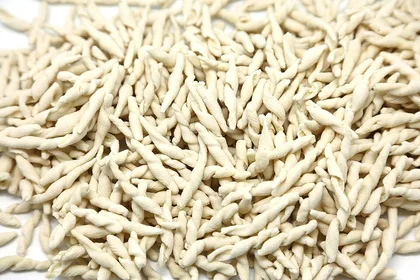
Both are twisted, both are famously served with pesto, and they twist for different reasons. Trofie is a short hand-rolled Ligurian shape with tapered ends and a loose spiral pressed into it; the twist is shallow and the body is dense, so pesto coats it rather than filling anything. Fusilli's deeper grooves hold noticeably more sauce per piece. For a classic Genoese pesto with potatoes and green beans, trofie is the traditional partner; for a heavier or chunkier pesto, fusilli carries it better.
| This | Trofie | |
|---|---|---|
| Origin | Campania and the southern Apennines | Liguria |
| Shape | Deep regular helix | Short tapered twist, shallow spiral |
| Cook time | 11-14 minutes dried | 5-8 minutes fresh, 10-12 dried |
| Sauce held | More, thanks to deep grooves | Less, it coats the surface |
| Classic dish | Pesto, ricotta, ragù | Pesto genovese with potato and green beans |
Fusilli substitutes
- Rotini or eliche
The same shape under different names, sometimes from the same factory. No adjustment needed beyond checking the box time, which can be a minute shorter on the shorter rotini.
1:1 - Cavatappi (cellentani)
A ridged hollow corkscrew that splits the difference between the two families: it has grooves outside and a channel inside. Excellent with anything creamy. Add a minute to the cook time for the thicker wall.
1:1 - Gemelli
Two strands twisted together, so the seam between them acts like a groove. Slightly denser and chewier than fusilli and a good stand-in for hot sauces, less good cold, where it clumps.
1:1 - Casarecce
A short rolled shape with a lengthwise furrow, from Sicily. It holds a chopped or creamy sauce almost as well as a helix and is more widely stocked in Italy. Cook time is similar, around 11 minutes.
1:1 - Gluten-free fusilli
This is the shape gluten-free pasta handles best, because the twist gives structure that a strand does not have. Jovial brown rice, Rummo Senza Glutine and Barilla's corn-and-rice blend all hold their spiral. Stop a minute early and dress off the heat: gluten-free helices unwind if tossed hard in a hot pan.
1:1
Where to buy it
In the US, De Cecco and Barilla fusilli are everywhere at $1.50 to $3 a pound. Rummo, Garofalo and Mancini sit at $4 to $6, and bronze-cut Gragnano IGP and small artisan producers (Faella, Setaro, Gentile, Rustichella d'Abruzzo, Benedetto Cavalieri) run $7 to $14 a pound through Eataly, Gustiamo and Market Hall Foods. Dried fusilli col ferretto is rare and specialist: expect $9 to $20 a pound from importers who deal with Molise and Basilicata producers.
In the UK, supermarkets carry De Cecco and Garofalo at £2 to £4.50 per 500g, so £4 to £9 per kilo; Natoora, Vorrei and Vallebona ship artisan Gragnano at £8 to £18 per kilo. Italian prices run €1.10 to €2.20 per kilo for supermarket brands, €6 to €14 for artisan, and €8 to €18 for the hand-rolled version.
On the pack, look at the spiral through the window: deep grooves and sharp crests, at least two and a half full turns, pale matte colour. Glossy bright helices with shallow, rounded turns were Teflon-extruded and dried fast, and they lose their twist in the pot.
Where to eat it in Italy
In Irpinia, in the hill towns around Sant'Angelo dei Lombardi and Gesualdo, fusilli col ferretto is Sunday food served with a long-cooked ragù, and a few trattorie still roll it in the dining room.
Molise treats the shape as an identity. Around Campobasso, Agnone and the upper Molise villages it is served with ragù di castrato, mutton simmered for hours, and it is the dish of the patron saint festivals.
In Cilento, south of Salerno, fusilli goes with goat or pork ragù, and inland villages still hold summer festivals dedicated to the shape in July and August.
For the industrial version, Gragnano near Naples is the place: the historic factories along Via Roma run tours and sell direct, and anything sold as Pasta di Gragnano IGP must be bronze-cut under its specification.
Frequently asked questions
What is the difference between fusilli and rotini?
Mostly the market they are sold in. Rotini is the American name for a short, tightly wound helix; fusilli is the Italian name for the same family of shapes. Where producers distinguish them, rotini is shorter and eliche has wider, flatter blades. They substitute for each other freely.
What are fusilli col ferretto?
Hollow twisted tubes rolled by hand around a square iron rod in Irpinia, Molise, Basilicata and Cilento. Unlike the industrial helix they have an internal channel, which is why they are served with long-simmered meat ragù that runs inside. A kilo takes over an hour to make by hand.
How do you pronounce fusilli?
foo-ZEE-lee, stress on the second syllable, with a z sound in the middle because a single Italian 's' between vowels is voiced. Not 'few-SILL-ee'. One piece is a fusillo.
Are fusilli good for pasta salad?
They are the best shape for it. The twist holds dressing even when cold and the pieces stay separate instead of compacting into a block. Cook them a minute longer than usual, since pasta firms up as it chills.
Related foods
 Oil and preservesPesto GenoveseHeat never touches this sauce, and by the rule neither does a blender: basil pounded in a marble mortar with…
 Pasta and breadTrofieTrofie are the pasta that pesto was made for: short, tapered twists of flour and water, rolled one by one…
 Cured meatsSalsicciaCoarsely ground pork, salt, pepper, wine and usually garlic, packed into natural hog casing and sold raw.
 CheeseRicottaRicotta is not a cheese. It is a dairy product made from whey, the liquid left over after cheese has been…
 Pasta and breadSpaghettiA solid round strand of durum semolina and water, 1.7 to 2.0mm across. It looks like the most neutral pasta…
 Pasta and breadPaccheriPaccheri are large smooth tubes of durum wheat pasta from Campania: 4-5 cm long, 3-4 cm across, with a thick…
 Pasta and breadMaccheroniThe most misunderstood name in Italian pasta. In Naples it means dried semolina pasta in general, in Abruzzo…
 Pasta and breadNeapolitan PizzaNeapolitan pizza has been an EU-registered Traditional Speciality Guaranteed since 2010: four ingredients in…