What is Paccheri?
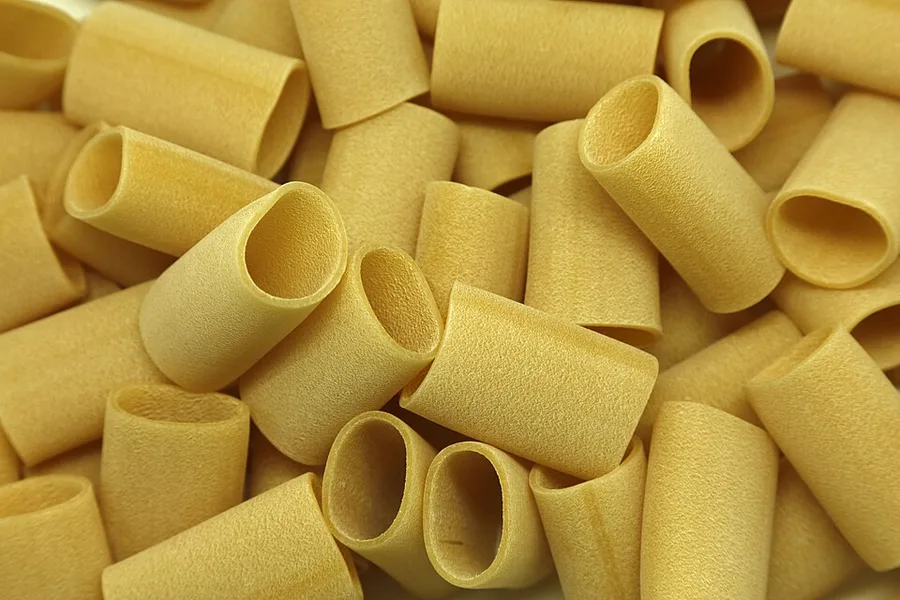
A pacchero is a short, wide tube of dried pasta made from durum wheat semolina and water, cut square at both ends and smooth on the outside: 4-5 cm long, 3-4 cm in external diameter, with a wall over 1.5 mm thick in well-made versions. That wall is what lets a tube this wide survive a quarter of an hour of boiling without collapsing.
Mezzi paccheri are the same tube cut to half length, around 2-2.5 cm; paccheri rigati carry external ridges and are a recent industrial variation; schiaffoni is a related name used by several Campanian producers for the same tube or a slightly longer one. Calamarata, despite sharing the shelf, is a different shape: same diameter, but a ring 1.5-2.5 cm tall built to resemble squid rings, cooking two minutes faster and holding nothing inside.
The best come from Gragnano, a hill town near Naples whose pasta has held European IGP status since 2013: semolina and water from the local aquifer, bronze dies, drying at 40 to 85 °C for 4 to 60 hours, the range allowed since the specification was amended in 2020, and production confined to the town's municipal boundary.
What does it taste like?
Dried pasta has a narrow flavour range, and paccheri sit at the wheat-forward end of it: toasted grain, a faint sweetness, a mineral edge from the water. Slow-dried Gragnano pasta tastes more of wheat than high-temperature industrial pasta, and the gap shows most in a bowl dressed with butter and cheese alone.
The real event is texture. Bronze-die pasta has a chalky, slightly rough surface, and the thick wall gives a chew that resists for a moment before giving way; then the tube collapses in the mouth and releases the sauce that worked its way inside. Timing is unforgiving: a minute early and the wall stays chalky, two minutes long and the tubes tear and flatten.
How to use it
Use a wide pot rather than a tall one and give them room: at least 5 litres of water for 400 g, salted at roughly 10 g per litre. Add them a handful at a time and stir straight away, because dry paccheri nest inside each other like stacked cups and any pair that seals cooks unevenly.
Cook 13-16 minutes depending on the producer. Drain two minutes early and finish them in the pan with the sauce and a ladle of pasta water, which brings the starch that binds everything, then lift them out with a spider: tipping the pot into a colander cracks a good share of them and pours out the sauce they have already taken on.
The sauces that suit them are long ones. Genovese (the Neapolitan white ragu of onions and beef simmered four to six hours until the onions dissolve) is the definitive pairing, because the onion cream flows into the tubes, and a long-cooked tomato ragu works the same way; on the seafood side, grouper or scorpionfish flaked off the bone with cherry tomatoes, or swordfish and aubergine. For the baked version, boil five to six minutes, pipe in ricotta, meat or bechamel, then stand them upright in a dish with sauce and cheese for twenty minutes in the oven. Paccheri alla vodka, for the record, is a recent American restaurant format rather than anything Neapolitan.
How long it keeps
Paccheri are dried pasta: a dry, dark cupboard, and a best-before date generally two or three years from production, printed on the box by the maker. That date is the producer's own reference. What happens with time is gradual: the flavour flattens and the tubes get more brittle, so more of them crack in the pot.
Damp matters more than time. A cupboard above the hob or beside the dishwasher takes on steam every time either runs, and semolina absorbs it: the walls soften and the tubes split open in water. Once the pack is open, tip the contents into an airtight glass jar and keep it away from coffee and spices, because semolina picks up smells. The fridge is the wrong place, since cold surfaces raise condensation inside the container. Broken tubes at the bottom of the bag are worth keeping: snapped by hand they are the right shape for pasta e fagioli. In a sealed jar in a dry room, the format holds its texture for years.
Spot the real thing
Look at the surface first. A bronze die leaves the pasta matte, faintly chalky under the fingers and pale straw in colour; a Teflon die gives a bright yellow tube that is smooth and glossy. Hold two boxes side by side and the difference is obvious.
Shape is the second signal. Slowly dried paccheri are not perfect cylinders: they go oval and some fold slightly, which is normal rather than a fault. A box with many tubes split lengthways is one to leave, because they come apart in water. On the label look for Pasta di Gragnano IGP with the blue and yellow European mark. Bronze cut on its own says nothing about where the pasta was made, and Gragnano style is not a protected phrase. The IGP fixes the place of manufacture, not the origin of the wheat.
On a shop shelf, paccheri are wider and shorter than manicotti or cannelloni, which are built to be stuffed and baked.
How to pronounce Paccheri
PAH-keh-ree
Three syllables, stress on the first. The double 'cch' is a hard k held for an extra beat: 'PAH' then 'keh', the same doubling English speakers already make in 'book-keeper'. It is never the 'ch' of chair and never an 'sh': 'pa-CHAIR-ee' and 'pa-SHAY-ree' are the two mistakes you hear most often. One tube is a pacchero, PAH-keh-roh.
Paccheri compared
vsRigatoni
Both are tubes, at very different scales. A pacchero is roughly two and a half times the diameter of a rigatone, with a thicker wall, a smooth surface and three more minutes in the pot. Rigatoni ridges grip ground-meat sauces; the smooth interior of a pacchero swallows chunky, long-cooked sauces whole.
| This | Rigatoni | |
|---|---|---|
| External diameter | 30-40 mm | 13-16 mm |
| Surface | Smooth | Ridged |
| Wall thickness | 1.5 mm and up | Around 1 mm |
| Cook time | 13-16 minutes | 11-13 minutes |
| Best sauces | Genovese, long ragu, flaked fish, baked | Ground meat ragu, amatriciana |
| Draining | Spider | Colander is fine |
vsCandele and ziti
The long tubes of the same Neapolitan repertoire, sold full length and snapped by hand before they go into the water. Candele are the wider of the two and break into rough 4-6 cm lengths, which lands them close to a pacchero in the finished dish, though a pacchero holds far more inside.
| This | Candele and ziti | |
|---|---|---|
| Sold as | Cut tubes, 40-50 mm | Long tubes, 250-300 mm, snapped by hand |
| External diameter | 30-40 mm | 8-15 mm depending on shape |
| Ends | Square machine cut | Jagged, from breaking |
| Cook time | 13-16 min | 12-15 min |
| Classic dish | Genovese, seafood, stuffed and baked | Ragu napoletano, pasta al forno |
| Can be stuffed | Yes | No, too narrow |
vsManicotti and American cannelloni
These look like relatives and are built for the opposite job. Manicotti and boxed cannelloni are sold to be stuffed raw and baked, often ridged, longer and much thinner-walled, and many go into the oven without boiling. Paccheri are boiled first and dressed in a pan.
| This | Manicotti and American cannelloni | |
|---|---|---|
| Length | 40-50 mm | 100-110 mm |
| Diameter | 30-40 mm | 25-30 mm |
| Wall | Thick, holds up in a pan | Thinner, cracks when handled dry |
| Designed for | Boiling and saucing; baking optional | Stuffing and baking, sometimes no-boil |
| Found in | Campania, Italian delis | US supermarkets, Italian-American kitchens |
Paccheri substitutes
- Mezzi paccheri
The same tube cut to half length, so wall and surface are identical. Take two to three minutes off the cook time, and prefer it in bean and chickpea soups, where the shorter piece fits a spoon.
1:1 by weight - Calamarata
Same diameter, ring shape. Cook one to two minutes less and reduce the sauce a little further, since it sits on the outside rather than inside. Natural fit for seafood, useless for stuffing.
1:1 by weight - Rigatoni or tortiglioni
The easiest supermarket swap anywhere. Cut two to three minutes from the cook time and chop the solids smaller: a chunk of braised beef that slides into a pacchero will just sit outside a rigatone.
1:1 by weight - Candele or ziti, snapped by hand
The Neapolitan alternative rather than a compromise, and the traditional shape for a Sunday ragu. Break them into 4-5 cm lengths over the open pack so the pieces stay put, and start tasting at twelve minutes.
1:1 by weight - Conchiglioni or lumaconi
For stuffed baked dishes only. Giant shells hold a filling more securely than a tube and need no standing upright, but contribute nothing in a pan-tossed sauce.
1:1 by count for stuffing
Where to buy it
In the US, Italian importers and specialists such as Eataly and Gustiamo carry Gragnano IGP paccheri, and Garofalo is in most large supermarkets. Expect 6 to 10 dollars for a 500 g pack, roughly 6 to 9 dollars per pound; in the UK, Italian delicatessens and online specialists sell the shape at about 8 to 15 pounds per kilo, and in Italy the same pack is 3.50 to 6 euros, or 7 to 12 euros per kilo.
On the label, look for 'Pasta di Gragnano IGP' next to the blue and yellow European PGI mark: 'bronze die', 'metodo gragnanese' or 'Gragnano style' on their own say nothing about where the pasta was made. Through the window, the tubes should look matte and pale straw rather than glossy and bright yellow; a few bent tubes mean slow drying, while split walls are the thing to reject.
One point worth knowing before paying a premium: the IGP governs where the pasta is made, not where the wheat was grown. Gragnano pasta is frequently made with durum from Canada, the US or Australia, prized for high, consistent protein, and packs sold in Italy carry a country-of-cultivation line under a 2017 Italian rule.
Where to eat it in Italy
Gragnano, in the province of Naples, takes half a day on foot. Via Roma is the street the historic pasta makers face (Di Martino, Gentile, Faella and Afeltra among them, several with a shop open to the public, plus the Garofalo plant), and it was laid out wide and angled so the air current between the sea and the Lattari mountains would dry pasta hung on frames in the open street. A path leads up into the Valle dei Mulini, where the ruins of the water mills still stand, and the town holds a festival dedicated to pasta every September, at the start of the month.
Torre Annunziata, ten minutes away by train, was the other historic pasta town. The Setaro mill still dries slowly and sells on site, sitting outside the IGP for reasons of municipal boundary rather than method.
In Naples, look for Genovese, which many kitchens in the old centre serve as the Thursday dish, and for paccheri with grouper along the waterfront; on the Amalfi and Sorrento coasts the shape is almost always seafood, with the day's catch and piennolo tomatoes. The Circumvesuviana line from Naples terminates at Gragnano.
Frequently asked questions
What are paccheri?
Large smooth tubes of dried durum wheat pasta from Campania, 4-5 cm long and 3-4 cm wide, with a thick wall. Semolina and water only, no egg; the best come from Gragnano near Naples, which has held European IGP status since 2013.
How do you pronounce paccheri?
PAH-keh-ree, three syllables with the stress on the first. The 'cch' is a hard k held for an extra beat, as in 'book-keeper', not the 'ch' of chair and not an 'sh' sound. A single tube is a pacchero, PAH-keh-roh.
What is the difference between paccheri and rigatoni?
Size and surface. Paccheri are 30-40 mm across, smooth, with a wall over 1.5 mm thick and a 13-16 minute cook. Rigatoni are 13-16 mm, ridged, thinner-walled and cook in 11-13 minutes. Paccheri take chunky, long-cooked sauces inside the tube; rigatoni ridges grip finer, ground-meat sauces.
Why do my paccheri break or stick together?
Too little water, too narrow a pot, or rough draining. Use at least 5 litres for 400 g in a wide pot, add them a few at a time and stir immediately so they cannot nest inside one another, then lift them out with a spider. Tipping the pot into a colander is what splits them.
Can you stuff paccheri?
Yes, and baked stuffed paccheri are a Neapolitan dish in their own right. Boil them five to six minutes, spread them on a cloth to cool, pipe in ricotta, meat or bechamel, then stand them upright in a baking dish with sauce and cheese for twenty minutes in the oven. Count on losing about one tube in ten to tearing.
Related foods
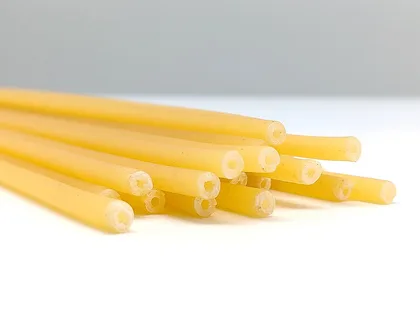 Pasta and breadBucatiniBucatini are thick spaghetti with a hole running through the middle.
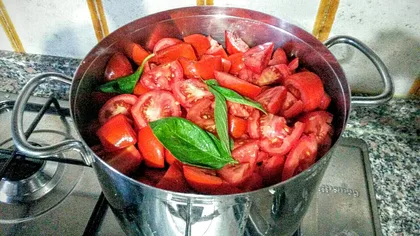 Vegetables and fruitSan Marzano TomatoesSan Marzano is a long, thin-skinned plum tomato grown in the volcanic plain between Naples and Salerno, and…
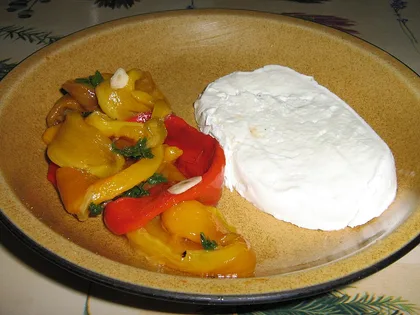 CheeseBuffalo MozzarellaMozzarella di Bufala Campana DOP is made from the whole raw milk of Italian Mediterranean water buffalo…
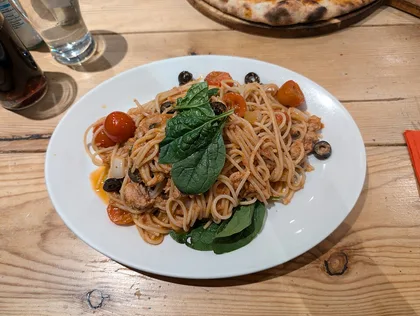 Pasta and breadSpaghettiA solid round strand of durum semolina and water, 1.7 to 2.0mm across. It looks like the most neutral pasta…
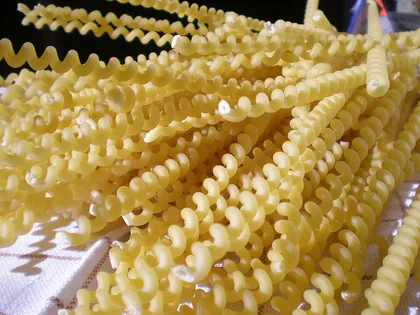 Pasta and breadFusilliTwo different pastas share this name. The industrial spiral is solid and holds sauce on its outside surface…
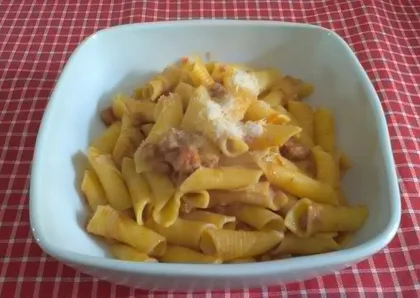 Pasta and breadMaccheroniThe most misunderstood name in Italian pasta. In Naples it means dried semolina pasta in general, in Abruzzo…
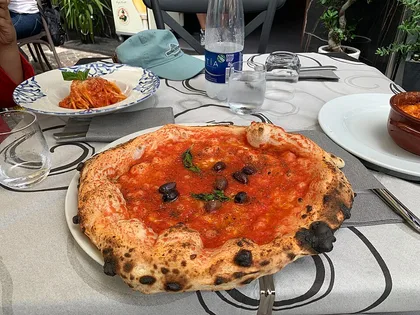 Pasta and breadNeapolitan PizzaNeapolitan pizza has been an EU-registered Traditional Speciality Guaranteed since 2010: four ingredients in…
 Pasta and breadPizza di Scarola (Neapolitan Escarole Pie)Pizza di scarola is Naples's Christmas Eve pie: bread dough wrapped around escarole stewed with Gaeta olives…