What is Bucatini?
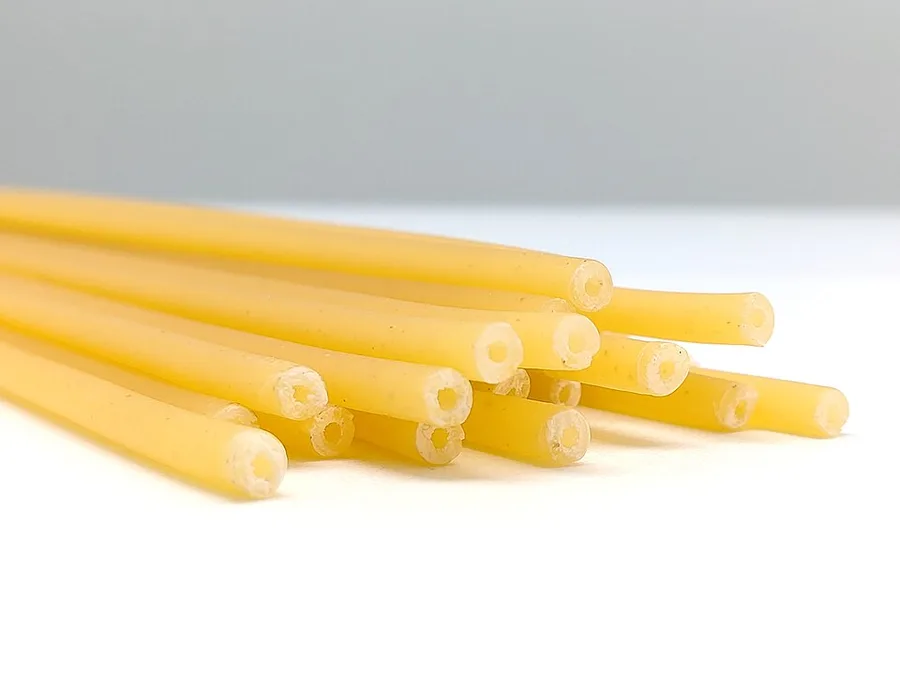
Bucatini is a dried durum wheat pasta, semolina and water and nothing else, extruded as a hollow tube. It is about 3mm across on the outside with a narrow channel down the centre, which makes it noticeably thicker and chewier than spaghetti while cooking in roughly the same time.
The name comes from buco, Italian for hole. That channel does real work. During cooking, water enters it and cooks the strand from the inside as well as the outside, so the pasta can be thick without a raw core. On the plate, the channel fills with sauce and delivers it into your mouth in a way solid strands cannot.
In Naples and much of southern Italy the identical shape is called perciatelli, from perciare, to pierce. If you have seen both names on a shelf and wondered what the difference was, the answer is: the region of the person who named it.
What does it taste like?
Pasta is a texture argument more than a flavour one, and bucatini wins that argument on chew. The strand has real resistance: a springy, slightly rubbery bite that spaghetti does not have, because there is more material between your teeth. Cooked properly it should still have a faint chalky line at the centre of the wall.
Flavour depends entirely on how it was made. Slow-dried bronze-cut bucatini from a serious producer tastes of wheat: nutty, faintly sweet, sometimes almost of toast. Fast-dried supermarket pasta tastes of very little and mostly carries whatever sauce is on it.
The practical consequence people always mention is that bucatini is aggressive to eat. Twirl it and hot sauce shoots out of the tube. Bite it and the same thing happens. Roman trattorie tuck the napkin into your collar for a reason.
How to use it
Do not break the strands. Drop them into hard-boiling water at full length and push them under as they soften: it takes about fifteen seconds. Use more water than you would for spaghetti, at least four quarts per pound, because the shape takes up more room and sticks if crowded.
Salt the water properly once it boils. Cook a minute and a half short of the box time, then finish in the pan with the sauce and a ladle of pasta water. Bucatini absolutely needs this finishing step: the interior channel takes on sauce during that last minute, which is where the format earns its reputation.
The canonical dish is amatriciana: guanciale rendered in a cold dry pan, tomato, pecorino romano, no onion and no garlic. Then gricia, which is amatriciana without the tomato. In Sicily, pasta con le sarde uses bucatini for the same reason: it stands up to sardines, wild fennel and toasted breadcrumbs.
One warning worth taking seriously. Bucatini traps hot sauce inside the tube and releases it when you twirl or bite. Wear something you do not care about, or do what Roman trattorie do and tuck the napkin in.
How long it keeps
Sealed, dried bucatini sits in a cool dark cupboard for two to three years, and the date printed on the box is the reference point, not the look of the pasta. What changes across that time is aroma: the smell of wheat is strongest when the box is new and grows fainter month by month. Keep it away from the hob and the kettle, since heat and steam are what alter the surface.
Once the packet is open, tip the strands into an airtight jar or clip the bag shut. Pasta pulls moisture out of humid air, and strands that have taken it up cook unevenly and go soft on the outside before the centre is done; open bags left in a warm kitchen over summer are also where pantry moths appear, and a bay leaf in the jar is the old Italian habit. Cooked and sauced, bucatini goes in the fridge in a sealed box for a couple of days. Reheat it in a pan with a spoonful of water rather than the microwave, which dries the channel and leaves the strand papery.
Spot the real thing
Bucatini is the long strand with a hole running through it. Hold a piece up to the light and you should see a pinprick of daylight down the middle, centred and the same size along the whole length; in cheap production the pin wanders and the wall thickness varies. The strand measures around three millimetres across, clearly thicker than spaghetti. Colour tells you how it was made: bronze-cut pasta looks pale, matte and almost chalky, and leaves a dusting of semolina at the bottom of the bag, while bright yellow and glossy points to a Teflon die.
American and British shelves often file the same shape under perciatelli, so check both words before deciding a shop does not stock it. It is not long macaroni or ziti, which are cut into short lengths and have a much wider bore, and it is not thick spaghetti, which is solid all the way through. Price is a fair guide: the cheapest supermarket boxes are industrial, and the Gragnano artisan tier costs three to five times as much.
How to pronounce Bucatini
boo-kah-TEE-nee
Four syllables, stress on the third. The 'c' before 'a' is a hard k, so 'boo-kah', never 'boo-cha'. The 'u' is 'oo' as in 'boot', not the 'yoo' or 'uh' English speakers reach for: 'byoo-ka-teeny' and 'buh-ka-TEE-nee' are both wrong. It is already plural: one strand is a bucatino, and 'bucatinis' is not a word in either language.
Bucatini compared
vsSpaghetti
The same idea with a hole through it and roughly 50% more pasta per strand. Bucatini is chewier, holds more sauce and stands up to heavy, fatty sauces; spaghetti is more delicate, easier to eat and better suited to light oil-based or seafood sauces. If a recipe calls for spaghetti and the sauce is rich, bucatini is an upgrade. If the sauce is olive oil, garlic and clams, it is not.
| This | Spaghetti | |
|---|---|---|
| Shape | Hollow tube | Solid strand |
| Diameter | 2.7-3.2mm | 1.8-2.0mm |
| Cook time | 9-12 minutes | 8-10 minutes |
| Bite | Chewy, springy, substantial | Softer, more yielding |
| Sauce carrying | Outside and inside the tube | Surface only |
| Best sauces | Amatriciana, gricia, sardines, rich ragù | Aglio e olio, vongole, light tomato, pesto |
| Eating | Sprays; awkward to twirl | Twirls cleanly |
| Price (US, good brands) | $4-9 per lb | $3-8 per lb |
vsPerciatelli
The same pasta under a different regional name: bucatini in Rome and the north, perciatelli in Naples and the south. American brands use both, sometimes on the same shelf, which makes shoppers think there is a distinction to find. There isn't a meaningful one. Where a difference exists it is a fraction of a millimetre, and it varies more between producers than between the two names.
| This | Perciatelli | |
|---|---|---|
| Name origin | buco, meaning hole | perciare, to pierce |
| Used in | Rome, Lazio, central and northern Italy | Naples, Campania, the south |
| Diameter | 2.7-3.2mm | 3.0-3.5mm at the widest |
| Cook time | 9-12 minutes | 10-13 minutes |
| Substitutable | Yes, entirely | Yes, entirely |
vsLinguine
Both are long, both are thicker than spaghetti, but they solve different problems. Linguine is flattened, so it has a wide surface that clings to thin, emulsified sauces. Bucatini is round and hollow, so it traps chunky, fatty sauces inside. Swapping one for the other changes how the dish eats more than most people expect.
| This | Linguine | |
|---|---|---|
| Cross-section | Round, hollow | Flat oval, solid |
| Surface area | Moderate outside, plus interior | High, flat, clinging |
| Bite | Chewy and springy | Silky, more delicate |
| Best sauces | Guanciale, tomato, chunky | Seafood, pesto, butter emulsions |
| Regional home | Lazio | Liguria and Campania |
Bucatini substitutes
- Perciatelli
Not a substitute so much as the same thing with a southern Italian name. If your store has perciatelli and not bucatini, buy it and stop looking.
1:1 - Spaghettoni or thick spaghetti
The best non-hollow stand-in. Look for spaghetti no. 7 or 8 (roughly 2.2mm) rather than standard no. 5. You lose the sauce-in-the-tube effect but keep the chew, which is most of what bucatini is for.
1:1 by weight - Ziti tagliati or cut candele
Short hollow tubes with the same wall thickness. The eating experience is completely different, but the sauce behaves identically, which matters for amatriciana. A good option if you are cooking for children or anyone who will not fight a long noodle.
1:1 - Pici
Hand-rolled Tuscan pasta, thick and solid, usually fresh. Chewier than bucatini and more rustic. Cook time drops to 4-6 minutes for fresh. Works beautifully with the same guanciale-and-pecorino sauces.
1:1 dried, or 1.5:1 by weight if fresh - Gluten-free bucatini
Jovial (brown rice) and Rummo Senza Glutine both make a hollow long format that holds shape far better than most gluten-free pasta. Salt the water more heavily and stop cooking a minute early, since gluten-free strands collapse quickly once they go past.
1:1 - Udon or thick wheat noodles
An outside-the-tradition option that works better than it sounds. Fresh udon has the same springy chew and the same ability to stand up to a heavy sauce. Not Italian, and the flavour of the noodle is different, but the texture logic holds.
1:1 dried weight, or 1.5:1 if fresh
Where to buy it
In the US, De Cecco and Barilla bucatini are in almost every supermarket at $2 to $4 a pound and are perfectly serviceable. The step up is worth taking: Rummo, Garofalo and Montebello sit around $4 to $6, and true artisanal bronze-cut brands (Rustichella d'Abruzzo, Setaro, Faella, Martelli, Mancini, Afeltra) run $7 to $12 a pound through Eataly, Gustiamo, Market Hall Foods and Amazon. Note that American brands often label the shape perciatelli, so check both words.
In the UK, Waitrose, Ocado and Sainsbury's carry De Cecco and Garofalo bucatini at £2 to £4 for 500g. For the artisanal tier, Natoora, Vorrei, Vallebona and Seggiano ship bronze-cut Gragnano pasta nationwide at £6 to £14 per kilo.
What to look for on the pack: 'bronze cut' or 'trafilata al bronzo' if you want the rougher surface, and the protein figure, since higher protein generally means pasta that stays firmer in the pot. Bronze-cut pasta looks pale, matte and slightly dusty; if the strands are glossy and bright yellow, it was most likely extruded through Teflon.
Where to eat it in Italy
Rome is the place, specifically the trattorie of Testaccio and Pigneto, where bucatini all'amatriciana is a default rather than a statement. The old-guard restaurants around Prati and San Giovanni serve it the same way.
Amatrice, in the province of Rieti two hours northeast of Rome, gave the sauce its name and holds a festival for it on the last weekend of August. The town's own registered recipe specifies spaghetti, not bucatini, which is a running argument with Roman cooks and part of the fun of going.
For the pasta itself rather than the dish, Gragnano near Naples is the pilgrimage. The historic pasta factories along Via Roma run tours and sell direct, and the local perciatelli is the same format under its southern name.
In New York, bucatini has become a signature of the city's Italian-American revival, and several Manhattan and Brooklyn kitchens make their own fresh, a very different and softer object from the dried Italian version, and worth trying as its own thing.
Recipes with it
Frequently asked questions
What is bucatini?
A thick, hollow, long dried pasta made from durum wheat semolina and water. It looks like spaghetti with a hole through the centre, is about 3mm across, and is the traditional shape for Roman amatriciana and gricia.
How do you pronounce bucatini?
boo-kah-TEE-nee, with the stress on the third syllable. Hard 'k' sound, and the first syllable is 'boo' as in 'boot'.
Why does bucatini have a hole in it?
So the strand can be thick without the centre staying undercooked: water enters the channel and cooks it from the inside too. The hole also fills with sauce, which is why bucatini carries heavy sauces better than spaghetti and why it sprays when you eat it.
What is the difference between bucatini and perciatelli?
Nothing meaningful. They are the same shape under a Roman name and a Neapolitan name. Perciatelli is sometimes a hair wider, but that varies by producer, not by name.
Can I use spaghetti instead of bucatini?
Yes, but use the thickest spaghetti you can find: no. 7 or 8 rather than no. 5. You will lose the sauce-inside-the-tube effect, so reduce the sauce slightly more so it clings.
Related foods
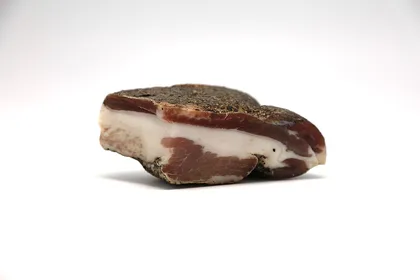 Cured meatsGuancialeGuanciale is cured pork jowl: unsmoked, rubbed with salt and pepper, aged for one to three months.
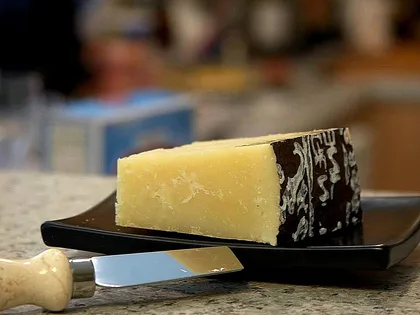 CheesePecorino RomanoPecorino Romano DOP is a hard, dry-salted sheep's milk cheese aged at least five months, made in Sardinia…Cured meatsPancettaPancetta is Italian cured pork belly: salt, pepper and warm spices, dried for months, never smoked.
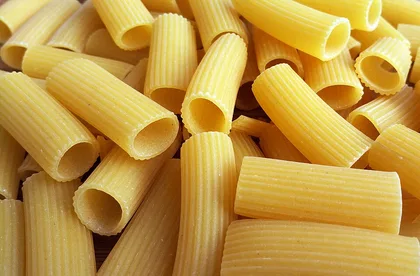 Pasta and breadRigatoniWide ridged tubes of durum semolina, cut straight across. The ridges and the square cut are engineering, not…
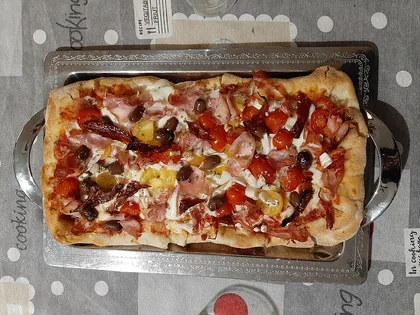 Pasta and breadPinsa RomanaIt is not pizza, and the difference starts with the flour: wheat, rice and soy blended together, hydration…
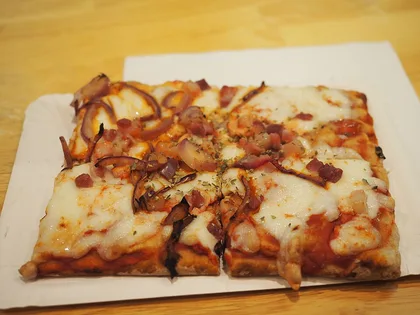 Pasta and breadPizza al TaglioPizza al taglio is Roman pizza by the slab: a very wet dough baked in an oiled rectangular pan, sold by…
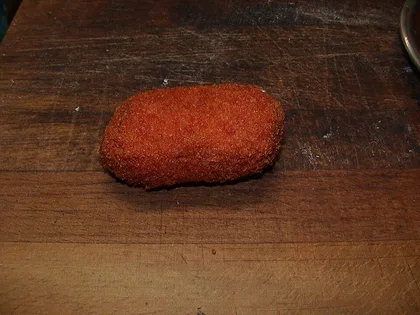 Pasta and breadSupplìSupplì are Rome's fried rice croquettes: rice cooked in tomato sauce, moulded around a plug of mozzarella…
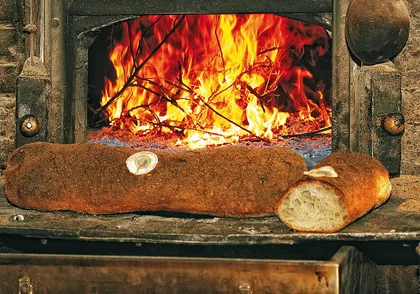 Pasta and breadPane di Genzano (Genzano Bread)Pane di Genzano is a sourdough loaf from the Alban Hills south of Rome, baked in a wood oven on a bed of bran…