What is Pane di Genzano (Genzano Bread)?
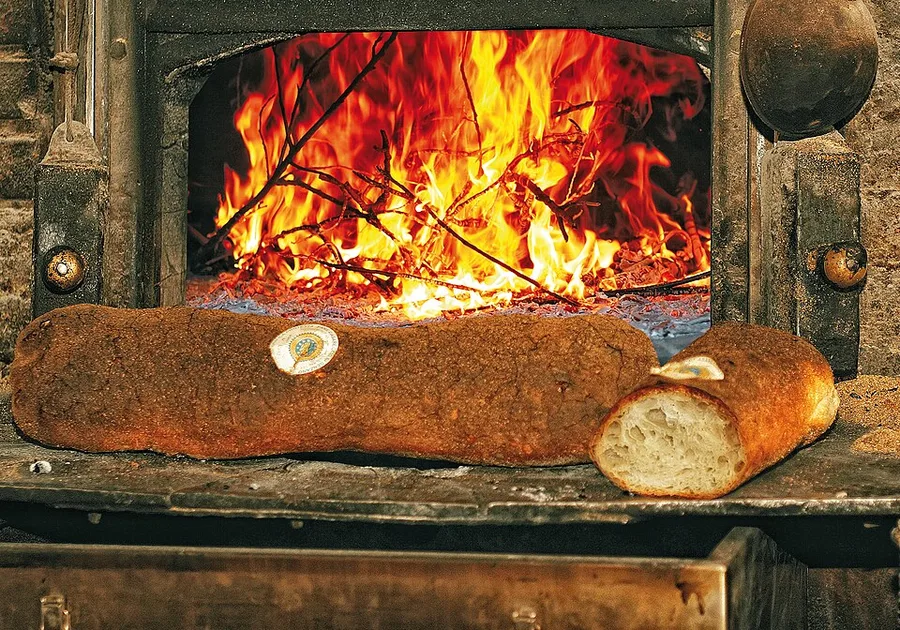
Pane casareccio di Genzano is a soft-wheat sourdough loaf, round or long, weighing anywhere from half a kilo to two and a half kilos. Four ingredients only: type 0 flour, water, salt, and a natural sourdough starter that must make up at least ten per cent of the flour weight. It is baked directly on the floor of a wood-fired oven, on a scattering of cruschello, the fine bran left over from milling.
That bran is the whole trick. It stops the dough sticking to the oven floor, but more importantly it smoulders underneath the loaf and toasts the base almost to the point of scorching. The result is a crust of at least three millimetres, dark brown on top and darker still beneath, wrapped around a pale ivory crumb full of irregular holes.
The bread was engineered for keeping. Households in the Alban Hills baked once a week, so the loaf had to last: the heavy crust seals the crumb, still moist on day three and ideal for bruschetta by day five. In 1997 it became the first bread in Europe granted a Protected Geographical Indication.
What does it taste like?
Wheat first, then a clean, low sourness: this is a sourdough loaf, but a mild one, nothing like a San Francisco-style tang. Behind that sits a distinct toasted, almost bitter note that comes from the burnt bran on the base and reads as roasted grain rather than char.
The texture is the point. The crust cracks dryly and stays thick enough to chew; the crumb is dense, moist and slightly chewy, with none of the cottony softness of a supermarket loaf. Torn rather than sliced, it holds together in your hand.
Eaten with olive oil and salt, which is how everyone in the region eats it first, the bitterness of the crust and the fruitiness of the oil meet halfway. It is a savoury, grown-up loaf, and it stands up to strong things: aged pecorino, salted anchovies, roast pork with pepper and fennel.
By day three the sourness fades and the wheat gets rounder. Toasted, it tastes better than it did fresh, which is not something you can say about many breads.
How to use it
On day one, do almost nothing to it: thick slices, good olive oil, coarse salt. This is the standard Roman way and it is the fairest test of whether you bought the real thing.
Day one is also porchetta day. In the hill towns around Genzano, Ariccia above all, the loaf exists largely to hold slow-roasted pork with pepper, garlic and wild fennel. Cut a piece the size of your hand, split it, load it with warm pork and skin, add nothing else. The crust keeps the fat off your fingers.
From day two, bruschetta. Slice a good finger and a half thick, grill or toast until the surface is marked, rub the hot crust with a raw garlic clove, pour oil over, salt. The tight crumb absorbs without going soggy, which is the specific thing a soft loaf cannot do.
From day three, put it in liquid on purpose. Roman panzanella uses a short soak and a firm hand with vinegar; pancotto is the same bread simmered with garlic and bay into a rough porridge; ribollita and pappa al pomodoro belong to Tuscany but work perfectly. Cube it, toast it and it becomes a crouton sturdy enough to sit in a bean soup for twenty minutes.
Stale and grated it makes a dark, savoury breadcrumb. Do not use it for delicate sandwiches or anything needing thin slices: the crust fights the knife and wins.
How long it keeps
Never in the fridge and never in plastic. Between 0 and 8 °C is where starch retrogrades fastest, so a fridge stales bread in a day; a sealed bag traps the moisture leaving the crumb and softens the crust into leather. The traditional handling is a cloth: keep the loaf cut side down on a wooden board, covered with a linen cloth or in a paper bag, at room temperature. A whole loaf of this size holds its character for four to five days, and a cut one for two or three.
The staling is the point rather than the problem, and Roman cooking is organised around it. Water moves out of the crumb into the crust, so the inside firms and dries while the outside softens; the flavour concentrates and the sourness reads more clearly. By day three the loaf slices thin and holds liquid without collapsing, which is what panzanella and pancotto need. Freezing works if you cut the loaf into thick slices first, bag them and toast from frozen, and it holds a month or two. A hot oven for five minutes revives a whole loaf.
Spot the real thing
The loaf is large and round, half a kilo to two and a half, and the first thing you notice is bran: the crust is dusted with a coat of wheat bran that comes off on your hands. Under it the crust is dark, almost three millimetres thick, and it crackles audibly when squeezed. Inside, the crumb is ivory, faintly grey rather than white, distinctly moist, with irregular holes of very different sizes. It smells sour and toasted at once, and a slice bends without tearing.
Outside Lazio the genuine article is essentially unavailable, since the IGP ties baking to Genzano itself and the loaf does not travel by air in any useful state. What you are looking for in a bakery abroad is the nearest relative: a large wood fired sourdough with a bran dusted crust, made with a natural starter rather than commercial yeast, sold whole or by the half rather than sliced. Ask what the leavening is. Anything labelled Genzano abroad is a style reference, not the IGP, and priced like ordinary artisan bread at $6 to $12 a loaf.
How to pronounce Pane di Genzano (Genzano Bread)
PAH-neh dee jen-TSAH-noh
Five syllables in the place name plus the article. The 'G' in Genzano is soft, like the 'g' in 'gentle', not a hard 'gu'. The 'z' is an Italian dental affricate, closer to 'ts' in 'cats' than to an English 'z', so 'jen-TSAH-noh' rather than 'jen-ZAY-no'. Stress falls on ZAH. 'Pane' keeps its final 'e' voiced: PAH-neh, never 'payn'. The full protected name is PAH-neh kah-zah-RECH-choh dee jen-TSAH-noh.
Pane di Genzano (Genzano Bread) compared
vsPane di Altamura
Italy's two great keeping loaves, made from opposite grains. Altamura in Puglia uses durum wheat semolina, which gives a yellow crumb and a nutty, almost sweet flavour; Genzano uses soft wheat type 0 flour and comes out white inside with a sharper, more toasted edge. Altamura holds DOP status and a distinctive folded shape; Genzano holds IGP and is baked on bran, which is what darkens its base. Both keep for days, both were designed for weekly baking, and neither is a substitute for the other at the table.
| This | Pane di Altamura | |
|---|---|---|
| Grain | Soft wheat, type 0 flour | Durum wheat semola rimacinata |
| Crumb colour | White to ivory | Deep yellow |
| Flavour | Toasted, faintly bitter crust, mild acidity | Nutty, sweeter, more aromatic |
| Certification | IGP since 1997 | DOP since 2003 |
| Oven floor | Bed of cruschello bran | Bare stone |
| Region | Alban Hills, Lazio | Murgia plateau, Puglia |
| Keeps | 5-6 days | Up to 2 weeks in the largest sizes |
vsStandard Italian white bread (pane comune)
The bread most Italians actually buy day to day is a fast one: brewer's yeast, a two-hour rise, a gas deck oven, a thin pale crust. It is fine on the day and stale by the next morning. Genzano is the older model: long fermentation with a live starter, wood fire, thick crust, several days of useful life. The difference shows up most clearly on day two, when one has become a rusk and the other has barely started.
| This | Standard Italian white bread (pane comune) | |
|---|---|---|
| Leavening | Sourdough starter, min. 10% of flour | Compressed brewer's yeast |
| Total fermentation | 3-5 hours plus starter refresh cycle | Around 2 hours |
| Crust | 3mm or more, dark | Thin, pale gold |
| Shelf life | 5-6 days | Less than 24 hours |
| Best use | Bruschetta, soups, roast pork | Sandwiches on the day |
| Price per kilo | EUR 3.50-5.00 | EUR 2.50-3.50 |
vsCraft sourdough (US and Northern Europe)
Both are naturally leavened, but they aim at different things. A modern craft sourdough chases an open, blistered, high-hydration crumb and often a pronounced tang. Genzano is deliberately restrained: less acidity, a tighter and moister crumb, a crust built for storage rather than for shattering.
| This | Craft sourdough (US and Northern Europe) | |
|---|---|---|
| Acidity | Low, clean, barely perceptible | Often pronounced and deliberate |
| Hydration | Moderate, around 60-65% | Frequently 75-85% |
| Crumb | Tight to medium, irregular, moist | Open, glossy, airy |
| Baked on | Wood-oven floor over bran | Steel, stone or Dutch oven |
Pane di Genzano (Genzano Bread) substitutes
- A dense country sourdough (pain de campagne, miche)
The closest thing you can buy outside Italy. Look for a large, dark, thick-crusted loaf at moderate hydration rather than an airy, blistered one. If the bakery offers a version with some wholemeal in the mix, take it: the bran note gets you closer.
1:1 by weight - Pane di Altamura
Different grain and a yellow crumb, but the same job: it keeps for days, holds oil without collapsing and makes excellent bruschetta. Increasingly exported, so easier to find abroad than Genzano itself.
1:1 by weight - Pão alentejano
Thick-crusted, dense and built for soaking: the Portuguese answer to the same problem. In bread soups it behaves almost identically.
1:1 by weight - Home-baked type 0 sourdough finished on bran
The one way to get genuinely close. Use a 60-65% hydration sourdough with 10% starter, bake on a stone at 250C falling to 200C, and scatter a tablespoon of coarse bran on the stone before the loaf goes down. The bran chars and reproduces the base.
1:1 by weight - Ciabatta or focaccia
Use only if nothing else exists. Both are far wetter and airier, they go stale within hours, and they turn to mush the moment they meet a wet topping or a soup.
1.2:1 by weight, and serve the same day - Gluten-free: buckwheat and rice sourdough boule
Nothing gluten-free reproduces the chew, but a buckwheat-heavy loaf gets the earthy, faintly bitter register. Toast it first, because untoasted it collapses under oil.
1:1, always toasted
Where to buy it
Inside Italy, the reliable place is a bakery in Genzano di Roma itself, or a Roman market stall that takes daily deliveries: Mercato Trionfale in Prati and the Testaccio market both carry it. Ask specifically for Genzano IGP, because plenty of bread is sold as 'tipo Genzano', which means nothing at all.
Outside Italy the honest answer is that you will not find it. A loaf whose entire selling point is a fresh thick crust does not survive international logistics, and no producer exports it in any volume. What you can find, in Italian delicatessens in the US and the UK, is pane di Altamura, which travels better and does a similar job.
In the US, look for a bakery selling a large naturally leavened country loaf at moderate hydration, roughly 8 to 14 dollars for a kilo loaf. In the UK the equivalent runs 5 to 9 pounds. In Genzano itself the bread costs 3.50 to 5 euros per kilo, 5 to 7 in Rome.
When you buy it, check the base: it should be dusty with dark bran and noticeably darker than the top. A clean, pale bottom means a tin, and a tin means it is not the real loaf.
Where to eat it in Italy
Genzano di Roma sits on the rim of the Nemi crater in the Castelli Romani, about forty minutes south of Rome. Consortium bakeries work through the night and sell from early morning along the main street. If you can time it, go on the third Sunday in June for the Infiorata, when a two-hundred-metre carpet of flower petals is laid down the steps of via Italo Belardi and the whole town is outdoors.
Ariccia, four kilometres away, is the porchetta capital of Italy and the home of the fraschette, the plain long-table taverns serving cured meats, cheese and loose wine. Genzano bread is the default there, not a choice. Nemi, on the far side of the crater, adds wild strawberries in June and a view over the lake.
Rome is an easy base: the Castelli are reachable by bus from Anagnina metro station or by regional train from Termini, and one day covers Frascati for the wine, Ariccia for the pork, Genzano for the bread and Nemi for the strawberries, twenty kilometres end to end. Inside the city, the trattorie of Testaccio and the Trionfale market stalls serve it daily.
Recipes with it
Further reading
Frequently asked questions
Why is Pane di Genzano so dark on the bottom?
Because the loaves are baked directly on the wood-oven floor over a scattering of cruschello, the fine bran left from milling. The bran smoulders under the dough and toasts the base almost to scorching. A pale, clean bottom means the loaf was baked in a tin and is not the genuine article.
How long does it keep?
Five to six days at room temperature, wrapped in a cotton cloth or a paper bag and stored cut-side down. Never plastic and never the fridge: refrigeration stales bread faster than a countertop. From day three onwards it is at its best for bruschetta and bread soups.
Is Pane di Genzano sourdough?
Yes. The PGI rules require a natural starter making up at least ten per cent of the flour weight, which is a high proportion. The acidity is deliberately mild, though, so it tastes far less tangy than a typical American or Nordic sourdough.
Can I buy it outside Italy?
Realistically, no. It is not exported in any meaningful quantity because the crust and crumb that justify the price do not survive shipping. Pane di Altamura is the exported Italian loaf that comes closest, and a dense local country sourdough is the practical everyday substitute.
What is the difference between Pane di Genzano and Pane di Altamura?
Grain, mostly. Genzano is soft wheat with a white crumb, IGP since 1997, baked over bran in Lazio. Altamura is durum semolina with a yellow crumb, DOP since 2003, baked on bare stone in Puglia. Genzano tastes toasted and faintly bitter; Altamura tastes nutty and sweeter.
Sources
Where to check what you just read.
- 1
L'elenco ministeriale in cui la denominazione compare per esteso come «Pane Casareccio di Genzano IGP», con il PDF del disciplinare scaricabile.
- 2
Gli ingredienti ammessi (farine 0 e 00, acqua, sale, cruschello di grano e lievito naturale, senza additivi) e il vincolo al solo comune di Genzano.
Related foods
 Cured meatsPorchettaSix to eight hours in a wood oven to reach two opposite textures in one piece of meat: skin that shatters…
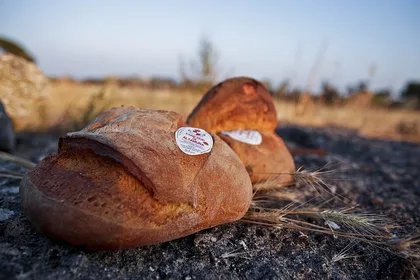 Pasta and breadPane di AltamuraPane di Altamura is a durum-wheat sourdough from the Murgia plateau in Puglia, and in 2003 it became the…
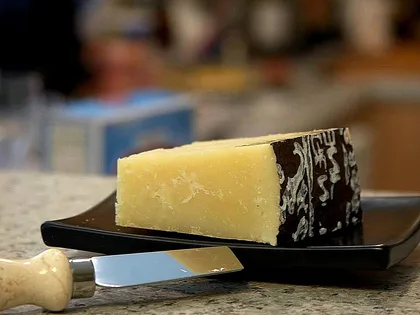 CheesePecorino RomanoPecorino Romano DOP is a hard, dry-salted sheep's milk cheese aged at least five months, made in Sardinia…
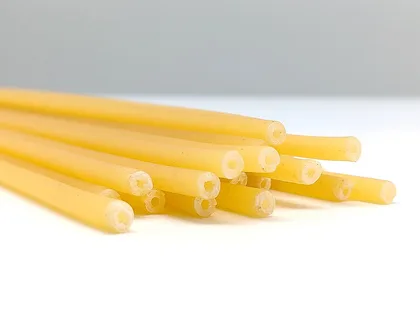 Pasta and breadBucatiniBucatini are thick spaghetti with a hole running through the middle.
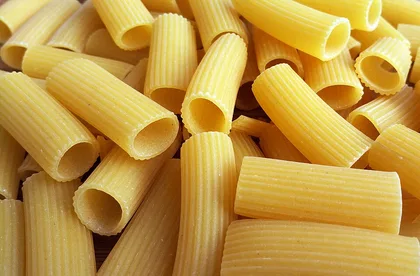 Pasta and breadRigatoniWide ridged tubes of durum semolina, cut straight across. The ridges and the square cut are engineering, not…
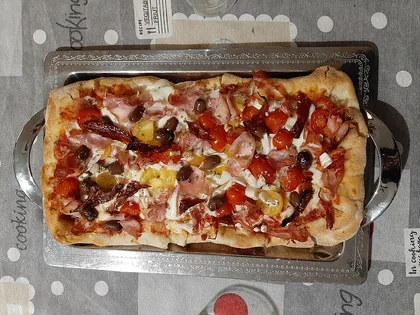 Pasta and breadPinsa RomanaIt is not pizza, and the difference starts with the flour: wheat, rice and soy blended together, hydration…
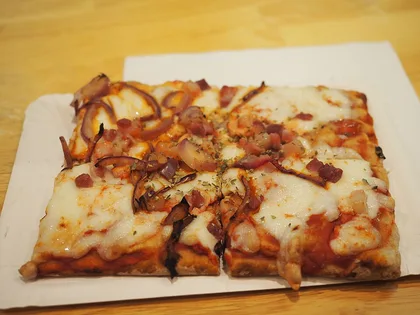 Pasta and breadPizza al TaglioPizza al taglio is Roman pizza by the slab: a very wet dough baked in an oiled rectangular pan, sold by…
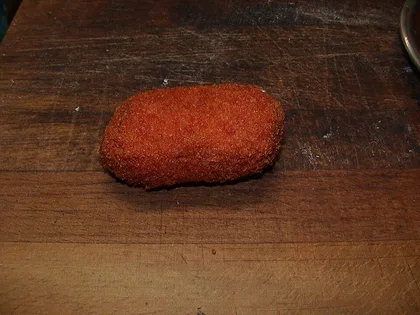 Pasta and breadSupplìSupplì are Rome's fried rice croquettes: rice cooked in tomato sauce, moulded around a plug of mozzarella…