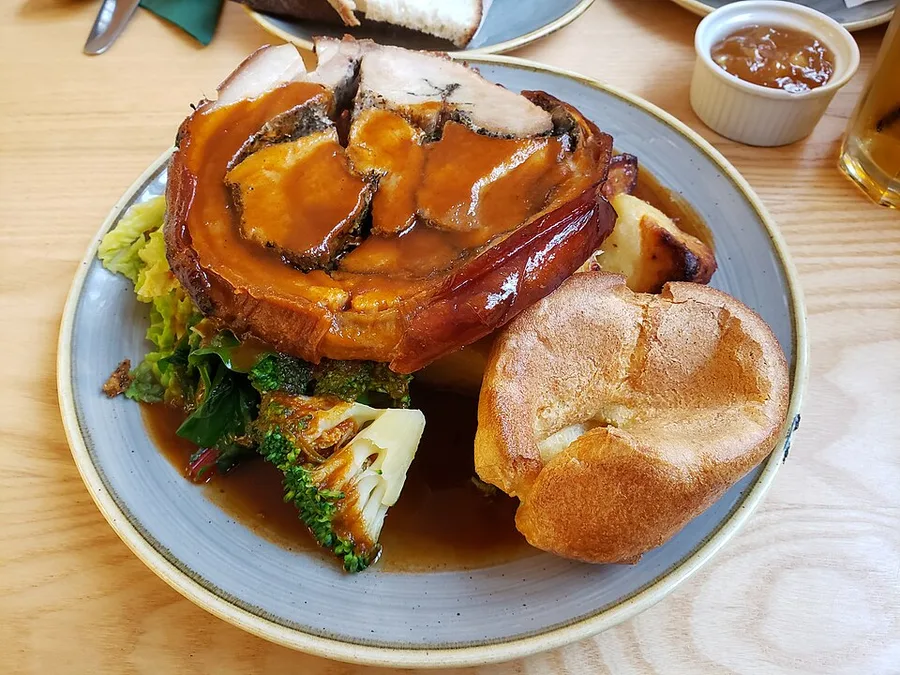
What is Porchetta?
Porchetta is a whole deboned pig, head removed in the Roman style, seasoned inside with salt, black pepper, garlic and rosemary, rolled up, tied at intervals with butcher's twine and slow-roasted in a wood oven. A finished one weighs 40 to 90 kilos and is sold by weight, carved in thick slices with a shard of crackling laid on top.
It sits in an odd category: part deli meat, part roast. In Italy you buy it from a van at a market, eat it in a hard-crusted roll with nothing else added, and that is the whole experience. Restaurants abroad serve it as a plated main, usually in a much smaller version.
The defining quality is the contrast: glassy crackling against meat that has stayed wet through eight hours of heat, plus the depth of garlic and herbs that cooked inside the roll rather than on its surface.
What does it taste like?
Deeply savoury and unmistakably herbal. The garlic has cooked long enough to lose its bite and turn sweet, the rosemary is present in every slice rather than only on the outside, and the fat carries both. It is much less sweet than American roast pork and much more aromatic than a British Sunday roast.
The texture does most of the work. Crackling snaps and dissolves; the meat under it is soft and slightly gelatinous where the fat has rendered into it; the leaner sections closer to the loin are firmer and a little drier. A good slice contains all three.
Umbrian and Marchigiana porchetta swaps rosemary for wild fennel, which pushes the flavour towards anise and makes it taste noticeably lighter. Roman porchetta is the more savoury of the two.
How to use it
Eat it in a sandwich, and keep the sandwich stupid: hard-crusted bread, two or three thick slices, a piece of crackling wedged in sideways, nothing else. No mustard, no mayonnaise, no leaves. It is already seasoned, and condiments bury the herbs.
On a plate, serve it at room temperature or barely warm, not piping hot, with bitter greens, roast potatoes cooked in the rendered fat, or a puntarelle salad in winter.
Leftovers improve with a hard sear: chop the meat, fry it in a dry pan until the edges caramelise, and use it to dress short pasta with broccoli rabe, or fold it into an omelette. Re-crisp leftover crackling in a 200 °C / 400 °F oven for five minutes.
Never the microwave. It dries the meat and turns the crackling to leather.
How long it keeps
Porchetta is fully cooked and sold sliced or in a piece, and it belongs in the fridge from the moment you get it home. A vacuum sealed piece carries a date on the pack, and that date governs. Loose from a deli counter, wrap the meat in butcher paper inside a container, and keep the crackling separate and uncovered, because any wrapping traps steam and the crust goes soft within an hour. Sliced porchetta dries much faster than a whole piece: cut only what you are about to eat.
The changes are the usual ones for roast meat. The cut face darkens and forms a dry skin, the lean tightens and loses juice, and the rendered fat firms to white and slowly takes on a flat, tallowy note. Fennel and garlic stay assertive far longer than the meat itself does. Porchetta freezes well in a piece, less well sliced; wrap it tight, and count on roughly two to three months before the texture starts to suffer, with the crackling coming out of the freezer soft. Recrisp it dry in a hot oven rather than adding fat.
Spot the real thing
Porchetta is a cooked roast, not a cured salume, so the meat is pale grey pink all the way through with no cured red. A cut face should read as a spiral: a sheet of belly wound around lean loin, with distinct fat seams and a dark green flecked line of herbs between the layers, fennel above all, plus garlic, rosemary and pepper. The skin should be a hard, blistered, mahogany shell that resists the knife and shatters rather than bends. Skin that is soft or pale has been steamed rather than roasted.
Abroad the word has drifted onto any herbed pork roast, and plenty of American versions are belly wrapped loin with the skin removed but never crisped. Ask whether it was made from a whole boned pig or a rolled belly, and whether the crackling comes with it; both are legitimate, but only one gives the sandwich its point. The Lazio version carries Porchetta di Ariccia IGP on the label, with fennel dominant. Price sits around $12 to $20 per pound at a deli counter, and anything much cheaper is usually roast pork under a borrowed name.
How to pronounce Porchetta
por-KET-tah
The 'ch' is a hard k, and this is the single most common mistake, and 'por-CHET-ta' is wrong. Three syllables, stress on the middle one, with the double t held briefly: por-KET-tah. Ariccia, the town, is 'ah-REE-chah'.
Porchetta compared
vsRoast pork
A British or American roast pork is a single cut (loin, shoulder or leg) cooked for one to three hours with seasoning mostly on the outside. Porchetta is the whole animal boned and rolled, so every slice contains loin, belly, shoulder and fat together, with the herbs and garlic sealed inside for six to eight hours. That is why porchetta stays moist where a lean roast dries out, and why the flavour goes all the way through instead of sitting on the crust.
| This | Roast pork | |
|---|---|---|
| Cut | Whole pig, boned and rolled | One cut: loin, shoulder or leg |
| Seasoning | Inside the roll: garlic, rosemary, pepper | On the surface, often just salt |
| Cooking time | 6-8 hours | 1-3 hours |
| Skin | Crackling across the whole outside | Crackling on one face, if at all |
| Served | Room temperature or warm, in a roll | Hot, plated, with gravy |
| Sauce | None: it is already seasoned | Gravy or apple sauce expected |
vsRestaurant 'porchetta' (belly wrapped around loin)
Almost every porchetta served in a US or UK restaurant is a scaled-down construction: a slab of pork belly wrapped around a loin, tied and roasted for three or four hours. It is a genuinely good dish and the right way to cook porchetta at home. It is not what is sold in Ariccia, where the animal goes in whole and the mix of muscles is far wider.
| This | Restaurant 'porchetta' (belly wrapped around loin) | |
|---|---|---|
| Composition | Whole boned pig | Belly wrapped around loin |
| Weight | 40-90 kg | 2-5 kg |
| Cooking | Wood oven, 6-8 hours | Domestic oven, 3-4 hours |
| Sold | By weight, from a van or counter | Plated, in a restaurant |
| Feasible at home | No | Yes |
vsPulled pork
Both are slow-cooked pork, and there the similarity ends. Pulled pork is shoulder cooked low and long until the muscle fibres separate, usually smoked and finished with a sweet or vinegared sauce. Porchetta is roasted dry, sliced rather than shredded, never smoked, and never sauced.
| This | Pulled pork | |
|---|---|---|
| Cut | Whole pig | Shoulder / Boston butt |
| Method | Dry roast, wood oven | Smoked or braised, low and slow |
| Texture | Sliced, with crackling | Shredded, no crackling |
| Flavour | Garlic, rosemary or fennel, salt | Smoke, sugar, vinegar, chilli |
| Sauce | Never | Central to the dish |
Porchetta substitutes
- Home porchetta: pork belly rolled around loin
The realistic route. A 2.5 kg piece of skin-on belly wrapped around a 1 kg loin, seasoned inside with salt, pepper, crushed garlic and rosemary, tied every 3 cm. Three hours at 150 °C / 300 °F, then 20 minutes at 230 °C / 450 °F for the crackling. Dry the skin uncovered in the fridge overnight first.
2.5 parts belly to 1 part loin - Boneless pork shoulder with fennel and garlic
Cheaper and more forgiving than belly-and-loin, and hard to overcook. Score the fat, season heavily inside, roast four hours at 150 °C. Less crackling, similar flavour.
1:1 by weight - Porchetta-style turkey breast
Sometimes called turchetta. A butterflied turkey breast rolled with the same garlic, fennel and rosemary seasoning, wrapped in pancetta to replace the missing fat. Much leaner, so pull it at 68 °C / 155 °F internal or it will be dry.
1:1 - Italian deli roast pork (US)
In Philadelphia and South Jersey, Italian roast pork with broccoli rabe and sharp provolone is the local descendant of the same tradition. Not porchetta, but the closest thing sold ready-made in much of the US.
- Vegetarian: whole roasted cauliflower or seitan roll
For the herb-and-garlic profile without the pig: a whole cauliflower rubbed with garlic, fennel seed, rosemary and olive oil, roasted 50 minutes at 200 °C; or a seitan roll seasoned the same way and roasted in a foil wrap. Neither gives you crackling: accept that and dress the plate with something crisp.
Where to buy it
In the US, Italian delis carry porchetta by the pound in most large cities: expect 14 to 22 dollars per pound sliced. New York, Philadelphia, Boston and Chicago all have counters that roast their own; a porchetta sandwich runs 12 to 18 dollars. In Philadelphia, the Italian roast pork sandwich sold at Reading Terminal Market is a related local tradition rather than porchetta proper, and worth knowing the difference before you order.
In the UK, Italian delicatessens and market stalls sell it at roughly 15 to 25 pounds per kilo, and porchetta rolls at London markets (Borough, Maltby Street, Mercato Metropolitano) cost 8 to 12 pounds. Some butchers will roll a belly-and-loin porchetta to order with a day's notice, which is the best value option.
In Italy, 12 to 18 euros per kilo from a porchettaro's van, and 4 to 6 euros for a sandwich at a market.
Avoid vacuum-packed pre-sliced 'porchetta' that looks perfectly cylindrical: it is usually reconstructed from assembled cuts.
Where to eat it in Italy
Ariccia, in the Castelli Romani about 25 km south-east of Rome, is the place. Its fraschette, plank-table taverns with paper instead of cloth, serve porchetta on yellow paper with bread, olives and jug wine, and the Sagra della Porchetta has taken over the town on the first weekend of September every year since 1950. The town's Porchetta di Ariccia has held IGP status since 2011.
In Rome itself, look for the porchettari's vans at neighbourhood markets (Testaccio, Trionfale, Ponte Milvio) on market mornings. Porchetta is brought into the city, not made in it.
In Umbria, around Costano and Bastia Umbra, the seasoning switches to wild fennel and the late-summer village sagre build their menus around it. Campli, in Abruzzo, makes a more heavily spiced version of its own.
Recipes with it
Further reading
Frequently asked questions
How do you pronounce porchetta?
por-KET-tah, with a hard k. Italian 'ch' is always a k sound, so 'por-CHET-ta' is incorrect. Stress the middle syllable.
What is the difference between porchetta and roast pork?
Porchetta is a whole boned pig seasoned on the inside with garlic and herbs, rolled, tied and roasted six to eight hours, so every slice mixes loin, belly and fat. Roast pork is a single cut seasoned on the outside and cooked for a fraction of the time.
Is porchetta eaten hot or cold?
Both, but rarely piping hot. In Italy it is most often eaten at room temperature or slightly warm, in a roll. Reheat gently in the oven if you want it warm, and re-crisp the crackling separately.
What herbs go in porchetta?
It depends on the region. Roman and Ariccia-style porchetta uses garlic, rosemary and black pepper. Umbrian, Marchigiana and Tuscan versions use wild fennel, which gives a distinctly aniseed character. Both use a great deal of salt inside the roll.
Can you make porchetta at home?
Not a whole pig, but a very good scaled version: wrap skin-on pork belly around a loin, season inside with salt, pepper, garlic and rosemary, tie it every 3 cm, roast three hours at 150 °C and finish 20 minutes at 230 °C. Drying the skin uncovered in the fridge overnight is what gets you crackling.
Sources
Where to check what you just read.
- 1
L'atto del 14 giugno 2011 che iscrive «Porchetta di Ariccia» fra le IGP: l'unica porchetta italiana con una denominazione europea.
- 2
I numeri della denominazione: pesi ammessi (27-45 kg il pezzo intero, 7-13 kg il tronchetto), razze suine consentite, aromi obbligatori e obbligo di lavorare tutto nel comune di Ariccia.
- 3
L'elenco ministeriale in cui l'unica porchetta certificata compare come «Porchetta di Ariccia IGP», con il PDF del disciplinare vigente.
Related foods
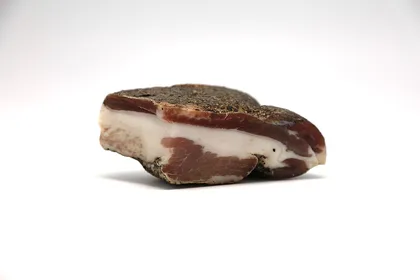 Cured meatsGuancialeGuanciale is cured pork jowl: unsmoked, rubbed with salt and pepper, aged for one to three months.
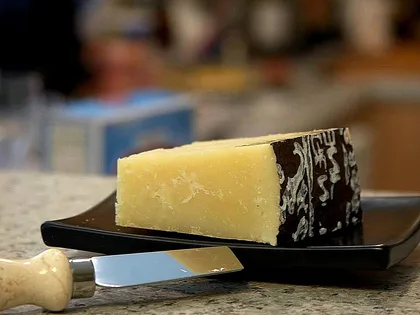 CheesePecorino RomanoPecorino Romano DOP is a hard, dry-salted sheep's milk cheese aged at least five months, made in Sardinia…
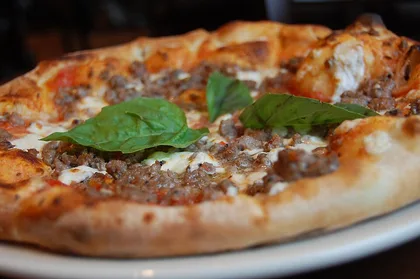 Cured meatsSalsicciaCoarsely ground pork, salt, pepper, wine and usually garlic, packed into natural hog casing and sold raw.
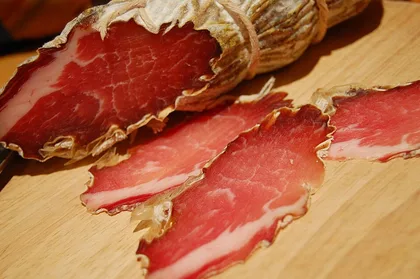 Cured meatsLonzinoLonzino is whole pork loin, dry-salted and air-cured for two to four months: the leanest cut on the animal…
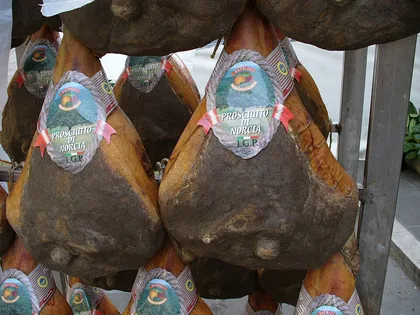 Cured meatsProsciutto di Norcia IGPProsciutto di Norcia IGP is Italy's mountain dry-cured ham, aged for at least twelve months between 400 and…Cured meatsSalsiccia di FegatoSalsiccia di fegato is Italian pork liver sausage: coarsely chopped liver, pork fat, salt and spices in…
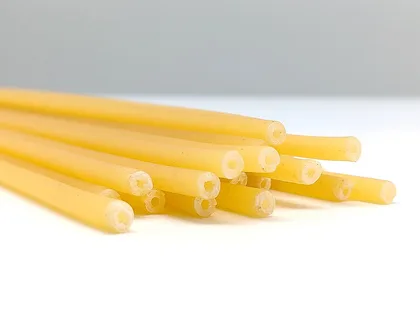 Pasta and breadBucatiniBucatini are thick spaghetti with a hole running through the middle.
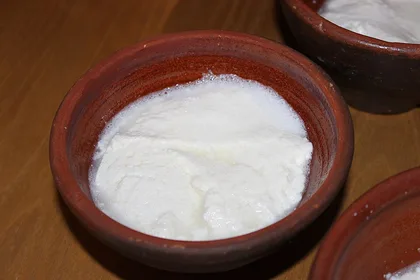 CheeseRicottaRicotta is not a cheese. It is a dairy product made from whey, the liquid left over after cheese has been…