What is Prosciutto di Norcia IGP?
Prosciutto di Norcia is a dry-cured pork leg made in five mountain towns of south-eastern Umbria and protected as an IGP since 1997. It comes from Italian heavy pigs, is salted twice with sea salt and aged a minimum of twelve months, and must weigh at least 8.5 kilos when the ageing is finished.
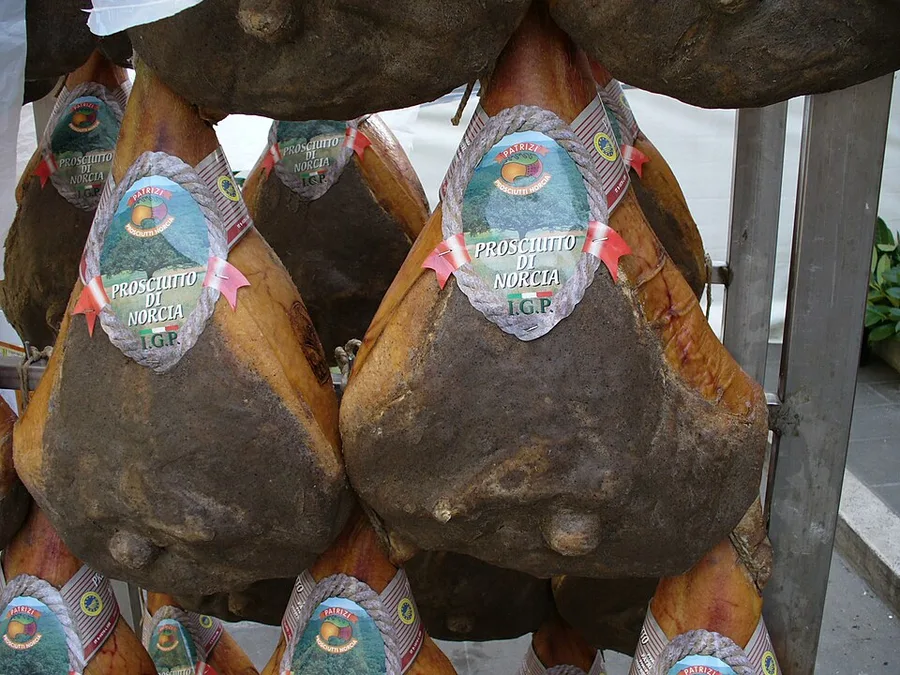
Two features identify it on sight. The first is the trim: the leg is cut into a short, rounded pear shape rather than the long profile of Emilian hams, which exposes more muscle and speeds up the drying. The second is the pepper. Around the sixth month the exposed meat is coated with a paste of lard, salt and coarsely ground black pepper, and Umbrian producers use far more pepper than anyone else, so the finished ham reaches the counter with a dark, gritty crust no other major Italian prosciutto has.
Production is small. Where Parma turns out millions of hams a year, Norcia counts in the hundreds of thousands, and much of it never leaves central Italy. The fire brand on the rind is the only real guarantee: a ham made in Norcia is not automatically a Prosciutto di Norcia IGP.
What does it taste like?
Savoury and firm where Parma is sweet and yielding. The salt registers first, then a nutty, almost roasted depth, then the pepper from the rind edging in on the finish. Twenty-four-month pieces develop a mushroom and dried-fruit note that is closer to a good Spanish serrano than to anything from Emilia.
Texture is the other difference. Mountain air with wide day-night temperature swings dries the meat faster and more evenly, so the fibre is tighter and the slice has more bite. It does not dissolve on the tongue in the way a young Parma does; it stays present and chews.
The fat is white, firm and clean-tasting, and it carries most of the aroma, which is why the ham needs fifteen minutes out of the fridge before serving. Eaten cold it tastes flat and salty; at room temperature it opens up considerably.
How to use it
Slice it thin but not transparent. Norcia has a tighter fibre than Parma and a slice with a little body eats better than a gossamer one. Have it cut to order, and give it fifteen minutes out of the fridge before eating so the fat can release its aroma.
The traditional partner is Umbrian bread, which is made without salt. That is not a quirk: it is the reason the pairing works, because the ham brings all the salt the mouthful needs. Serve it with salted focaccia or a heavily seasoned sourdough and the balance collapses.
Melon and figs are less successful here than with Parma: the high salt and the sweet fruit fight rather than fuse. It does much better against neutral fat (butter, stracciatella, fresh sheep's ricotta) or against bitterness, like chicory crostini or a puntarelle salad.
Keep whole slices out of the pan. Twelve months of work disappears in twenty seconds of heat. The end piece near the bone, the gambuccio, is a different matter: dice it into lentil or farro soups, and simmer the bone itself for stock.
How long it keeps
A vacuum pack, whole boneless piece or sliced, carries a date printed by the producer and keeps at 0 to 7 C until then; that date is the reference. A bone-in leg on a stand belongs in a dry room at 15 to 18 C rather than a fridge, and once it is opened the cut face is what needs attention: cover it with the fat and rind you trimmed off, or with a cloth, because bare muscle dries and darkens within a day and a hard rim forms that has to be pared away before the next slicing.
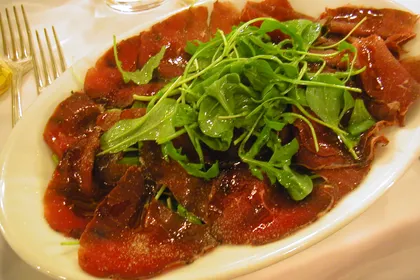
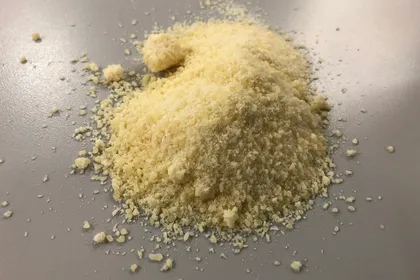
The changes over months are slow and visible. The fat moves from white toward ivory and then yellow as it oxidises and the smell turns nuttier; the lean tightens and small white tyrosine crystals appear in older legs; the salt tastes stronger as water leaves. Sliced ham is the fastest to change, going matte and brick-dark at the edges within an hour of the pack opening, so keep slices layered between paper in the fridge. Freezing makes the fat grainy and is not how it is normally kept.
Spot the real thing
A whole Norcia leg is pear-shaped, heavy, with the trotter removed, and the exposed muscle face is sealed with a dark paste of lard and cracked pepper rather than left bare. Fire-branded into the rind is the IGP mark with the Norcia name. The mountain cure runs longer and drier than the ones on the plain, and it shows in the slice: the lean is a deep brick red rather than pink, the fat is firm and clean white, the aroma is more savoury than sweet, and the salt is more forward. Twelve months is the minimum, and many are older.
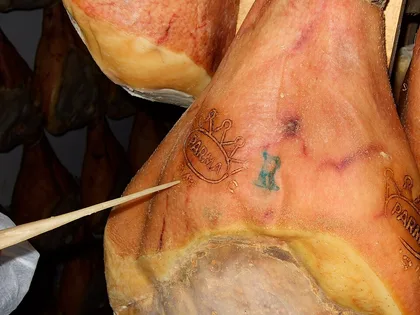
The two Italian hams it sits beside look different once you know where to look. Parma DOP keeps the trotter and carries a five-pointed ducal crown; San Daniele DOP also keeps the trotter and is pressed noticeably flat. Prosciutto sold plain in an American deli is usually domestic and milder. Spanish serrano and jamon come from other breeds and cures. Imported IGP is sold by the hundred grams from a slicer and costs several times the price of a domestic ham.
How to pronounce Prosciutto di Norcia IGP
pro-SHOO-toh dee NOR-chah
The tricky part is Norcia. The 'ci' is soft, as in 'chair', and the final vowel is a short 'ah': 'NOR-chah', never 'NOR-see-ah' or 'NOR-kee-ah'. Prosciutto has a 'sh' sound in the middle and a held double 't': 'pro-SHOO-toh'.
Prosciutto di Norcia IGP compared
vsProsciutto di Parma
The reference point for most people, and the comparison that explains Norcia fastest. Parma ages in the humid hills south of the Via Emilia and is famously sweet, soft and delicate. Norcia ages in real mountains, with cold winters, dry summers and wide temperature swings, which pulls water out faster and leaves a firmer, saltier, more assertive ham. Neither is better; they answer different questions. If you want a ham that disappears on the tongue, buy Parma. If you want one that stands up to bread, cheese and a tannic red, buy Norcia.
| This | Prosciutto di Parma | |
|---|---|---|
| Where it ages | Umbrian mountains, 400–900 m | Emilian hills, 200–400 m |
| Climate | Dry, cold winters, wide day-night swing | Mild, humid, sea breezes from the Ligurian coast |
| Minimum ageing | 12 months | 12 months, commonly 18–24 |
| Shape | Short and pear-shaped | Long, rounded, chicken-thigh profile |
| Surface | Coated in lard and coarse black pepper | Lard paste, little or no pepper |
| Flavour | Savoury, firm, nutty, peppery finish | Sweet, mellow, melting |
| Protection | IGP since 1997 | DOP since 1996 |
| Scale | Hundreds of thousands of hams a year | Millions |
vsProsciutto di San Daniele
San Daniele comes from a single small town in Friuli where Alpine air meets Adriatic humidity, and it is pressed flat during curing, which gives it its guitar shape and its very soft texture. It is the sweetest and most delicate of the three. Norcia is its opposite on every axis except the raw material: drier air, firmer bite, more salt, more aroma.
| This | Prosciutto di San Daniele | |
|---|---|---|
| Region | Umbria, inland mountains | Friuli, foothills near the Tagliamento |
| Pressing | Not pressed | Pressed, hence the flat 'guitar' shape |
| Trotter | Removed | Left on, by regulation |
| Texture | Firm, tight fibre | Very soft, almost buttery |
| Salt | Higher | Lowest of the three |
| Best use | Bread, cheese, bitter greens | On its own, or with melon and figs |
vsJamón serrano
Spain's mountain ham is the closest foreign relative. The name literally means 'from the sierra', and the logic is identical: cold, dry, high-altitude air doing the work. Serrano is usually cured for shorter periods and from white pig breeds, so it is leaner and simpler; jamón ibérico is a different and much fattier animal altogether. A reserva-grade serrano at eighteen months is the nearest thing to Norcia most people can buy easily.
| This | Jamón serrano | |
|---|---|---|
| Country | Italy, Umbrian Apennines | Spain, various sierras |
| Pig | Italian heavy pig, min. 9 months old | White breeds (serrano); Ibérico is separate |
| Ageing | 12 months minimum, often 18–24 | 7–18 months by grade |
| Surface | Lard and black pepper coating | Usually bare, sometimes lard only |
| Flavour | Savoury, nutty, peppery | Salty, drier, less aromatic |
| Price | Higher, smaller production | Lower, industrial scale available |
Prosciutto di Norcia IGP substitutes
- Prosciutto Toscano DOP
The closest Italian match by flavour rather than by geography. Tuscan ham is salted more heavily and rubbed with pepper, garlic and juniper, so it lands in the same savoury, aromatic register. Widely available in Italy and reasonably easy to find abroad.
1:1 - Jamón serrano reserva (18 months)
Easy to buy in almost any supermarket in the US and UK, and genuinely comparable. Choose a longer-aged grade, since young serrano is much simpler. Slightly drier, so serve it with a little more fat on the plate.
1:1 - Prosciutto di Parma
The default substitute and the easiest to source, but expect a sweeter, softer, less peppery result. If the dish relies on the salt of the Norcia (with unsalted bread, or with bitter greens) season slightly more elsewhere to compensate.
1:1 - Presunto or other mountain-cured hams
Portuguese presunto from Chaves, and French jambon de Bayonne, are cured in similar dry upland conditions and reach a similar savouriness. Bayonne is rubbed with piment d'Espelette, which changes the finish but keeps the spiced edge.
1:1 - Pork-free: bresaola or violino di capra
For anyone avoiding pork, air-dried beef or goat leg gives the same salty, thin-sliced, eaten-raw function. Both are far leaner, so add a drizzle of good olive oil to replace the fat that carries the aroma in a prosciutto.
1:1 - Vegetarian: salt-cured and roasted celeriac or aubergine
Nothing replaces cured pork, but for the savoury, salty, thin-sliced role on a board, celeriac salted overnight with pepper and juniper, roasted slowly and chilled, slices thin and carries the same seasoning.
Where to buy it
In the US, Italian importers and better delis carry it, though far less widely than Parma. Check for the fire brand rather than the word 'Norcia' on the label. Prices run 22 to 34 dollars per pound. In the UK, Italian delicatessens and online specialists list it at 32 to 48 pounds per kilo.
Buying whole is only worth it if you can hang it properly: a bone-in leg weighs 8.5 to 11 kilos and needs a cool, dark, ventilated space between twelve and eighteen degrees. Boned and vacuum-packed costs about twenty per cent more per kilo but is far more practical.
Whatever you do, buy it sliced to order rather than in pre-packed trays. Sliced prosciutto oxidises within hours: the fat picks up a rancid note and the edges dry. A hundred grams cut fresh beats half a kilo cut last Tuesday.
Where to eat it in Italy
Norcia itself, a walled town at 600 metres on the edge of the Sibillini mountains. Its norcinerie are the reason the town is known: 'norcino' became the Italian word for pork butcher because butchers from this valley travelled to Rome and across central Italy to work pigs in people's homes. The 2016 earthquake destroyed much of the centre, including the Basilica of San Benedetto, but most of the producers have rebuilt.
The last weekend of February and the first of March bring the black truffle fair, which is the best few days of the year to be there: the same valley produces the prized black truffle, and the two are sold side by side.
Beyond Norcia, the Valnerina villages of Preci, Cascia, Monteleone di Spoleto and Poggiodomo, and the road climbing to Castelluccio at 1,300 metres, where the wildflower bloom across the Piano Grande between late June and mid-July draws photographers from across Europe. Castelluccio lentils and Norcia ham come from the same few kilometres.
Further reading
Frequently asked questions
What is Prosciutto di Norcia?
An Italian dry-cured ham made above 500 metres in five mountain towns of south-eastern Umbria (Norcia, Preci, Cascia, Monteleone di Spoleto and Poggiodomo) aged at least twelve months and protected as an IGP since 1997. It is pear-shaped, weighs at least 8.5 kilos, and carries a coating of lard and coarse black pepper.
How is it different from Parma ham?
Altitude, and therefore climate. Norcia ages in dry mountain air with wide temperature swings, which produces a firmer, saltier, more aromatic ham. Parma ages in humid hills and is sweeter and softer. Norcia is also short and pear-shaped rather than long, and it is the only major Italian prosciutto finished with a heavy pepper coating.
Is Prosciutto di Norcia saltier than other prosciutto?
Yes, noticeably. That is a consequence of the mountain climate and of the curing, not a fault. It is the reason it is traditionally eaten with Umbrian bread, which is baked without salt.
How do you pronounce Norcia?
NOR-chah. The 'ci' is soft as in 'chair' and the final vowel is a short 'ah'. The full name is pro-SHOO-toh dee NOR-chah.
Is it the same as Spanish serrano?
No, but they are cousins. Both are mountain-cured hams dried by cold, dry, high-altitude air. Norcia has a legal minimum of twelve months, a pepper-and-lard coating and a heavier, nuttier profile; serrano varies enormously by grade and is usually leaner and simpler. An eighteen-month reserva serrano is the closest easily available comparison.
Sources
Where to check what you just read.
- 1
Il regolamento del 12 giugno 1997 che registra «Prosciutto di Norcia» come IGP, insieme alla Lenticchia di Castelluccio di Norcia.
- 2
I cinque comuni ammessi (Norcia, Preci, Cascia, Monteleone di Spoleto e Poggiodomo), con il vincolo di lavorare sopra i 500 metri, e le razze suine da cui devono venire le cosce.
- 3Consortium · interested partyConsorzio di Tutela del Prosciutto di Norcia IGP
L'elenco nominativo dei produttori autorizzati, che sono nove, e l'organismo che certifica la denominazione.
Related foods
 Cured meatsProsciutto di ParmaProsciutto di Parma DOP is Italian ham made from three things only: pork, sea salt and at least 400 days.
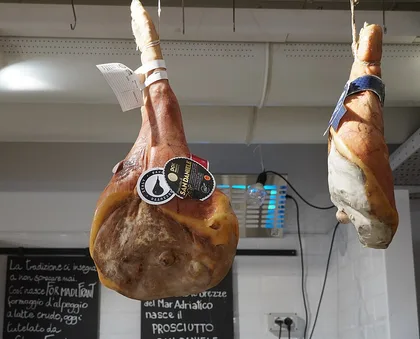 Cured meatsProsciutto di San DanieleProsciutto di San Daniele DOP is made in one town in Friuli from two ingredients: pork leg and sea salt.
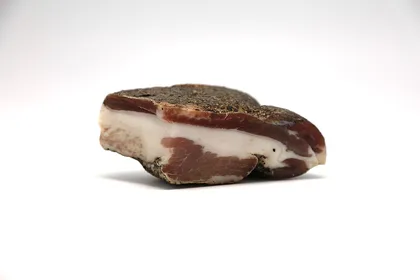 Cured meatsGuancialeGuanciale is cured pork jowl: unsmoked, rubbed with salt and pepper, aged for one to three months.
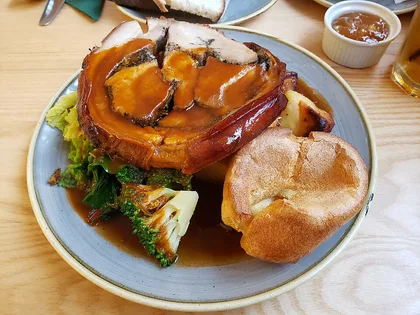 Cured meatsPorchettaSix to eight hours in a wood oven to reach two opposite textures in one piece of meat: skin that shatters…
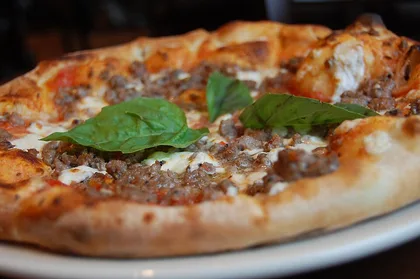 Cured meatsSalsicciaCoarsely ground pork, salt, pepper, wine and usually garlic, packed into natural hog casing and sold raw.
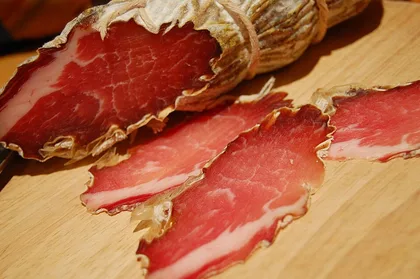 Cured meatsLonzinoLonzino is whole pork loin, dry-salted and air-cured for two to four months: the leanest cut on the animal…Cured meatsSalsiccia di FegatoSalsiccia di fegato is Italian pork liver sausage: coarsely chopped liver, pork fat, salt and spices in…
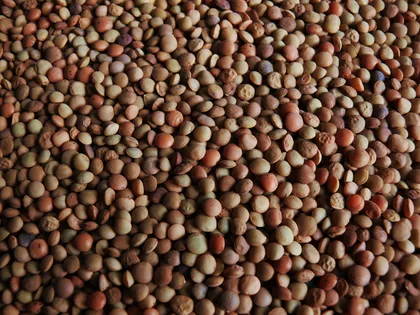 Vegetables and fruitCastelluccio LentilsCastelluccio lentils grow at 1,400 metres on the Pian Grande, a treeless karst plateau inside the Sibillini…