What is Prosciutto di Parma?
Prosciutto di Parma is a dry-cured raw ham produced exclusively in the hills south of Parma, in Emilia-Romagna. Its ingredient list has two entries: pork leg and sea salt. Nothing is smoked, nothing is injected, and no nitrates or nitrites are permitted, a rarity among cured meats sold in the US and UK.
It has held DOP status since 1996; the producers' Consorzio dates to 1963 and Italian legal protection to 1970. A finished bone-in ham weighs 9 to 11 kilos, having lost about a quarter of its green weight to evaporation.
The pigs are Large White, Landrace and Duroc, born and raised in eleven regions of central and northern Italy, slaughtered at a minimum of nine months and 150 kilos. Part of their feed is whey left over from making Parmigiano Reggiano: the two most famous products of the region are literally linked by the same milk.
What does it taste like?
Sweet before salty, which surprises people who know Spanish or American cured hams. The first note is delicate and almost milky, then a slow savoury build, then a nutty finish that lingers longer than the bite lasted. There is no smoke and no sugar cure, so nothing masks the meat.
The texture is the other half of the story. A properly cut slice is silky and slightly moist, and the ribbon of fat along the edge melts at body temperature: it should dissolve on the tongue rather than chew. That fat is where most of the aroma lives, which is why removing it is a mistake.
Longer ageing shifts the balance. At 18 months it is soft and gentle; at 24 to 30 months it turns denser and more concentrated, with small crunchy white specks of tyrosine crystals and a flavour closer to aged cheese.
How to use it
Serve it at room temperature: out of the fridge twenty to thirty minutes before eating. Cold prosciutto tastes of almost nothing, because the fat that carries the aroma has not softened.
Do not cook it for long. Heat drives off the fat and concentrates the salt, which is exactly what you paid to avoid. If it must meet heat, let it meet heat last: draped on a risotto after mantecatura, laid on a pizza the moment it leaves the oven, wrapped around asparagus after roasting.
The classic pairings are classic because they work: melon, ripe figs, good butter and bread, or Parma's own version, hot fried dough (torta fritta or gnocco fritto) with the slices laid over so they warm and go translucent.
Buy it sliced to order if you can, and eat it the same day. Ask for it cut thin enough to be flexible but not transparent; slices that tear are cut wrong.
How long it keeps
A whole started ham stays in a cool, dry room rather than the fridge, its cut face covered with greaseproof paper and the trimmed fat cap laid back over it. Take a thin slice off the face before each session, because the exposed edge dries and darkens within a day. A ham once opened is normally worked through over a few weeks, and it keeps losing water the whole time, so the last slices are drier and more concentrated than the first.
Sealed packs of pre sliced ham keep in the fridge to the date printed on them, and the usual instruction once opened is two days. Thin slices meet a great deal of air: the red fades towards orange at the edges and the fat picks up an oxidised smell. Ham sliced to order at a counter is the most delicate of all. Buy it for the same day, leave it in its paper, keep it on the least cold shelf and take it out half an hour before serving. Freezing costs texture: ice crystals break the fat structure and thawed slices come out watery and loose.
Spot the real thing
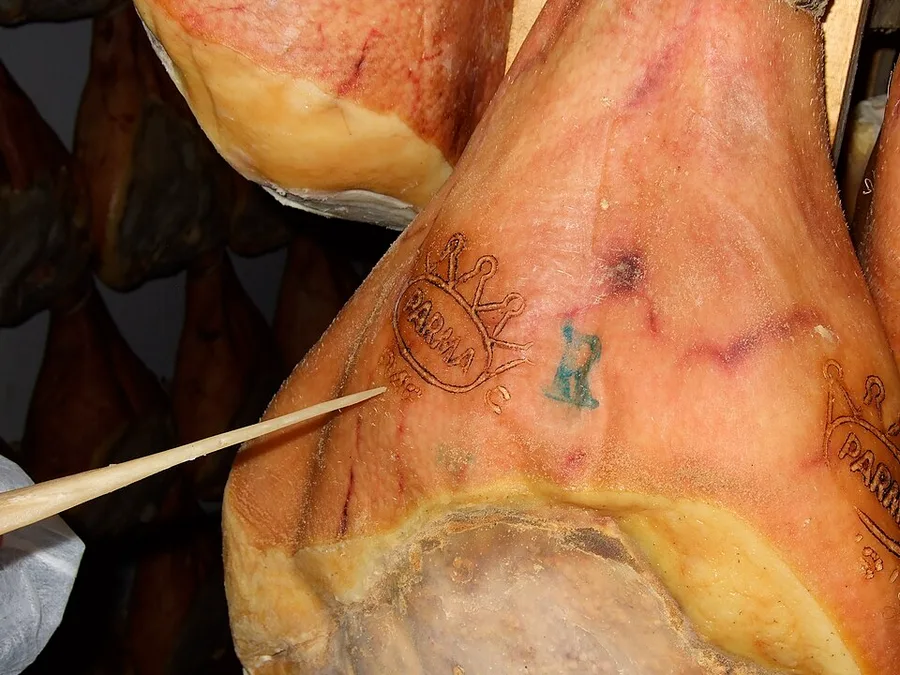
The five pointed ducal crown with the word PARMA is branded into the rind, and it is the only mark that settles the question. On a pre sliced pack or a boneless block the crown may not be visible, so look for the Consorzio logo printed on the packaging together with the number of the producing plant. In American delis, prosciutto on its own usually means a domestic ham, younger and distinctly saltier. In British shops Parma ham is the same product under its English name.
Cut, the lean is an even rosy red and the fat is pure white with a pink cast, never yellow. A band of fat about a centimetre wide should run along the edge, and trimming it away removes the part that carries the aroma. On long aged hams the tiny white crunchy specks are tyrosine crystals thrown out during ageing, not salt and not mould. A good slice is thin but not transparent and stands up on its own for a moment before folding. San Daniele, its usual neighbour on the counter, is sweeter and keeps the trotter attached.
How to pronounce Prosciutto di Parma
pro-SHOOT-toh dee PAR-mah
The 'sci' is a 'sh' sound, and the double 't' is held slightly: 'pro-SHOOT-toh', not 'pro-SHOO-toe'. The Italian-American 'pruh-ZOOT' or 'bruh-zhoot' is a real southern-Italian dialect form, not an error, but it is not how it is said in Parma. Parma is 'PAR-mah', stress on the first syllable.
Prosciutto di Parma compared
vsProsciutto di San Daniele
Italy's other great raw ham, from Friuli in the north-east. San Daniele keeps the trotter attached and is pressed flat during curing, giving it the distinctive guitar shape; Parma is trimmed round and unpressed. San Daniele is generally sweeter and softer, Parma slightly drier and more savoury. Both use only pork and sea salt. Parma produces roughly three times the volume, so it is far easier to find abroad.
| This | Prosciutto di San Daniele | |
|---|---|---|
| Region | Emilia-Romagna, south of Parma | Friuli-Venezia Giulia, San Daniele del Friuli |
| Shape | Rounded, trotter removed | Flattened guitar shape, trotter left on |
| Minimum ageing | 400 days from salting | 13 months |
| Flavour | Sweet-savoury, nutty finish | Softer, sweeter, more delicate |
| Ingredients | Pork, sea salt | Pork, sea salt |
| Availability abroad | Widespread | Specialist delis |
vsJamón Serrano
Spain's everyday cured ham, and the closest price competitor on a US or UK deli counter. Serrano comes from white pig breeds, is cured 12 to 24 months, and tastes drier, saltier and more mineral than Parma, with a firmer chew. It is usually cheaper and it holds up better to cooking: where Parma is a waste of money, Serrano is a reasonable ingredient.
| This | Jamón Serrano | |
|---|---|---|
| Country | Italy, Parma only | Spain, many regions |
| Pig | Italian heavy pigs, min 9 months | White breeds, typically younger |
| Cure | Sea salt only | Salt, often with nitrite/nitrate |
| Flavour | Sweet, milky, nutty | Saltier, drier, more mineral |
| Texture | Silky, melting fat | Firmer, chewier |
| Price | Higher | Typically 30-50% less |
vsJamón Ibérico de Bellota
Not a competitor so much as a different luxury. Ibérico de bellota comes from black Iberian pigs finished on acorns, and the fat is unsaturated enough to look almost liquid at room temperature. It tastes nuttier, gamier and more intense than Parma, and costs two to four times more. Parma is the more versatile ham; bellota is the one you serve alone and say nothing else.
| This | Jamón Ibérico de Bellota | |
|---|---|---|
| Pig | Large White, Landrace, Duroc | Black Iberian, acorn-finished |
| Fat | Firm, white, melts on the tongue | Soft, glossy, almost oily at room temp |
| Flavour | Sweet and clean | Nutty, gamey, long and intense |
| Ageing | 400 days minimum | 36-48 months typical |
| Price per kg | High | Two to four times higher |
vsAmerican-made 'prosciutto'
US producers sell domestic dry-cured hams under the word prosciutto, since the term is not protected in the United States the way the DOP name is. They are typically cured for 10 to 14 months, often with added nitrites and sometimes sugar, and sliced thicker. Perfectly good food, materially different product. The check is simple: genuine Parma always carries the ducal crown and the Consorzio mark on the pack.
| This | American-made 'prosciutto' | |
|---|---|---|
| Name protection | DOP, legally defined | Generic term in the US |
| Curing agents | Sea salt only | Salt, usually nitrite, sometimes sugar |
| Ageing | 400 days minimum | Often 10-14 months |
| Mark | Fire-branded ducal crown | Brand label only |
Prosciutto di Parma substitutes
- Prosciutto di San Daniele
The nearest possible substitute: same category, same two ingredients, slightly sweeter and softer. Use it anywhere Parma is called for without adjusting anything.
1:1 - Jamón Serrano
Saltier and firmer. Fine wrapped around melon or figs, but cut back any additional salt in the dish and slice it a touch thinner to compensate for the tougher chew.
1:1, with less added salt - Speck Alto Adige
Also Italian, also DOP, but lightly smoked and boned before curing. It brings smoke that Parma never has, so use it where that is welcome (with rye bread, apples, mountain cheese) and not with melon.
1:1 - Culatello di Zibello
Made in the misty lowlands north of Parma from the heart of the same leg, aged in cellars rather than airy lofts. Rarer, more expensive, more perfumed. An upgrade rather than a substitute, and hard to find outside Italy.
1:1 - Bresaola (pork-free)
Air-dried salted beef from Valtellina, the standard choice for anyone avoiding pork. Far leaner, so dress it with olive oil, lemon and rocket to make up for the missing fat.
1:1 by weight, plus a spoon of olive oil - Vegetarian: aged pecorino or ricotta salata shavings
Nothing replicates cured ham, but on melon, figs or a summer salad the job Parma does is salt-and-fat against sweetness. Thin shavings of a 12-month pecorino or crumbled ricotta salata do that job honestly.
Where to buy it
In the US, Prosciutto di Parma is one of the easiest Italian DOP products to find. Whole Foods, Costco and most supermarket deli counters carry it; Eataly and Italian delis will slice it to order. Expect roughly 28 to 45 dollars per pound sliced at a counter, or 15 to 22 dollars per pound if you buy a whole boneless leg, which Costco has stocked seasonally.
In the UK, Waitrose, Ocado and Italian delicatessens carry it at about 45 to 70 pounds per kilo sliced, or 3.50 to 6 pounds for a 70-100 g pack. Borough Market and Lina Stores in London slice it fresh.
In Italy, 26 to 34 euros per kilo at 18 months, 38 to 48 at 24 to 30 months.
Whatever the country, check the pack for the Consorzio's five-pointed ducal crown and the wording Prosciutto di Parma DOP. 'Italian-style prosciutto' or plain 'prosciutto' means the protected name does not apply.
Where to eat it in Italy
Langhirano, twenty minutes south of Parma, is the curing capital and holds the Festival del Prosciutto di Parma each September, including the 'Finestre Aperte' days when the curing houses open to visitors. It is the one time of year you can walk between the hanging rows.
In Parma itself, order it in a prosciutteria with torta fritta, puffed squares of fried dough, still hot, with the slices laid on top, and a glass of dry sparkling Malvasia dei Colli di Parma. It is an afternoon thing, eaten standing at the counter.
The Musei del Cibo network keeps a prosciutto museum at Langhirano and a salame museum at Felino, twenty minutes apart. Pair either with an early-morning Parmigiano Reggiano dairy visit: production starts around 6.30 am, and the whey that comes off it is what fed the pigs.
Recipes with it
Further reading
 InvestigationItalian sounding: what is it really worth?Sixty billion, then a hundred, then a hundred and twenty, then forty-two.
 GuideHow long food keeps once openedThe date on the label describes the sealed package. After that, four things govern everything: water, salt…
 InvestigationProtected names vs common names: PDO and PGIEuropean protection attaches to a name in full, and that name is almost always longer than the one used at…
Frequently asked questions
What is the difference between Prosciutto di Parma and San Daniele?
Both are Italian DOP raw hams made only from pork and sea salt. Parma comes from the hills south of Parma in Emilia-Romagna and is trimmed round; San Daniele comes from Friuli, keeps its trotter and is pressed flat. San Daniele is a little sweeter and softer, Parma a little drier and more savoury.
Is prosciutto raw?
It is uncooked but not raw in the risky sense: it is cured, meaning salted and aged for well over a year, which makes it safe to eat as is. 'Prosciutto crudo' means cured; 'prosciutto cotto' is the cooked pink ham, a different product entirely.
How do you pronounce prosciutto di Parma?
pro-SHOOT-toh dee PAR-mah. The 'sci' is 'sh', the double 't' is held, and the stress falls on the second syllable of prosciutto and the first of Parma.
Can you cook with Prosciutto di Parma?
You can, but you usually shouldn't. Prolonged heat burns off the delicate fat and leaves salt behind. Add it at the very end (over a finished risotto, on a pizza out of the oven) or use Serrano or the ham's end trimmings when a recipe genuinely needs cooked ham.
Does Prosciutto di Parma contain nitrates or gluten?
Neither. The DOP rules allow only pork and sea salt, with no nitrates, nitrites, preservatives or smoke, and no gluten-containing ingredients. Watch for pre-sliced packs from other producers labelled simply 'prosciutto', which may be cured differently.
Sources
Where to check what you just read.
- 1
L'allegato del 12 giugno 1996 dove «Prosciutto di Parma» compare fra le DOP: accanto a San Daniele e Modena, che sono denominazioni separate.
- 2
Il disciplinare in PDF: razze suine e regioni di allevamento ammesse, peso minimo della coscia, mesi minimi di stagionatura e divieto di conservanti.
- 3Consortium · interested partyConsorzio del Prosciutto di Parma
Il consorzio che appone la corona ducale: quando il marchio viene impresso e quali prosciutti restano esclusi dopo il controllo finale.
Related foods
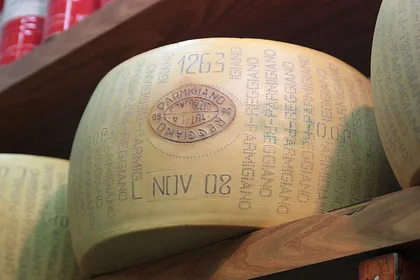 CheeseParmigiano ReggianoThree ingredients and no additives of any kind are permitted: raw cow's milk, salt and calf rennet, from five…
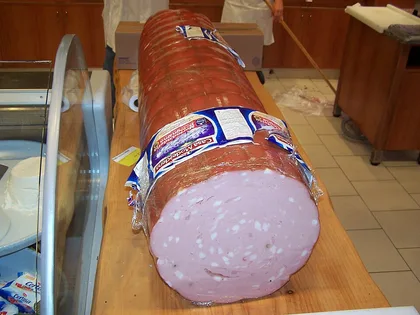 Cured meatsMortadellaThe white cubes are not just any fat: they are jowl, the firmest part of the pig, and they stay whole…
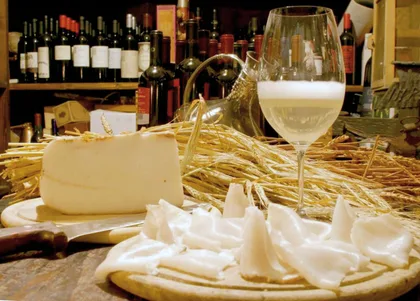 Cured meatsLardo di ColonnataLardo di Colonnata IGP is cured pork back fat, aged at least six months inside vats carved from Carrara…Cured meatsPancettaPancetta is Italian cured pork belly: salt, pepper and warm spices, dried for months, never smoked.
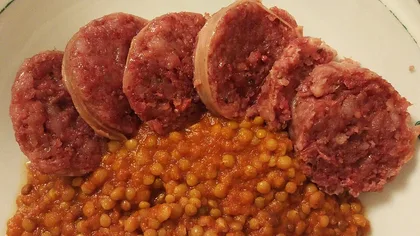 Cured meatsCotechinoCotechino is a large fresh pork sausage from Emilia-Romagna, made with pork meat, fat and rind, and always…
 Cured meatsZamponeZampone Modena IGP is spiced pork and rind forcemeat stuffed into a boned pig's trotter: same filling as…
 Cured meatsCulatello di ZibelloCulatello di Zibello is the heart muscle of a pork leg, boned out, sewn into a pig's bladder, tied by hand…
 Cured meatsSalame FelinoSalame Felino IGP comes from a village of four thousand people in the hills above Parma.