What is Parmigiano Reggiano?
Parmigiano Reggiano is a hard, cooked, slowly ripened cheese made from raw cow's milk: evening milk left to let the cream rise, skimmed and combined with whole morning milk in copper vats. There are no additives, no preservatives and no colourings: only milk, salt and natural calf rennet. That purity is why the specification bans silage and any fermented feed from the cows' diet.
A wheel weighs at least 30 kilos and usually 38 to 40, and takes around 550 litres of milk, roughly sixteen litres for every kilo of finished cheese. Minimum ageing is twelve months, but the standard commercial ages are 24, 30 and 36 months.
The zone has not changed in centuries: the provinces of Parma, Reggio Emilia and Modena in full, the part of Bologna west of the Reno river and the part of Mantua south of the Po. Boccaccio described it in the Decameron in 1349, in a passage about a mountain of grated parmigiano used to dress pasta.
What does it taste like?
Savoury depth first: the flavour scientists call umami, and Parmigiano has more free glutamate than almost any other food. Underneath that sit brown butter, toasted hazelnut, dried pineapple and a long beef-broth finish. Salt is present but restrained, around 1.4%, which surprises people who arrive expecting Pecorino-level intensity.
The texture is hard, dry and granular, splitting into irregular shards rather than slicing, and from eighteen months onwards it is dotted with crunchy white tyrosine crystals that read as tiny bursts of savoury crunch.
Age changes it substantially. Twelve to eighteen months is milky, yoghurt-tangy and comparatively soft. Twenty-four is the balanced classic. Thirty and thirty-six are drier, spicier and fruitier. Past forty months it becomes crumbly and almost peppery, a cheese for tasting rather than grating.
How to use it
Buy a wedge with the rind on and grate to order. Pre-grated Parmigiano loses most of its aroma within days of opening, and the pre-grated tubs sold as 'Parmesan' abroad are frequently a different cheese entirely.
Use 12 to 18 months for shaving raw over salads, carpaccio and vegetables. Use 24 months for cooking: grated over tagliatelle, stirred into risotto at the mantecatura, folded into pasta fillings, whisked into a crema di parmigiano. For that cream, heat milk or cream to about 80°C, take it off the heat and stir in the grated cheese, because boiling makes it split.
From 30 months upwards, stop cooking with it. Break it into irregular shards with an almond-shaped knife and serve it with traditional balsamic vinegar, honey, pears and walnuts.
Save every rind. Scraped clean and dropped into minestrone or a bean soup, it releases flavour for an hour and is good to eat afterwards.
How long it keeps
A vacuum pack keeps in the fridge at 4 to 8 C until the date on the label. Once it is open, wrap the wedge in a barely damp cloth and then in greaseproof paper, or keep it in a rigid box that is not airtight. Cling film laid straight against the cheese makes it sweat and a wet sheen builds on the surface inside a week. A piece that still has its rind holds around three months at fridge temperature.
What changes over those months is water. The cut face dries, goes glassy and darkens at the edge, and that skin comes away with a scrape of the knife before you use the rest. Dry bloom on the rind itself lifts with a cloth dipped in vinegar; anything else on the surface is a question for the shop that sold it and for the date on the pack. It freezes in 200 to 300 g portions for about six months and comes back more crumbly, which is why thawed pieces are better grated than served in shards. Rinds, scraped clean, sit in the freezer indefinitely and go into soup.
Spot the real thing
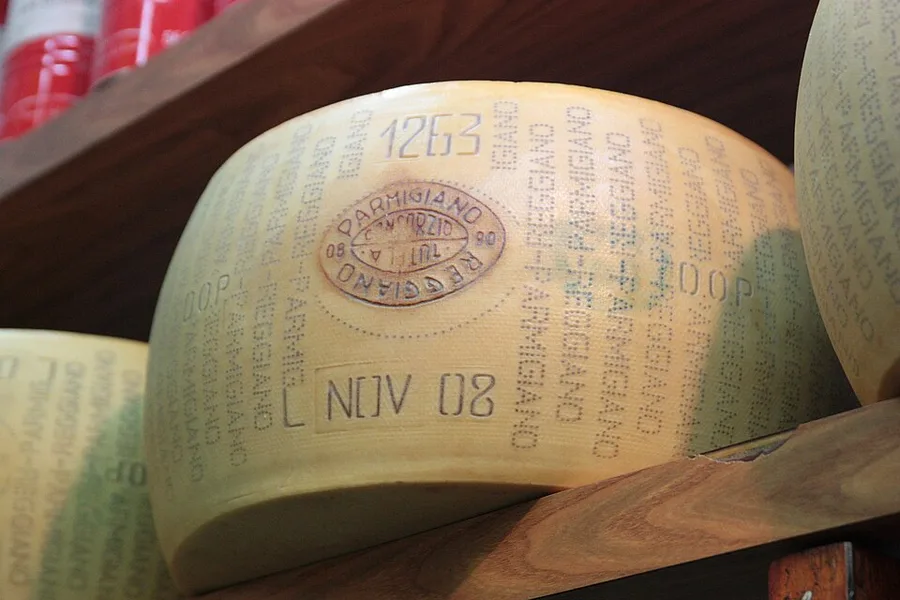
Everything you need is pressed and burned into the rind. Around the whole heel the words PARMIGIANO-REGGIANO appear in pin dots, repeated over and over, alongside the month and year of production, the registration number of the dairy, a casein plaque carrying the unique code of that wheel, and the oval fire brand added only after the inspection, which comes at around twelve months. On a wedge cut abroad you should still see a stretch of that dotted rind: a rindless block, or a rind with nothing on it, is another cheese. Ask the counter for the age in months rather than accepting the word aged.
The paste is straw yellow and breaks into granular flakes instead of slicing clean, with white tyrosine crystals often visible in older wheels. It should smell of melted butter, nuts and meat broth. What it gets confused with abroad is the word parmesan, which outside the EU is generic: shaker tubs and pre-grated bags can be domestic hard cheese, sometimes with cellulose added to stop caking, and the label says which. Grana Padano is its closest protected relative, milder and cheaper.
How to pronounce Parmigiano Reggiano
par-mee-JAH-noh reh-JAH-noh
Seven syllables, stress on the third of each word. Both 'gi' and 'ggi' make a soft 'j' as in 'jam', never a French 'zh' and never a hard 'g'. The double 'gg' in Reggiano is held slightly longer than a single one. Common errors are 'par-mi-ZHAH-no' and 'par-mi-GEE-ah-no'. Italians shorten it in speech to 'parmigiano'; nobody says 'parmesan' in Italy.
Parmigiano Reggiano compared
vsGrana Padano
The two look alike and behave alike, and the differences are all in the rulebook. Parmigiano ages longer, forbids silage in the cows' feed, and permits no additive of any kind; Grana Padano starts at nine months, allows silage and allows egg-derived lysozyme. Parmigiano tastes deeper and longer; Grana Padano is milder and around a third cheaper.
| This | Grana Padano | |
|---|---|---|
| Zone | Parma, Reggio Emilia, Modena, part of Bologna and Mantua | 32 provinces across 5 regions of the Po Valley |
| Minimum ageing | 12 months | 9 months |
| Cow feed | No silage, no fermented feed | Silage permitted |
| Additives | None: milk, salt, calf rennet only | Lysozyme from egg white permitted |
| Milk per wheel | About 550 litres | About 500-550 litres |
| Flavour | Deep umami, nutty, long, crystalline | Milder, sweeter, shorter finish |
| Egg allergen | None permitted | Possible, must be declared |
| Annual production | About 4 million wheels | About 5 million wheels |
| Price | $18-30 per lb | $10-18 per lb |
vs'Parmesan' (US and generic)
In the EU, 'Parmesan' is legally reserved to Parmigiano Reggiano following a 2008 European Court of Justice ruling. In the United States it is a generic name for any hard grating cheese, with a federal standard of identity requiring only ten months of ageing. Shaker Parmesan is usually a domestic cheese with cellulose added to stop it caking.
| This | 'Parmesan' (US and generic) | |
|---|---|---|
| Legal meaning | Protected DOP, traceable to the individual wheel | Generic in the US; reserved to Parmigiano in the EU |
| Where made | Five provinces of northern Italy | Wisconsin, California, Argentina, anywhere |
| Milk | Raw, from cows fed no silage | Usually pasteurised, no feed rules |
| Ingredients | Milk, salt, calf rennet | Often includes cellulose, potassium sorbate, anti-caking agents |
| Minimum ageing | 12 months, verified by hammer inspection | 10 months under US standard, often less in practice |
| Flavour | Complex, sweet-savoury, long | Salty, flat, sometimes chalky |
| Price | $18-30 per lb | $6-14 per lb |
vsPecorino Romano
The other great Italian grating cheese, and not a substitute. Pecorino Romano is sheep's milk, dry-salted to around 5% salt and sharply piquant; Parmigiano is cow's milk, brine-salted to 1.4% and savoury-sweet. Swapping them without adjusting the salt is the most common mistake in Italian home cooking abroad.
| This | Pecorino Romano | |
|---|---|---|
| Milk | Cow, raw, partly skimmed | Whole sheep's milk |
| Salting | Brine, 20-25 days | Dry salt rubbed by hand, 80-100 days |
| Salt content | About 1.4% | About 5% |
| Rennet | Calf rennet | Lamb rennet paste |
| Flavour | Nutty, sweet, deeply savoury | Salty, sharp, piquant |
| Classic dishes | Risotto, tortellini in brodo, tagliatelle, board | Cacio e pepe, carbonara, amatriciana |
vsParmigiano 24 months vs 36 months
The choice most shoppers actually face. Twenty-four months is the balanced everyday wheel, still moist enough to grate cleanly; thirty-six is drier, spicier and more crystalline, and is wasted in a sauce. Buy 24 for cooking and 36 for the board.
| This | Parmigiano 24 months vs 36 months | |
|---|---|---|
| Texture | Firm, grates finely, some crystals | Dry, crumbly, heavily crystalline |
| Flavour | Balanced: milk, nut, broth | Spice, dried fruit, pronounced piquancy |
| Best for | Grating, risotto, fillings, everyday | Cheeseboard, shards with balsamic, tasting |
| Melting | Melts smoothly into sauces | Tends to stay grainy |
| Price | $18-24 per lb | $26-34 per lb |
Parmigiano Reggiano substitutes
- Grana Padano
The standard everyday replacement and the one Italians themselves use for cooking. Milder and less salty, so where the cheese is the main flavour you may want a little more, or an Oltre 16 Mesi wheel.
1.2:1 - Trentingrana
Grana Padano made in Trentino under stricter rules: no silage, no lysozyme, usually over twenty months. The closest thing to Parmigiano at a lower price, and free of egg derivatives.
1:1 - Piave Vecchio
A Veneto cow's milk hard cheese, sweeter and milkier than Parmigiano but with a similar granular structure. Grates cleanly and is excellent on a board in its own right.
1:1 - Pecorino Romano
Use only with adjustment. Roughly three times as salty and much sharper: halve the quantity and remove salt elsewhere in the dish, including the pasta water.
0.5:1, with no added salt - Vegetarian: Twineham Grange or supermarket Italian-style hard cheese
Parmigiano Reggiano can never be vegetarian: the specification requires natural calf rennet with no alternative permitted. Twineham Grange, made in Sussex with microbial rennet, is the established British substitute, and Sainsbury's, Tesco, Waitrose and Whole Foods all sell an own-label vegetarian Italian-style hard cheese that grates identically.
1:1 - Vegan: cashew and nutritional yeast, or a fermented almond wheel
Blitz 100 g cashews with 3 tablespoons nutritional yeast, half a teaspoon of salt and a pinch of garlic powder to a sandy crumb, good scattered over finished pasta. For something closer to the real texture, aged almond-based wheels from Miyoko's or Nuts for Cheese grate and shave.
Where to buy it
In the US, Costco, Whole Foods, Wegmans, Eataly and Italian delis all carry it, at roughly $18-30 per pound depending on age. Costco's Kirkland wedge is genuine DOP and is usually the best value in the country. Avoid anything labelled simply 'Parmesan' or 'Parmesan cheese': in the US that is a generic name and means nothing about origin.
In the UK, all major supermarkets carry it at about £22-40 per kilo, and 'Parmesan' on a UK label legally means Parmigiano Reggiano.
The rind carries the entire identity: dotted pin writing reading PARMIGIANO-REGGIANO all around the heel, the month and year of production, the dairy's registration number, a casein plate with the wheel's unique code, and an oval fire brand applied only after the twelve-month hammer inspection. Wheels that failed inspection have those marks stripped or scored with parallel grooves.
Ask for the exact age rather than accepting 'aged'. Two labels worth paying more for: Prodotto di Montagna, from mountain dairies above 600 metres, and Vacche Rosse, made from the milk of the Reggiana red breed alone and aged at least twenty-four months.
Where to eat it in Italy
The dairies themselves. Around fifty caseifici across Parma, Reggio Emilia and Modena take visitors in the early morning, when the curd is broken at about half past six. The local tourist consortia handle bookings, and a visit usually ends with a tasting of three different ages.
The Museo del Parmigiano Reggiano at Soragna, in the province of Parma, sits inside a nineteenth-century dairy. Bibbiano, in the Reggio hills, claims to be the cheese's birthplace and its cooperative dairy is a standard stop.
In September the Caseifici Aperti weekends open the whole zone to free visits. And in the covered markets of Parma and Modena you can taste twelve, twenty-four, thirty-six and sixty months in sequence at a single counter, which teaches more in ten minutes than any amount of reading.
Recipes with it
Further reading
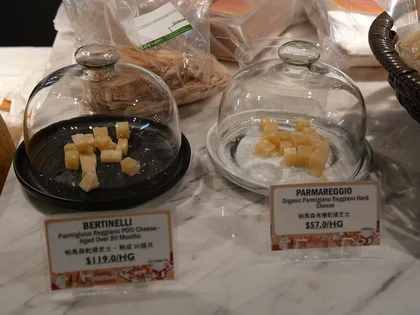 ExplainerParmesan vs Parmigiano Reggiano: the differenceIn Europe «parmesan» evokes a protected designation and cannot be used for anything else.
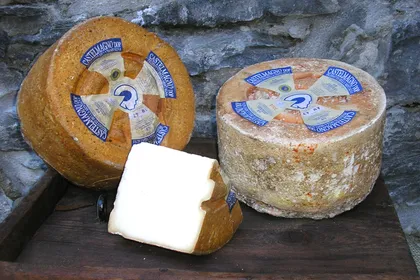 InvestigationItalian raw milk cheeses: the full listWe counted: 19 of 43 declare raw milk, and 16 of those 19 carry a protected designation.
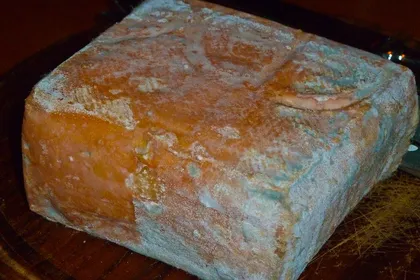 GuideCan you eat cheese rind?On some wheels the rind is the same paste, dried out. On others it is paraffin.
Frequently asked questions
Is Parmigiano Reggiano the same as Parmesan?
In the European Union, yes: a 2008 court ruling reserved the word Parmesan to Parmigiano Reggiano. In the United States, no: 'parmesan' is a generic name for any hard grating cheese and most of it is domestic.
Is Parmigiano Reggiano vegetarian?
No, and it cannot be. The specification requires natural calf rennet and permits no microbial alternative. Vegetarians should look at Twineham Grange or a supermarket vegetarian Italian-style hard cheese instead.
Does Parmigiano Reggiano contain lactose?
Effectively none. After twelve months of ageing the lactose has been entirely consumed by lactic bacteria, and the Consorzio classifies the cheese as naturally lactose-free. Most people with lactose intolerance tolerate it without trouble.
What are the crunchy white crystals?
Tyrosine, an amino acid that precipitates during long ripening. They appear from around eighteen months and indicate a properly aged wheel: they are not salt and not a defect.
Which age should I buy?
Twelve to eighteen months for shaving over salads, twenty-four for everyday cooking, thirty or thirty-six for a cheeseboard. Beyond forty months it is a tasting cheese, too dry and too expensive to grate into a sauce.
Sources
Where to check what you just read.
- 1
L'atto del 12 giugno 1996 che porta «Parmigiano Reggiano» nel registro europeo: la grafia esatta protetta, quella che «parmesan» non può usare.
- 2
Il disciplinare in PDF: alimentazione delle bovine, divieto di additivi, mesi minimi di stagionatura e province della zona di origine.
- 3Consortium · interested partyConsorzio del Formaggio Parmigiano Reggiano
L'ente di Reggio Emilia che gestisce marchiatura ed espertizzazione: qui si controllano i caseifici aderenti e il significato dei marchi a fuoco.
Related foods
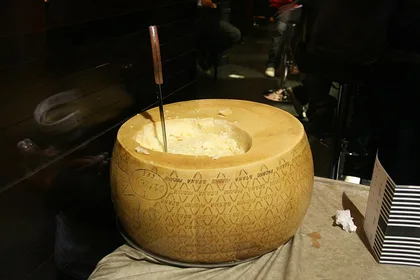 CheeseGrana PadanoNine months is the floor the specification sets before a wheel may carry the name.
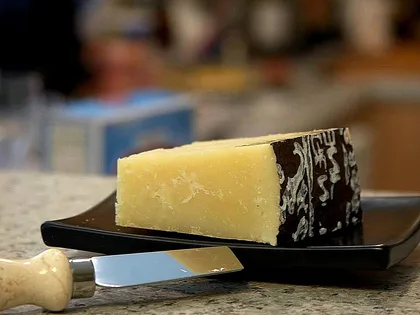 CheesePecorino RomanoPecorino Romano DOP is a hard, dry-salted sheep's milk cheese aged at least five months, made in Sardinia…
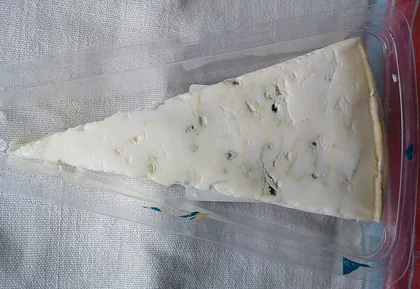 CheeseGorgonzolaThe green veining is the product, not a flaw anyone tolerates: it grows from a mould added to the milk and…
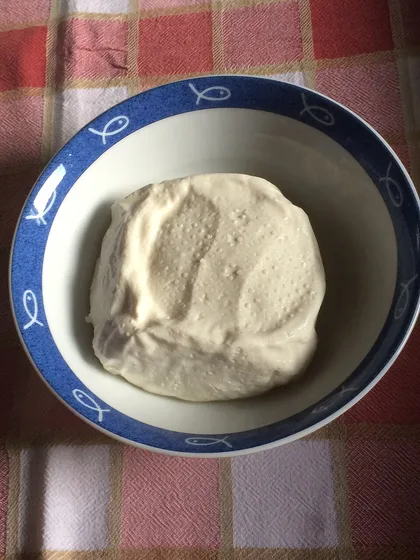 CheeseSquacquerone di RomagnaSquacquerone di Romagna DOP is a fresh cow's milk cheese so soft it cannot hold a shape: it takes the form of…
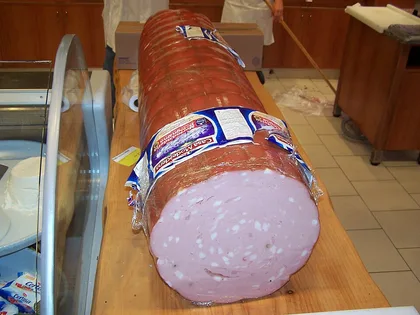 Cured meatsMortadellaThe white cubes are not just any fat: they are jowl, the firmest part of the pig, and they stay whole…Cured meatsPancettaPancetta is Italian cured pork belly: salt, pepper and warm spices, dried for months, never smoked.
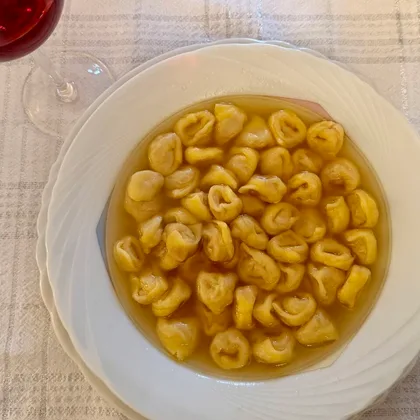 Pasta and breadTortelliniTortellini are tiny ring-shaped egg pasta parcels filled with pork, prosciutto, mortadella and Parmigiano…
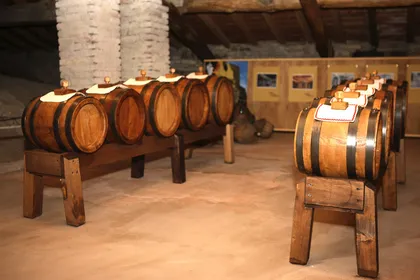 Oil and preservesBalsamic VinegarTwo different products share the name. Traditional Balsamic Vinegar DOP is cooked grape must aged at least…