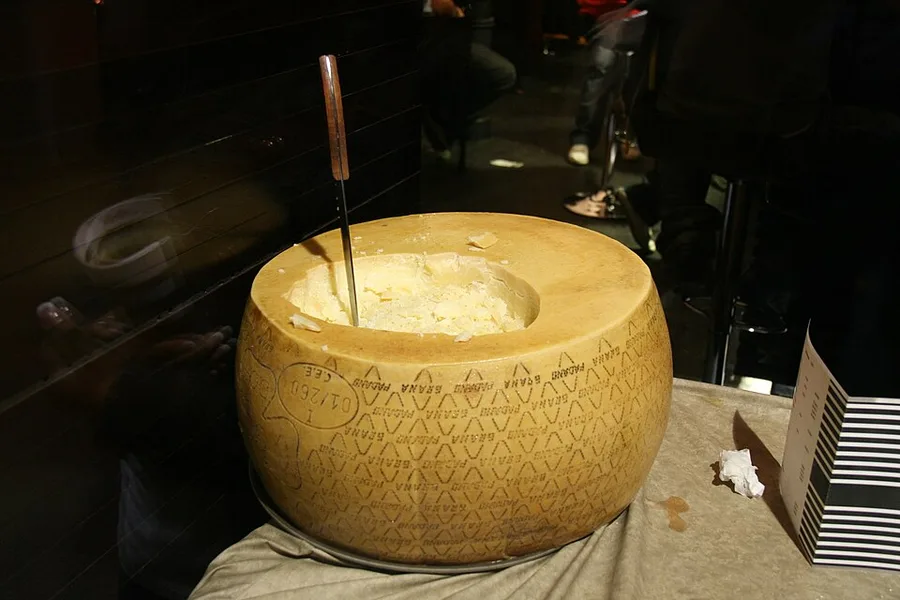
What is Grana Padano?
Grana Padano is made from raw cow's milk, partly skimmed by letting the cream rise naturally, cooked in copper vats and pressed into wheels of 24 to 40 kilos. The name is descriptive: grana means grainy, for the flaking, crystalline structure the paste develops, and padano refers to the Po Valley plain where it is made, across thirty-three provinces in Piedmont, Lombardy, Veneto, Trentino and Emilia-Romagna, plus five municipalities in the province of Bolzano.
The minimum age is nine months. Riserva is reserved for wheels of at least twenty months that pass the Consorzio's inspection, in which an expert taps the wheel with a small hammer and listens to the internal structure, and its labels read «Riserva Oltre 20 Mesi» or «Riserva Oltre 24 Mesi». From twelve months, packs may state the age as «oltre», meaning over, a given number of months.
In 2025 its makers produced 6,053,690 wheels, against 4,189,945 of Parmigiano Reggiano. The consortium traces its origins to the Cistercian monks of Chiaravalle, outside Milan.
What does it taste like?
Mild, milky and gently sweet, with a nuttiness that builds with age and a savoury finish that stops well short of Parmigiano's. At nine to sixteen months it is soft-flavoured enough to disappear into a dish, which is exactly what most cooking wants. At twenty months and beyond it develops brown-butter and dried-fruit notes and a crumbly, crystalline texture.
The texture is grainy rather than smooth: it fractures into irregular shards, never slices cleanly, and by sixteen months is studded with crunchy tyrosine crystals.
Set against Parmigiano Reggiano, the honest summary is less of everything: less salt, less depth, less length on the palate, and less complexity. That is not always a drawback. In a delicate risotto or a béchamel, Parmigiano can dominate where Grana Padano supports.
How to use it
Buy a wedge with rind attached and grate it as you need it. Pre-grated Grana Padano loses aroma within days of opening and often costs more per kilo than a whole piece.
Use the nine-to-sixteen-month for cooking: grated over pasta, stirred into risotto at the end, folded into béchamel, meatballs and fillings. Its mildness is the point: in an asparagus risotto or a pumpkin soup, Parmigiano can bully the other flavours while Grana Padano stays underneath them. Save the older wheels and the Riserva for the board, shaved with traditional balsamic vinegar, honey or mostarda.
Never throw away the rind. Scrape it clean and drop it into a minestrone or a bean soup, where it releases flavour for a good hour, or roast it in a hot oven until it puffs.
How long it keeps
An unopened vacuum-sealed wedge keeps in the refrigerator to the date on the pack, typically some months out. Once you break the seal, the wrapping matters more than the temperature: a barely damp cloth next to the cheese, then parchment or waxed paper, then the vegetable drawer, or a rigid box that is not airtight. Plastic film pressed directly on the surface works for a few days and after that the cheese sweats against it. Handled that way a wedge holds two to three months. Grated cheese, whether you grate it yourself or buy it in a tub, dries out within days.
What changes is water. The cut faces dry first, going glassy and darker, and that skin is normally scraped off before grating; the wedge as a whole loses weight, hardens and tastes more concentrated and saltier. Older cheese crumbles rather than flakes. Freezing in 200 to 300 gram portions works for about six months, though the paste comes out more friable and suits the grater rather than the table. Rinds freeze well and go into soup. Past the printed date, refer to it and to the dairy.
Spot the real thing
Look at the rind first. A genuine wedge carries the dotted diamonds with GRANA PADANO repeated across the whole curved edge, pressed in by marking bands before salting, plus a branded four-leaf clover with the province initials and the dairy number, added once the wheel has reached its minimum age. A casein plaque with an alphanumeric code identifies the individual wheel. The paste is pale straw, finely granular, and it fractures into irregular flakes; anything that cuts into bendy slices is a different cheese. From sixteen months on you get crunchy white tyrosine crystals.
Outside Italy the near-miss is usually wording rather than a lookalike wheel: Italian hard cheese, grana-style, or plain parmesan on a domestic block or a shelf-stable shaker. Grated Grana Padano DOP always shows the Consortium mark and states the rind content, which is capped at eighteen per cent. Parmigiano Reggiano is a separate DOP with its own rind stamping and usually costs several dollars a pound more, so a wedge priced well below both is telling you something.
How to pronounce Grana Padano
GRAH-nah pah-DAH-noh
Five syllables, stress on the first of 'grana' and the second of 'padano'. Every 'a' is a full open vowel as in 'father', not the flat 'a' of 'grand'. The most common English errors are 'GRAN-uh puh-DAN-oh' and adding a 'y' sound to make 'gran-YA'. There is no 'y' anywhere in the word.
Grana Padano compared
vsParmigiano Reggiano
The comparison everybody wants. Same family, different rules. Parmigiano ages longer, bans silage in the cows' feed and uses no additives at all; Grana Padano ages from nine months, allows silage and permits egg-derived lysozyme as a preservative. Parmigiano tastes deeper and saltier; Grana Padano is milder, sweeter and roughly a third cheaper.
| This | Parmigiano Reggiano | |
|---|---|---|
| Zone | 32 provinces across 5 regions of the Po Valley | Parma, Reggio Emilia, Modena, part of Bologna and Mantua |
| Minimum ageing | 9 months | 12 months |
| Cow feed | Silage permitted | Silage and fermented feed forbidden |
| Additives | Lysozyme from egg white permitted | None: milk, salt, rennet only |
| Milk | Two milkings or free-access milking robots; collected within 24 hours | Two milkings; delivered within 2 hours of milking |
| Wheel | 24-40 kg | Minimum 30 kg, usually 38-40 |
| Flavour | Mild, milky, sweetly nutty | Deep, savoury, complex, longer finish |
| Brining | 12 to 25 days, fixed by the specification | Not fixed by the specification; about three weeks in practice |
| Suitable with egg allergy | Check the label: lysozyme must be declared | Yes, no egg derivatives permitted |
| Price | $10-18 per lb | $18-30 per lb |
vsTrentingrana
Grana Padano made in the Trentino valleys under the same DOP, but with two extra rules the local consortium imposed on itself: no silage in the cows' diet and no lysozyme. It ages longer, costs more and tastes noticeably closer to Parmigiano. If you want the best version of Grana Padano, this is it.
| This | Trentingrana | |
|---|---|---|
| Legal status | Grana Padano DOP | Grana Padano DOP, Trentino sub-designation |
| Silage | Permitted | Forbidden |
| Lysozyme | Permitted | Never used: no egg allergen |
| Typical ageing | 9-20 months | 20-24 months and up |
| Flavour | Mild and sweet | Fuller, nuttier, closer to Parmigiano |
| Price | $10-18 per lb | $18-26 per lb |
vsGeneric 'Parmesan'
In the EU, 'Parmesan' is legally reserved to Parmigiano Reggiano. In the US it is a generic name, and most shaker Parmesan is a domestic hard cheese with anti-caking agents and, in some cases, cellulose. Grana Padano is a genuine protected cheese and a far better everyday buy than generic Parmesan at a similar price.
| This | Generic 'Parmesan' | |
|---|---|---|
| Protected | DOP, EU-protected, traceable to the wheel | Generic name in the US, no origin rules |
| Ingredients | Milk, salt, calf rennet, lysozyme | Often includes cellulose and anti-caking agents |
| Ageing | 9 months minimum | As little as 10 months, often unstated |
| Flavour | Milky, nutty, real depth | Salty, flat, sometimes chalky |
| Price | $10-18 per lb | $6-12 per lb |
vsPecorino Romano
Frequently offered as interchangeable and genuinely not. Pecorino Romano is sheep's milk, far saltier than Grana Padano and a sharp, piquant edge. Substituting one for the other without adjusting the salt of the dish is the single most common Italian-cooking mistake made abroad.
| This | Pecorino Romano | |
|---|---|---|
| Milk | Cow, partly skimmed, raw | Whole sheep's milk |
| Salt | Moderate | High: salted far more heavily |
| Flavour | Sweet, milky, nutty | Salty, sharp, piquant |
| Ageing | 9 months minimum | 5 months minimum, 8 for grating |
| Use | General cooking, risotto, sauces | Roman pasta dishes as a seasoning |
Grana Padano substitutes
- Parmigiano Reggiano
The obvious upgrade rather than a compromise. Stronger and saltier, so in a delicate dish use slightly less and taste before adding salt.
0.8:1 - Trentingrana
The same DOP made to stricter rules in Trentino, with no lysozyme and no silage. The right choice if you need to avoid egg derivatives or simply want more flavour.
1:1 - Piave Vecchio
A Veneto cow's milk hard cheese with a sweeter, milkier profile. Grates cleanly and works in exactly the same places, at a similar price.
1:1 - Pecorino Romano
Only with adjustment. It is far saltier and sharper: use about half as much and remove salt from the rest of the recipe, including the pasta water.
0.5:1, with no added salt - Vegetarian: Twineham Grange or a supermarket Italian-style hard cheese
Grana Padano requires calf rennet and is never vegetarian. Twineham Grange, made in Sussex with microbial rennet, is the established British stand-in, and Sainsbury's, Tesco and Waitrose all sell an own-label vegetarian Italian-style hard cheese that grates the same way.
1:1 - Vegan: cashew, nutritional yeast and salt
Pulse 100 g cashews or blanched almonds with 3 tablespoons nutritional yeast, half a teaspoon of salt and a pinch of garlic powder until sandy. Best scattered on finished dishes; it will not melt into a sauce.
Where to buy it
Grana Padano is stocked almost everywhere Italian cheese is sold. In the US, Costco, Trader Joe's, Whole Foods and Italian delis carry it at roughly $10-18 per pound, usually the nine-to-sixteen-month. Riserva and Trentingrana need a specialist or an online seller such as Eataly or iGourmet.
In the UK, all the major supermarkets carry it at about £14-24 per kilo, and it is often the best-value real DOP cheese on the shelf.
The identity checks are on the wheel. Dotted diamond marks reading GRANA PADANO run all around the heel, applied by the marking band before salting. A fire-branded four-leaf clover carries the province code and the dairy number, and a casein plate on the face gives the individual wheel's alphanumeric code. Riserva wheels are additionally branded 'Riserva Oltre 20 Mesi'. If you need to avoid egg, read the allergen line: lysozyme from egg white is permitted and must be declared.
Where to eat it in Italy
Chiaravalle Abbey, just south of Milan, is where the story starts: the Cistercians who drained the Po plain are credited with inventing the cheese around 1135, and the abbey complex and its mill can still be visited.
Around Cremona, Lodi and Mantua a number of dairies open the make room to visitors in the early morning, when the curd is broken with the spino. The Consorzio publishes a list. If you can time a visit to coincide with the hammer inspection of finished wheels, do it: nothing explains the cheese faster.
In Trentino, the cooperative dairies of the Val di Non, Val di Fiemme and Giudicarie make Trentingrana and most have a shop attached. In Milan, the older cheesemongers keep thirty- and thirty-six-month Riserve that never reach supermarkets.
Recipes with it
Further reading
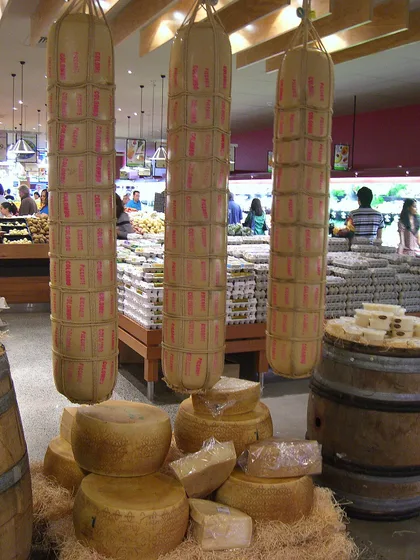 ExplainerWhich Italian cheeses contain no lactoseItaly sets a legal threshold, and long-aged cheeses clear it on their own, with no treatment involved.
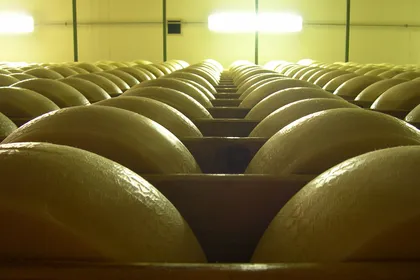 ExplainerGrana Padano vs Parmigiano ReggianoSame family, same rennet, raw milk in both. The real differences are written in the rules: the zone, silage…
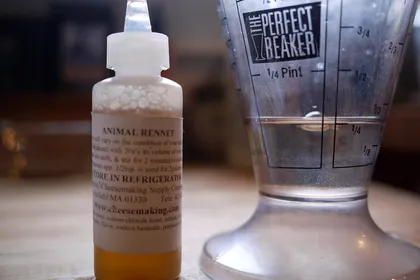 InvestigationWhich Italian cheeses are vegetarianWe counted what rennet the 43 cheeses in our atlas declare: 35 out of 43 say animal, none say otherwise.
Frequently asked questions
What is the difference between Grana Padano and Parmigiano Reggiano?
Different zone, different minimum age (nine months against twelve), and different rules on feed and additives. Grana Padano permits silage and egg-derived lysozyme; Parmigiano permits neither. The result is milder, sweeter and around a third cheaper.
Does Grana Padano contain egg?
It may. The specification allows lysozyme extracted from egg white as a preservative against late blowing, and when used it must be declared as an allergen. Trentingrana and some organic producers never use it.
Is Grana Padano vegetarian?
No. Calf rennet is required by the DOP specification. British vegetarian alternatives include Twineham Grange and supermarket own-label Italian-style hard cheese, both made with microbial rennet.
Can you substitute Grana Padano for Parmesan?
Yes, in nearly every cooked application, and in Italy it is done constantly. Grana Padano is milder, so in a dish where the cheese is the main flavour (cacio e pepe aside, which needs pecorino) you may want a little more of it, or a longer-aged wheel.
How do you pronounce Grana Padano?
GRAH-nah pah-DAH-noh, with open 'ah' vowels throughout, stress on the first syllable of grana and the second of padano, and no 'y' sound anywhere.
Sources
Where to check what you just read.
- 1
Il regolamento del 12 giugno 1996 che ha iscritto Grana Padano fra le DOP europee, nello stesso allegato di Fontina, Montasio e Quartirolo Lombardo.
- 2
Il PDF del disciplinare vigente, dove si verificano stagionatura minima, alimentazione delle bovine, uso del lisozima e confini della zona di produzione.
- 3Consortium · interested partyConsorzio Tutela Grana Padano — la DOP
La mappa delle province ammesse e i piani produttivi pluriennali scaricabili: servono a capire quanto formaggio il Consorzio autorizza a marchiare e dove.
Related foods
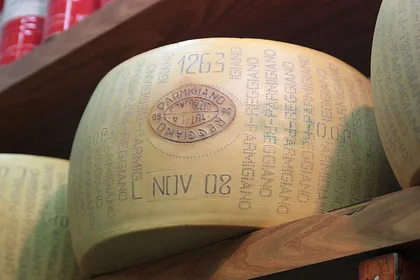 CheeseParmigiano ReggianoThree ingredients and no additives of any kind are permitted: raw cow's milk, salt and calf rennet, from five…
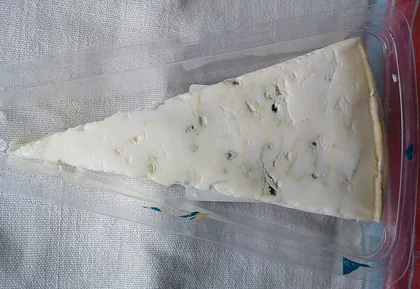 CheeseGorgonzolaThe green veining is the product, not a flaw anyone tolerates: it grows from a mould added to the milk and…
 CheeseAsiagoOne name covers two cheeses nobody would mistake for each other at the counter.
 CheeseProvoloneProvolone is a stretched-curd cow's milk cheese from northern Italy, rope-tied and hung to age in shapes from…
 CheeseTaleggioTaleggio DOP is a square, washed-rind cow's milk cheese from the Bergamo Alps, aged at least 35 days.
 CheeseRobiolaRobiola is a family of soft young cheeses from north-west Italy rather than a single cheese.
 CheeseSquacquerone di RomagnaSquacquerone di Romagna DOP is a fresh cow's milk cheese so soft it cannot hold a shape: it takes the form of…
 CheeseBittoBitto DOP can only be made between 1 June and 30 September, on high summer pasture, in a dismantlable stone…