Animal rennet in Italian cheese
Most Italian PDO cheeses are legally required to use animal rennet from calves, lambs or kids, so Parmigiano Reggiano, Grana Padano, Pecorino Romano, Gorgonzola and Mozzarella di Bufala Campana are not vegetarian. The label almost never tells you.
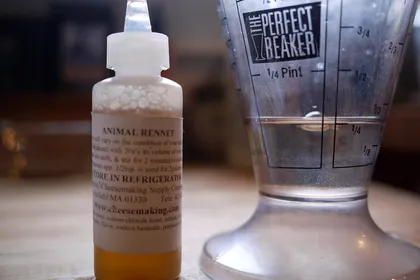
Rennet is extracted from the abomasum, the fourth stomach of unweaned ruminants. Its active enzyme is chymosin, accompanied by some pepsin, and it works with surgical precision: it cuts κ-casein at a single bond, between phenylalanine 105 and methionine 106, releasing the caseinomacropeptide that keeps casein micelles suspended. Stripped of that protective layer, the micelles clump and the milk becomes curd. It comes as liquid, powder or paste, and the paste form is not a convenience variant but a flavour decision. This specificity is the reason no substitute behaves identically: everything else you can put in milk cuts casein in more places than chymosin does.
The PDO specifications are explicit, and they are law, not custom. Parmigiano Reggiano: raw cow's milk, calf rennet, no additives of any kind. Grana Padano: calf rennet, and it additionally permits lysozyme from egg white (additive E1105, used to control late blowing) so it is neither vegetarian nor safe for an egg allergy. Pecorino Romano: lamb rennet paste of Italian origin. Mozzarella di Bufala Campana: natural rennet. Gorgonzola, Fontina, Provolone Valpadana, Taleggio and Fiore Sardo all require animal rennet too. The most unusual case in Italy is Pecorino di Farindola in Abruzzo, a Slow Food Presidium and the only cheese in the world made with pig rennet.
Rennet paste deserves its own explanation, because it is why substitution fails on certain cheeses. Paste carries pregastric lipases alongside chymosin, and during ageing those lipases release short-chain free fatty acids: butyric, caproic, caprylic. Those acids are precisely the sharp, peppery, faintly animal notes of Pecorino Romano, Fiore Sardo and provolone piccante. A microbial coagulant contains no such lipases and cannot generate them. Asking for a vegetarian Pecorino Romano is not asking for the same cheese with one ingredient swapped; it is asking for a cheese that does not exist, because the pungency is a product of the rennet itself.
The alternatives all involve trade-offs. Microbial rennet comes from moulds, chiefly Rhizomucor miehei and Cryphonectria parasitica; its proteases are less specific than chymosin and, crucially, keep working throughout ageing, generating bitter peptides and a paste that crumbles, which is why they are avoided for cheeses aged 24 or 36 months. Fermentation-produced chymosin (FPC) is made by genetically modified Kluyveromyces lactis or Aspergillus niger and is molecularly identical to calf chymosin; most vegetarian organisations accept it, though its GM origin troubles some, and since it counts as a processing aid it does not appear on EU labels. True plant rennet uses cardoon, Cynara cardunculus, whose cardosin proteases give lower yields, a fragile curd and growing bitterness with age, which is why it suits soft, short-aged cheeses, and why it is the signature of Portugal's spoonable PDOs, Serra da Estrela, Serpa, Nisa and Azeitão, as well as Italy's Caciofiore della Campagna Romana.
If you are vegetarian and shopping in Italy, here is the practical position. EU rules require rennet to be listed but not its source, so "caglio" on an ingredient list tells you nothing. Look for the volunteered wording: caglio microbico, coagulante microbico, caglio non animale, vegetarian rennet, or the V-Label. Mascarpone is acid-set with citric or tartaric acid and is vegetarian. Ricotta is not a cheese but a whey product made with heat and acid, so no rennet is added; the whey, however, almost always comes from cheesemaking that used animal rennet, which strict vegetarians treat as disqualifying. Plenty of industrial fiordilatte mozzarella, burrata, robiola and stracchino is made with microbial coagulant, and producers will tell you if you ask. What will never exist is a vegetarian Parmigiano Reggiano: a wheel made with microbial rennet cannot legally carry the name.
Guides that cover this
 ExplainerGrana Padano vs Parmigiano ReggianoSame family, same rennet, raw milk in both. The real differences are written in the rules: the zone, silage…
 InvestigationWhich Italian cheeses are vegetarianWe counted what rennet the 43 cheeses in our atlas declare: 35 out of 43 say animal, none say otherwise.
Frequently asked questions
Is Parmigiano Reggiano vegetarian?
No. The specification requires calf rennet and allows no alternative, so a vegetarian Parmigiano Reggiano PDO cannot exist. A similar hard cheese made with microbial rennet may be sold, but not under that name.
Which Italian PDO cheeses are vegetarian?
Essentially none of the famous ones: Parmigiano Reggiano, Grana Padano, Pecorino Romano, Gorgonzola, Fontina, Taleggio, Provolone Valpadana and Mozzarella di Bufala Campana all require animal rennet. Vegetarian options are found among non-PDO cheeses made with microbial coagulant, plus acid-set mascarpone.
Why can't microbial rennet replace lamb rennet paste?
Because paste rennet also carries pregastric lipases, which during ageing release short-chain fatty acids responsible for the pungency of Pecorino Romano, Fiore Sardo and provolone piccante. Microbial coagulants contain no such lipases, and microbial proteases keep breaking down protein during long ageing, causing bitterness.
Is ricotta vegetarian?
No rennet is added to ricotta, which is made by heating whey with an acid. But the whey is normally a by-product of cheesemaking that used animal rennet, so strict vegetarians usually avoid it unless the producer states that microbial coagulant was used upstream.