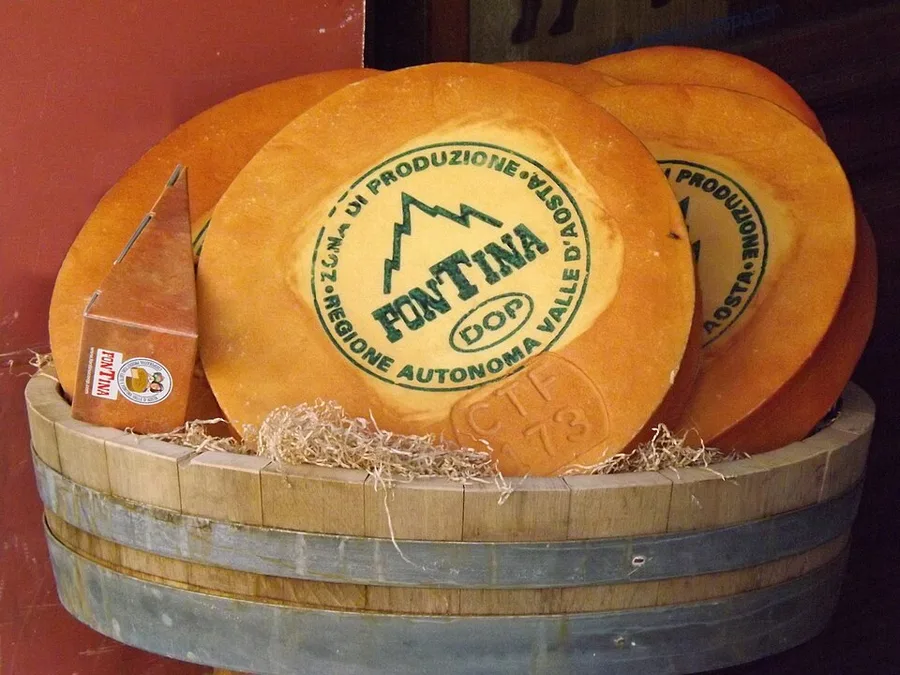
What is Fontina?
Fontina is a semi-cooked, pressed cow's milk cheese made only in the Aosta Valley, the small Alpine region wedged between France, Switzerland and Piedmont. Two rules in the DOP specification explain everything about it: the milk must come from a single milking, and it must be in the vat within two hours, raw and still warm. Nothing else on a cheese counter is made that way.
The wheels are cylindrical with a concave heel, 7.5 to 12 kg, 35-45 cm across and 7-10 cm tall, with a minimum of 45% fat in dry matter. One wheel takes roughly 100 litres of milk. The paste runs from ivory in winter to deep straw in summer, elastic, with small sparse eyes; the rind is thin, washed and brushed by hand to a brown-orange finish.
The name is the problem. Outside the EU 'fontina' is not a protected word, so it sits on Danish, Swedish and generic Italian cheeses that share nothing with the original. Real Fontina carries one mark: the Matterhorn stamp pressed into the heel of the wheel, with the dairy's number beside it. Italian recognition came in 1955, the producers' Consorzio in 1957, EU DOP status in 1996.
What does it taste like?
Mild but never bland, and that is the trick of it. The first note is warm milk and butter, then hay and boiled chestnut, then a faint hazelnut finish and a small savoury tug from the washed rind. There is no sharpness and no salt spike; a good wheel tastes sweet in the way fresh cream is sweet.
The alpage version, made above 1,700 metres between June and September, tastes noticeably different: grassier, more herbal, longer on the finish, with a yellower paste from the summer pasture.
The texture is supple and semi-soft. It gives under a knife without crumbling and without the squeak of a young cheddar. Melted, it turns to cream rather than strings, which is why it belongs in a sauce and not on a pizza.
How to use it
Fonduta valdostana is the dish this cheese was made for, and it is easier than Swiss fondue. Take 400 g of Fontina, cut off the rind, slice it thin and cover it with about 250 ml of whole milk for two to three hours, or overnight in the fridge. Melt it in a double boiler with 30 g of butter, then take it off the direct heat and whisk in three or four egg yolks. Keep it under 70 °C: past that it splits, goes stringy and turns grainy. No wine, no kirsch, no garlic: that is a different country's recipe.
Serve it over soft polenta, on crostini, or with shaved white truffle if the season and the budget allow.
Beyond fonduta: dice it into hot polenta for polenta concia; stuff it with cooked ham into a pocket cut in a veal chop, bread it and fry it in butter for costoletta alla valdostana; layer it with stale bread, savoy cabbage and broth and bake it for seupa à la Valpellenentse. It also makes an unusually good grilled cheese sandwich.
What it is not good for: grating over pasta, where you want a hard cheese, and any dish where you need the cheese to stretch in ropes. Fontina goes creamy, not stringy.
How long it keeps
Fontina belongs in the vegetable drawer of the fridge, between 4 and 8 °C, wrapped in greaseproof paper or the waxed cheese paper from the counter. Never press cling film directly against the paste: the cheese breathes, and sealed in plastic it develops an ammonia smell within days. A wedge with its rind intact holds three or four weeks that way, and it keeps changing while it does. The cut face dries and takes on a white veil, and the paste behind it firms up and tastes more concentrated. Scraping a millimetre off the face brings the original surface back.
Green or black growth on the paste itself is a different change from that veil on a cut face, and there the date on the pack and the cheesemonger who sold it are the reference. Fontina does not freeze: the paste flakes apart and releases water in a fonduta. If there is no alternative, freeze only the share meant for cooking, cut into cubes, for no more than two months. Take it out of the fridge a full hour before serving, because straight from the cold it says almost nothing.
Spot the real thing
Look for the Matterhorn stamp branded into the heel of the wheel with the dairy number beside it, and it is the only mark that decides the question. The rind is thin, compact and brown orange, and it is never waxed. Red or yellow wax means fontal, or one of the northern European and Argentine cheeses that borrow the name: mild, springy, built for melting. In American shops the word fontina on its own is usually one of those; the label to look for reads Fontina Val d'Aosta DOP.
The paste runs from ivory in winter to deep straw in summer alpine milk, with a few small scattered eyes. It should be elastic under the knife, giving way without crumbling and without bouncing back. It smells of milk, hay and boiled chestnut, with hazelnut on the finish. Two things to walk past: pre wrapped slices with no rind, where the stamp cannot be checked, and wedges with a white, dried band along the cut face, cut weeks ago. It is fair to ask how long the wheel has been open. Expect roughly $20 to $28 a pound or £6 to £9 for 200 g.
How to pronounce Fontina
fon-TEE-nah
Three syllables, stress on the middle one. The 'o' is short and closed, closer to the 'o' in 'font' than to the 'o' in 'phone', and the final 'a' is a clear 'ah'. English speakers usually get it wrong by stressing the first syllable, as 'FON-tin-uh'. If the label says Fontina Val d'Aosta, that second part is 'val dah-OH-stah'.
Fontina compared
vsSupermarket 'fontina' (fontal, Danish or Swedish)
This is the comparison that matters most outside Italy. The wax-coated wheel labelled fontina in an American or British supermarket is almost always fontal or a Northern European copy: pasteurised, younger, industrially made and legally free to use the name outside the EU. It melts, but it melts differently and tastes of very little.
| This | Supermarket 'fontina' (fontal, Danish or Swedish) | |
|---|---|---|
| Milk | Raw, whole, single milking, Valdostana cows in the Aosta Valley | Pasteurised, pooled from many milkings, no origin rule |
| Rind | Washed natural rind, brown-orange, Matterhorn stamp | Red or yellow wax, or plastic film |
| Ageing | Minimum 80 days, often 4-5 months, in rock cellars | Typically 6-10 weeks in a temperature-controlled room |
| Format | Wheels of 7.5-12 kg with a concave heel | Waxed rounds or rectangular blocks |
| Melting | Turns to smooth cream around 60 °C | Elastic and stringy, can go greasy when pushed |
| Flavour | Milk, hay, chestnut, hazelnut finish | Mild, buttery, largely neutral |
| Price | $16-26 per lb, $28-38 for alpage | $7-11 per lb |
| Legal status | DOP, name protected across the EU | Generic name, unprotected outside the EU |
vsRaclette
Both are Alpine washed-rind cheeses built to be melted, but they are melted in opposite ways. Raclette is scraped molten off a half wheel onto potatoes; Fontina is dissolved into milk and egg yolks and eaten with a spoon or poured over polenta. Raclette is the rounder, more buttery of the two.
| This | Raclette | |
|---|---|---|
| Origin | Aosta Valley, Italy | Valais in Switzerland and Savoie in France |
| Milk | Raw, single milking, worked within 2 hours | Often pasteurised, pooled milkings |
| Ageing | 80 days to about 5 months | 3 to 6 months |
| Wheel | 7.5-12 kg, concave heel | 5-7 kg, straight-sided |
| Classic dish | Fonduta with milk, butter and yolks, no wine | Melted and scraped over potatoes, cornichons, pickled onions |
| Flavour | Milky and grassy, hazelnut finish | Butterier, meatier, more pungent rind |
| Price | $16-26 per lb | $14-22 per lb |
vsGruyère AOP
Gruyère is a hard cooked cheese made for long ageing; Fontina is a semi-soft cheese made for melting young. The curd is cooked hotter and the wheels are three times bigger in Switzerland, which is why one grates and the other flows.
| This | Gruyère AOP | |
|---|---|---|
| Wheel | 7.5-12 kg | 25-40 kg |
| Curd cooking | 46-48 °C | Around 55 °C |
| Ageing | 80 days to 5 months | 5 to 18 months, up to 24 for reserve |
| Texture | Semi-soft and elastic, slices cleanly | Hard and dense, crystalline when old |
| Flavour | Sweet, milky, gentle | Dry, nutty, savoury, increasingly sharp |
| Best use | Fonduta, polenta concia, stuffed veal chop | Grating, gratins, Swiss fondue with white wine |
| Price | $16-26 per lb | $18-30 per lb |
Fontina substitutes
- Fontal
The closest match for melting and the easiest to find. It is milder and flatter in flavour, so season the finished dish a little more assertively; it behaves almost identically in a sauce or a gratin.
1:1 - Gruyère or Comté
Drier and more savoury, and they can turn stringy on their own. For a fonduta, add a tablespoon of cream per 200 g and keep the heat lower than you would with Fontina.
1:1 by weight, plus 15 ml cream per 100 g - Raclette
Melts beautifully and sits at a similar moisture level, but releases more surface fat. Blot the top of a gratin before serving, and use a little less than the recipe asks for.
0.9:1 - Vacherin Fribourgeois
The best substitute in a fondue-style dish: it melts smooth at low temperature and does not split easily. Noticeably more pungent, so use it where the cheese is meant to lead.
1:1 - Young Asiago or Taleggio
For polenta concia or anything where the cheese melts into a starch, both work well. Taleggio is wetter and stronger, so cut the quantity by a fifth and remove the rind.
Asiago 1:1, Taleggio 0.8:1 - Vegetarian alternative
No Fontina DOP is vegetarian: the specification requires calf rennet and allows no microbial substitute, and the same is true of Gruyère AOP and most Alpine DOP cheeses. Ask your cheesemonger for an Alpine-style tomme made with microbial rennet, since several British and American creameries make one, and treat it as you would fontal.
1:1
Where to buy it
In the US, ask for it by the full name, Fontina Val d'Aosta DOP, at a real cheese counter: Eataly, Murray's, Di Bruno Bros, igourmet and better Whole Foods counters carry it, and several importers ship cut-to-order wedges. Expect $16-26 per pound, or $28-38 for alpage. In the UK it turns up at La Fromagerie, Lina Stores, I Camisa and Italian delicatessens, roughly £24-36 per kilo.
Buy a wedge with the rind still attached. The rind is where the Matterhorn stamp lives, and without it you have no way of checking what you bought. If the cheese is coated in red or yellow wax, it is not Fontina DOP, whatever the label says.
Check the cut face: it should be even in colour and slightly moist. A dry, chalky edge means the wheel was opened weeks ago. Ask when it was cut, because a good counter will know.
Where to eat it in Italy
The Aosta Valley is small and reachable: two hours from Turin, three from Milan, and the train and motorway follow the same valley floor. Aosta itself is the base, but the cheese is best chased into the side valleys: seupa à la Valpellenentse in Valpelline, polenta concia in the refuges above Cogne and Valgrisenche, the stuffed veal chop in the trattorie of Courmayeur and Gressoney.
At Valpelline the Consorzio ages its wheels in a converted tunnel and runs a visitor centre, which is the fastest way to understand what 80 days at 8 °C and 95% humidity actually does.
In summer, alpine dairies above 1,800 metres sell directly to walkers, and that is where the alpage wheels come from. In autumn the Modon d'Or competition judges the best of them; on 30 and 31 January the Fiera di Sant'Orso fills Aosta with craft and food stalls.
Further reading
 GuideCan you eat cheese rind?On some wheels the rind is the same paste, dried out. On others it is paraffin.
 InvestigationItalian raw milk cheeses: the full listWe counted: 19 of 43 declare raw milk, and 16 of those 19 carry a protected designation.
 ExplainerWhich Italian cheeses contain no lactoseItaly sets a legal threshold, and long-aged cheeses clear it on their own, with no treatment involved.
Frequently asked questions
Is the fontina in my supermarket real Fontina?
Usually not. If it comes in red or yellow wax, it is fontal or a Danish or Swedish cheese using an unprotected name. Genuine Fontina is DOP, made only in the Aosta Valley, and carries a Matterhorn stamp pressed into its natural brown-orange rind.
Is Fontina vegetarian?
No. The DOP rules require calf rennet and permit no microbial alternative, so there is no vegetarian version of the real thing. Alpine-style cheeses made with microbial rennet exist outside the DOP system, so ask your cheesemonger specifically.
What is the best substitute for Fontina?
Fontal, one for one, if you only need the melt. If you need flavour as well, use Gruyère or Comté with a spoonful of cream per 200 g to stop it going stringy, or Vacherin Fribourgeois in anything fondue-like.
Can you eat Fontina raw?
Yes: it is a table cheese as much as a cooking one. Take it out of the fridge an hour before serving and eat it with rye bread, walnuts and chestnut honey. Cut the rind off; it is washed and brushed, not waxed, but it is not meant to be eaten.
How do you pronounce Fontina?
fon-TEE-nah, with the stress on the middle syllable and a short, closed 'o'. Not 'FON-tin-uh'.
Sources
Where to check what you just read.
- 1
L'atto europeo che ha iscritto Fontina fra le DOP: la tutela copre il nome «Fontina» da solo, motivo per cui le imitazioni si chiamano quasi sempre in altro modo.
- 2
Il PDF del disciplinare vigente, dove si verificano razze ammesse, latte di una sola mungitura, temperature di lavorazione e stagionatura minima.
- 3Consortium · interested partyConsorzio Produttori e Tutela della DOP Fontina — disciplinare e normative
La raccolta normativa completa, dal DPR 1269/1955 che ha riconosciuto la denominazione al disciplinare aggiornato: qui si trovano i tre mesi minimi di maturazione e il 45% di grasso sulla sostanza secca.
Related foods
 CheeseTaleggioTaleggio DOP is a square, washed-rind cow's milk cheese from the Bergamo Alps, aged at least 35 days.
 CheeseAsiagoOne name covers two cheeses nobody would mistake for each other at the counter.
 CheeseGrana PadanoNine months is the floor the specification sets before a wheel may carry the name.
 Cured meatsMocettaMocetta is an Alpine cured meat from Valle d'Aosta: a lean leg muscle dry-salted with juniper, sage and…
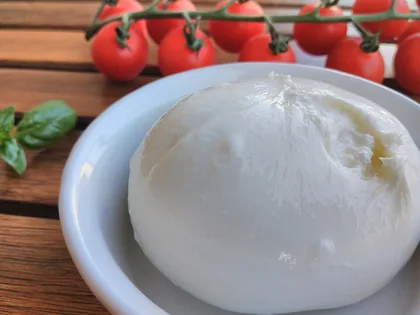 CheeseBurrataIt began as a way of using offcuts: leftover shreds of pasta filata, drowned in cream and sealed inside a…
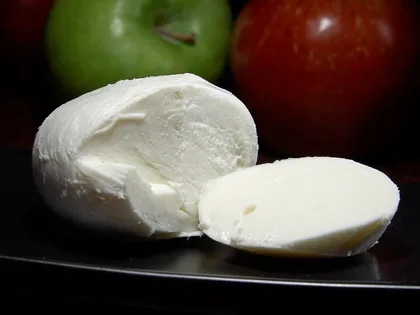 CheeseMozzarellaThe name is a verb before it is a cheese: mozzare means to lop off, which is what the cheesemaker does by…
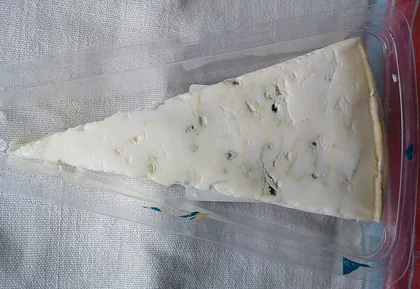 CheeseGorgonzolaThe green veining is the product, not a flaw anyone tolerates: it grows from a mould added to the milk and…
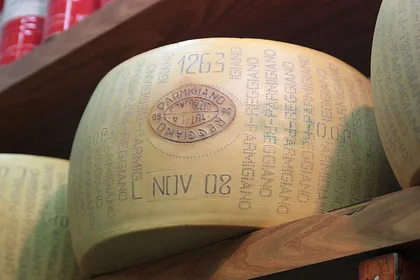 CheeseParmigiano ReggianoThree ingredients and no additives of any kind are permitted: raw cow's milk, salt and calf rennet, from five…