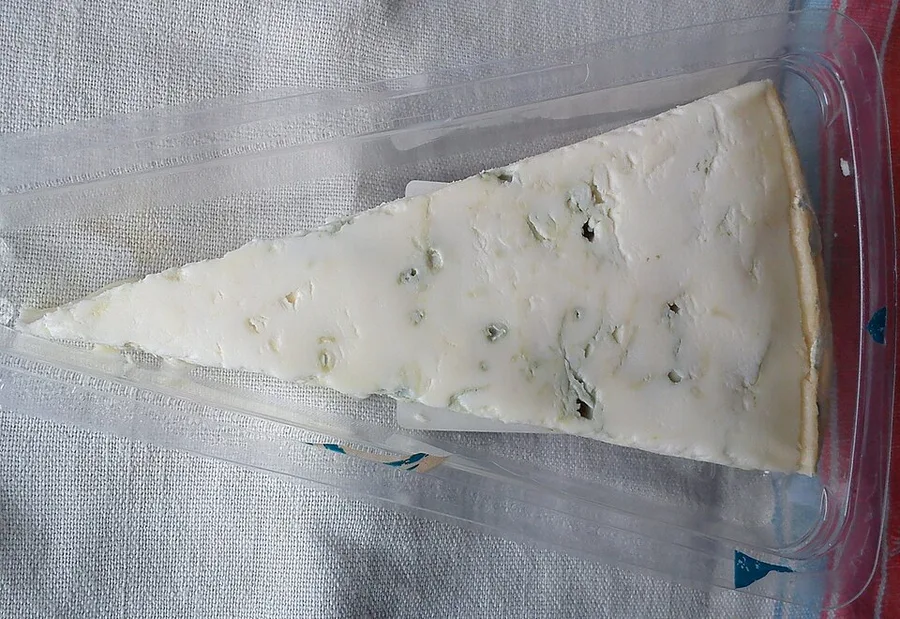
What is Gorgonzola?
Gorgonzola is a blue-veined cow's milk cheese from northern Italy, protected as a DOP since 1996. The curd is cut coarsely and ladled into moulds without pressing, so air pockets remain between the lumps; Penicillium spores added to the milk colonise those pockets once steel needles pierce the wheel and let oxygen in. That piercing, done once for dolce and two or three times for piccante, is what creates the veins.
Wheels weigh 9 to 13 kilos and are wrapped in embossed foil carrying the Consorzio's stylised 'g' and the dairy's number. The cheese comes from fifteen provinces across Lombardy and Piedmont, with the modern production centre around Novara rather than the Milanese town that gave it its name.
The single most useful thing to know is that dolce and piccante are separate products, not stages of the same one. Ask which you are buying.
What does it taste like?
Gorgonzola dolce is soft, almost spoonable, milky and buttery, with a gentle mushroomy tang and a faint bitterness at the finish. It is one of the mildest blue cheeses in Europe, and people who dislike Roquefort often like this. The blue reads as savoury rather than sharp.
Gorgonzola piccante is a different proposition: drier, crumblier, distinctly salty, with a peppery bite and a long spicy finish. It is closer in intensity to Stilton, though earthier and less mineral.
Both have a strong smell relative to their taste, and both need half an hour out of the fridge to open up. Cold gorgonzola tastes mostly of salt.
How to use it
Take it out of the fridge thirty minutes before serving and unwrap it, because cold gorgonzola tastes only of salt, and it needs air. Cut off the rind; it is not meant to be eaten.
For a pasta or gnocchi sauce, use dolce: melt 100 g per two servings into 60 ml of cream or milk over low heat, off the boil, and finish with black pepper and a splash of pasta water. It goes very liquid, so if you want a clinging sauce, whisk in an egg yolk off the heat or a spoonful of mashed potato. Piccante is the one for polenta, for a pan sauce on steak, and for pizza with walnuts and honey.
On a board, serve it with chestnut honey, walnuts, pears and mostarda. The classic Lombard preparation is gorgonzola layered with mascarpone: mild, rich and startlingly good on toasted bread.
How long it keeps
Keep it in the fridge between 2 and 6 °C, wrapped in its own foil or in waxed paper. Cling film pressed against the surface is the one thing to avoid: the cheese keeps exchanging gases as it matures, and sealed against plastic it develops an ammonia note within days. On a cut piece, cover the cut face and leave the rind exposed to the air. A lidded box keeps the smell away from the rest of the fridge, but open it every couple of days so the air moves.
Dolce is generally sold to be used within about ten days of cutting, piccante holds three weeks or more, and the date on the wrapper is the reference rather than the look of it. Across that time the paste keeps softening and spreading, the veining shifts from blue-green towards grey, and the cut face dries where it meets the air. Freezing only makes sense for cheese headed into a cooked sauce: 100 gram pieces, up to three months, and it thaws grainy and crumbly.
Spot the real thing
Start with the wrapper. Real Gorgonzola arrives in foil printed with the stylised letter g of the Consorzio and the number of the dairy that made it, and on a half or quarter wheel the same mark is branded into one of the cut faces. Two cheeses hide behind the single name: dolce is white to pale straw, soft enough to spread, with sparse blue-green veins scattered unevenly; piccante is drier, ivory, firmer and marbled densely and evenly right through. In both the veining should read green or blue, and the wrinkled pink-grey rind is trimmed away rather than served.
At a British or American counter the neighbours are different animals. Danish Blue is whiter, firmer, saltier and evenly veined; Cambozola is a mild brie-blue hybrid with a white bloomy rind; Roquefort is sheep's milk; Stilton is crumbly and dry rather than spoonable. Domestic blues sold as gorgonzola-style crumble instead of spreading, and sit well below the imported DOP wheel on price.
How to pronounce Gorgonzola
gor-gon-DZOH-lah
Four syllables, stress on the third. In Italian the 'z' is a 'dz' sound, as in 'adze', so the English 'gor-gon-ZOH-lah' is understood everywhere but is not quite right. Both 'g's are hard, as in 'go'. The final 'a' is a full open vowel, not 'uh'.
Gorgonzola compared
vsGorgonzola piccante (dolce vs piccante)
The comparison that matters most, because both sit under the same name and the same DOP. Dolce is a spreading and melting cheese; piccante is a crumbling and seasoning cheese. Recipes that just say 'gorgonzola' almost always mean dolce in Italy and piccante in English-language cookbooks.
| This | Gorgonzola piccante (dolce vs piccante) | |
|---|---|---|
| Minimum ageing | 50 days | 80 days |
| Piercing | Once | Two or three times |
| Texture | Soft, creamy, spreadable | Firm, crumbly, drier |
| Veining | Sparse, irregular, pale green | Dense, even, blue-green |
| Flavour | Milky, buttery, slightly bitter finish | Salty, sharp, peppery, long |
| Melts | Very liquid, needs an egg yolk or starch to thicken | Holds some grain, better for sauces on meat |
| Best for | Gnocchi sauce, risotto, spreading, pears | Polenta, steak sauce, pizza with walnuts and honey |
| Price | $10-16 per lb | $13-19 per lb |
vsRoquefort
Both are blue, and that is roughly where the similarity ends. Roquefort is sheep's milk, cave-ripened, salty and mineral; gorgonzola is cow's milk and far softer and milkier. Substituting one for the other changes a dish considerably.
| This | Roquefort | |
|---|---|---|
| Milk | Pasteurised cow | Raw sheep |
| Mould | Penicillium roqueforti and glaucum | Penicillium roqueforti |
| Ripening | Cellars, 50-80+ days | Combalou caves at Roquefort-sur-Soulzon, 90+ days |
| Texture | Creamy (dolce) to crumbly (piccante) | Moist, crumbly, dense |
| Salt | Moderate | High, distinctly saline |
| Flavour | Milky, mushroomy, mild to sharp | Sharp, tangy, mineral, lanolin |
vsStilton
The closest English equivalent, and the fairer comparison is with gorgonzola piccante rather than dolce. Stilton is drier and more crumbly, with a nutty, slightly sweet base under the blue. It is also usually made with vegetarian rennet, which gorgonzola never is.
| This | Stilton | |
|---|---|---|
| Milk | Pasteurised cow | Pasteurised cow |
| Rennet | Calf rennet, not vegetarian | Usually microbial, most Stilton is vegetarian |
| Minimum ageing | 50 days (dolce) or 80 (piccante) | 9 weeks, typically 12-14 |
| Texture | Creamy to firm | Dry, crumbly, buttery on the palate |
| Flavour | Lactic, mushroomy, tangy | Nutty, sweet, mellow blue |
| Rind | Thin, reddish, not eaten | Thick, crusty, edible if you want it |
vsDolcelatte and Cambozola
Two industrial mild blues that sit on shelves next to gorgonzola and are often mistaken for it. Dolcelatte is a Galbani trademark, not a DOP; Cambozola is German, a blue-brie hybrid with added cream. Both are milder and sweeter than even gorgonzola dolce.
| This | Dolcelatte and Cambozola | |
|---|---|---|
| Protected status | DOP since 1996 | Trademarks, no protected origin |
| Origin | Lombardy and Piedmont | Dolcelatte: Italy (Galbani). Cambozola: Bavaria |
| Cream added | None | Cambozola is enriched with cream |
| Flavour | Tangy, with real blue character | Sweet, mild, blue as an accent |
| Use | Cooking and board | Mostly board; too mild to carry a sauce |
Gorgonzola substitutes
- Dolcelatte
The nearest easy stand-in for gorgonzola dolce, and made in Italy by Galbani. Milder and sweeter, so a sauce will taste flatter: add a little salt and a scrape of nutmeg.
1:1, slightly more if you want the blue to read - Saint Agur
French, cow's milk, double-cream and mild. Behaves very like gorgonzola dolce when melted and is stocked in most UK and US supermarkets. Slightly richer, so use a touch less cream in the sauce.
1:1 - Stilton
The best replacement for gorgonzola piccante. Crumble rather than slice, and remember it is drier: in a melted sauce it will need more liquid than gorgonzola.
1:1, plus a splash of milk or cream - Bleu d'Auvergne
Cow's milk, moist, moderately sharp, it sits neatly between dolce and piccante and melts cleanly. A good default when a recipe just says 'blue cheese'.
1:1 - Vegetarian: Cashel Blue or Colston Bassett Stilton
Gorgonzola is never vegetarian: the DOP requires calf rennet. Cashel Blue from Tipperary and most Stilton, including Colston Bassett, are made with microbial rennet. Cashel Blue is the creamier of the two and the closer match to dolce.
1:1 - Vegan: cashew blue or a miso-and-tahini cream
Cultured cashew blues from Nurishh, Willicroft and Climax are now genuinely blue-veined and melt acceptably. For a quick sauce, blend 100 g soaked cashews with a tablespoon of white miso, a teaspoon of tahini, lemon juice and salt.
Where to buy it
In the US, Whole Foods, Wegmans, Costco and Italian delis all carry it, though many stock only one version, usually a mild dolce sold simply as 'gorgonzola'. Ask, or read the foil. Igor, Palzola and Mauri are the names most often imported. Expect $10-19 per pound depending on type.
In the UK, Waitrose, Sainsbury's, Ocado and cheesemongers stock both types at roughly £14-22 per kilo. Piccante is harder to find in supermarkets and easier at a counter.
The check is the foil: embossed with a stylised 'g' and the dairy's identification number. Cut pieces should carry the fire-branded mark on one face. Look for veins that are green or blue, never grey or brown, and pass on anything that smells of ammonia through the paste rather than only at the rind.
Where to eat it in Italy
The town of Gorgonzola, twenty minutes east of Milan on the metro, holds a cheese festival every September and keeps the signs of its old dairies along the canal. It is more pilgrimage than gastronomy, but the festival is real.
Novara, now the production capital, runs an autumn showcase where the region's dairies pour side-by-side tastings of dolce and piccante. Several producers in the Novarese and the Valsesia open their ripening cellars, and watching the piercing needles go in explains the cheese faster than any description.
In Milan, the cheese shops around Porta Romana and the market on via Fauché carry intermediate ageings that never reach supermarkets: a 90-day dolce, or a piccante pushed past six months.
Further reading
 ExplainerWhich Italian cheeses contain no lactoseItaly sets a legal threshold, and long-aged cheeses clear it on their own, with no treatment involved.
 GuideCan you eat cheese rind?On some wheels the rind is the same paste, dried out. On others it is paraffin.
 InvestigationWhich Italian cheeses are vegetarianWe counted what rennet the 43 cheeses in our atlas declare: 35 out of 43 say animal, none say otherwise.
Frequently asked questions
What is the difference between gorgonzola dolce and piccante?
Dolce is aged at least 50 days, pierced once, and is soft, creamy and mild. Piccante is aged at least 80 days, pierced two or three times, and is firm, crumbly and sharp. They are separate products under the same DOP, not two ages of one cheese.
Is gorgonzola vegetarian?
No. The DOP specification requires calf rennet. If you need a vegetarian blue, most Stilton and Irish Cashel Blue are made with microbial rennet and work well as replacements.
Can you eat the rind?
No. The rind is thin, reddish-grey and there only to protect the paste while it ripens. Cut it away before serving.
Is gorgonzola safe in pregnancy?
The milk is pasteurised, but UK and Italian guidance advises against soft blue-veined cheeses during pregnancy because of Listeria risk. Cooked until steaming hot, in a sauce for example, it is considered safe.
How do you pronounce gorgonzola?
gor-gon-DZOH-lah, with hard 'g's, a 'dz' where the z is, and the stress on the third syllable.
Sources
Where to check what you just read.
- 1
La data esatta da cui «Gorgonzola» è protetto in Europa: l'allegato del 12 giugno 1996, dove il nome compare fra le DOP italiane dei formaggi.
- 2
Il disciplinare del Gorgonzola in PDF: i minimi di stagionatura delle due tipologie, le misure e il peso ammessi per le forme, il caglio prescritto.
- 3Consortium · interested partyConsorzio per la tutela del formaggio Gorgonzola
La sezione «DOP e disciplinare» del consorzio con sede a Novara: chi può usare la denominazione e come, secondo l'ente che la sorveglia.
Related foods
 CheeseTaleggioTaleggio DOP is a square, washed-rind cow's milk cheese from the Bergamo Alps, aged at least 35 days.
 CheeseGrana PadanoNine months is the floor the specification sets before a wheel may carry the name.
 CheeseParmigiano ReggianoThree ingredients and no additives of any kind are permitted: raw cow's milk, salt and calf rennet, from five…
 CheeseProvoloneProvolone is a stretched-curd cow's milk cheese from northern Italy, rope-tied and hung to age in shapes from…
 CheeseRobiolaRobiola is a family of soft young cheeses from north-west Italy rather than a single cheese.
 CheeseBittoBitto DOP can only be made between 1 June and 30 September, on high summer pasture, in a dismantlable stone…
 CheeseQuartirolo LombardoQuartirolo Lombardo is named after quartirola, the fourth grass cut of the year in September: it was made…CheeseToma PiemonteseIn Piedmont, toma is not a cheese: it is a category. Dozens of different valley cheeses go by that name, and…