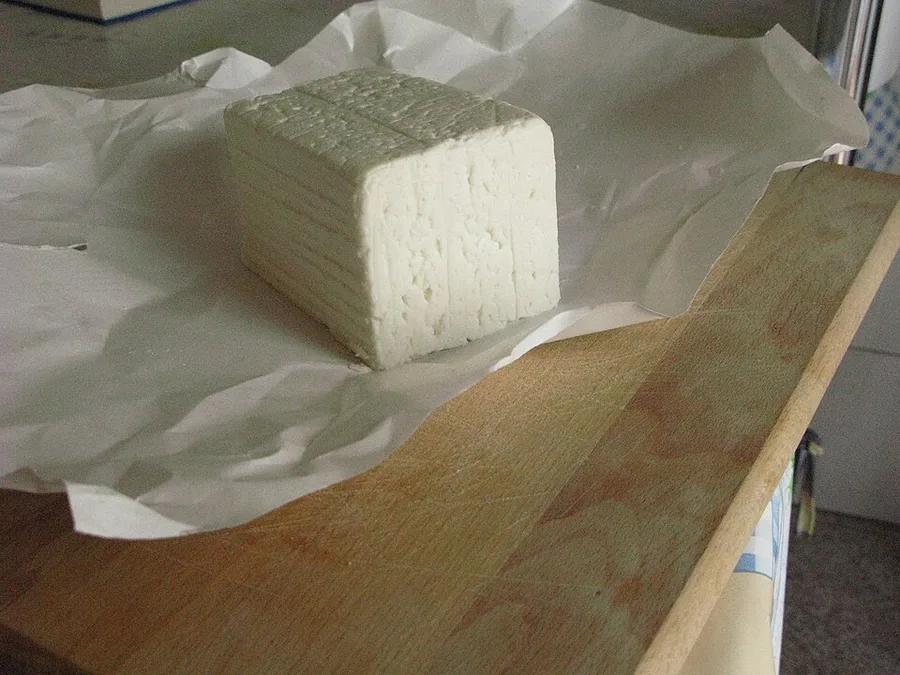
What is Quartirolo Lombardo?
Quartirolo Lombardo is an uncooked cow's milk cheese made across most of Lombardy: the provinces of Bergamo, Brescia, Como, Cremona, Lecco, Lodi, Milan, Monza e Brianza, Pavia and Varese. The shape is a flat square block, 18 to 22 centimetres a side and only 4 to 8 centimetres tall, weighing 1.5 to 3.5 kilos. It has been DOP since 1996.
It belongs to the stracchino family: Lombard cheeses made from the milk of cows tired (stracche) by the seasonal move between the plain and the high pastures. Taleggio, Salva Cremasco and crescenza come from the same root.
The specification recognises two types, and they are best treated as two cheeses. Fresh Quartirolo is sold between five and thirty days old: a barely-there white rind, a chalk-white paste that crumbles rather than bends, a clean lactic acidity and a smell of yoghurt. Aged Quartirolo, past thirty days and often reaching two months, has a thicker pink-brown rind, a paste that yellows slightly and softens under the rind, and a deeper, faintly pungent aroma.
It is one of Lombardy's best-selling cheeses at home and one of its least exported, which is why it is a supermarket staple in Milan and effectively unknown in London or New York.
What does it taste like?
Fresh Quartirolo tastes like a firm, mild yoghurt made solid: clean milk, a distinct lactic tang, a faint lemon note, and a texture that crumbles under the knife instead of stretching. It is refreshing rather than rich, and the acidity is the point. Think of a young feta with the salt removed and the sourness softened, or of a fresh farmer's cheese with better structure.
Aged Quartirolo is a different animal. The lactic tang recedes, the paste under the rind softens toward creaminess, and the flavour becomes savoury and mushroomy with a peppery lift at the end. It is still nowhere near the intensity of Taleggio or a washed-rind cheese and it stays polite, but it acquires depth and a longer finish.
What neither version is: rubbery, bland or aggressive. If a piece squeaks against your teeth or stretches, you have something else. The crumble is the signature, and it comes from breaking the curd twice.
How to use it
Fresh Quartirolo is best eaten as it is, at room temperature, with olive oil, black pepper and good bread. It takes well to mostarda, acacia honey and ripe fruit, and crumbled over a tomato and basil salad it behaves like a sweeter, gentler feta.
In cooking it appears throughout everyday Lombard food: in vegetable tarts, in pumpkin tortelli filling, melted over polenta, stirred into risotto at the end. It melts creamily but keeps a slight grain, which in a risotto is an advantage rather than a fault.
Aged Quartirolo shifts to the board, with mostarda and rye bread, and in cooking you need less of it, because the aroma carries further.
One rule for both: never boil it. This is an acidic, uncooked curd, and at high heat it splits into whey and curds. Add it off the flame and stir. And take it out of the fridge half an hour early; cold, the fresh version in particular says almost nothing.
How long it keeps
Quartirolo carries a lot of water and behaves like a soft cheese throughout. A vacuum-sealed piece keeps at 4 to 6 C until the date on the pack, set by the dairy. Once open, wrap it in waxed paper and put it in a box that is not sealed tight, in the vegetable drawer, and stand it on paper or a small rack rather than letting it sit in the whey it releases. Cling film against the paste is the one thing to avoid, since it traps that moisture and a slick film forms on the surface within a day or two.
The fresh type holds about one to two weeks in the fridge, the aged type longer, and both keep changing while they sit. The paste softens progressively inward from the rind, the crumbly core turns waxy and then creamy, the acid lactic note gives way to something fuller and more mushroomy, and the rind darkens from white toward pink-grey. Freezing does not work here: the free water tears the structure, and it thaws grainy and watery with liquid pooling in the wrapper.
Spot the real thing
It is a square, and a low one: roughly eighteen to twenty-two centimetres across, four to eight high, with straight sides and flat faces carrying the stamped Quartirolo Lombardo DOP mark. The rind is very thin, white to pale pink on the fresh version and grey-pink on the aged one. Cut a fresh wheel and the paste is chalk white and crumbly, breaking under the knife rather than slicing clean, with a lactic and faintly sour smell. An aged one softens from the rind inward, so the outer centimetre turns waxy and creamy while the core stays firm.
Taleggio is the cheese it gets shelved beside and mistaken for: also square and Lombard, but bigger, taller, washed to an orange rind and far more pungent. Stracchino and crescenza come in tubs with no rind at all and are spreadable. Robiola is smaller and rounder. Crumbly white cheeses on foreign counters, feta and queso fresco among them, are brined and salty in a way this is not. It is uncommon outside Italy and priced as a specialist import.
How to pronounce Quartirolo Lombardo
kwar-tee-ROH-loh lom-BAR-doh
Five syllables in the first word, stress on the fourth: kwar-tee-ROH-loh. 'Qu' is 'kw' as in 'quick', and the 'r' is tapped rather than rolled. 'Lombardo' simply means 'from Lombardy' and takes the stress on 'BAR'. In shops and on menus it is usually shortened to just Quartirolo.
Quartirolo Lombardo compared
vsStracchino (crescenza)
The comparison Italians make constantly, because the two share an ancestor and get confused on menus. Stracchino in modern usage means the soft, rindless, spreadable fresh cheese also sold as crescenza: eaten within days, spread on bread, melted onto pizza bianca. Quartirolo comes from the same stracchino tradition but was moulded, salted, given a rind and allowed to age, so it slices, crumbles and can go to two months. Stracchino is a spread; Quartirolo is a cheese you cut.
| This | Stracchino (crescenza) | |
|---|---|---|
| Protected status | DOP since 1996 | None, it is a generic name |
| Shape | Square block, 1.5-3.5 kg | Soft slab, sold in tubs or paper |
| Rind | Thin and white, or aged pink-brown | None |
| Texture | Firm and crumbly, or soft under rind | Spreadable throughout |
| Ageing | 5-30 days fresh, 30+ days aged | Days, eaten immediately |
| Flavour | Lactic and tangy, or savoury when aged | Sweet, milky, very mild |
vsTaleggio
Close cousins with opposite outcomes, and the pairing that explains what a washed rind actually does. Both are square, uncooked, Lombard and descended from stracchino. But Taleggio's rind is washed during ageing, which grows surface bacteria that ripen the cheese inward until it is creamy, fruity and mildly funky throughout. Quartirolo's rind is left dry, so the paste stays whiter, firmer and lactic. Taleggio is thicker, richer and internationally famous; Quartirolo is flatter, fresher and stays home.
| This | Taleggio | |
|---|---|---|
| Rind | Dry, thin, white to pink-brown | Washed, pink-orange, smeared |
| Height | 4-8 cm | 4-7 cm, but denser and heavier |
| Ripening | Minimal, from the inside out | From the rind inward |
| Texture | Crumbly, or softening under the rind | Creamy and uniform |
| Flavour | Tangy and clean, or gently savoury | Fruity, buttery, mildly pungent |
| Minimum ageing | 5 days (fresh) or 30 days (aged) | 35 days |
| Availability abroad | Rare | Widely stocked |
vsSalva Cremasco
The other square Lombard DOP, and the one that trips people up at the counter. Height settles it instantly: Quartirolo is a flat 4 to 8 centimetres, Salva is a tall block of 9 to 15. Salva has a washed, mould-flecked rind and a legal minimum of 75 days; Quartirolo has a dry rind and can be sold at five days. In practice Quartirolo is a fresh cheese with an aged option, Salva an aged cheese with no fresh option.
| This | Salva Cremasco | |
|---|---|---|
| Height | 4-8 cm | 9-15 cm |
| Rind | Dry, thin | Washed, pink-yellow, with moulds |
| Minimum ageing | 5 days | 75 days |
| Paste | White and crumbly, or softening | Creamy band plus firm white core |
| Price | EUR 9-18 per kg | EUR 13-26 per kg |
Quartirolo Lombardo substitutes
- Stracchino or crescenza
The right substitute when the recipe wants creaminess and mildness rather than structure: melted onto flatbread, folded into a filling. It will not crumble or slice, so do not use it where texture matters.
1:1 - Taleggio DOP
The best stand-in for aged Quartirolo and easy to buy anywhere. Richer, fruitier and more pungent, so use a little less and expect the cheese to dominate more than the original would.
0.8:1 - Fresh farmer's cheese or a young Tomme fraîche
For fresh Quartirolo, an unaged pressed curd cheese gets the crumble and the lactic tang. Add a pinch of salt and a squeeze of lemon if it tastes flat, because Quartirolo has more acidity than most fresh cheeses.
1:1 - Feta, rinsed
An unorthodox but effective substitute for crumbling over salads or vegetables. Rinse it under cold water and pat dry to strip the salt, and the texture and tang land close to fresh Quartirolo.
0.8:1, because it stays saltier - Robiola or a mild Brie-style cheese
For aged Quartirolo on a board, either works: soft under the rind, gently savoury, unthreatening. Neither has Quartirolo's lactic bite, so serve with something sharp: mostarda or pickled fruit.
1:1 - Vegetarian: microbial-rennet fresh cheeses
Quartirolo Lombardo is never vegetarian: the specification requires calf rennet, as do Taleggio, Salva Cremasco, Gorgonzola and Strachitunt. Fresh cheeses from British and American creameries labelled 'suitable for vegetarians' are the realistic alternative for the young version; for the aged one, a vegetarian-rennet Brie-style cheese.
1:1
Where to buy it
Outside Italy this is a specialist purchase, which is odd for a cheese that fills supermarket counters in Milan. In the US, Italian delis and importers list it occasionally at roughly 12 to 20 dollars per pound; in the UK, Italian delicatessens carry it at about 16 to 26 pounds per kilo. Neither market stocks it reliably, and the fresh version travels particularly badly.
If you find only the aged version abroad, that is normal: it survives the journey. For fresh Quartirolo, ask the date of production rather than the sell-by date. At ten days it is bright, chalky and clean; at twenty-five it is already softening and turning. Both are legitimate, but they are not the same experience.
In Lombardy the price is 9 to 14 euros a kilo for fresh and 13 to 18 for aged, with raw-milk artisan production above 20. Buy from a local dairy rather than a national brand where you can: the price gap is small and the difference in flavour is not.
At the counter, check the height. A square Lombard cheese 4 to 8 centimetres tall is Quartirolo; at 9 to 15 it is Salva Cremasco, a different DOP at a different price.
Where to eat it in Italy
Brianza, the hilly belt between Milan, Como and Lecco, is the historic heartland, and village dairies still make it. In the weekly markets it sits alongside mascarpone and crescenza. The Lodi plain and the lower Bergamo province are the other two production basins, with Treviglio as the natural hub.
Milan is the easiest place to eat it, and the most honest: this is a cheese Milanese households buy without thinking. Any covered market or neighbourhood gastronomia will have both versions, and you can taste them side by side for the price of a coffee.
In Bergamo, the shops of the Città Alta stock Quartirolo alongside the province's other protected cheeses (there are nine, more than in any other province in Europe) and in October the Forme festival brings them all into the squares.
For the version closest to the original, go to the Val Brembana or the Valsassina between September and November, when the herds have come down from the summer pastures and dairies make Quartirolo from that autumn milk. It is the one time of year the name means what it says.
Further reading
 GuideCan you eat cheese rind?On some wheels the rind is the same paste, dried out. On others it is paraffin.
 ExplainerWhich Italian cheeses contain no lactoseItaly sets a legal threshold, and long-aged cheeses clear it on their own, with no treatment involved.
 InvestigationWhich Italian cheeses are vegetarianWe counted what rennet the 43 cheeses in our atlas declare: 35 out of 43 say animal, none say otherwise.
Frequently asked questions
Why is it called Quartirolo?
After quartirola, the fourth cut of grass in the year, the September regrowth that follows three summer mowings. Cows coming down from the mountain grazed it, and their milk made a more aromatic cheese. The name stuck even though production is now year-round.
What is the difference between fresh and aged Quartirolo?
Fresh is sold at five to thirty days: white, crumbly, tangy, smelling of yoghurt. Aged goes past thirty days and often to two months: thicker pink-brown rind, paste softening under the rind, deeper and faintly peppery. They are best understood as two cheeses rather than two ages of one.
Is Quartirolo the same as stracchino?
No, though they share an ancestor. Stracchino today means the soft, rindless, spreadable fresh cheese also sold as crescenza. Quartirolo is a DOP with a square shape, a rind and a crumbly structure, and in its aged form it reaches two months.
How is it different from Taleggio?
Taleggio has a washed rind, so surface bacteria ripen it inward until it is creamy, fruity and mildly pungent throughout. Quartirolo has a dry rind, stays whiter and firmer, and keeps a lactic acidity Taleggio does not have. Close cousins, opposite results.
Is Quartirolo Lombardo vegetarian?
No. The specification requires calf rennet, as do Taleggio, Salva Cremasco, Gorgonzola and Strachitunt. Fresh cheeses labelled 'suitable for vegetarians' or 'microbial rennet' are the practical alternative.
Sources
Where to check what you just read.
- 1
L'allegato del 1996 che iscrive «Quartirolo Lombardo» fra le DOP: il nome protetto comprende l'aggettivo, quindi un «quartirolo» generico può essere fatto ovunque.
- 2
Il PDF del disciplinare vigente, dove si verificano le province ammesse, i tempi di stagionatura che separano il tipo molle da quello maturo e i parametri della pasta.
Related foods
 CheeseTaleggioTaleggio DOP is a square, washed-rind cow's milk cheese from the Bergamo Alps, aged at least 35 days.
 CheeseGorgonzolaThe green veining is the product, not a flaw anyone tolerates: it grows from a mould added to the milk and…CheeseSalva CremascoSalva Cremasco is a square, washed-rind Lombard cheese whose name means 'it saves': it was invented to rescue…
 CheeseRobiolaRobiola is a family of soft young cheeses from north-west Italy rather than a single cheese.
 CheeseGrana PadanoNine months is the floor the specification sets before a wheel may carry the name.
 CheeseProvoloneProvolone is a stretched-curd cow's milk cheese from northern Italy, rope-tied and hung to age in shapes from…
 CheeseBittoBitto DOP can only be made between 1 June and 30 September, on high summer pasture, in a dismantlable stone…
 CheeseValtellina CaseraValtellina Casera is made from partially skimmed milk for a specific reason: the cream went to butter, which…