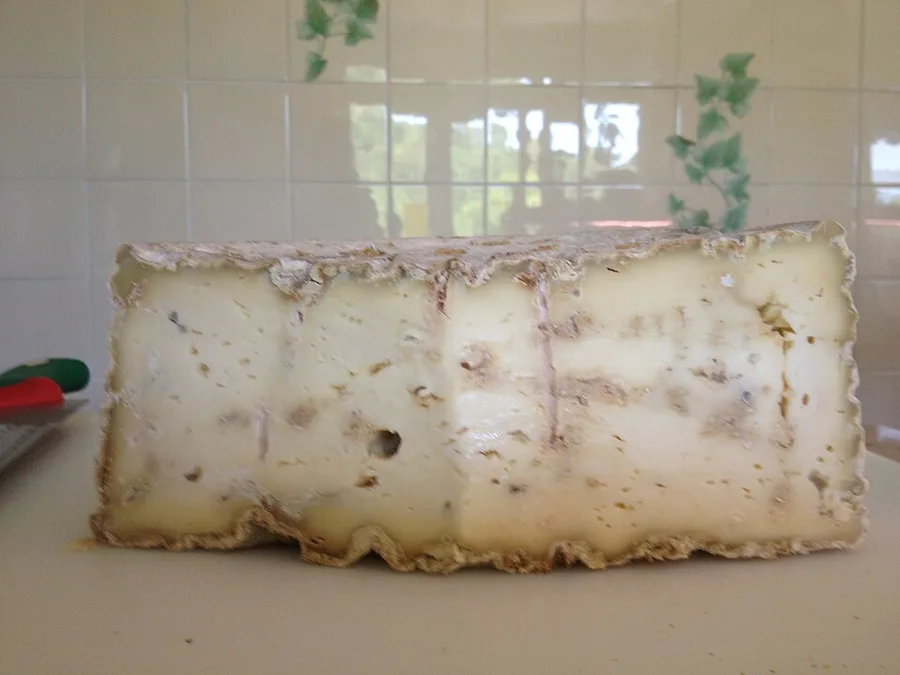
What is Strachitunt?
Strachitunt is a raw whole cow's milk blue cheese from the province of Bergamo in Lombardy, DOP since 2014. The wheels are 4 to 6 kilos, 25 to 28 centimetres across, and 15 to 18 centimetres tall, taller than they are wide, which no other Italian blue is, and the quickest way to identify it.
The technique is the whole story. Curd from the evening milking is left to rest overnight; it cools and acidifies. Curd from the morning milking is fresh and warm. The two are broken by hand and layered alternately into the mould. Because they differ in temperature, acidity and moisture, they never fully knit together, and the fissures left between the layers are where oxygen reaches the interior. Wild moulds already present in the raw milk, the wooden hoops and the cellar air do the rest.
After about a month the wheels are pierced with long needles to open further channels. The veining that results is irregular and blotchy, pockets and patches following the seams between curds, rather than the even marbling of an inoculated blue.
Minimum ageing is 75 days. The specification requires raw milk and a predominance of Bruna Alpina cows, the historic breed of these valleys.
What does it taste like?
Sweeter and rounder than any blue its appearance suggests. There is a clear lactic sweetness underneath, the raw milk of mountain cows, with mushroom, wet stone and cellar behind it, and only a moderate blue bite at the finish. If your reference is Gorgonzola piccante or a mature Stilton, expect roughly half the punch and considerably more nuance.
The texture is the second surprise. It is soft but not creamy, and it crumbles along the seams where the two curds meet, so a slice breaks into irregular pieces rather than spreading. The whiter, less veined sections taste of fresh milk and yoghurt; the darker, veined pockets are savoury and peppery. One mouthful can contain both.
Because nothing is inoculated, no two wheels are the same, and the variation within a single wheel is part of the design rather than a fault. Buy a wedge that runs from rind to centre and taste across it.
How to use it
Treat it as a board cheese first. Serve it at room temperature, an hour out of the fridge and not ten minutes, with the rind on, alongside chestnut or fir honeydew honey, walnuts and pears. Rye bread rather than white. Buy a wedge that runs from rind to centre so you can taste the range within it, because the range is the point.
In cooking, use it sparingly and off the heat. Over polenta taragna it melts unevenly, since the two curds behave differently, and that unevenness is more interesting than the flat result an inoculated blue gives. Stirred into risotto at the end, a small amount carries the dish. In a light cream sauce for stuffed pasta it works well, and on roast potatoes it goes on in the last few minutes.
The rule: never let it boil. Above about 70C the moulds turn bitter and the sweet-savoury balance that separates Strachitunt from gorgonzola disappears entirely.
The local seasonal dish worth copying: Martine pears poached in red wine, served with a piece of Strachitunt alongside.
How long it keeps
Keep it in the vegetable drawer of the fridge, wrapped in greaseproof paper or in foil, never with cling film pressed against it, which smothers the moulds and produces an ammonia smell within days. Foil is acceptable for blues in a way it is not for other cheeses, because it slows the cut face drying. A wedge holds two or three weeks and it never stands still: the blueing keeps advancing even at fridge temperature, so it gets progressively sharper, the paste softens near the veins and the flavour that was mushroomy at the start moves towards pepper.
Blue green growth appearing on a cut face is the same mould that made the cheese, carrying on. Black, pink or furry growth, or a strong ammonia smell, is a different phenomenon, and there the date on the pack and the cheesemonger who cut it are the reference. It does not freeze: the paste separates and the veins turn bitter on thawing. Half an hour out of the fridge is the minimum and an hour is better, because a cold blue gives you only salt and heat.
Spot the real thing
The proportions give it away before anything else: a heel of 15 to 18 centimetres on a wheel only 25 to 28 across, which no other Italian blue has. The denomination mark and the producer code are stamped into the wheel itself, so a wedge should carry them. Cut, the veining has to be irregular and patchy, with blotches, pockets, greener zones and almost white ones, the pattern following the fissures between the two curds. Veins that are thin and evenly spread belong to an inoculated blue, a different cheese however good it is.
The paste is white to ivory, soft but not creamy, and next to gorgonzola it stays firmer and drier, crumbling along the seam where the two curds meet. The rind is thin and wrinkled, grey yellow, with the moulds that arrived on their own. The smell is cellar, raw milk, mushroom and undergrowth, and the bite stays moderate rather than fierce, the opposite of what people expect from a blue. In British and American shops the neighbours are Gorgonzola, Stilton and Roquefort, sharper and more uniform, and none a substitute.
How to pronounce Strachitunt
strah-kee-TOONT
Three syllables, stress firmly on the last. The 'ch' is hard, as in 'school', never soft as in 'church': this is Bergamo dialect, not standard Italian. 'Tunt' rhymes with 'boont', not 'bunt'. The name is simply 'stracchino tondo', round stracchino, compressed by dialect.
Strachitunt compared
vsGorgonzola
This is the comparison that explains the cheese. Historically gorgonzola was also made a due paste, two curds layered so that mould could colonise the seams, and it was inconsistent, slow and difficult. Through the twentieth century producers moved to a single curd with selected Penicillium spores injected into it, which gave a reliable, even, industrially scalable cheese. Strachitunt is what gorgonzola stopped being. It is made from raw milk in one small valley, the mould arrives on its own, and the veining is patchy because the seams are patchy. Gorgonzola dolce is creamier and sweeter, gorgonzola piccante sharper and firmer; Strachitunt is drier, more crumbly, less predictable and more interesting.
| This | Gorgonzola | |
|---|---|---|
| Curd | Two curds layered: cold evening, warm morning | Single curd |
| Mould | Wild, from raw milk and cellar | Selected Penicillium, inoculated |
| Milk | Raw, mostly Bruna Alpina | Pasteurised |
| Veining | Irregular, blotchy, follows the seams | Even and marbled |
| Texture | Soft but crumbly along the seams | Creamy (dolce) or firm (piccante) |
| Minimum ageing | 75 days | 50 days (dolce) or 80 days (piccante) |
| Producers | Fewer than ten dairies | Dozens, including large industrial plants |
| Price | EUR 22-32 per kg | EUR 12-20 per kg |
vsStilton
The blue most English speakers measure everything against, and a useful contrast because the two are built on opposite philosophies. Stilton is made from pasteurised milk, inoculated, hand-ladled into cylinders, dry-salted and matured for nine to twelve weeks into a crumbly, mineral, distinctly salty cheese with even blue veins. Strachitunt uses raw milk, no inoculation and a two-curd structure, and comes out sweeter, wetter and far less uniform.
| This | Stilton | |
|---|---|---|
| Milk | Raw cow's milk | Pasteurised cow's milk |
| Mould | Wild | Inoculated Penicillium roqueforti |
| Structure | Two curds layered | Single curd, hand-ladled |
| Texture | Soft, crumbling along seams | Firm, evenly crumbly |
| Salt | Moderate | Noticeably higher |
| Rennet | Animal, always | Usually vegetarian-suitable |
vsTaleggio
Same valley, same family, opposite outcome. Both descend from the stracchino tradition: cheeses made from the milk of cows tired, stracche, from the seasonal move between plain and mountain, and the Valle Taleggio gave its name to one of them. Taleggio is square, washed-rind, ripened from the outside by surface bacteria, creamy and mild. Strachitunt is round, blue, ripened from the inside by moulds in the seams. The dialect name exists specifically to distinguish the round one from the square one.
| This | Taleggio | |
|---|---|---|
| Shape | Tall cylinder, 4-6 kg | Flat square slab, about 2 kg |
| Ripening | Internal, by wild blue moulds | External, by washed-rind bacteria |
| Milk | Raw | Usually pasteurised |
| Flavour | Blue, sweet-savoury, mushroomy | Creamy, fruity, mildly funky |
| Production | A few dozen tonnes a year | Around nine thousand tonnes a year |
Strachitunt substitutes
- Gorgonzola piccante DOP
The closest available cheese and the direct descendant of the same technique. Firmer and sharper than Strachitunt, with even veining and a more consistent bite. Use it anywhere Strachitunt is called for and expect a louder, less varied result.
1:1 - Gorgonzola dolce DOP
Better if the recipe wants the cheese to melt into a sauce, since it is far creamier. Sweeter and softer than Strachitunt, with none of the crumble, so it is the wrong choice for a cheeseboard comparison and the right one for a risotto.
1:1, or slightly less as it is richer - Stichelton
For UK readers this is the sharpest substitute conceptually: a raw-milk English blue made deliberately outside the Stilton denomination in order to use unpasteurised milk. Saltier and firmer than Strachitunt, but the same argument about raw milk and wild character runs through it.
1:1 - Cashel Blue or Rogue River Blue
Farmhouse blues from Ireland and Oregon respectively, both moister and sweeter than Stilton and closer in balance to Strachitunt. Rogue River Blue is seasonal and expensive; Cashel Blue is affordable and stocked across the UK.
1:1 - Bleu d'Auvergne or Fourme d'Ambert
Widely available French blues in the middle of the intensity range. Fourme d'Ambert in particular is mild, tall-cylindrical and gentle, which makes it the nearest thing on a supermarket shelf to Strachitunt's proportions and restraint.
1:1 - Vegetarian: microbial-rennet blues
Strachitunt is never vegetarian: the specification requires animal rennet, as do Gorgonzola, Taleggio and Roquefort. Stilton, Cashel Blue and most British blues are the exception: they are typically made with microbial rennet and labelled 'suitable for vegetarians'. That is the practical route.
1:1
Where to buy it
This is one of the smallest DOP productions in Italy: fewer than ten dairies, a few dozen tonnes a year, so outside Lombardy it is a special order. In the US, look to Murray's, Formaggio Kitchen, Eataly and specialist importers, at roughly 28 to 40 dollars per pound when it appears at all. In the UK, expect 35 to 50 pounds per kilo through Italian specialists and serious cheesemongers, and expect to wait.
At the counter, check the veining. It should be irregular and patchy, with pockets and blank areas following the seams between curds. Regular, even marbling means an inoculated blue, which Strachitunt is not. The rind should be thin, wrinkled and greyish-yellow with natural moulds.
Ask for a wedge cut from rind to centre rather than a slab from one side, and ask the age: at 75 days it is sweet and lightly veined, at four or five months markedly more savoury.
In Bergamo the price is 22 to 32 euros a kilo, against 12 to 20 for gorgonzola DOP, made in tens of thousands of tonnes rather than tens.
Where to eat it in Italy
The Valle Taleggio is reached from San Giovanni Bianco, in the Val Brembana, up a narrow road that threads through a gorge. The villages (Taleggio with its hamlets of Peghera, Sottochiesa and Olda, plus Vedeseta, Gerosa and Blello) hold a few hundred people each, and the dairies are the main economic activity and sell at the door.
Some producers still age cheese in natural rock cellars that hold the temperature and humidity the mountain provides free, and several will show them on request.
Bergamo is an hour away and is the practical base: the old shops of the Città Alta stock Strachitunt alongside the province's other protected cheeses, and Bergamo has more DOP cheeses within its boundaries than any other province in Europe. In October the city hosts Forme, a festival built entirely around them, which is the single best opportunity to taste several producers' wheels side by side.
Combine it with the Val Brembana: the Liberty-style spa architecture of San Pellegrino Terme, and further up the valley the alpine pastures that make Formai de Mut. Milan Bergamo airport is thirty minutes from the city.
Further reading
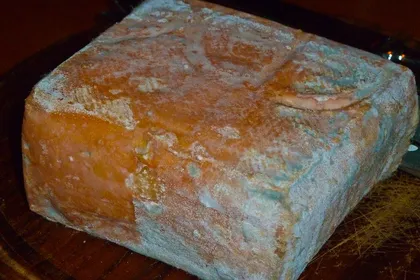 GuideCan you eat cheese rind?On some wheels the rind is the same paste, dried out. On others it is paraffin.
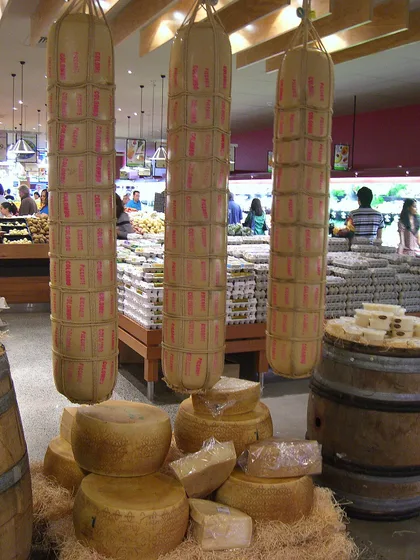 ExplainerWhich Italian cheeses contain no lactoseItaly sets a legal threshold, and long-aged cheeses clear it on their own, with no treatment involved.
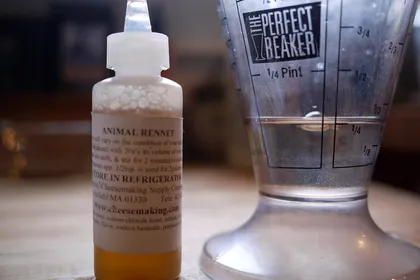 InvestigationWhich Italian cheeses are vegetarianWe counted what rennet the 43 cheeses in our atlas declare: 35 out of 43 say animal, none say otherwise.
Frequently asked questions
What does Strachitunt mean?
'Round stracchino' in the Bergamo dialect. Stracchino is the historic name for cheeses made from the milk of cows tired, stracche, by the seasonal move between plain and mountain, and 'tunt' means round, distinguishing it from Taleggio, which is square.
How is Strachitunt different from gorgonzola?
The method. Strachitunt layers cold evening curd with warm morning curd, and wild moulds colonise the fissures between them; nothing is inoculated. Modern gorgonzola uses a single curd with selected Penicillium injected into it, giving even veining and consistent results. Historic gorgonzola was also made with two curds, and Strachitunt is the version that never changed.
Is Strachitunt very strong?
Less than it looks. It is a medium-intensity blue with a persistent lactic sweetness underneath and a moderate bite at the finish. Anyone expecting the punch of gorgonzola piccante or a mature Stilton will find it noticeably gentler and more complex.
Why is it so expensive?
Scale. Fewer than ten dairies in four small municipalities make it, from raw milk, without inoculation, totalling a few dozen tonnes a year. Gorgonzola DOP is measured in tens of thousands of tonnes.
Is Strachitunt vegetarian?
No. The specification requires animal rennet, as do Gorgonzola, Taleggio and Roquefort. Most British blues, Stilton and Cashel Blue among them, are made with microbial rennet and labelled suitable for vegetarians, and are the practical alternative.
Sources
Where to check what you just read.
- 1
L'atto del 7 marzo 2014 che ha iscritto «Strachitunt» fra i formaggi DOP: una delle DOP casearie italiane più recenti, il che spiega quanto sia piccola la produzione.
- 2
Il PDF del disciplinare vigente, dove si verificano la tecnica delle due paste a temperature diverse, l'uso di latte crudo e la stagionatura minima.
- 3Consortium · interested partyConsorzio per la Tutela dello Strachítunt Valtaleggio
I pochi produttori autorizzati in Val Taleggio e la descrizione della lavorazione: serve a capire quante forme esistono davvero e dove trovarle.
Related foods
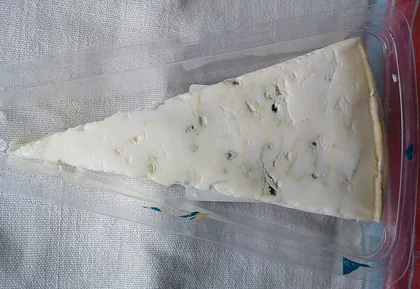 CheeseGorgonzolaThe green veining is the product, not a flaw anyone tolerates: it grows from a mould added to the milk and…
 CheeseTaleggioTaleggio DOP is a square, washed-rind cow's milk cheese from the Bergamo Alps, aged at least 35 days.
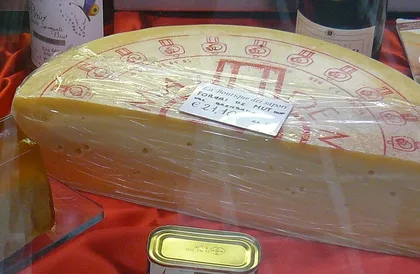 CheeseFormai de MutFormai de Mut means mountain cheese in the Bergamo dialect, and it is the alpine cheese almost nobody outside…Pasta and breadPolenta TaragnaPolenta taragna is the dark alpine polenta of Lombardy: cornmeal cut with buckwheat flour, stirred for the…
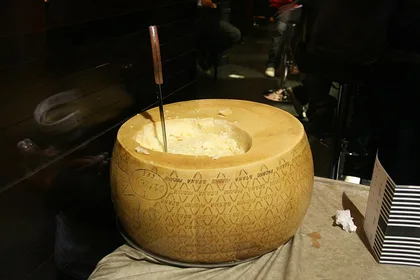 CheeseGrana PadanoNine months is the floor the specification sets before a wheel may carry the name.
 CheeseProvoloneProvolone is a stretched-curd cow's milk cheese from northern Italy, rope-tied and hung to age in shapes from…
 CheeseRobiolaRobiola is a family of soft young cheeses from north-west Italy rather than a single cheese.
 CheeseBittoBitto DOP can only be made between 1 June and 30 September, on high summer pasture, in a dismantlable stone…