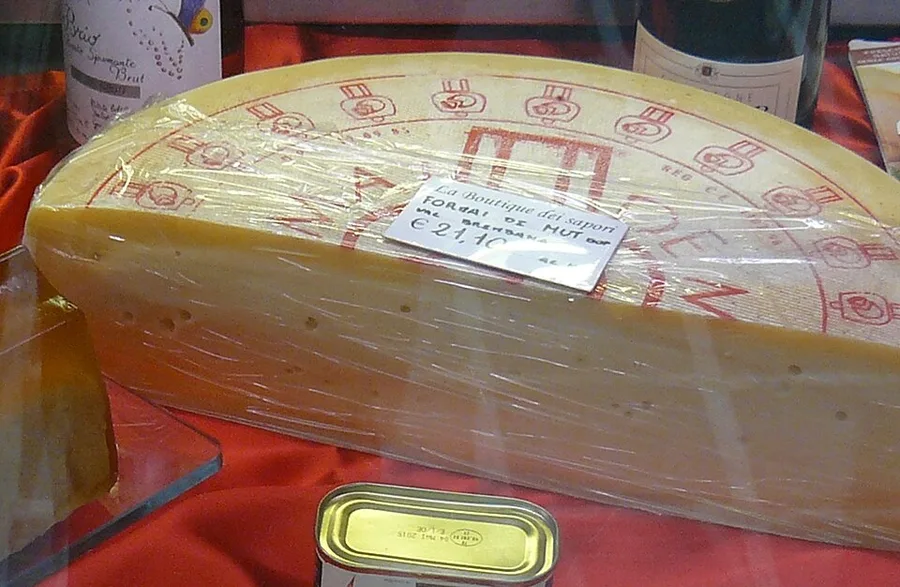
What is Formai de Mut?
Formai de Mut dell'Alta Valle Brembana is a semi-cooked raw cow's milk cheese from the upper Brembo valley, north of Bergamo, inside the Orobie Bergamasche park. Wheels weigh 8 to 12 kilos, measure 30 to 40 centimetres across, and have straight or very slightly concave sides, with a thin straw-yellow rind that greys and browns with age.
The denomination covers two cheeses that share a name. The valley version is made all year in dairies along the floor of the Val Brembana and is the everyday table cheese of the area. The monticazione version is made only during the summer transhumance, from 1 June to the end of September, up on the pasture, from milk worked minutes after milking. Alpine wheels carry their own mark and usually the name of the individual malga that made them. They are a small fraction of total output and a genuinely different cheese, not a marketing tier.
Minimum ageing is 45 days. Most of what is sold sits between two and six months; alpine wheels take a year and more without tiring. The milk is raw and whole, with no skimming and no pasteurisation, and the rennet is calf.
Production is small, a few hundred tonnes a year against the tens of thousands of the industrial names, which is why the cheese is effectively unknown twenty kilometres outside its valley, let alone abroad.
What does it taste like?
The valley version tastes of sweet milk, butter and cooked hay, with a nutty finish and a clean, gentle acidity. The texture is the point: firm, elastic, faintly springy, with tiny scattered eyes. It is a friendly cheese, easy to eat in quantity, closer to a young Alpkäse than to anything sharp.
The alpine version is a different proposition. Milk from cows eating high-summer pasture carries herbs into the cheese, and it shows as a green, almost mentholated top note over the butter. At six months to a year it becomes savoury and deep, with hazelnut and dried-mushroom notes and a long finish that turns faintly meaty.
Across both, the register is sweet rather than salty. If you know Fontina Val d'Aosta, start there and add firmness; if you know Comté, start there and remove some of the salt and the brothy weight. Nothing about it is challenging: the reason to seek it out is the pasture, not the punch.
How to use it
Young Formai de Mut is a melting cheese. The local dish is polenta taragna bergamasca: buckwheat and cornmeal polenta, cooked long, with cubes of cheese and plenty of butter stirred in off the heat until the whole thing turns glossy and pulls in short strings. It also works grated over casoncelli, the local stuffed pasta, with brown butter and pancetta, and in a savoury tart with potatoes and onion.
The rule that matters is heat. Above about 70C the fat separates and you get a rubbery mass that nothing recovers. Add it off the flame, or melt it in a bain-marie with a splash of milk and an egg yolk for a mountain fondue to pour over boiled potatoes.
Past six months it becomes a board cheese. Serve it in shards at room temperature with rhododendron or chestnut honey, walnuts and pears. Year-old alpine wheels are strong enough to grate in small quantities over barley soup or risotto, where the herbal note carries the whole dish.
How long it keeps
Fridge, vegetable drawer, wrapped first in a barely damp cloth and then in greaseproof paper. A young piece holds three or four weeks that way and an aged one about two months, while a vacuum pack runs to its printed date, which is the dairy's reference. Cling film laid straight on the cheese is the worst option available: the paste cannot breathe, the rind softens and the cut face turns slick within days.
What the cheese does over those weeks is lose water from the outside in. The cut face dries, hardens and darkens slightly, and a millimetre scraped off with a knife gets you back to the paste; as moisture leaves, the salt concentrates and the flavour sharpens. Dry white or green bloom on the rind lifts with a cloth dipped in vinegar or white wine, while anything else on the surface is a question for the shop and the date on the label. Whole wheels live in a cellar at 8 to 12 C with high humidity, turned every fortnight. Freezing is not for this cheese: it tears the semi-cooked paste and leaves it mealy.
Spot the real thing
The heel of a certified wheel carries the denomination mark stamped into it with the dairy code, and summer mountain wheels add the alpeggio mark, usually alongside the name of the hut written or cut by hand. That is the first thing to find, because ten euros a kilo separate the two. The paste should be compact and elastic, ivory in young wheels and straw-coloured with altitude and age, with sparse, tiny eyes of the kind Italians call partridge-eye. Large irregular holes are a sign of an odd fermentation rather than a feature of the type.
The rind is thin and even, never thick and cracked, and a cut piece should neither crumble nor bead with whey; a sweating wedge has been under cling film too long. The mistake worth avoiding in the valley itself, and on any counter that stocks both, is Branzi. It comes from the same Val Brembana, it is made all year, the wheels are bigger and the paste softer, and it is a fine cheese, but it is not DOP and it costs less. Sold as Formai de Mut, it is trading on the confusion.
How to pronounce Formai de Mut
for-MY deh MOOT
Three beats, stress on 'MY' and on 'MOOT'. It is dialect, not standard Italian: 'formai' collapses to two syllables, roughly the English word 'my' with 'for' in front, and 'mut' rhymes with 'boot', never with 'but'. Locals shorten the full name, Formai de Mut dell'Alta Valle Brembana, to the first three words, and so should you.
Formai de Mut compared
vsBitto
The two cheeses of the same mountain ridge, made on opposite sides of it. Bitto belongs to the Valtellina, north of the Orobie crest; Formai de Mut to the Val Brembana, south of it. A handful of upper Brembana municipalities sit inside both denominations, so the same pasture can legally produce either. The difference is in the rules: Bitto exists only as a summer alpine cheese, permits up to 10% Orobica goat's milk and ages for years; Formai de Mut is made year-round in the valley as well, never contains goat's milk, and is mostly eaten young. Bitto is the more famous and roughly twice the price; Formai de Mut is the one locals actually cook with.
| This | Bitto | |
|---|---|---|
| Valley | Val Brembana, Bergamo | Valtellina, Sondrio (plus alpine Bergamo and Lecco) |
| Season | Year-round, plus a summer alpine version | 1 June to 30 September only |
| Goat's milk | Never permitted | Optional, up to 10%, Orobica breed |
| Wheel | 8-12 kg, straight sides | 8-25 kg, markedly concave sides |
| Minimum ageing | 45 days | 70 days |
| Usual age sold | 2-6 months | 1-3 years, sometimes far longer |
| Price | EUR 14-35 per kg | EUR 18-45 per kg, more for old wheels |
vsValtellina Casera
The other everyday alpine cheese of northern Lombardy, and the closest thing to a like-for-like comparison. Casera is made from partly skimmed milk in valley dairies across the province of Sondrio; Formai de Mut uses whole milk and is a smaller, richer, more buttery wheel. Casera is the standard melting cheese for pizzoccheri, Formai de Mut for the Bergamo version of polenta taragna. If you find both, buy both: the fat difference is obvious side by side.
| This | Valtellina Casera | |
|---|---|---|
| Milk | Whole raw milk | Partly skimmed cow's milk |
| Wheel | 8-12 kg | About 7-12 kg |
| Texture | Richer, more elastic | Leaner, slightly firmer |
| Minimum ageing | 45 days | 70 days |
| Classic dish | Polenta taragna bergamasca, casoncelli | Pizzoccheri, sciatt |
| Price | EUR 14-20 per kg (valley version) | EUR 12-18 per kg |
vsFontina Val d'Aosta
The Italian alpine cheese English speakers are most likely to know, and a fair orientation point. Both are raw whole-milk mountain cheeses with a sweet, buttery register, and both have a summer alpine version made above the treeline. Fontina is softer, wetter and melts into a proper fondue; Formai de Mut is firmer, drier and holds its shape longer under heat. Fontina is on supermarket shelves in the US and UK; Formai de Mut is a specialist order.
| This | Fontina Val d'Aosta | |
|---|---|---|
| Region | Lombardy, upper Val Brembana | Valle d'Aosta |
| Paste | Semi-cooked, firm and elastic | Semi-cooked, softer and more yielding |
| Wheel | 8-12 kg | 7.5-12 kg |
| Melting | Good, but holds shape | Exceptional, the fonduta cheese |
| Availability abroad | Rare, specialist importers | Widely stocked |
Formai de Mut substitutes
- Fontina Val d'Aosta DOP
The closest Italian match and the easiest to find abroad. Sweeter and softer, so a dish made with it will be looser and richer. For melting applications it is a straight swap; on a board it reads younger.
1:1 - Valtellina Casera DOP
Same mountains, leaner milk. If you are cooking a buckwheat dish (pizzoccheri, polenta taragna) this is the substitute that behaves correctly, and it is cheaper than either original.
1:1 - Asiago d'allevo (mezzano)
Widely stocked in Italian delis on both sides of the Atlantic. Firmer and blunter, with less herbal lift, but it grates and melts in the same places and costs less than any alpine DOP.
1:1 - Swiss Alpkäse or Le Gruyère d'Alpage AOP
For the alpine version specifically, this is the right structural analogue: raw milk, summer pasture, semi-cooked paste. Saltier and more brothy than Formai de Mut, so pair it with honey to rebalance.
1:1 - Comté aged 12-18 months
Available everywhere and reliably good. Rounder and sweeter, without the herbal note; the best stand-in on a cheeseboard when nothing Italian is available.
1:1 - Vegetarian: microbial-rennet alpine-style tomme
Formai de Mut is never vegetarian: the specification requires calf rennet, and so do Bitto, Fontina, Comté and Gruyère. Look for British, Irish or American farmhouse alpine-style wheels explicitly labelled 'suitable for vegetarians' or 'microbial rennet'; several behave identically in a melted dish.
1:1
Where to buy it
This is a genuinely hard cheese to find outside Lombardy. In the US, look to specialist importers and cheese counters that carry Italian alpine wheels: Murray's, Formaggio Kitchen, Eataly and the better regional cheesemongers occasionally list it, most often in autumn when the summer alpine wheels come down. Expect roughly 22 to 35 dollars per pound, more for a named malga.
In the UK, Italian delicatessens and alpine-cheese specialists are the realistic route, at about 28 to 45 pounds per kilo. Neither market stocks it consistently, and it is worth asking a good cheesemonger to source it rather than hunting shelves.
When you find it, check two things: the denomination mark branded on the side, and whether the wheel is valley or monticazione. The alpine version costs ten euros a kilo more at source and should not be sold at the valley price, or bought at the alpine price without the mark. Also, do not accept Branzi as a substitute sold under the same name: it is a fine cheese from the same valley, but it is not the DOP and it is cheaper.
Where to eat it in Italy
Branzi is the natural base: the village dairy has been working for over a century, and the road onward serves Carona, Foppolo and Valleve. Piazza Brembana, Valtorta, Ornica and Mezzoldo are the other villages where the cheese is bought where it is made.
In summer, walk up to the malghe of the upper valley or eat at the Orobie mountain huts, where the cheese arrives on the board a day after leaving the mould. The Passo San Marco above Mezzoldo is the old Venetian road over the ridge into the Valtellina, and it crosses pastures that also make Bitto DOP.
Bergamo itself is forty-five minutes from the valley mouth and the obvious base for anyone flying into Milan Bergamo airport. The old shops of the Città Alta stock both versions and will let you taste them side by side, which is the fastest way to understand the cheese. In October the city hosts Forme, a festival built around the province's protected cheeses, since Bergamo has more DOP cheeses within its boundaries than any other province in Europe, and this is where they are all in one place.
Further reading
 ExplainerWhich Italian cheeses contain no lactoseItaly sets a legal threshold, and long-aged cheeses clear it on their own, with no treatment involved.
 GuideHow long food keeps once openedThe date on the label describes the sealed package. After that, four things govern everything: water, salt…
 InvestigationItalian raw milk cheeses: the full listWe counted: 19 of 43 declare raw milk, and 16 of those 19 carry a protected designation.
Frequently asked questions
What does Formai de Mut mean?
Mountain cheese, in the Bergamo dialect. 'Formai' is cheese and 'mut' is the high summer pasture, so the name literally describes the cheese made up on the alp between June and September.
Is Formai de Mut the same as Branzi?
No. Branzi is a traditional cheese from the same valley, made year-round in larger wheels with a softer, more melting paste, but it has no protected denomination. It is very good and costs less. Some sellers blur the line, so check for the DOP mark on the rind.
What is the difference between the valley and alpine versions?
Season and altitude. The valley version is made all year in dairies on the valley floor. The monticazione version is made only from 1 June to the end of September, on high pasture, from milk worked immediately after milking, and carries its own mark plus usually the name of the malga. It is scarcer, more herbal and about ten euros a kilo dearer.
Is Formai de Mut vegetarian?
No. The specification requires calf rennet, as do Bitto, Fontina, Comté and Gruyère. Alpine-style cheeses explicitly labelled as made with microbial rennet are the practical alternative.
What can I use instead of Formai de Mut?
Fontina Val d'Aosta for melting and general use, Valtellina Casera if you are cooking a buckwheat dish, and Comté or Swiss Alpkäse on a cheeseboard. None is identical, but all sit in the same sweet, buttery, alpine register.
Sources
Where to check what you just read.
- 1
L'allegato registra la denominazione per esteso, «Formai de Mut dell'Alta Valle Brembana»: è il nome completo a essere protetto, non le prime tre parole.
- 2
Il PDF del disciplinare vigente, dove si verificano i comuni ammessi, la differenza fra produzione di alpeggio e di fondovalle e la stagionatura minima.
- 3Consortium · interested partyConsorzio per la Tutela e Valorizzazione del Formai de Mut dell'Alta Valle Brembana
L'ente attivo dal 1997 con gli elenchi di aziende e alpeggi: serve a capire quali malghe producono davvero sotto marchio DOP.
Related foods
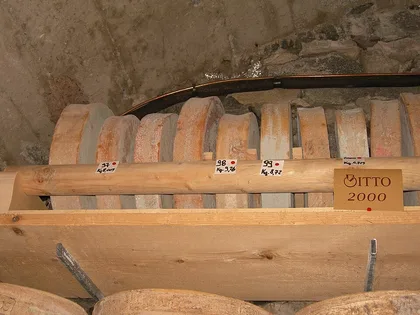 CheeseBittoBitto DOP can only be made between 1 June and 30 September, on high summer pasture, in a dismantlable stone…
 CheeseTaleggioTaleggio DOP is a square, washed-rind cow's milk cheese from the Bergamo Alps, aged at least 35 days.Pasta and breadPolenta TaragnaPolenta taragna is the dark alpine polenta of Lombardy: cornmeal cut with buckwheat flour, stirred for the…
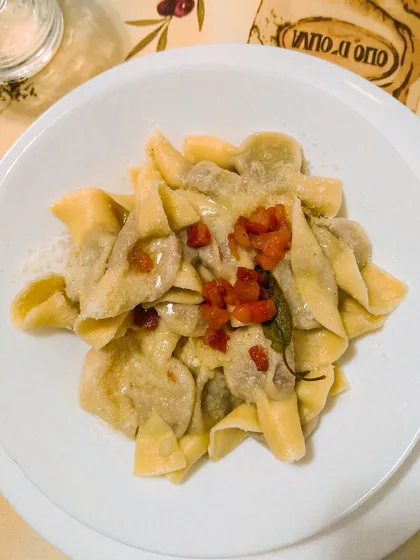 Pasta and breadCasoncelliCasoncelli are Bergamo's stuffed pasta: beef and salami filling laced with crushed amaretti and raisins…
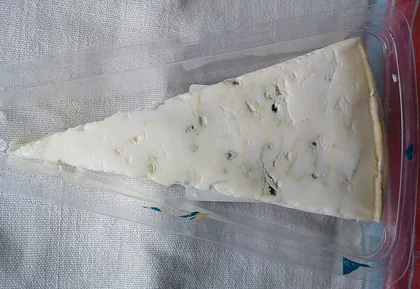 CheeseGorgonzolaThe green veining is the product, not a flaw anyone tolerates: it grows from a mould added to the milk and…
 CheeseGrana PadanoNine months is the floor the specification sets before a wheel may carry the name.
 CheeseProvoloneProvolone is a stretched-curd cow's milk cheese from northern Italy, rope-tied and hung to age in shapes from…
 CheeseRobiolaRobiola is a family of soft young cheeses from north-west Italy rather than a single cheese.