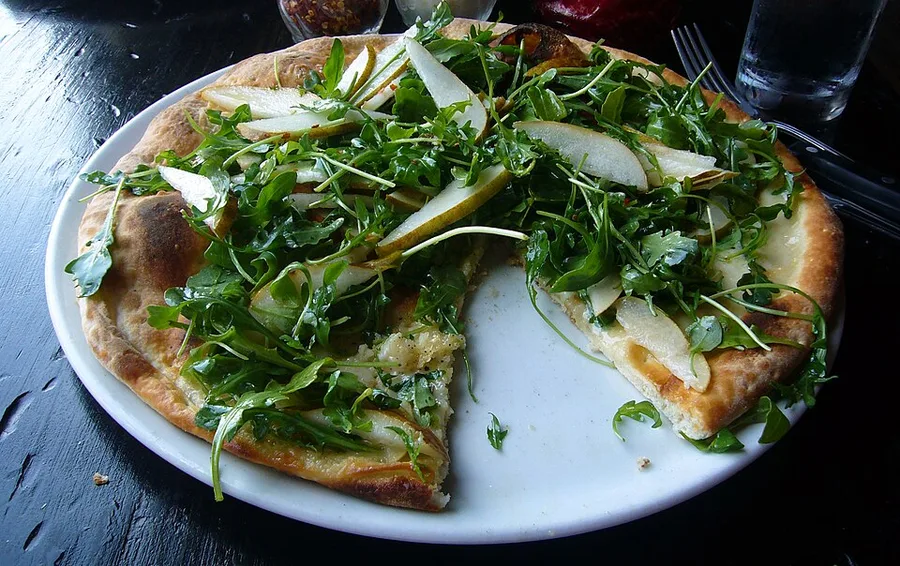
What is Taleggio?
Taleggio is a soft, washed-rind cheese made from whole cow's milk, shaped into squares of about 18 to 20 centimetres a side and 4 to 7 centimetres deep, weighing roughly two kilos. The shape is functional rather than decorative: a flat square gives a lot of surface relative to volume, and in a washed-rind cheese ripening travels inwards from the rind.
It belongs to the stracchino family (cheeses made in Lombardy from the milk of cows tired, stracche, after coming down from summer pasture) and was known for centuries as stracchino quadro. The name Taleggio, from the Val Taleggio in the Bergamo Alps, only took hold in the twentieth century.
During ripening the rind is sponged weekly with brine. That washing encourages Brevibacterium linens on the surface, which produces both the powerful smell and the enzymes that soften the paste into a runny ring beneath the rind.
What does it taste like?
This is the classic case of a cheese that smells much stronger than it tastes. The aroma is barnyard and cellar and, honestly, feet: the same bacterium is at work on both. The flavour is mild by comparison: milky and buttery up front, then a fruity tang, a hint of hazelnut, and a light salty finish. There is none of the aggression the smell promises.
Texture is the other half of the appeal. A well-ripened Taleggio has an almost liquid layer just under the rind and a firmer, faintly chalky centre. Young wheels are more uniform and mild; at sixty or seventy days the whole paste goes yielding and the fruitiness deepens.
Melted, it turns silky and even-textured, without the elastic stretch of mozzarella or the graininess of a hard cheese.
How to use it
Taleggio is a melting cheese first. Cube it and stir it into polenta off the heat, fold it through a risotto at the mantecatura, lay it over a pizza in place of mozzarella, or melt it over roasted asparagus, potatoes or radicchio. It goes smooth and even rather than stringy, which is why Italian cooks reach for it in gratins.
One rule: add it with the heat off. Above about 70°C the fat separates and the cheese turns oily. And use it alone, because its aroma overwhelms almost any cheese you blend it with.
On a board, serve it at room temperature, rind on if you like the intensity. Rye bread, chestnut honey, walnuts and pear mostarda are the traditional Lombard partners. It also makes an outstanding toasted sandwich with prosciutto cotto and a little mustard.
How long it keeps
Keep it in the fridge at 4 to 6°C, and if there is a vegetable drawer use it, because the higher humidity there stops the rind drying out. Wrap it in the two-layer cheese paper it came in, or in baking paper with a loose sheet of foil outside; do not press cling film onto the rind, which seals the surface, traps moisture and makes the paste sweat. A cut wedge holds a week or two, an uncut wheel several weeks, and the producer date is the reference for both.
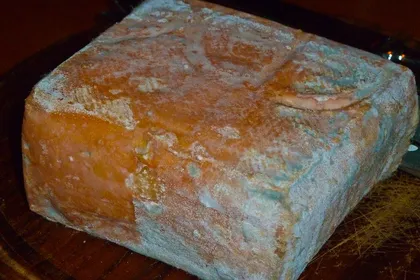
It keeps changing in the fridge, which is the point of a washed rind cheese. The rind deepens in colour and puts out more white and grey bloom, the soft band under the rind widens as it works inwards, the chalky core shrinks and eventually disappears, and the smell gains an ammoniacal edge as the proteins break down further. A cut face left open dries into a firm skin and the edges harden. Freezing turns the paste crumbly and grainy on thawing, so it only makes sense for cooking.
Spot the real thing
Taleggio is square, roughly 20cm on a side and 5 to 7cm high, and a whole wheel weighs about two kilos, so what you see at a counter is usually a wedge cut from that square. The consortium mark is pressed into the rind as four circles, each carrying a stylised T and the wheel number, and a wedge should still show part of it. The rind itself is thin, pink-orange with grey and white bloom. Inside, the paste is ivory, noticeably softer in the band just under the rind and firmer towards the centre when young. It smells far stronger than it tastes.
What gets sold alongside it: Taleggio style squares made in the United States and elsewhere, which cannot use the DOP name; Quadrello di Bufala, a buffalo milk square of similar shape; and Stracchino or Crescenza, which come from the same tradition but are fresh and rindless. Bloomy rind cheeses like brie have a white fuzzy rind, not an orange washed one. Reckon on 12 to 18 euro a kilo in Italy, £3 to £5 for a 200g wedge, $18 to $28 a pound.
How to pronounce Taleggio
tah-LED-joh
Three syllables, stress on the second. The double 'gg' before an 'i' makes a held 'dj' sound, as in 'edge', not a hard 'g' and not a French 'zh'. Common mistakes are 'ta-LEG-ee-oh' and 'ta-LAY-zhee-oh'. Give the double consonant a slight lean and drop the 'i' entirely.
Taleggio compared
vsBrie
Both are soft and both have a rind, but they are made by opposite methods. Brie is a bloomy-rind cheese, ripened by white Penicillium mould growing on the outside; Taleggio is washed-rind, ripened by bacteria encouraged with brine. Taleggio is tangier, fruitier and meatier; brie is creamier and more mushroomy.
| This | Brie | |
|---|---|---|
| Rind type | Washed, pinkish-orange with grey moulds | Bloomy, white and downy |
| Ripening agent | Brevibacterium linens, brine-washed | Penicillium camemberti |
| Shape | Square, about 2 kg | Round wheel, 1-3 kg |
| Minimum ageing | 35 days | Around 4 weeks for Brie de Meaux AOP |
| Smell | Strong, cellar and barnyard | Mild, mushroomy |
| Flavour | Fruity, tangy, faintly nutty | Buttery, creamy, mushroomy |
| Melting | Excellent, smooth and even | Melts but can go oily and split |
| Price | $12-20 per lb | $10-18 per lb |
vsFontina Val d'Aosta
The other great Italian melting cheese, and the one Taleggio is most often confused with on a cheeseboard. Fontina is firmer, made from raw Alpine milk, aged three months minimum, and tastes nuttier and more savoury. Taleggio is softer, tangier and younger.
| This | Fontina Val d'Aosta | |
|---|---|---|
| Texture | Soft, runny under the rind | Semi-firm, sliceable, elastic |
| Milk | Whole cow's milk, raw or pasteurised | Raw whole milk, single Valdostana herd |
| Minimum ageing | 35 days | 3 months |
| Flavour | Tangy, fruity, mild | Nutty, earthy, savoury, more intense |
| Shape | Square, 2 kg | Wheel, 8-12 kg |
| Classic dish | Polenta, pizza, risotto | Fonduta |
vsReblochon
The closest French cousin, and the fairest one-to-one comparison. Both are washed-rind, both are made from cow's milk in an Alpine valley, both melt beautifully. Reblochon is rounder in shape and flavour, with a stronger nutty note; Taleggio is squarer, tangier and a little saltier.
| This | Reblochon | |
|---|---|---|
| Origin | Val Taleggio, Lombardy | Haute-Savoie, France |
| Shape | Square, about 2 kg | Disc, 450-550 g |
| Milk | Raw or pasteurised cow | Raw cow, from three Alpine breeds |
| Ageing | 35 days minimum | Around 4-5 weeks in a cellar |
| Flavour | Fruity, tangy, salty finish | Nutty, creamy, slightly sweet |
| Signature dish | Polenta taragna | Tartiflette |
| US availability | Widely imported | Raw-milk version banned; pasteurised versions only |
vsStracchino and Crescenza
Taleggio's own relatives, and the source of a lot of shelf confusion. Stracchino and Crescenza are fresh, rindless, eaten within days; Taleggio is the aged, washed-rind member of the same family. If a recipe wants a spreadable mild white cheese it means stracchino, not Taleggio.
| This | Stracchino and Crescenza | |
|---|---|---|
| Rind | Washed, pinkish, edible | None |
| Ageing | 35 days or more | Days, sold fresh |
| Texture | Soft with a runny ring | Uniformly soft, spreadable, wet |
| Flavour | Tangy, fruity, aromatic | Sweet, milky, lactic |
| Protected | DOP | No protected designation |
Taleggio substitutes
- Fontina Val d'Aosta
The best all-round replacement when Taleggio is going into something hot. Firmer and nuttier, so it will make a polenta or gratin more savoury and less tangy. Grate rather than cube it.
1:1 - Reblochon
Structurally the closest substitute: same washed rind, same soft interior, same melting behaviour. Note that raw-milk Reblochon cannot be sold in the US; the pasteurised versions are milder still.
1:1 - Brie or Camembert (ripe)
Works when Taleggio is a board cheese or a filling. In cooking it splits more readily, so keep the heat low and add it at the end. Trim the rind if you want the flavour closer to Taleggio.
1:1 - Raclette
If the point of the recipe is melting (potatoes, gratins, toasted sandwiches) raclette does the job better than any soft cheese and is easy to find. It is nuttier and less tangy, and firmer to slice.
1:1 - Vegetarian: Stinking Bishop or Tunworth
Taleggio is not vegetarian: the DOP requires calf rennet. Charles Martell's Stinking Bishop is an English washed-rind made with vegetarian rennet and is the closest match in style, though considerably more pungent. Tunworth is a vegetarian-rennet Camembert-style alternative for a milder result.
1:1, using less Stinking Bishop if flavour matters more than volume - Vegan: cultured cashew washed-rind styles
Nothing reproduces a washed rind convincingly, but cashew-based soft cheeses from Miyoko's or Climax melt into polenta and gratins acceptably. Add a teaspoon of white miso and a squeeze of lemon to get some of the tang back.
Where to buy it
In the US, Taleggio is one of the more widely distributed Italian soft cheeses: Whole Foods, Wegmans, Central Market and Italian delis carry it, as do online sellers like Murray's, Eataly and iGourmet. Expect $12-20 per pound. Most imported wheels are pasteurised, since raw-milk versions under 60 days cannot legally enter the US.
In the UK, Waitrose, Ocado, Neal's Yard Dairy and Italian delicatessens stock it at roughly £18-30 per kilo, with raw-milk wheels available at specialist cheesemongers.
Check the flat face for the Consorzio mark: four circles in a row, three carrying the letter T and one carrying the dairy's number, impressed into the rind. Buy a cut piece rather than a pre-wrapped one where you can, and ask when it was cut, because Taleggio does not improve in cling film. A slightly damp, pinkish rind with grey-green mould patches is correct; a sticky, slimy rind or an ammonia smell running into the paste is not.
Where to eat it in Italy
The Val Taleggio itself, an hour north of Bergamo between the Valsassina and the Val Brembana, is where the cheese was born, and a handful of dairies around Vedeseta and Taleggio still ripen in natural caves cut into the rock. Several take visitors by appointment, and the difference from cellar-aged wheels is obvious in the rind.
Bergamo Alta, the walled upper town, has cheese shops carrying ageings that never reach supermarkets, and hosts Forme every September, a festival dedicated to the DOP cheeses of the Orobie Alps.
For Taleggio in its natural context, the mountain huts and rifugi of the Orobie serve it melted over polenta taragna from October onwards, which is the single best way to eat it.
Further reading
 GuideCan you eat cheese rind?On some wheels the rind is the same paste, dried out. On others it is paraffin.
 GuideHow long food keeps once openedThe date on the label describes the sealed package. After that, four things govern everything: water, salt…
 InvestigationWhich Italian cheeses are vegetarianWe counted what rennet the 43 cheeses in our atlas declare: 35 out of 43 say animal, none say otherwise.
Frequently asked questions
Can you eat the rind of Taleggio?
Yes. The washed rind is edible and concentrates the flavour, though on a very ripe wheel it can be too pungent for some. Trim it if you prefer; it is never harmful.
Why does Taleggio smell so strong?
Because the rind is washed weekly with brine, which encourages Brevibacterium linens, the same bacterium responsible for the smell of human feet. The taste, unusually, is far milder than the aroma.
Is Taleggio vegetarian?
No. The DOP specification calls for calf rennet. For a vegetarian washed-rind alternative, Stinking Bishop from Gloucestershire uses microbial rennet and is close in style, if stronger.
Does Taleggio melt well?
Very well: it is one of Italy's best melters. It goes smooth and even without stringing, provided you add it off the heat. Above roughly 70°C the fat separates and it turns greasy.
How do you pronounce Taleggio?
tah-LED-joh, three syllables, stress on the second, with the double 'gg' making an 'edge' sound and the 'i' silent.
Sources
Where to check what you just read.
- 1
L'allegato del 12 giugno 1996 dove «Taleggio» compare fra le DOP italiane: la data da cui il nome smette di essere un tipo di formaggio qualsiasi.
- 2
Il disciplinare del Taleggio in PDF: misure e peso della forma quadrata, giorni minimi di maturazione, province lombarde, piemontesi e venete ammesse.
Related foods
 CheeseGorgonzolaThe green veining is the product, not a flaw anyone tolerates: it grows from a mould added to the milk and…
 CheeseGrana PadanoNine months is the floor the specification sets before a wheel may carry the name.
 CheeseAsiagoOne name covers two cheeses nobody would mistake for each other at the counter.
 CheeseProvoloneProvolone is a stretched-curd cow's milk cheese from northern Italy, rope-tied and hung to age in shapes from…
 CheeseRobiolaRobiola is a family of soft young cheeses from north-west Italy rather than a single cheese.
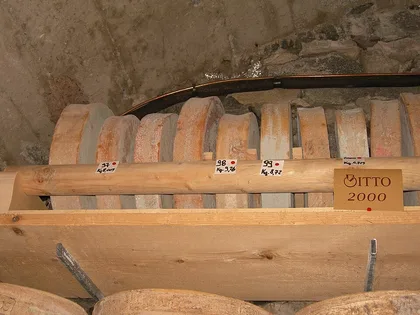 CheeseBittoBitto DOP can only be made between 1 June and 30 September, on high summer pasture, in a dismantlable stone…
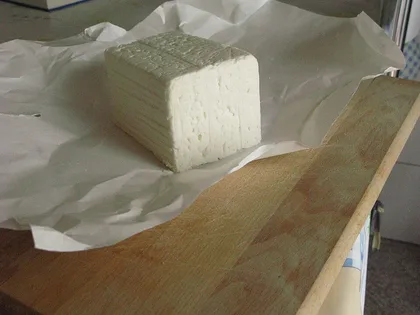 CheeseQuartirolo LombardoQuartirolo Lombardo is named after quartirola, the fourth grass cut of the year in September: it was made…
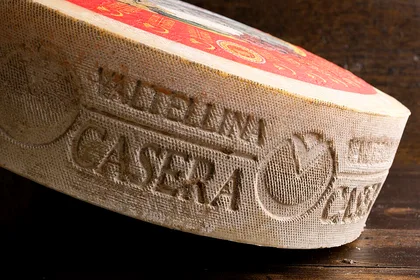 CheeseValtellina CaseraValtellina Casera is made from partially skimmed milk for a specific reason: the cream went to butter, which…