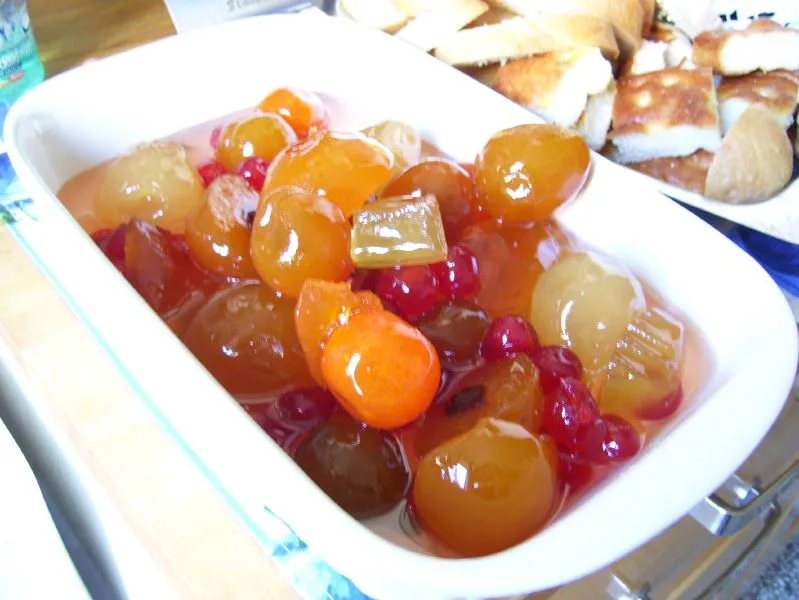
What is Mostarda?
Mostarda is whole or chopped fruit candied in sugar syrup, then flavoured with a few drops of mustard essential oil. The effect is unlike anything else in European preserving: pure sweetness on the palate, and a sharp volatile heat that rises through the sinuses and disappears almost immediately.
That heat is chemically different from chilli. Capsaicin binds to receptors on the tongue and stays there; allyl isothiocyanate, the compound in mustard oil, evaporates upward and clears within seconds. You can eat a fiercely hot mostarda without wrecking the rest of the meal, because every spoonful resets.
The name has nothing to do with the mustard plant. It comes from mustum ardens, burning must, because medieval cooks preserved fruit in cooked grape must and made it 'burn' with crushed mustard seed. Sugar replaced the must centuries ago, but the word stayed, and it is the root of endless confusion with French moutarde and English mustard.
There is no single mostarda. Four regional families exist, all from the Po valley, differing in fruit, cut, syrup thickness and how violent the mustard is: Cremona, Mantua, Voghera and Vicenza.
What does it taste like?
The first impression is candied fruit and nothing else: pear, cherry, fig, orange peel, thick syrup, straightforwardly sweet. Then, about two seconds in, the mustard arrives, not on the tongue but behind the nose, like a mouthful of very fresh wasabi or fresh horseradish. Your eyes may water. Then it is gone.
The fruit keeps its own character throughout. A cherry tastes like a cherry, a fig like a fig; the syrup carries them rather than flattening them into jam. Traditional artisan mostarda from Cremona is genuinely fierce. Supermarket versions are usually pitched at a fraction of the strength, and mostarda from Voghera or Vicenza is milder still: closer to a sweet fruit preserve with an edge.
What it is not: sour, vinegary, spiced or savoury. There is no cumin, no ginger, no onion, no vinegar. That is the whole difference from chutney.
How to use it
The historic use is bollito misto, the Sunday cart of boiled meats in Lombardy, Emilia and Piedmont: beef, capon, tongue, cotechino. Mostarda arrives alongside salsa verde and grated horseradish, and its job is to cut through fat and wake up meat that is by nature soft and mild. One small spoonful per mouthful of meat.
The second use is the cheese board, where it belongs with cheeses that can fight back: Gorgonzola, mature Taleggio, long-aged Parmigiano, hard sheep's cheeses. On fresh or mild cheese it simply overwhelms.
The third is Mantuan and it is an ingredient rather than a condiment. Tortelli di zucca are filled with roast pumpkin, crushed amaretti, grated Grana Padano, nutmeg and finely chopped mostarda. Leave the mostarda out and the filling is just sweet; put it in and the whole dish acquires a spine.
Beyond tradition it is excellent with roast pork, duck, and any cured pork sausage. Always serve it cold or at room temperature, because heating it drives off the mustard entirely.
How long it keeps
Sugar and mustard essence between them make mostarda one of the longest keeping things in an Italian larder. A sealed jar sits in a dark cupboard until the best before date printed on it, commonly two to three years out, and needs nothing else. Once opened it moves to the fridge, closed tight, and Italian producers generally give three to six months from there. Always take it out with a clean dry spoon: fruit dragged out of the syrup starts drying at the top of the jar.
What fades first is the mustard. Allyl isothiocyanate is volatile, so every time the jar is opened some of the sharpness leaves with the vapour, and a jar six months into its life is noticeably sweeter and rounder than a fresh one. The fruit meanwhile keeps absorbing syrup, darkens slowly, and softens. Sugar crystals forming on the rim or in the syrup are the syrup coming out of solution, and warming the jar gently in a bowl of hot water redissolves them. Do not freeze it; the fruit cells rupture and the pieces come out slack.
Spot the real thing
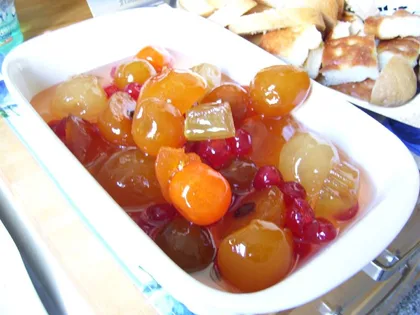
Mostarda is not mustard, despite what the word does to English speakers, and it is not chutney either. In the jar you should see whole or large pieces of fruit suspended in a clear, thick, almost glassy syrup, the fruit translucent and holding its shape rather than collapsed into a puree. Colours stay close to the fruit: green figs, amber pears, red cherries, pale quince. The heat is not chilli. Open the jar and the vapour catches the back of the nose the way horseradish does, then fades.
The ingredient list should be short and must name mustard: senape, mustard essence or essential oil of mustard, alongside fruit and sugar. Without it the jar is candied fruit. Regional styles differ legitimately and the label usually says which: Cremona keeps the fruits whole in clear syrup, Mantova is chunky apple or quince, Vicenza is a thick paste, and Piedmontese cognà contains no mustard at all, being cooked grape must with fruit. Expect $12 to $22 for a 380 gram jar abroad, and treat anything in the chutney price bracket as a different product.
How to pronounce Mostarda
moh-STAR-dah
Three syllables, stress on the second, and every letter pronounced, including the final 'a'. Not 'mustard', not the French 'moo-TARD'. The plural is mostarde, moh-STAR-deh. Cremonese, the adjective for the Cremona style, is kreh-moh-NEH-zeh.
Mostarda compared
vsChutney
Both are fruit preserves eaten with meat and cheese, and there the resemblance stops. Chutney is cooked down with vinegar, sugar and warm spices into a soft, sour-sweet mass. Mostarda is candied over several days with no vinegar and no spices at all, keeping the fruit whole, and its heat comes from mustard oil added cold at the very end.
| This | Chutney | |
|---|---|---|
| Acid | None, no vinegar | Vinegar is structural |
| Texture | Whole fruit in clear syrup | Soft, cooked-down, jammy |
| Spicing | Mustard essence only | Ginger, cumin, chilli, cloves, onion |
| Heat type | Volatile, nasal, gone in seconds | Chilli heat on the tongue, lingering |
| Method | Repeated candying over 4-8 days | Single long simmer |
| Classic pairing | Boiled meats, Gorgonzola, cotechino | Curry, cold cuts, cheddar |
vsMostarda di Cremona vs Mostarda mantovana
The two main Italian styles are used in completely different ways. Cremona makes a mixed-fruit condiment served on the side; Mantua makes a single-fruit paste used as an ingredient. Buying the wrong one for tortelli di zucca is the classic mistake.
| This | Mostarda di Cremona vs Mostarda mantovana | |
|---|---|---|
| Fruit | Cremona: mixed, with cherry, fig, pear, apricot, mandarin, melon | Mantua: one fruit, usually campanina apple |
| Cut | Whole fruits, visible and intact | Finely chopped or grated |
| Syrup | Abundant, clear, glossy | Scarce, thick, rustic |
| Mustard level | Traditionally fierce | Moderate |
| Role | Condiment served alongside | Ingredient inside a filling |
| Signature dish | Bollito misto | Tortelli di zucca |
vsMustard (Dijon, English, wholegrain)
Same linguistic root, entirely different food. Mustard is a savoury emulsion of ground seed, liquid and salt used as a condiment or an emulsifier. Mostarda is a sweet fruit preserve that borrows a few drops of mustard oil for contrast. Substituting one for the other never works.
| This | Mustard (Dijon, English, wholegrain) | |
|---|---|---|
| Base | Candied fruit and sugar | Ground mustard seed |
| Sweet or savoury | Sweet | Savoury |
| Mustard content | A few drops of essential oil | The entire product |
| Used in | Boiled meat, cheese boards, pasta fillings | Sandwiches, dressings, sauces |
| Keeps its heat | Fades within weeks of opening | Fades over months |
Mostarda substitutes
- Quince paste (membrillo) with mustard powder
The closest homemade approximation. Warm the paste slightly to loosen it, then whisk in English mustard powder off the heat and let it sit an hour. Gives you the sweetness, the fruit body and the nasal heat.
1 teaspoon mustard powder per 100 g paste - Fig jam with wholegrain mustard
The cheese-board shortcut, widely used in restaurants. Less elegant because the seeds are visible and the vinegar in the mustard shows, but it works with Gorgonzola and aged pecorino.
3 parts jam to 1 part mustard - Candied fruit with mustard essence
If you can source food-grade mustard essential oil, buy good mixed candied fruit, warm a light sugar syrup, cool it completely and stir in the essence. This is genuinely how mostarda is made.
2-4 drops of essence per 500 g fruit: start low, it is very strong - Apple jelly with Dijon and horseradish
For the bollito misto use specifically. The horseradish supplies the nasal heat that Dijon alone cannot, and apple jelly matches the Mantuan style closely.
4 parts jelly, 1 part Dijon, 1 teaspoon grated horseradish - Chutney
Serviceable on a cheese board and wrong everywhere else. The vinegar and the warm spices push the dish somewhere completely different. Never use it inside tortelli di zucca.
1:1 on cheese only
Where to buy it
In the US, Eataly, Gustiamo, Formaggio Kitchen and most serious cheese counters stock Cremona-style mostarda; expect 14 to 26 dollars for a 380 g jar, roughly 17 to 31 dollars per pound. In the UK, Italian delis, Ocado and specialists such as Vorrei carry it at 8 to 16 pounds a jar, or 20 to 40 pounds per kilo.
Read the ingredients: they should say fruit, sugar and mustard essential oil, and very little else. Glucose-fructose syrup at the top of the list, added pectin or generic 'flavourings' all point to a cheap industrial version.
Look at the fruit through the glass. It should be recognisable, a cherry that looks like a cherry and a pear shaped like a pear, and should carry its own colour rather than a uniform orange. The syrup should be clear and pourable, not set like jelly.
If you are buying for tortelli di zucca, look specifically for Mantuan-style apple mostarda, sold as mostarda di mele campanine. It is harder to find abroad and usually needs ordering online.
Where to eat it in Italy
Cremona is the obvious pilgrimage: the old shops in the centre sell mostarda loose from the jar and will let you taste before buying, and the town's November nougat festival draws the mostarda makers into the square as well.
Mantua, an hour east, is where you eat tortelli di zucca, served all year but ritual on Christmas Eve, in trattorie in the centre and in the villages along the Mincio.
Voghera and the Oltrepò Pavese hills serve the sweeter, gentler style, usually with local goat's cheese.
Anywhere in the Po valley between November and February, follow the bollito cart. That is the season when mostarda makes sense and when trattorie put it on the table without being asked.
Frequently asked questions
Is mostarda the same as mustard?
No. Mustard is a savoury paste of ground mustard seed; mostarda is candied fruit in sugar syrup with a few drops of mustard essential oil added at the end. The shared name comes from the Latin mustum ardens, burning grape must, not from the plant.
What is the difference between mostarda and chutney?
Chutney is cooked down with vinegar and warm spices into a soft jammy mass with chilli heat. Mostarda contains no vinegar and no spices, keeps the fruit whole through days of repeated candying, and gets its heat from volatile mustard oil that hits the nose rather than the tongue.
What do you eat mostarda with?
Boiled meats, especially the northern Italian bollito misto; aged and blue cheeses such as Gorgonzola, Taleggio and Parmigiano; cotechino and zampone; roast pork and duck. In Mantua it also goes inside the filling of pumpkin tortelli.
Why does mostarda burn your nose and not your mouth?
The heat comes from allyl isothiocyanate in mustard essential oil, a volatile compound that rises into the sinuses, rather than from capsaicin, which binds to receptors on the tongue. The sensation is sharp but lasts only a few seconds.
How long does mostarda keep?
An unopened jar keeps two to three years in the pantry. Once opened, refrigerate it with the fruit fully covered by syrup and use it within two or three months, though the mustard heat noticeably fades after three or four weeks.
Related foods
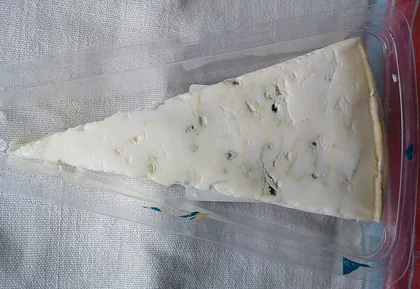 CheeseGorgonzolaThe green veining is the product, not a flaw anyone tolerates: it grows from a mould added to the milk and…
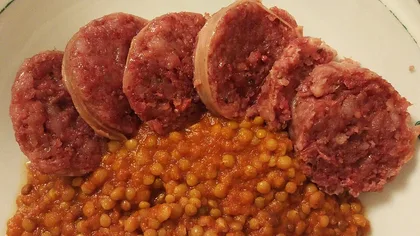 Cured meatsCotechinoCotechino is a large fresh pork sausage from Emilia-Romagna, made with pork meat, fat and rind, and always…
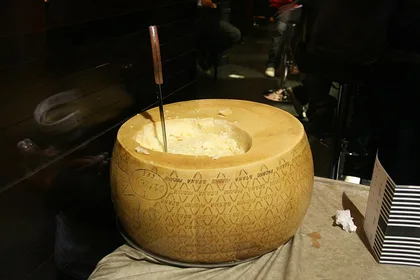 CheeseGrana PadanoNine months is the floor the specification sets before a wheel may carry the name.SweetsTorroneHoney and sugar go over a water bath and stay there for hours, sometimes twelve, while someone keeps stirring.
 Oil and preservesGiardinieraGiardiniera means two very different jars. In Italy it is a mild mix of vegetables pickled in wine vinegar…
 Oil and preservesMostarda di CremonaWhole candied fruit suspended in clear syrup and charged with mustard essence.Pasta and breadGnocchiGnocchi are small boiled dumplings, in their modern form made of potato bound with a little flour.Cured meatsPancettaPancetta is Italian cured pork belly: salt, pepper and warm spices, dried for months, never smoked.