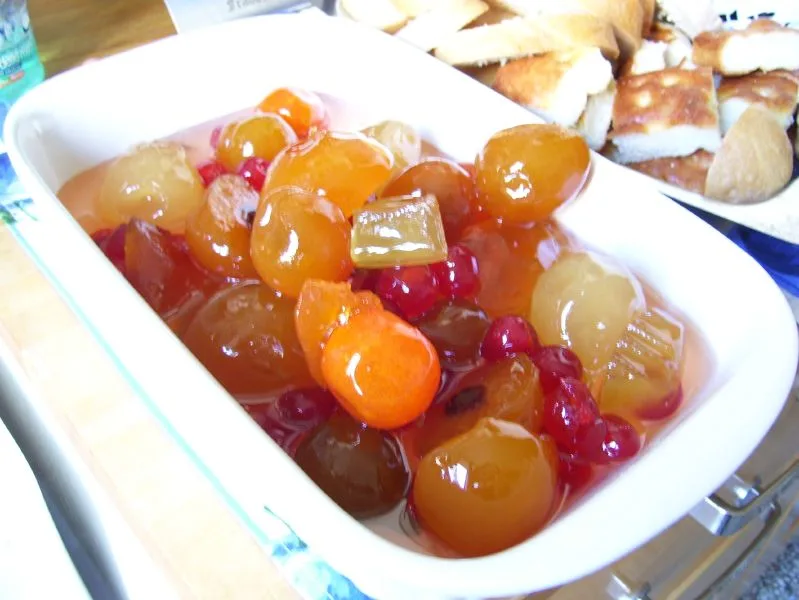
What is Mostarda di Cremona?
Mostarda di Cremona is whole fruit, or large pieces of it, candied in sugar syrup and flavoured with mustard essential oil. What sets the Cremona version apart from every other mostarda is a single decision: the fruit stays whole and stays mixed. One jar holds cherries, figs, pears, apricots, clementines, melon and pumpkin, each still identifiable by shape and colour, floating in syrup that should be clear and glossy.
The heat is not chilli heat, and that is the part that surprises people. Capsaicin burns on the tongue and stays there for minutes. Allyl isothiocyanate, released by mustard essence, is volatile: it rises into the sinuses and disappears in a few seconds. You can eat a very strong mostarda without wrecking the rest of the meal, because each spoonful is an episode that ends.
The name comes from must, not from mustard. Mustum ardens, burning must: medieval cooks preserved fruit in cooked grape must, and ardens described the bite of crushed mustard seed. Sugar replaced the must, the name stayed, and the confusion with French moutarde and English mustard has never gone away.
How much mustard goes in is the producer's signature. Traditional Cremonese houses reach levels that make your eyes water; supermarket lines dose ten times lower, which is why many people assume mostarda is just fruit in syrup.
What does it taste like?
Sweet first, then a sudden clean burn behind the eyes, then nothing. The sequence takes about six seconds and it is unlike anything else on a table. The fruit itself tastes intensely of what it is (a candied cherry is very much a cherry, concentrated rather than transformed) and the syrup is honeyed and slightly floral.
The pungency is dry and volatile, closer to horseradish or fresh wasabi than to chilli. It clears the sinuses and vanishes without any lingering heat on the palate, which is exactly why it works against fatty boiled meat: it resets the mouth between bites.
If the heat lingers on the tongue rather than rising into the nose, something other than mustard essence is doing the work. If there is no heat at all, you have a jar of candied fruit.
How to use it
Serve it by the teaspoon, not the spoonful. One or two pieces of fruit and a little syrup per person, set beside the meat and never on top of it. A 380 g jar covers eight to ten people at the table.
With bollito misto (the Po valley trolley of boiled beef cuts, capon, tongue and cotechino, carved at the table) it alternates with salsa verde and grated horseradish rather than replacing them. At Christmas it goes with cotechino and zampone, where the mustard cuts through the fat of the rind.
On a cheese board it is the use that carried mostarda out of Lombardy. It needs cheese strong enough to stand up to it: Grana Padano aged past 24 months, piccante gorgonzola, ripe taleggio, mature pecorino. On anything mild it just reads as sugar.
With roast pork or stuffed poultry, chop it finely and stir it into the pan juices off the heat at the last second. Cooked, the mustard evaporates and you are left with syrup.
One warning: pumpkin tortelli from Mantua take the mantovana version, chopped small. Cremonese whole-fruit mostarda can be made to work if you chop it, but the filling comes out sweeter and less coherent.
How long it keeps
The jar is engineered to last: fruit at very high sugar concentration under an essential oil that is itself a preservative. Sealed, it sits in a dark cupboard at room temperature until the date printed on the lid, typically two to three years out. After opening, keep it in the fridge with the lid screwed down and use it over the following months rather than years. Make sure every piece of fruit stays submerged in syrup; anything left proud of the surface dries and hardens at the exposed face.
The mustard is the part with a clock on it. Its pungency sits in a volatile compound that escapes each time the lid comes off, so a jar opened at Christmas and finished in March is measurably milder by the end, with the sugar coming forward. The fruit itself darkens, absorbs more syrup and slowly loses its edges. Crystals in the syrup or a stiffening around the rim are sugar leaving solution; standing the jar in warm water dissolves them again. Freezing is not the answer, since candied fruit thaws limp. The lid date and the producer settle anything else.
Spot the real thing
A Cremona jar looks like a jewel box: whole candied fruits kept intact and separate, each one candied on its own before assembly, so you can pick out a cherry, a fig, a slice of pear, an apricot, a mandarin, a piece of melon rind, and each keeps its own colour. The syrup around them is clear, thick and glassy, not cloudy and not a puree. The fruit should be translucent right through and still firm under a fork, not slumped or grainy.
Two confusions abroad. The first is with candied fruit: check the ingredient list for senape or essential oil of mustard, and if it is absent you have glacé fruit in syrup. The second is with the Mantovana and Vicentina styles, which are chunky or pasted and legitimately different products; Cremona means whole fruit. Anglophone shops sometimes shelve it as mustard fruits or Italian chutney, which describes neither the texture nor the heat. Sperlari, Fieschi and Vergani are the Cremonese names on export shelves, at $14 to $24 for a 380 gram jar.
How to pronounce Mostarda di Cremona
mos-TAR-dah dee kreh-MOH-nah
Stress on the second syllable of mostarda and on the second of Cremona. The 'o' in mos- is short; the final 'a' of mostarda is clearly pronounced, not swallowed. Cremona is kreh-MOH-nah, not 'kreh-MOAN-uh'.
Mostarda di Cremona compared
vsMostarda mantovana
Same name, fifty kilometres apart, two different jobs. Cremona keeps the fruit whole and mixed and doses the mustard hard: it is a condiment for the boiled-meat trolley, spooned alongside the plate. Mantua works one fruit only, the campanina apple, a small, firm, sharp heirloom variety from the plain between Mantua and Modena, chopped small, with less syrup and a gentler bite, because its main destination is inside something: the filling of tortelli di zucca, mixed with amaretti and grated Grana.
| This | Mostarda mantovana | |
|---|---|---|
| Fruit | Mixed: cherry, fig, pear, clementine, melon | Campanina apples only |
| Cut | Whole or in large pieces | Small dice or grated |
| Syrup | Abundant, clear, glossy | Less syrup, rustic look |
| Mustard | Assertive to fierce | Restrained |
| Used for | Bollito misto, cheese boards | Pumpkin tortelli filling |
vsChutney
The comparison English speakers reach for first, and it breaks down on both texture and acid. Chutney is cooked down: fruit and vegetables simmered with vinegar, sugar and spices until they collapse into a jammy, sour-sweet mass. Mostarda is never reduced (the fruit is candied slowly over days precisely so it holds its shape) and contains no vinegar at all. The sharpness in a chutney is acetic and stays on the tongue; the sharpness in mostarda is volatile and goes up the nose.
| This | Chutney | |
|---|---|---|
| Texture | Whole fruit in clear syrup | Cooked down, jammy |
| Acid | None added | Vinegar, central to it |
| Heat source | Mustard essential oil, volatile | Chilli and spices, lingering |
| Spicing | None beyond mustard | Ginger, cumin, cinnamon, cloves |
| Method | Candied over 4-8 days | Simmered in one session |
vsFrench mustard
A shared etymology and nothing else. Dijon or Meaux mustard is an emulsion of ground mustard seed with verjuice, wine or vinegar: savoury, acidic, used by the teaspoon as a sauce base or a sandwich spread. Mostarda is a sweet fruit preserve that borrows only the pungency, and it is served in whole pieces on the plate. Substituting one for the other in a recipe does not work in either direction.
| This | French mustard | |
|---|---|---|
| Base | Candied whole fruit | Ground mustard seed |
| Liquid | Sugar syrup | Verjuice, wine or vinegar |
| Sweetness | High | None |
| Served | In pieces, alongside meat | As a spread or emulsifier |
Mostarda di Cremona substitutes
- Mostarda mantovana
The nearest real substitute and easy enough to find. Made from campanina apples, milder and finer-cut, so it works on a cheese board but reads as sweeter next to boiled meat. Add a drop of mustard oil per 100 g if you want it to bite like the Cremonese version.
1:1, plus 1 drop mustard essence per 100 g - Mostarda di Voghera
Whole fruit in a cloudier syrup with a much softer mustard dose, from the province of Pavia. Almost a dessert preserve, and the version to reach for if the Cremonese heat is too much for the table.
1:1 - Quince paste with mustard oil
A workable improvisation where no mostarda is sold. Cut membrillo or cotognata into cubes, stir in mustard essence drop by drop and rest it overnight. Texture is wrong (it is a paste, not whole fruit) but it plays the same role against aged cheese.
2-3 drops mustard essence per 100 g of paste - Candied fruit plus Dijon
The kitchen shortcut. Chop good candied fruit and fold in a small amount of strong Dijon, which brings pungency and unwanted acidity together. Use it for cooking rather than serving, and cut any other acid in the dish.
1 teaspoon Dijon per 100 g candied fruit - Cranberry or fig chutney
Not the same thing and it should not be sold as such, but if the job is a sweet-sharp accompaniment to a cheese board or a roast, a fig chutney does that job. Expect vinegar and spice where mostarda gives clean volatile heat.
1:1 on cheese, not recommended with bollito
Where to buy it
In Italy, an artisan 380 g jar runs 7 to 11 euro, which is 18 to 30 euro a kilo; supermarket lines sit at 12 to 16 euro a kilo and are notably milder. Christmas gift jars with the fruit arranged in visible layers reach 35 to 45 euro a kilo: presentation you are paying for, though with mostarda the look of the whole fruit genuinely is the product.
In the US, Italian importers and specialist grocers carry it at roughly 14 to 24 dollars a pound, usually in 200 to 380 g jars. In the UK, Italian delicatessens and cheese shops stock it at 25 to 40 pounds a kilo: cheesemongers are often the better bet, since mostarda has become a standard board accompaniment.
Read the label for two things. The ingredient list should be fruit, sugar or glucose syrup, and mustard essential oil; colourings such as E102 or E122 are there to brighten faded candied fruit. And check the fruit is whole and distinct through the glass: collapsed, indistinct pieces mean the candying was rushed.
If you can smell nothing when the jar opens, the mustard was dosed not to trouble anyone.
Where to eat it in Italy
Cremona is small and walkable: the Piazza del Comune under the Torrazzo, the tallest brick bell tower in Europe, and the Museo del Violino, which holds instruments by Stradivari, Amati and Guarneri. The mostarda is sold in the historic confectioners in the centre, in the same windows as the torrone: the two products have shared a trade in this city since the nineteenth century.
Go in the third week of November, when the Festa del Torrone fills the old centre with stalls, demonstrations and tastings. Mostarda is everywhere and you can try before you buy.
To eat it properly you want a bollito trattoria, and the geography is the Bassa: Cremona, Casalmaggiore, Soresina and the villages between the Po and the Oglio. The trolley runs from about October to March, because boiled meat is winter food.
Fifty kilometres east, Mantua lets you make the comparison directly: campanina apple mostarda and pumpkin tortelli, which is the fastest way to understand why the two are not the same product.
Frequently asked questions
Is mostarda the same as mustard?
No. They share an etymology, mustum ardens or burning must, but mostarda is whole fruit candied in sugar syrup and flavoured with mustard essential oil, while mustard is ground seed emulsified with vinegar or wine. One is sweet and served in pieces beside meat; the other is savoury and used as a spread.
How hot is mostarda di Cremona?
Artisan versions are genuinely fierce, but the heat behaves differently from chilli. Mustard's allyl isothiocyanate is volatile: it rises into the sinuses and clears in about six seconds rather than burning on the tongue. Supermarket versions are dosed far lower.
What is the difference between Cremona and Mantua mostarda?
Cremona uses mixed fruit left whole in clear syrup with an assertive mustard dose, and it is a condiment for boiled meats. Mantua uses only campanina apples, chopped small and much milder, mainly destined for the filling of pumpkin tortelli.
What do you serve mostarda with?
Bollito misto, cotechino and zampone, and aged or blue cheese: Grana Padano past 24 months, piccante gorgonzola, ripe taleggio. A teaspoon per person, alongside rather than on top. It also works stirred into pan juices for roast pork, off the heat.
How long does an open jar last?
Two to three months in the fridge, and the limit is aroma rather than safety. The sugar preserves indefinitely, but mustard oil is volatile and some escapes every time the jar is opened. Use a clean dry spoon and keep the fruit submerged in the syrup.
Related foods
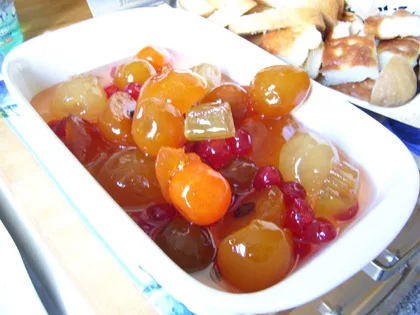 Oil and preservesMostardaMostarda is candied fruit suspended in sugar syrup and spiked with mustard essence.
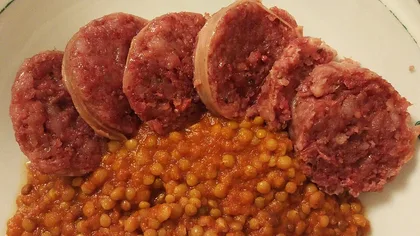 Cured meatsCotechinoCotechino is a large fresh pork sausage from Emilia-Romagna, made with pork meat, fat and rind, and always…
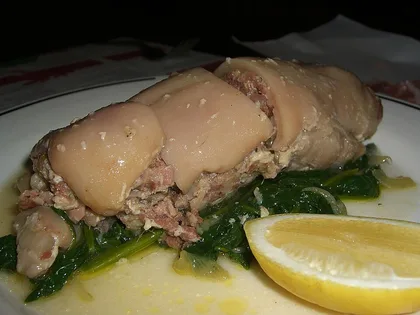 Cured meatsZamponeZampone Modena IGP is spiced pork and rind forcemeat stuffed into a boned pig's trotter: same filling as…
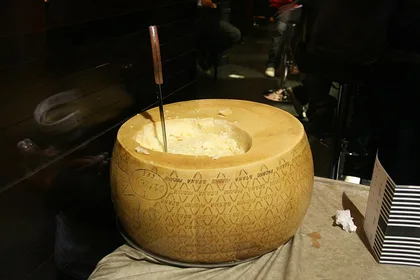 CheeseGrana PadanoNine months is the floor the specification sets before a wheel may carry the name.
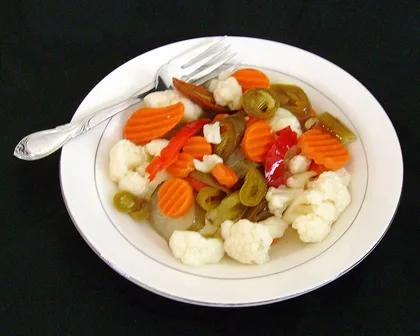 Oil and preservesGiardinieraGiardiniera means two very different jars. In Italy it is a mild mix of vegetables pickled in wine vinegar…Pasta and breadGnocchiGnocchi are small boiled dumplings, in their modern form made of potato bound with a little flour.Cured meatsPancettaPancetta is Italian cured pork belly: salt, pepper and warm spices, dried for months, never smoked.
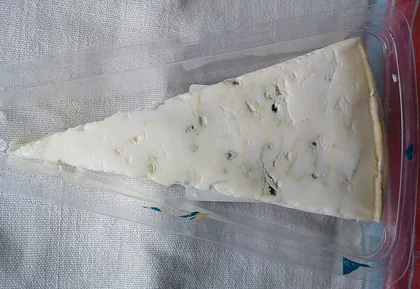 CheeseGorgonzolaThe green veining is the product, not a flaw anyone tolerates: it grows from a mould added to the milk and…