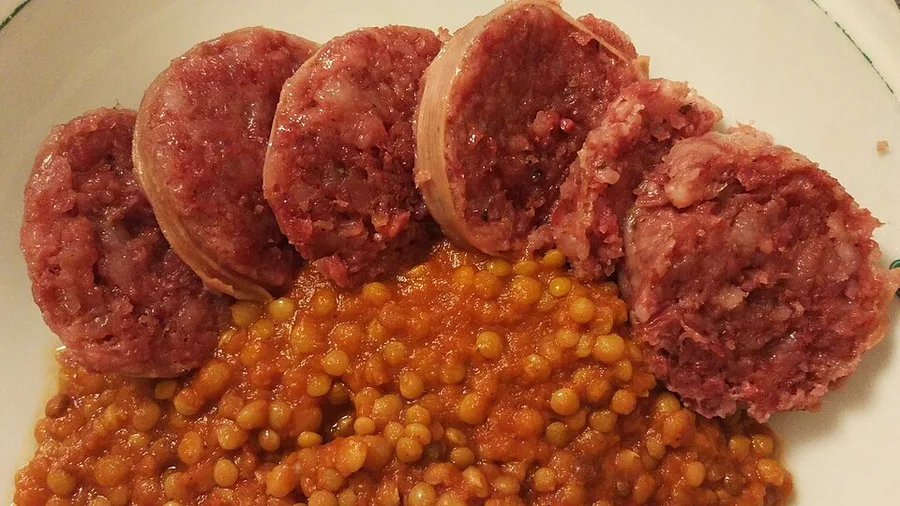
What is Cotechino?
Cotechino is a raw sausage made to be boiled, not cured. The filling is roughly half lean pork, a quarter hard fat and a quarter pork rind, ground together and seasoned with salt, black pepper, nutmeg, cinnamon and cloves in proportions that vary by butcher. It is packed into a wide natural or synthetic casing, seven or eight centimetres across, and tied.
The rind (cotica in Italian, which gives the sausage its name) is the technical ingredient. Long, slow cooking converts its collagen into gelatine, and that gelatine binds the slice and gives it a soft, faintly sticky texture nothing else in the Italian salumi repertoire has. Too little rind and the slice crumbles; too much and it turns rubbery.
Because it neither ferments nor dries, cotechino belongs to the cold months and to the days when a pig had just been butchered. Two forms exist today: fresh, which needs about three hours of gentle simmering, and precotto, industrially cooked and vacuum-sealed, which needs twenty minutes.
Cotechino Modena has held Protected Geographical Indication status since 1999, alongside Zampone Modena.
What does it taste like?
Deeply savoury and warmly spiced, closer to a coarse pâté than to a British banger. The nutmeg and cinnamon are noticeable but not sweet; the pepper comes through late. There is no smoke, no fermented tang and no garlic edge.
The texture surprises most first-timers. A slice is soft, dense and slightly gelatinous, and it melts rather than crumbles. Served hot with lentils, the starch of the pulses and the richness of the sausage meet halfway, which is exactly the point of the pairing.
Cold, it is a different and worse thing: the fat sets and the gelatine stiffens. Cotechino is one of the few Italian pork products that genuinely must be eaten hot.
How to use it
For fresh cotechino: prick the casing in eight or ten places with a cocktail stick, wrap it in a clean cotton cloth tied at both ends, and lower it into plenty of cold water. Bring it to just below a simmer and hold it there for three hours. It must never boil hard or the casing splits. Rest it in the water for twenty minutes before slicing.
For the vacuum-packed version: drop the unopened bag into boiling water for twenty to thirty minutes depending on weight, then open and slice at once.
Slice it thick, a centimetre at least, and serve it hot. Nothing about this sausage survives cooling.
The canonical partner is lentils: small, thin-skinned ones such as Castelluccio or Colfiorito, stewed with celery, carrot and onion and finished with a spoonful of the cooking liquid from the sausage. Mashed potato and wilted spinach are the other standards, and mostarda di Cremona is the traditional accompaniment when cotechino appears in a bollito misto.
One worthwhile Emilian variation is cotechino in galera (cotechino in prison), where the sausage is wrapped in a thin slice of beef and a slice of prosciutto and braised in red wine.
How long it keeps
The precooked brick is the easy one: sealed, it keeps at room temperature to the date printed on the foil, which is the producer's figure, and once the pouch is open it goes into the fridge at 0 to 4 C and behaves like any cooked meat, keeping a couple of days. The raw sausage is a fresh product and lives in the coldest part of the fridge to the date the butcher gives, wrapped in paper rather than sealed plastic so the casing does not go slippery. Over days the casing dries and shrinks against the filling and the exposed fat yellows as it oxidises.
Raw cotechino freezes at minus 18 C for two to three months, and the fat comes back slightly grainier than it went in. Thaw it in the fridge, never on the counter, because the piece is thick and warms unevenly. Once cooked, keep it whole in its own cooking liquid in the fridge: the gelatine from the rind sets to a jelly there and melts again on gentle reheating, which is what keeps the slices from drying.
Spot the real thing
Cotechino comes in two forms and it matters which one is in your hand. The raw sausage is a fat, soft cylinder in natural casing, tied at both ends, greyish pink and slightly greasy to the touch, sold chilled from a butcher through the winter; it needs hours of gentle simmering. The precooked one, marked precotto, is a foil brick sitting on an ambient shelf and it needs twenty to thirty minutes in its bag in boiling water. Cut open, either shows a coarse pink mixture flecked with white, which is the rind that gives the name and the sticky texture.
The things beside it are not it. Zampone is the same filling stuffed into a boned pig's trotter and comes out foot-shaped. Salame and other dry sausages are cured to be eaten as they are. Fresh Italian sausage and British bangers are made for a pan or a grill and contain no rind. Look for Cotechino Modena IGP if you want the protected version. Precooked bricks are cheap; a butcher's raw one costs a good deal more per kilo.
How to pronounce Cotechino
koh-teh-KEE-noh
Four syllables, stress on the third. Both C sounds are hard, as in 'cot' and 'key', because each precedes an O or an H-less consonant: no 'cotch' and no 'ko-cheeno'. The plural is cotechini, koh-teh-KEE-nee. Zampone, its sibling, is tsam-POH-neh, with the Z pronounced 'ts'.
Cotechino compared
vsZampone
The same filling in a different container. Cotechino goes into a sausage casing; zampone goes into the boned skin of a pig's front trotter. The trotter adds collagen and drama, and needs longer cooking. Both carry Modena IGP status and both turn up on the same New Year's Eve table.
| This | Zampone | |
|---|---|---|
| Casing | Beef or pork intestine casing | Boned skin of the front trotter |
| Filling | Pork, fat, rind, spices | Identical |
| Texture | Soft, sliceable, gelatinous | More gelatinous still, from the extra skin |
| Cooking time, fresh | About three hours | Three to four hours |
| Serving | Cut into rounds | Cut into wedges, skin included |
| Price | Lower | Higher: more hand work in boning |
vsSalame
Both start as ground pork in a casing and then go opposite ways. Salame is fermented and air-dried for weeks or months and is eaten raw; cotechino is never dried, never fermented, and is inedible until cooked. Confusing the two is a genuine food-safety issue, not a matter of style.
| This | Salame | |
|---|---|---|
| Process | Fresh, cooked by the eater | Fermented and air-dried |
| Eaten | Hot, always cooked | Raw, at room temperature |
| Rind in the mix | Around a quarter of the filling | None |
| Shelf life, fresh | Five or six days refrigerated | Months |
| Season | Winter, above all New Year | Year round |
vsMusetto friulano
The north-eastern cousin. Musetto uses more of the snout and head (muso means muzzle) and less lean meat, and is spiced more sharply, often with cinnamon and coriander. In Friuli it is eaten with brovada, turnips fermented in grape marc, rather than with lentils.
| This | Musetto friulano | |
|---|---|---|
| Region | Emilia-Romagna and the Po plain | Friuli Venezia Giulia |
| Cuts used | Shoulder, jowl, trimmings, rind | Snout, head meat, rind |
| Spicing | Nutmeg, cinnamon, cloves | Sharper, often coriander and cinnamon |
| Served with | Lentils, mashed potato, mostarda | Brovada, polenta |
| Protected name | Cotechino Modena IGP | Recognised as a regional traditional product |
Cotechino substitutes
- Zampone
Not really a substitute so much as the other half of the same tradition, and easier to find abroad because it looks striking. Same filling, longer cooking, more gelatine. Serve it with the same lentils.
1:1 by weight, allow an extra 30 minutes cooking - Musetto or luganega da cuocere
Any fresh, coarse, unsmoked Italian cooking sausage will fill the role on the plate even though the texture will be firmer, with none of the gelatinous quality.
1:1 - Boudin blanc or French saucisse à cuire
Closer in spirit than a British sausage: a fresh, gently spiced boiling sausage. It is leaner and finer-ground, so it will not give the sticky slice, but it works alongside lentils.
1:1 - Fresh pork sausage plus a piece of pork rind
The workaround if nothing Italian is available. Simmer good coarse pork sausages with a strip of blanched pork rind in the pot, then chop the softened rind into the lentils. It rebuilds the missing texture from the outside.
1 kg sausage to 150 g rind - Precotto cotechino, vacuum packed
The industrial version is a legitimate shortcut rather than a substitute, and the one form widely exported. Twenty to thirty minutes in boiling water in its own bag. Less texture, no work.
500 g feeds four
Where to buy it
The vacuum-packed precooked version travels well and is the one you will find abroad. In the US, Italian importers and delis stock it in 500-gram packs for roughly 12 to 22 dollars, with the Modena IGP versions at the top; Eataly and online specialists carry it reliably from November. In the UK, Italian delicatessens and larger online grocers list it at about 9 to 16 pounds a pack, mainly in December.
Fresh cotechino is essentially an Italy-only proposition, since it is a raw meat product with a shelf life of days. Italian butchers abroad occasionally make their own in winter, and that is worth asking about in late November.
Read the ingredients before the front label. Pork should be listed before rind; packs that put cotenna first are cheaper and give a bouncier, less meaty slice. The Cotechino Modena IGP mark guarantees the production area and the recipe parameters, not automatic superiority: an artisan sausage made outside the zone can be better, it just cannot use the name.
Buy in mid-November if you can. Prices rise twenty to thirty per cent in the fortnight before New Year.
Where to eat it in Italy
Modena, Reggio Emilia and the flat country around Mirandola, Carpi and Concordia sulla Secchia, where the sausage is made. In December the butchers' windows and the weekly market stalls fill with cotechini and zamponi and very little else.
Bologna serves it inside bollito misto, the trolley of boiled meats that also carries tongue, brisket and head, with salsa verde on the side. That trolley is the most complete way to meet it.
Castelnuovo Rangone, a town near Modena that has built its identity on the pig, holds a November festival dedicated to it. Mirandola, where the sixteenth-century siege legend places its origin, keeps the connection alive with winter food events.
Cremona pairs the local vanilla-scented cotechino with its own mostarda, candied fruit in mustard syrup, and that combination of gelatinous pork and sweet-hot fruit is the best argument the whole category has.
On 31 December it appears on tables the length of Italy, but in Emilian trattorie it still arrives fresh rather than from a bag, and the difference is obvious at the first mouthful.
Recipes with it
Further reading
Frequently asked questions
What is the difference between cotechino and zampone?
The filling is essentially the same. Cotechino is packed into a sausage casing; zampone is packed into the boned skin of a pig's front trotter, which adds collagen and makes the result more gelatinous. Zampone takes longer to cook and costs more because boning the trotter is hand work.
Why do Italians eat cotechino with lentils on New Year's Eve?
Lentils look like coins and have symbolised prosperity since Roman times, while the fatty sausage stands for abundance. There is a practical origin too: pulses and pork were what a farmhouse pantry still held at the end of December.
Can you eat cotechino raw?
No. Unlike salame, cotechino is a fresh sausage that is neither fermented nor dried, and it must be fully cooked. Fresh cotechino needs about three hours of gentle simmering; the vacuum-packed precooked kind still needs twenty to thirty minutes in boiling water.
How long does cotechino take to cook?
Fresh: around three hours in water held just below a simmer, pricked and wrapped in a cloth so the casing does not burst. Precooked and vacuum sealed: twenty to thirty minutes in its unopened bag in boiling water.
How do you pronounce cotechino?
koh-teh-KEE-noh, four syllables with the stress on the third. Both C sounds are hard: it is never 'ko-cheeno'.
Sources
Where to check what you just read.
- 1
Il regolamento del 18 marzo 1999 in cui compare «Cotechino Modena (IGP)»: la protezione riguarda quel nome composto, non il cotechino generico.
- 2
Il disciplinare del Cotechino Modena in PDF: composizione dell'impasto, budello ammesso, zona di produzione e requisiti del prodotto precotto.
- 3Consortium · interested partyConsorzio Zampone e Cotechino Modena IGP
Il consorzio che tutela le due IGP gemelle: qui si controllano i produttori aderenti e la distinzione fra cotechino e zampone.
Related foods
 Cured meatsMortadellaThe white cubes are not just any fat: they are jowl, the firmest part of the pig, and they stay whole…
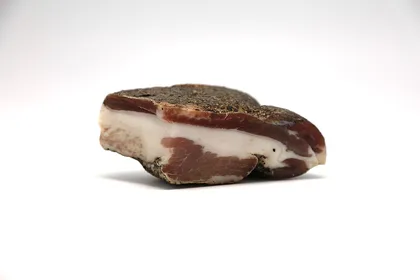 Cured meatsGuancialeGuanciale is cured pork jowl: unsmoked, rubbed with salt and pepper, aged for one to three months.Cured meatsPancettaPancetta is Italian cured pork belly: salt, pepper and warm spices, dried for months, never smoked.
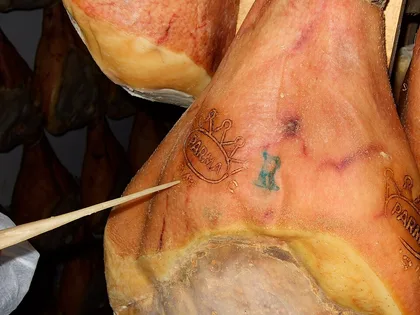 Cured meatsProsciutto di ParmaProsciutto di Parma DOP is Italian ham made from three things only: pork, sea salt and at least 400 days.
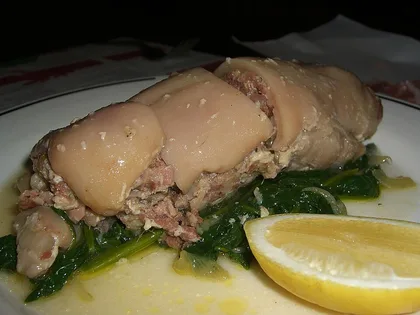 Cured meatsZamponeZampone Modena IGP is spiced pork and rind forcemeat stuffed into a boned pig's trotter: same filling as…
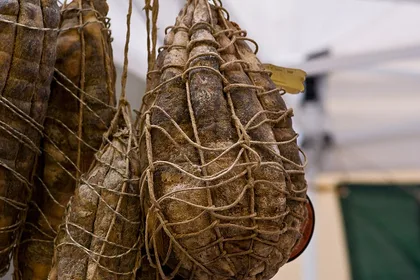 Cured meatsCulatello di ZibelloCulatello di Zibello is the heart muscle of a pork leg, boned out, sewn into a pig's bladder, tied by hand…
 Cured meatsSalame FelinoSalame Felino IGP comes from a village of four thousand people in the hills above Parma.
 Cured meatsCoppa PiacentinaCoppa Piacentina is dry-cured pork neck from the province of Piacenza, seasoned with cloves, cinnamon and…