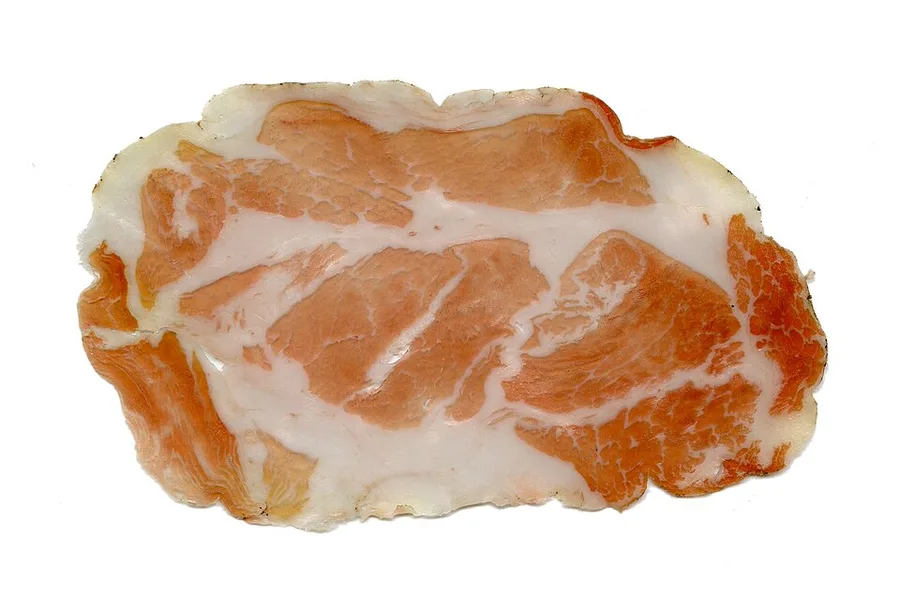
What is Coppa Piacentina?
Coppa Piacentina PDO is made from the coppa, the long muscle running along the pig's neck from the nape to the first ribs. Anatomically it is the same cut Americans meet at the deli counter as capicola and southern Italians call capocollo. What separates it is the cure.
The piece is dry-salted by hand with black pepper, cloves, cinnamon, nutmeg and bay, rested in cold rooms and massaged repeatedly so the salt reaches the centre, then cased in the pig's parietal diaphragm and tied by hand in a tight spiral of string. It ages a minimum of six months, often eight to ten.
A finished coppa weighs at least 1.5 kg. It is cylindrical, slightly tapered at both ends, with the string leaving visible grooves in the surface.
The cut is the reason it works. Neck muscle is neither fatty like belly nor lean like loin: it is threaded with intramuscular fat that renders slowly inside the meat over months of ageing. That is why a slice dissolves on the tongue instead of feeling greasy.
Piacenza is the only Italian province with three PDO cured meats (coppa, pancetta and salame) all recognised by the EU in 1996.
What does it taste like?
Sweet-spiced and rounded, with none of the chilli heat or garlic bite most people expect from Italian cured meat. The clove and cinnamon arrive first, faintly warm rather than pungent, then the pork underneath, deep and slightly nutty from long ageing.
The texture is the surprise. Where prosciutto is silky and bresaola is firm and dry, coppa is marbled: lean and fat alternate in a fine mosaic and melt together at mouth temperature. Nothing chews.
Well-aged pieces develop a note somewhere between hazelnut and butter at the finish. Younger ones, around the six-month minimum, taste sharper and more obviously spiced, with the seasoning still sitting on the surface rather than through the meat.
It should never be sour or metallic. A tang means the cure went wrong, and a soapy edge means the fat has oxidised.
How to use it
Slice it thin, around a millimetre and a half, and serve it at room temperature. Straight from the fridge the fat stays waxy and releases nothing; twenty minutes on the counter is the whole difference between a good coppa and a dull one.
In Piacenza it comes with chisulén, puffed diamonds of fried dough, the local name for what Parma calls torta fritta and Modena calls gnocco fritto, or with burtleina, a thin fried batter pancake. The point is the heat: the warm dough melts the edge of the fat as you fold it around the slice.
On a board, keep it plain. Unsalted bread, sweet butter, aged Parmigiano, and nothing sweet. The cure already carries cinnamon and clove, so jams and chutneys cancel it out rather than lift it.
It is not a cooking meat, but the end of the piece is worth dicing into a risotto or a white ragù. On pizza, add it after the oven, because heat separates the fat and turns the spice bitter.
Do not shave it as thin as prosciutto. Coppa has long fibre and needs enough thickness to hold together, but past two millimetres it turns chewy.
How long it keeps
A whole uncut coppa belongs in a cool room between 12 and 16 degrees, hanging or resting on a rack rather than flat on a closed surface, keeping for months and going on ageing. Once you cut into it, cover only the exposed face with waxed paper or film and leave the rest of the piece open to the air; from then on it is a three-to-four-week proposition. Vacuum packs run to the date on the sleeve in the refrigerator, and they want opening half an hour before serving, because straight out of the bag the smell is closed and flat and opens in air.
The changes are all about water leaving. The cut face dries and darkens into a firm rim that gets trimmed before slicing, the piece firms up and shrinks, the spice comes forward and the fat slowly oxidises from white towards ivory and yellow. A dry white bloom on the casing wipes off with a cloth dampened in vinegar or white wine. Freezing is not the answer: the intramuscular fat suffers and the slice loses its structure. The pack date and the producer are the reference.
Spot the real thing
Read the slice. A coppa piacentina shows a regular mosaic of deep red lean threaded with white fat, no large separate blocks of fat and no grey ring at the rim; yellowing fat marks a piece that has been around or warm for a while. It should feel compact but give slightly under a finger, and a slice should neither crumble nor cling to the blade. On the nose sweet spice comes first, because cinnamon and clove are the Piacenza signature, and cured meat second. If garlic or chilli leads, you are holding a capocollo from another tradition.
The outside matters too: the diaphragm casing should sit tight against the meat and the string should have left its marks, since a perfectly smooth cylinder means an artificial casing. On the label, look for the EU DOP mark and the Consorzio dei Salumi DOP Piacentini. Wording such as coppa stagionata, coppa nostrana or tipo piacentina describes something made outside the rules, often good and always cheaper. American delis sell it as capicola, usually the hotter Calabrian style; coppa di testa is head cheese and unrelated.
How to pronounce Coppa Piacentina
KOP-pah pyah-chen-TEE-nah
Two hard consonants in coppa: hold the double 'p' for a fraction longer than feels natural in English. KOP-pah, not COH-pa. In Piacentina the 'ci' is soft, as in 'chair', and the stress falls on the second-to-last syllable: pyah-chen-TEE-nah. The city itself is pyah-CHEN-tsah.
Coppa Piacentina compared
vsCapocollo di Martina Franca
Same anatomical cut, opposite philosophies. The Piacentina is a northern cure built on sweet baking spices, cased in diaphragm and given six months minimum in cool valley cellars. The Pugliese capocollo from Martina Franca is marinated in cooked local wine, rubbed with pepper and sometimes chilli, and, crucially, lightly smoked over Fragno oak bark, which no northern coppa ever is. The southern version is darker, sharper and more aromatic; the northern one is sweeter, cleaner and more marbled. Neither is a substitute for the other on a tasting board, though either works in a sandwich.
| This | Capocollo di Martina Franca | |
|---|---|---|
| Cut | Pork neck muscle | Pork neck muscle, identical |
| Seasoning | Cloves, cinnamon, nutmeg, bay, pepper | Cooked wine, pepper, sometimes chilli |
| Smoke | Never | Light, from Fragno oak bark |
| Casing | Pork parietal diaphragm, hand-tied | Natural casing or netting |
| Minimum ageing | 6 months (PDO rule) | Typically 3-4 months |
| Protection | PDO since 1996 | Slow Food Presidium, no PDO |
| Flavour | Sweet-spiced, mellow | Winey, smoky, more assertive |
vsBresaola della Valtellina
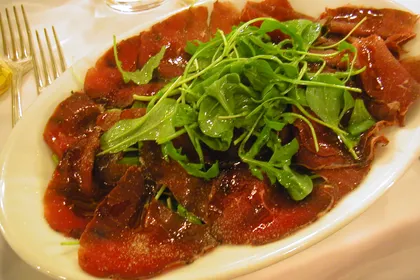
The two ends of the Italian cured-meat spectrum. Bresaola is beef, from the lean muscles of the round, salted with wine and juniper and aged one to three months into something almost fat-free: a slice is translucent burgundy and tastes clean and mineral. Coppa is pork, marbled through with intramuscular fat, and it coats the mouth. People reach for bresaola when they want protein without richness and for coppa when they want richness; swapping one for the other changes the character of a plate completely.
| This | Bresaola della Valtellina | |
|---|---|---|
| Animal | Pork | Beef |
| Cut | Neck, naturally marbled | Top round, almost fat-free |
| Fat content | Roughly 25-30% | Under 3% |
| Colour of slice | Pink-red with white marbling | Deep uniform burgundy |
| Ageing | 6 months minimum | 4-8 weeks typical |
| Dressing | Nothing: eaten plain | Lemon, oil, rocket, Parmigiano |
| Protection | PDO | PGI |
vsAmerican deli capicola ("gabagool")
The deli-counter version is the same cut, produced under a different logic. American capicola is usually wet-cured or brine-injected, often coated in paprika or cayenne for colour, frequently sold hot or sweet as a spice grade, and sometimes cooked rather than air-dried. It slices bright red, tastes of paprika before it tastes of pork, and costs a fraction of the Italian original. If you have only ever eaten capicola, the first slice of coppa Piacentina will read as under-seasoned for about ten seconds and then make sense.
| This | American deli capicola ("gabagool") | |
|---|---|---|
| Cure | Dry salt, months of air-drying | Often brined or injected |
| Coating | None: plain surface | Paprika or cayenne, hot or sweet |
| Cooked | Never | Sometimes |
| Dominant flavour | Pork and sweet spice | Paprika and salt |
| Slicing | 1.5 mm, by hand or slow blade | Shaved paper-thin |
| Price | 22-38 USD per pound | 8-14 USD per pound |
Coppa Piacentina substitutes
- Capocollo or coppa from another Italian region
Calabrian capocollo (chilli, PDO) or a Umbrian coppa will give you the same cut and the same texture with a different spice profile. Closest of all is Coppa di Parma PGI, which sits geographically and gastronomically next door.
1:1 - Lomo embuchado (Spanish)
Cured pork loin rather than neck, so noticeably leaner and firmer, and seasoned with pimentón. Excellent on its own terms and easy to find in the US and UK. Slice it slightly thicker to compensate for the missing fat.
1:1, sliced a touch thicker - Prosciutto crudo
Different cut and a saltier, more direct flavour, but it plays the same role on a board or in a sandwich. Use less of it: prosciutto is saltier than coppa and will dominate anything it shares a plate with.
0.8:1 - Speck Alto Adige PGI
A smoked, boned ham from the far north. The smoke changes the dish, so use it only where a smoky note is welcome: with cheese, on pizza, in a hot sandwich. Never as a straight swap on a tasting plate.
1:1 - Halal or no-pork: bresaola or cured beef coppa
Bresaola is the standard answer and is naturally pork-free, though far leaner. A handful of producers make cured beef neck the same way as coppa, which is closer in texture if you can find it.
1:1 for beef coppa, 1.2:1 for bresaola - Cured duck or turkey breast
Widely sold in the US and UK, pork-free, and similar in slicing behaviour. Much leaner and slightly gamey, good on a board with something fatty alongside, such as a soft cheese or butter.
1:1
Where to buy it
In the US, Italian importers and specialist grocers carry Coppa Piacentina PDO, though far more shelf space goes to domestic capicola. Eataly, Gustiamo and regional Italian delis are the reliable route; expect roughly 22 to 38 dollars per pound for a whole or half piece and considerably more sliced.
In the UK, Italian delicatessens and online grocers stock it at about 30 to 48 pounds per kilo. Availability is thinner than for prosciutto or salami, so it is often easier to order a vacuum-packed half piece direct.
Check the label for the blue-and-yellow PDO mark and a reference to the Consorzio dei Salumi DOP Piacentini. "Coppa stagionata", "coppa nostrana" and anything described as Piacenza-style are legally free to say almost nothing.
Look at the slice before you buy sliced. It should show a fine mosaic of red and white, not large separate blocks of fat, and the fat should be white: yellow means oxidised.
Buy a half piece vacuum-packed rather than a tray of slices whenever you can. It costs a third less per kilo and keeps its aroma, which sliced coppa loses in about two days.
Where to eat it in Italy
Piacenza itself, in the delicatessens and osterie around Piazza Cavalli, where the board of coppa, pancetta and salame arrives with hot fried dough as a matter of course.
The valleys are the better trip. Castell'Arquato, a medieval hill town in the Val d'Arda, serves all three PDO meats alongside pisarei e fasö, the local gnocchi and bean dish. Bobbio, on the Trebbia with its humpbacked bridge, pairs them with mountain cooking. Ponte dell'Olio and Vigolzone, in the Val Nure, have long-established producers who sell at the door.
In the Val Tidone, the wine festival that moves between Ziano, Borgonovo and Pianello in September is the fastest way to taste Colli Piacentini wines and local salumi side by side.
One request worth making at any producer: ask for a slice of six-month coppa and a slice of ten-month next to each other. It is the most instructive tasting available on this product, and nobody minds being asked.
Recipes with it
Further reading
Frequently asked questions
What is the difference between coppa and capicola?
They are the same cut of pork, the neck muscle. Capicola is the Americanised spelling of capocollo, the southern Italian name. Coppa Piacentina is the northern version: dry-cured with cloves, cinnamon and nutmeg, never smoked, and aged at least six months under PDO rules.
Is coppa the same as prosciutto?
No. Prosciutto is the hind leg, coppa is the neck. Prosciutto is leaner, saltier and more direct; coppa is marbled with intramuscular fat and tastes sweeter and rounder. Both are dry-cured and eaten raw.
How long should coppa be aged?
Six months is the legal minimum. Most pieces are at their best between eight and ten months, when the intramuscular fat has rendered into the muscle and the spice has moved from the surface through the meat. Beyond a year it dries out.
Do you eat the casing on coppa?
No. The outer membrane is the pig's diaphragm and is removed as you go. Peel it back only from the section you are slicing and leave it on the rest: it is what stops the piece drying out.
How do you pronounce coppa piacentina?
KOP-pah pyah-chen-TEE-nah. The double 'p' is held slightly longer than in English, and the 'ci' is soft like the 'ch' in chair.
Sources
Where to check what you just read.
- 1
L'atto del luglio 1996 che iscrive «Coppa Piacentina» fra le DOP dei prodotti a base di carne.
- 2
Da qui si scarica il disciplinare della Coppa Piacentina: provenienza dei suini, salatura a secco, peso minimo e stagionatura obbligatoria.
- 3Consortium · interested partyConsorzio Salumi DOP Piacentini
Il consorzio che tutela insieme Coppa, Pancetta e Salame Piacentino, con l'elenco dei salumifici autorizzati.
Related foods
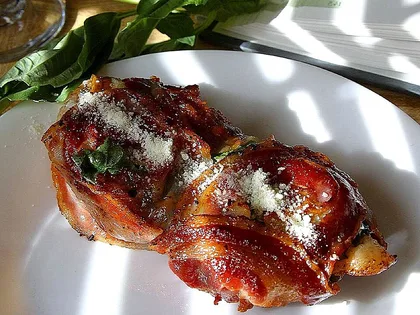 Cured meatsPancetta PiacentinaPancetta Piacentina is pork belly dry-cured with cloves and nutmeg, rolled tightly on itself, cased and aged…
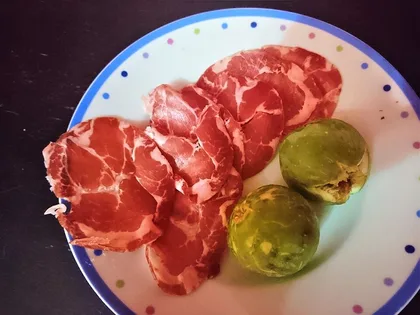 Cured meatsCapocolloCapocollo is the pork neck muscle, salted whole and aged in casing.
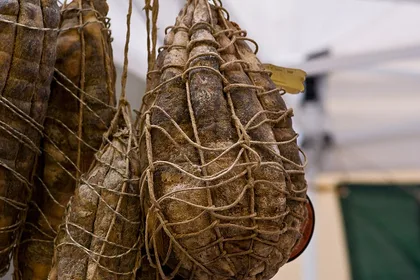 Cured meatsCulatello di ZibelloCulatello di Zibello is the heart muscle of a pork leg, boned out, sewn into a pig's bladder, tied by hand…
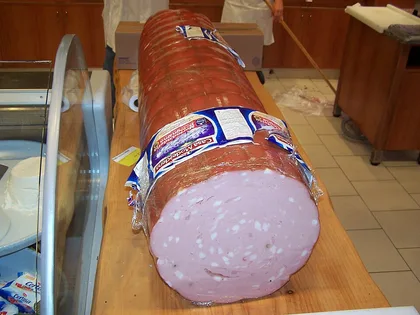 Cured meatsMortadellaThe white cubes are not just any fat: they are jowl, the firmest part of the pig, and they stay whole…Cured meatsPancettaPancetta is Italian cured pork belly: salt, pepper and warm spices, dried for months, never smoked.
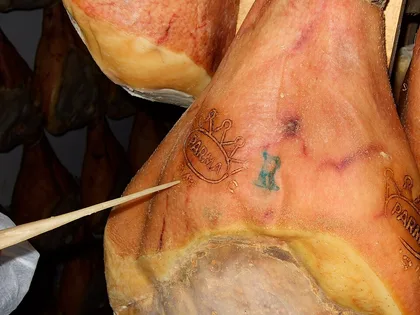 Cured meatsProsciutto di ParmaProsciutto di Parma DOP is Italian ham made from three things only: pork, sea salt and at least 400 days.
 Cured meatsCotechinoCotechino is a large fresh pork sausage from Emilia-Romagna, made with pork meat, fat and rind, and always…
 Cured meatsZamponeZampone Modena IGP is spiced pork and rind forcemeat stuffed into a boned pig's trotter: same filling as…