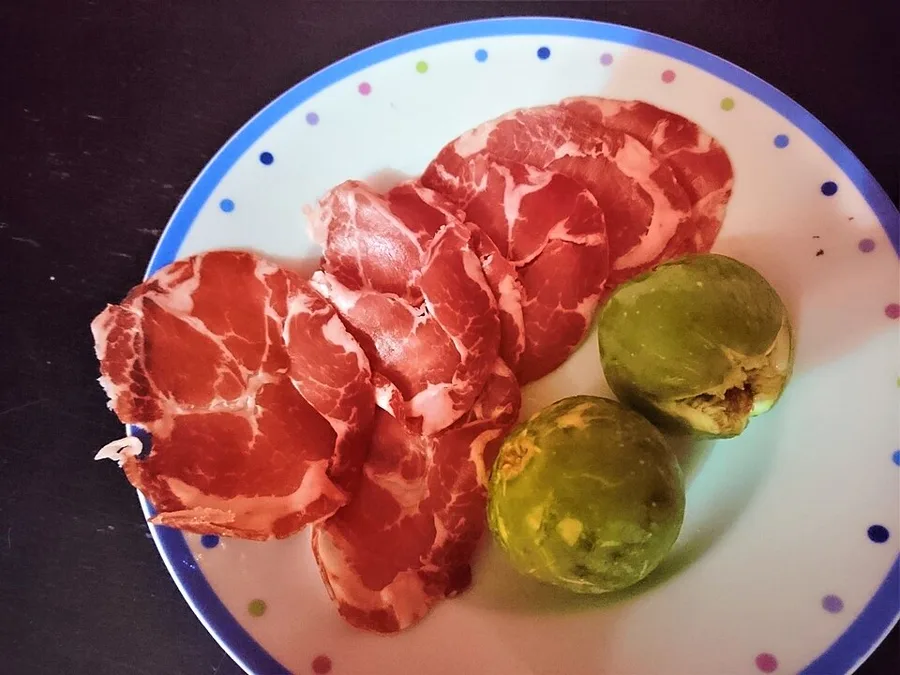
What is Capocollo?
Capocollo is a whole-muscle cured meat, not a ground sausage. The neck muscle, running from the base of the skull to the fourth or fifth rib, is salted, seasoned, stuffed into natural casing and hung to age.
The cut works because it is naturally marbled: the fat sits inside the muscle in fine seams rather than around it, which is what lets it age for months and stay soft, and what gives the slice its red and white mosaic.
Finished weights run from a kilo and a half to three kilos, and ageing from two to six months depending on region and size. The shape is a slightly flattened cylinder, hand-tied with string in even turns.
One clarification worth having: capocollo, coppa, lonzino and lonza are not perfect synonyms. Capocollo and coppa are the same cut worked differently; lonzino and lonza in much of central Italy mean the loin, which is a leaner, different muscle. Italian butchery vocabulary is a stack of dialects, not a single system.
What does it taste like?
Rich and sweet, with a texture between prosciutto and lardo: the fat seams melt on contact and carry the flavour, so it coats the palate more than a lean ham does.
What you taste after that depends entirely on where it was made. Martina Franca capocollo has a faint sweet smoke and a fig-and-cooked-wine roundness. Calabrian capocollo carries real chilli heat and a redder, sharper edge. Piacenza coppa tastes of cinnamon, clove and nutmeg and is the mildest and butteriest of the three.
Underneath all of them is the same base note: pork, salt and time, with none of the tang of a fermented salami.
American deli capicola, hot or sweet, is usually a much younger, wetter, paprika-seasoned product and tastes noticeably different: softer, saltier, less complex.
How to use it
Slice it thin but not transparent: one to two millimetres. Thinner than that and the marbling that makes the cut worth buying stops registering.
Serve at room temperature. In Puglia the standard partner is burrata: the smoke of the capocollo against fresh cream is one of the best pairings in southern Italian cooking. Focaccia barese, pickled lampascioni and broad beans do the same job.
In Calabria it goes on a board with soppressata, 'nduja and pecorino crotonese, with durum wheat bread.
It cooks better than most raw-cured meats because the internal fat protects it. Two thick slices seared in a dry pan work with peas or beans; diced, it goes into a sauce or a frittata; laid over a chicken breast it bastes the meat as it roasts.
In the US it is above all a sandwich meat, the capicola of the Italian sub alongside mortadella and provolone, and it is very good at that job.
How long it keeps
A whole piece hangs in a cool, dark, ventilated room between 12 and 16 °C, where it goes on curing for months, losing water and firming as it goes. Once you cut into it, press cling film against the cut face or cover it with a cloth, and reckon on three or four weeks. A fridge slows everything down but dries the meat out: wrap it in greaseproof paper and use the least cold shelf. White bloom on the outside comes with this kind of curing and is wiped away with a cloth dampened in white wine or vinegar before slicing.
Green or black growth, or a sour smell, are changes that curing does not bring on its own, and at that point the date on the pack and the butcher who sold it are the reference. Sliced to order, it is meant for that day or the next. Vacuum packs hold a few weeks chilled and want opening half an hour before serving so the meat breathes and the aroma returns. It does not freeze well: the internal fat crystallises and the slice loses its structure.
Spot the real thing
The slice is the test. It should show an irregular mosaic of red lean threaded with thin white veins right across the section. A piece with fat only around the rim and a uniform lean centre is loin sold under the wrong name. The fat should be white and firm: yellow points to oxidation or the wrong feed, soft and greasy to the touch points to curing cut short. The casing should sit tight against the meat, and air pockets under it are the commonest fault of all.
In American delis the word to watch is capicola, often heard as gabagool. That is usually a brined and sometimes cooked deli meat sliced to order, milder and wetter than a dry cured Italian capocollo. Coppa is simply the northern Italian name for the same cut. On the protected versions look for the consortium mark and the European symbol: Coppa Piacentina DOP, Capocollo di Calabria DOP. Capocollo di Martina Franca has no DOP and runs through a Slow Food Presidium list instead. The nose tells the region: light sweet smoke and cooked wine in Puglia, chilli in Calabria, sweet spice around Piacenza.
How to pronounce Capocollo
kah-poh-KOHL-loh
Four syllables, stress on the third, with the double 'l' held. In southern dialects the final vowels drop and the consonants soften, which is how Neapolitan-American speech turned capocollo into 'gabagool', a real dialect pronunciation and not a joke. Coppa is simply KOHP-pah.
Capocollo compared
vsCoppa, capocollo, lonzino: the same cut under different names
One muscle, several regional identities. In Emilia and Lombardy it is coppa, cured with sweet spices and aged in the damp cellars of the Piacenza valleys. In Puglia it is capocollo, marinated in cooked wine and cold-smoked. In Calabria it is capocollo again, but seasoned with chilli. In Umbria and the Marche, lonzino usually means the loin rather than the neck, which is where most of the confusion comes from. Seasoning, smoke and ageing change with the name; the anatomy does not.
| This | Coppa, capocollo, lonzino: the same cut under different names | |
|---|---|---|
| Emilia (Coppa Piacentina DOP) | Same neck muscle | Salt, pepper, clove, cinnamon, nutmeg; 6+ months; no smoke |
| Puglia (Martina Franca) | Same neck muscle | Cooked wine marinade; cold-smoked with fragno oak and maquis; 3-4 months |
| Calabria (DOP) | Same neck muscle | Chilli, pepper, sometimes wild fennel; 3-4 months |
| Umbria and Marche (lonzino) | Usually the loin, not the neck | Garlic and wine; leaner and drier |
| Corsica and Sardinia (coppa) | Same neck muscle | Salt, pepper, sometimes juniper; often lightly smoked |
| US delis (capicola) | Same cut, industrial method | Hot or sweet paprika; short cure; softer and wetter |
vsCapocollo di Martina Franca vs Coppa Piacentina DOP
The clearest way to see how far one cut can travel. Martina Franca sits in the Valle d'Itria in Puglia: after salting, the meat is marinated in vino cotto (fig or grape must boiled down) then cold-smoked over fragno oak with sprigs of Mediterranean maquis, myrtle and thyme. Piacenza cures its coppa in the humid cellars of the Arda and Tidone valleys with sweet baking spices and no smoke at all, for at least six months. One is sweet and smoky; the other is fragrant and buttery. Piacenza has a PDO; Martina Franca does not, but it is a Slow Food Presidium.
| This | Capocollo di Martina Franca vs Coppa Piacentina DOP | |
|---|---|---|
| Region | Valle d'Itria, province of Taranto | Arda and Tidone valleys, Piacenza |
| Marinade | Vino cotto (cooked fig or grape must) | None: dry salt and spices |
| Seasoning | Salt, pepper, sometimes chilli | Clove, cinnamon, nutmeg, pepper |
| Smoke | Cold smoke, fragno oak and maquis | None |
| Ageing | About 3-4 months | Minimum 6 months, humid cellars |
| Flavour | Sweet, smoky, aromatic | Delicate, spiced, buttery |
| Protection | Slow Food Presidium | PDO since 1996 |
vsProsciutto and pancetta
The three cured cuts most often confused on an English-language deli counter. Prosciutto is the hind leg: lean, sliced translucent, aged a year or more. Pancetta is the belly: layered fat and lean, usually cooked rather than eaten raw. Capocollo sits between them: a whole muscle like prosciutto, but marbled throughout like pancetta, and eaten raw like the first while cooking as forgivingly as the second.
| This | Prosciutto and pancetta | |
|---|---|---|
| Cut | Neck and shoulder muscle | Hind leg / pork belly |
| Fat | Marbled through the muscle | Outer rim / distinct layers |
| Ageing | 2-6 months | 12-24 months / 2-4 months |
| Eaten raw | Yes, sliced 1-2 mm | Yes / usually cooked |
| Price | 22-35 EUR per kg whole | 22-30 / 12-20 EUR per kg |
Capocollo substitutes
- Coppa (Piacentina or Parma)
The same cut in its Emilian form and the easiest swap outside Italy. Milder and spiced rather than smoked, so if the dish depends on the smoke of a Martina Franca, you will lose that entirely.
1:1 - American capicola, hot or sweet
Common in every US deli. Younger, softer and paprika-led, and often sliced too thin. Perfectly good in a sandwich; on a board it will read as a different product.
1:1 - Speck Alto Adige
The best stand-in when smoke is the quality you want. Speck is boned leg rather than neck, leaner and firmer, with juniper in the cure. Slice slightly thicker to compensate for the missing marbling.
1:1 - Lomo embuchado (Spanish cured loin)
Whole-muscle, paprika-rubbed, air-dried. Much leaner because it is loin rather than neck, so serve it with something fatty: burrata, butter, a good olive oil.
1:1, plus fat on the plate - Halal or no-pork: beef coppa or bresaola
Cured beef neck or chuck, made by the same whole-muscle salt-and-air method, is produced by halal charcutiers in Europe and the US and behaves closely. Bresaola della Valtellina is leaner and cleaner: pair it with olive oil, lemon and a fresh cheese.
1:1 for beef coppa; bresaola 1:1 with added oil - Smoked duck or beef pastrami, thinly sliced
For a board that needs smoke, richness and a red slice without pork. Pastrami is more heavily spiced and much saltier, so use about two-thirds and cut it thicker.
0.7:1
Where to buy it
In the US, capocollo is easy to find and easy to get wrong. Every Italian deli sells capicola, but most of it is domestic, young and paprika-seasoned; imported Italian capocollo and Coppa Piacentina DOP come through Eataly, Gustiamo, Di Bruno Bros and Formaggio Kitchen. Expect roughly 12 to 22 dollars per pound for deli capicola and 22 to 40 for imported DOP coppa.
In the UK, Italian delicatessens and online specialists carry coppa and capocollo at roughly 30 to 50 pounds per kilo, sliced.
Check the slice before anything else: fine white seams running through the whole section, not a lean core with a fat rim. A lean core means loin sold as neck.
Look for the consortium marks where they exist: Coppa Piacentina DOP and Capocollo di Calabria DOP both have them. Martina Franca does not have a PDO; it is a Slow Food Presidium, so the guarantee is the producer's name.
Buy a whole piece if you have somewhere cool to hang it. It costs a third less per kilo than sliced and improves for months.
Where to eat it in Italy
Martina Franca, in the province of Taranto, is where to go: the butchers of the old town cure and slice their own, and the fornelli pronti, butcher shops with a grill in the back, serve it alongside bombette. The rest of the Valle d'Itria, Locorotondo, Cisternino and Alberobello, does the same.
In Calabria, the villages of the Sila and the Crotonese hold their pork festivals between December and February, when the slaughter season and the curing calendar begin.
Around Piacenza, in the Arda and Tidone valleys, you can taste coppa, pancetta and salame piacentino, three PDO cured meats from one province, with fried dough and a glass of frothy Gutturnio.
In Bari, the market stalls and the delis of the old centre keep Apulian capocollo year-round, usually within arm's reach of a burrata from Andria, which is exactly how it should be eaten.
Further reading
Frequently asked questions
Are capocollo and coppa the same thing?
They are the same cut, the pork neck muscle, worked differently by region. Emilia and Lombardy call it coppa and season it with cinnamon, clove and nutmeg; Puglia and Calabria call it capocollo and either smoke it or spice it with chilli. Lonzino and lonza, in much of central Italy, mean the loin instead, which is a leaner and different muscle.
Is capocollo smoked?
Only in some places. The capocollo of Martina Franca in Puglia is cold-smoked over fragno oak with Mediterranean maquis, myrtle and thyme, after a marinade in cooked wine, and it is the only major Italian capocollo that is smoked. Calabrian capocollo and Emilian coppa are not smoked at all.
What is gabagool?
It is capocollo, pronounced through southern Italian dialect and Italian-American speech, where final vowels drop and hard consonants soften. The word travelled with emigrants from Campania and the south; the product it usually describes in an American deli is a younger, softer, paprika-seasoned version of the Italian original.
How is capocollo different from prosciutto?
Different muscle and different behaviour. Prosciutto is the hind leg: lean, with the fat around the outside, aged twelve months or more. Capocollo is the neck, marbled with fat through the whole muscle, aged two to six months, and it eats richer and softer with a mosaic-patterned slice.
How long does capocollo keep?
A whole piece hung in a cool, dark, ventilated place at 12 to 16 degrees keeps for months and continues to age. Once cut, cover the exposed face and eat it within three or four weeks. Sliced capocollo loses its aroma within a day or two, so buy small amounts.
Related foods
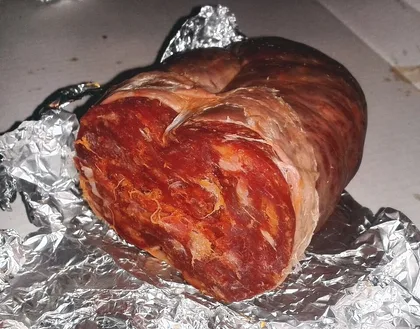 Cured meatsSoppressataSoppressata is a coarse-ground dry salami from southern Italy, pressed flat between boards while it dries…
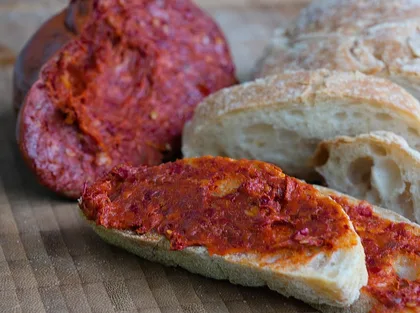 Cured meats'Nduja'Nduja is a soft, spreadable Calabrian pork salume that is up to 40% chilli.
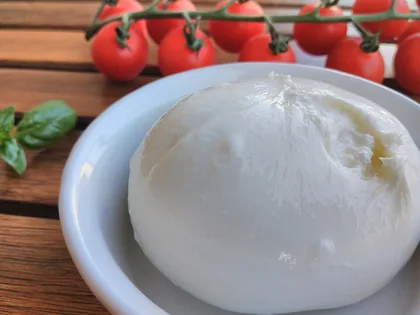 CheeseBurrataIt began as a way of using offcuts: leftover shreds of pasta filata, drowned in cream and sealed inside a…Cured meatsPodolica BeefPodolica is the grey, lyre-horned cattle breed that lives outdoors year-round in the southern Italian…
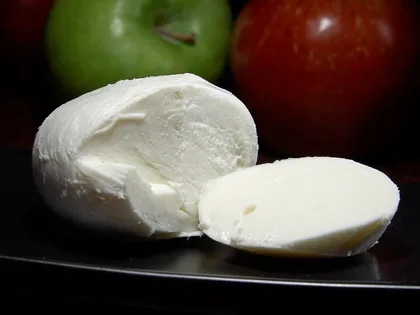 CheeseMozzarellaThe name is a verb before it is a cheese: mozzare means to lop off, which is what the cheesemaker does by…
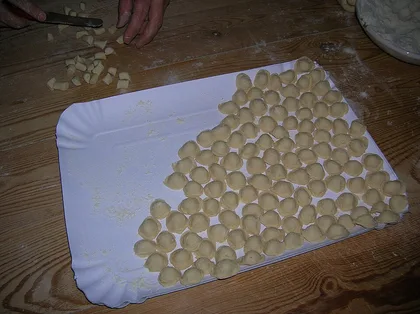 Pasta and breadOrecchietteOrecchiette are Puglia's handmade pasta: semolina and water, no egg, dragged with a knife and flipped over a…
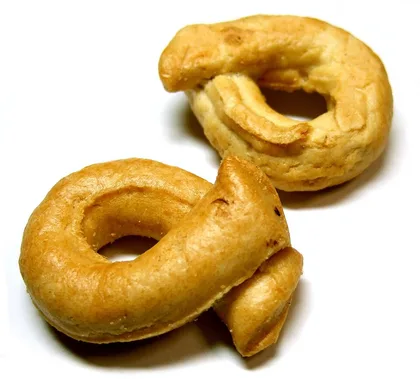 Pasta and breadTaralliTaralli are small, crunchy savoury rings from Puglia in southern Italy, made from just flour, dry white wine…
 CheeseCaciocavalloCaciocavallo is a stretched-curd cow's milk cheese from southern Italy, aged in a distinctive gourd shape…