What is Podolica Beef?
Podolica is a rustic southern Italian cattle breed: an ash-grey to silver coat, darker in bulls, over black skin; long lyre-shaped horns; a lean frame, long legs and famously hard hooves. Calves are born fawn red and turn grey within a few months.
It is a dual-purpose breed that survives today for two products: caciocavallo podolico, one of the most expensive cheeses in Italy, and a beef that almost nobody markets properly. The milk yield is tiny (five or six litres a day against twenty-five from a Holstein), strictly seasonal, and its composition tracks whatever the animal has been grazing that month.
The defining quality is hardiness. Podolica cattle eat what other breeds refuse: scrub, brambles, thistles, oak leaves, stubble. They tolerate water shortage, walk twenty kilometres a day, calve unassisted in the open and stay alive on mountain ground where no modern breed would last a season without trucked-in feed.
There is no protected designation for the meat. The cheese has local recognition and Slow Food backing; the beef is usually sold as generic Italian beef.
What does it taste like?
Dark, mineral and unmistakably grassy. Podolica beef tastes of what the animal ate (herbs, scrub, acorns) in a way that grain-finished beef never does, with an iron edge and a long savoury finish.
The texture is the trade-off. The muscle fibre is coarser and the meat is firmer than a specialised beef breed, with very little marbling and thin cover fat that can carry a yellow tinge from carotene, which is a sign of pasture rather than of age.
Braised, it turns into something quite different: dense, gelatinous, concentrated, with a stock so dark and thick it sets in the fridge. This is where the breed is genuinely excellent and where southern Italian cooking always used it.
Grilled without proper ageing it eats tough and dry, and most people who dismiss Podolica beef have met it in exactly that state. Three to five weeks of ageing, served rare, and the same cut is superb.
How to use it
Treat it as a braising animal and it will not disappoint you. Ragu that simmers four hours and dresses cavatelli or hand-rolled ferretti; shin and cheek stewed with red wine and bay; the Lucanian pignata, where beef, potatoes, onion and herbs cook for hours in a sealed terracotta pot; boiled beef with a green sauce sharp with vinegar and parsley. The stock these give is dark enough to set solid when cold.
For the grill, only after real ageing and only rare. Sirloin, rump and fillet all work, but they are lean by definition: finish with coarse salt and raw olive oil, and take them off before you think you should. Medium is already too far.
Mince is worth seeking out. Podolica mince makes meatballs and ragu with far more character than commodity beef, and it takes kindly to a little pork fat to compensate for how lean it is.
One pairing closes the circle: grate aged caciocavallo podolico over a Podolica beef ragu. Same animal, both halves of what it produces, and one of the best things you can eat in Basilicata.
How long it keeps
Fresh cuts go on the coldest shelf of the fridge, between 0 and 4°C, on a plate or rack, covered loosely rather than sealed, so the surface can dry slightly instead of sitting in its own liquid. Vacuum packed pieces hold to the butcher date, often a week or two, and the meat inside a sealed bag looks purplish because there is no oxygen; within twenty or thirty minutes of opening it blooms to bright red, and over the following day or two the surface pigment shifts again towards brown grey. That colour sequence is the pigment reacting with air, not a measure of anything else.
Older animals like these are often dry aged, hung three to six weeks near 1°C, over which they shed ten to twenty per cent of their weight as water and form a hard dark crust that is trimmed away before sale. In the freezer, wrapped airtight, whole cuts hold six to twelve months and mince rather less. Ice crystals rupture the fibres, so thawed meat gives up more liquid, and every freeze and thaw cycle costs more. The butcher date is the reference.
Spot the real thing
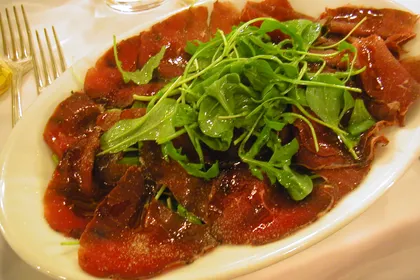
Podolica meat does not look like supermarket beef, and that is the point. Because the animals are slow growing, worked and much older at slaughter than commodity cattle, the muscle is a dark brick red rather than pink, the grain is visibly coarser and the fibres run in obvious bundles. The fat is ivory to yellow rather than white, carotene from months of grazing, and there is far less internal marbling than in grain finished beef. In the south the butcher states the breed on the ticket, and the EU traceability label gives birth, rearing and slaughter details.
Outside Italy the meat itself is almost never exported, so most of what carries the name abroad is something else: Caciocavallo Podolico, the cheese made from the milk of the same cows, or another Italian breed such as Chianina, which is white coated and the animal behind the Florentine steak, or Maremmana. Yellow fat also shows up on any grass finished beef, so on its own it proves nothing. Cuts run 18 to 30 euro a kilo in Basilicata and Puglia, and a restaurant steak considerably more.
How to pronounce Podolica Beef
RAHT-tsah poh-DOH-lee-kah
'Razza' means breed and the double z is a hard ts sound: RAHT-tsah. In 'podolica' the stress falls on the second syllable, poh-DOH-lee-kah, not on the 'lee'. English speakers usually shorten the whole thing to 'Podolica', which is fine.
Podolica Beef compared
vsModern beef breeds (Charolais, Limousin, Angus)
Podolica was never selected for beef, and it shows on a carcass grading sheet. Charolais and Limousin were bred for muscle mass and conformation, Angus for marbling; all three reach slaughter weight faster, on richer feed, with more saleable meat per animal. Podolica takes eighteen to thirty months on scrub and pasture, finishes lighter, grades poorly and has almost no marbling. What it has instead is flavour that comes from an extensive diet and a genuinely outdoor life, and, because the grading system cannot measure that, it is usually paid the commodity price.
| This | Modern beef breeds (Charolais, Limousin, Angus) | |
|---|---|---|
| Selected for | Survival on poor ground | Muscle mass, growth rate, marbling |
| Age at slaughter | 18-30 months | 14-20 months |
| Feeding | Scrub, pasture, acorns, minimal supplement | Grass plus concentrates, or feedlot grain |
| Marbling | Almost none | Low (Limousin) to high (Angus) |
| Carcass grading | Poor: frame, not muscle | Designed around these breeds |
| Ageing needed | 3-5 weeks minimum | 1-3 weeks |
| Price paid to farmer | Commodity: undervalued | Premium tiers exist |
vsChianina
Two Italian breeds that are both lean, for opposite reasons. Chianina is enormous, was selected for draught work and now sits at the premium end of the market with an IGP, a consortium and the bistecca alla fiorentina behind it. Podolica is medium-framed, was selected by the mountains rather than by anyone in particular, and has none of that commercial structure. On the plate the Chianina loin is finer-grained and better suited to the grill; Podolica has more grassy, gamey depth and belongs in a braise.
| This | Chianina | |
|---|---|---|
| Size | Medium, 400-600 kg | Largest in the world, bulls over 1,700 kg |
| Certification | None for the meat | Vitellone Bianco dell'Appennino Centrale IGP |
| Coat | Grey, lyre horns | Porcelain white, black skin |
| Best use | Braises, ragu, boiled beef | Bone-in loin over embers |
| Also gives | Milk for caciocavallo podolico | Beef only |
| Price | EUR 12-22 per kg | EUR 32-55 per kg for the loin |
vsMaremmana and other grey podolic breeds
Maremmana, from coastal Tuscany and northern Lazio, belongs to the same grey podolic family and looks similar to an untrained eye, but it is heavier, with wider horns, and it was a draught and marshland breed rather than a mountain one. The southern Podolica is lighter, longer-legged and better adapted to drought and steep ground. Podolica is also milked; Maremmana essentially is not.
| This | Maremmana and other grey podolic breeds | |
|---|---|---|
| Territory | Southern Apennines | Tuscan and Lazio coastal plains |
| Frame | Lighter, long-legged | Heavier, broader |
| Horns | Lyre-shaped, upright | Wider, crescent |
| Milked | Yes, for caciocavallo | Essentially no |
Podolica Beef substitutes
- Grass-fed, grass-finished beef, aged 4 weeks
The closest thing available almost anywhere. Look for pasture-finished rather than grass-fed-then-grain-finished, and insist on real dry ageing: without it you get the toughness without the flavour.
1:1 - Older native-breed beef (Longhorn, Dexter, Galloway, Highland)
British and Irish traditional breeds finished slowly on rough grazing behave much like Podolica: darker, firmer, more mineral, better braised than grilled.
1:1 - Beef from a cull cow or mature steer
Underrated everywhere. Meat from an older animal has the concentration and the gelatine that Podolica gets from age, and butchers often sell it cheap. Excellent for ragu and braises.
1:1 - Bison or buffalo
Lean, dark, grassy, iron-rich, and widely sold in the US. Not Italian and not the same animal, but it solves the same cooking problem and rewards the same slow methods.
1:1, watch it closely, even leaner - Beef shin and cheek from any breed, for braising dishes
If the dish is a ragu, a pignata or a stew, the cut matters more than the breed. Shin and cheek from ordinary beef, cooked four hours, get you most of the way there.
1:1
Where to buy it
Effectively, in southern Italy. There is no export chain for Podolica beef, no protected mark to carry it abroad and no volume to justify one. Outside Italy you will find caciocavallo podolico in specialist cheese shops in the US and UK, at roughly 45 to 90 dollars a pound or 35 to 70 pounds per kilo for aged wheels, but not the meat.
In Italy, buy it in the region. Butchers in Matera, Potenza, Foggia and the towns of the Gargano and the Cilento carry it and will name the farm. Expect 12 to 22 euros a kilo for most cuts, and 25 to 35 for prime cuts sold with the producer declared, which is the price it should always fetch and rarely does.
The single most useful question is how long the meat has been aged. Under fifteen days, take it home and leave it vacuum-packed in the fridge for another week before cooking. Podolica punishes impatience more than most beef.
Where to eat it in Italy
The Gargano peninsula in Puglia is the easiest place to meet the animal: grey cattle standing in the road around Monte Sant'Angelo, herds moving through the beech woods of the Foresta Umbra, masserie around Vico del Gargano and Carpino selling cheese at the gate and sometimes meat.
Inland Basilicata is the heartland. The Pollino massif, the Val d'Agri, the Lucanian Dolomites between Castelmezzano and Pietrapertosa, the country around Accettura and Stigliano. Matera is the market town, and its butchers and trattorie name the breed on the board.
In Campania, the Cilento and the Alburni hills around Sanza, Piaggine and Castelcivita; in Calabria, the Sila plateau and the Calabrian side of the Pollino.
Go between May and July. The herds are up on the high pastures, the grazing is at its peak, and the milk, and therefore the cheese, is at its best. It is also the only time of year when finding a Podolica herd is easy rather than lucky.
Further reading
Frequently asked questions
What is Podolica cattle?
A grey, lyre-horned breed of the southern Italian Apennines, kept outdoors all year on rough grazing. It belongs to the grey steppe cattle family named after Podolia, between Ukraine and Moldova. It gives very little milk, used for caciocavallo podolico, and a lean dark beef with no protected designation.
Why is caciocavallo podolico so expensive?
Because the cow gives five or six litres a day, only in season, and will not let her milk down without her calf beside her, which halves what reaches the dairy. Everything about the system is low-yield, and the cheese carries the cost of the whole herd.
Is Podolica beef tough?
Raw and unaged, yes. It needs at least three weeks of dry ageing and it rewards long, slow cooking. Properly aged and braised it is outstanding; rushed onto a grill after a few days it justifies its bad reputation.
Can I buy Podolica beef outside Italy?
Realistically no. There is no export chain and no protected mark to support one. Aged caciocavallo podolico does reach specialist cheese shops in the US and UK; the meat stays in the south of Italy.
Are Podolica cattle really free-range?
Yes, and in this case the phrase is literal: they live outdoors year-round, calve unassisted and forage most of their own food. The uncomfortable part is that the system survives because mountain pasture has no more profitable use, not because the market pays for it.
Related foods
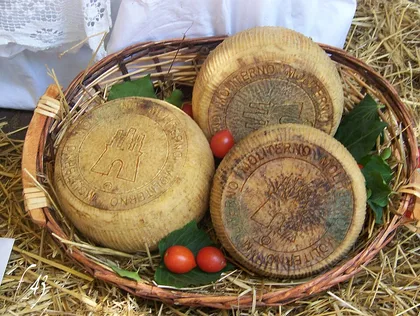 CheeseCanestrato PuglieseCanestrato Pugliese DOP is a hard sheep's milk cheese from the Tavoliere plain of northern Puglia, pressed…Vegetables and fruitPeperone CruscoPeperone crusco is a sweet Basilicata pepper, sun-dried on strings and then flash-fried for two or three…
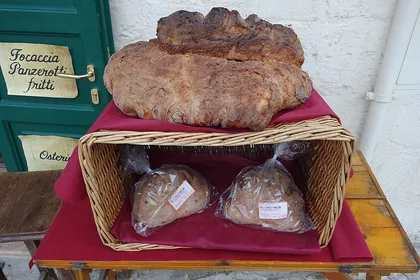 Pasta and breadPane di MateraPane di Matera is a durum-wheat sourdough from Basilicata, IGP since 2008, leavened with a mother culture…
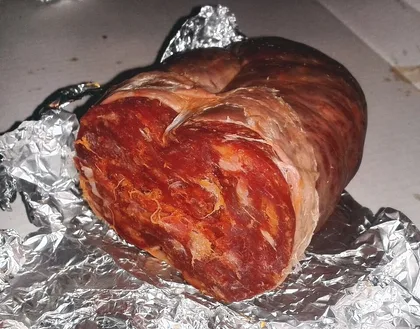 Cured meatsSoppressataSoppressata is a coarse-ground dry salami from southern Italy, pressed flat between boards while it dries…
 Cured meatsCapocolloCapocollo is the pork neck muscle, salted whole and aged in casing.Cured meatsSalsiccia di FegatoSalsiccia di fegato is Italian pork liver sausage: coarsely chopped liver, pork fat, salt and spices in…
 CheeseBurrataIt began as a way of using offcuts: leftover shreds of pasta filata, drowned in cream and sealed inside a…