What is Chianina Beef?
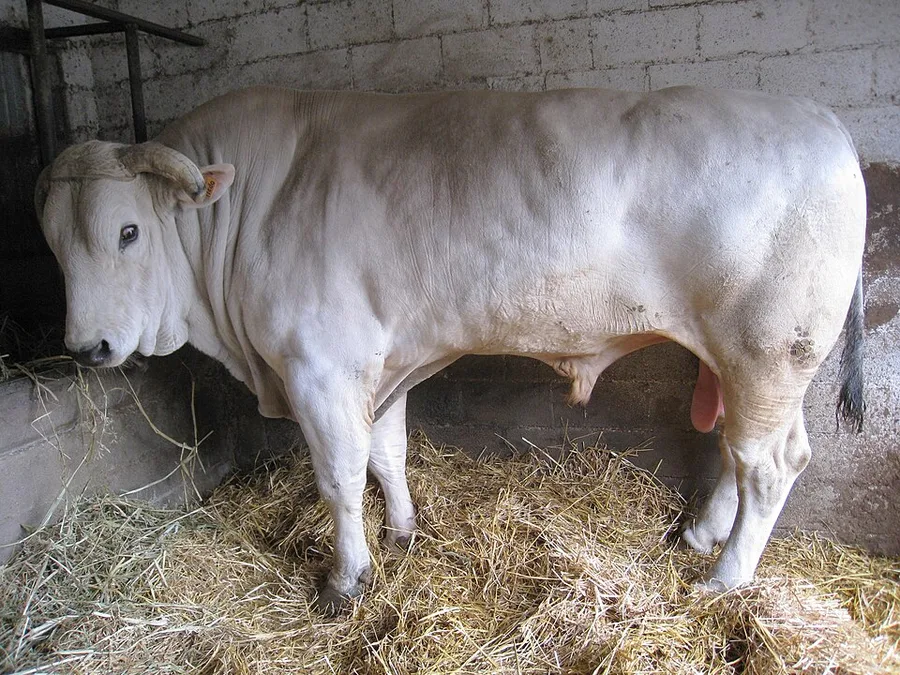
Chianina is an Italian cattle breed and the tallest in the world. Adult bulls reach 1.80 metres at the withers and pass 1,700 kg; cows sit around 900. The coat is porcelain white over black skin, and calves are born a reddish fawn that fades within a few months.
It was not bred for beef. For roughly two thousand years the Chianina was a draught animal, pulling ploughs and carts through the Chiana valley, selected for height, leg length and heat tolerance, never for marbling or carcass yield. The switch to beef production happened between the 1950s and 1970s, when tractors made oxen redundant and the breed came close to disappearing.
Certified Chianina beef today is sold under Vitellone Bianco dell'Appennino Centrale IGP, a mark covering three white breeds: Chianina, Marchigiana and Romagnola. Maremmana, the other Tuscan steak breed, is grey and sits outside that IGP.
The meat is lean. Fine grain, thin white cover fat, very little intramuscular marbling. Anyone raised on American beef reads it as dry on first encounter. Anyone who knows it will tell you that is exactly the point.
What does it taste like?
Beef flavour without the butter. The dominant note is mineral and faintly sweet, with an iron edge that gets stronger the rarer you eat it, and a long clean finish because there is almost no fat coating the palate.
On a properly grilled fiorentina the two muscles taste different enough to be worth separating. The strip side is firmer, denser, more savoury, with a charred crust that carries most of the flavour. The fillet side is soft, mild and almost delicate: it is the part people fight over and the less interesting half.
What you will not find is the buttery mouthfeel of a well-marbled ribeye. No fat melts through the muscle, so texture comes from the grain and from ageing: under-aged Chianina is simply tough, while three to five weeks of dry ageing turns it tender and adds a nutty, almost cured depth. Cook it past medium-rare and it goes fibrous, with no fat left to rescue it.
How to use it
One rule matters more than the rest: take it out of the fridge two hours before cooking. A cold, thick, lean steak dries out on the surface long before the centre warms up.
Build a wood or charcoal fire and let it burn down to embers, because flames scorch and embers cook. Oak or holm oak in Tuscany, any hardwood elsewhere. Put the steak on a very hot grate, five to seven minutes a side, and do not move it or press it. Then stand it upright on its bone for another five to seven minutes so the heat reaches the middle.
Salt afterwards, never before, with black pepper and a thread of olive oil if you want it. Rest five minutes on a warm plate, cut the strip and the fillet away from the bone, slice both across the grain, and put the bone on the table: it gets picked up and gnawed, and that is normal. Rare is a requirement here, not a preference.
The rest of the animal is where the value sits. Peposo, shin with whole black peppercorns and red wine and six hours in a low oven, is the classic Tuscan use of the cheap cuts, and Chianina mince makes a ragù with far more character than commodity beef.
How long it keeps
Raw, a fiorentina holds two or three days in the coldest part of the fridge, set on a rack inside a plate so it is not sitting in its own liquid, covered but not sealed. Cling film pressed against the surface keeps that liquid on the meat. With air around it the surface darkens as the pigment oxidises and a slightly tacky skin forms, which is exactly what a dry-ageing cabinet does on purpose. Vacuum packed by the butcher it holds ten to fifteen days and keeps ageing slowly; the sharp note on opening the bag clears within ten minutes in the air, and anything that persists is a question for whoever packed it.
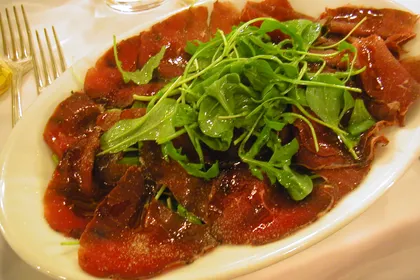
It freezes badly. Ice crystals rupture the fibres and meat this lean comes out drier than it went in, so braising cuts are the ones worth putting in the freezer. Cooked leftovers are not reheated in Tuscany: the steak goes cold into the fridge and gets sliced thin the next day with oil, salt and rocket.
Spot the real thing
Certified meat carries the Vitellone Bianco dell'Appennino Centrale IGP mark and a label giving the animal's identification code, the farm and the abattoir. That code can be checked, and it is the only test that settles anything. On the cut itself the colour is a bright red leaning towards pink rather than dark, the covering fat is white and thin, never yellow and never generous, and the grain is fine with very little marbling. A heavily marbled loin is not Chianina, whatever the sign says, so anyone shopping by American standards should expect the opposite of Prime.
A fiorentina is a cut, not a breed: the loin on the T-bone, fillet on one side and sirloin on the other, cut at least three or four centimetres thick and weighing one to one and a half kilos. An English-speaking butcher calls that a porterhouse; a thin 700 gram steak is a rib steak. In the United States, cattle sold as Chianina are usually domestic Chiangus crossbreeds, and restaurant menus using the word alone at a low price are rarely selling the IGP.
How to pronounce Chianina Beef
kyah-NEE-nah
Three syllables, stress on the middle one. The 'chi' is a hard k sound, as in 'chemistry', never 'chee' or 'shee'. So kyah-NEE-nah, not 'chee-ah-NEE-nah'. The name comes from the Val di Chiana (val dee KYAH-nah), the valley it was bred in.
Chianina Beef compared
vsAngus
These are opposite arguments about what beef is for. Angus was selected for marbling: fat inside the muscle that melts during cooking, keeps the meat juicy and forgives overcooking. Chianina was selected for two millennia as a working animal and marbles very little, so its flavour comes from the muscle itself and from ageing rather than from fat. An Angus ribeye is richer, more consistent and much harder to ruin. A Chianina fiorentina is leaner, more mineral and only good rare: get it wrong and there is nothing to fall back on. Neither is better; they answer different questions.
| This | Angus | |
|---|---|---|
| Selected for | Draught work, then size | Marbling and carcass quality |
| Marbling | Minimal | Moderate to abundant |
| Fat flavour | Almost none: muscle and mineral | Rich, buttery, sweet |
| Doneness window | Rare only | Rare to medium works |
| Typical slaughter age | 18-24 months | 14-20 months |
| Finishing | Hay, maize, cereals in loose housing | Grain feedlot (US) or grass (UK, AU) |
| Classic cut | Bone-in loin, 4-5 cm thick | Ribeye, strip, tenderloin |
vsWagyu
The extreme opposite pole. Japanese Wagyu is bred for intramuscular fat so extensive that the meat looks more white than red at A5 grade, with a fat melting point low enough that it softens at body temperature. Chianina sits at the far lean end of the same spectrum. Wagyu is eaten in small portions because the richness saturates the palate within a few bites; a Chianina fiorentina is a kilo shared by two people and you keep eating. Serving one to someone expecting the other disappoints on expectation, not on quality.
| This | Wagyu | |
|---|---|---|
| Intramuscular fat | Very low | Extremely high (BMS 8-12 at A5) |
| Mouthfeel | Firm, clean, mineral | Melting, buttery, saturating |
| Portion size | 400-600 g per person | 80-150 g per person |
| Cooking | Hard char over wood embers | Brief sear, low heat, thin slices |
| Ageing | Essential: 3 to 5 weeks | Short or none |
| Price (Italy / Japan) | EUR 32-55 per kg | EUR 200-500+ per kg |
vsT-bone and porterhouse
Structurally the same cut: a fiorentina is the bone-in short loin with fillet on one side and strip on the other, which makes it an American porterhouse. The differences are thickness, weight and method: cut four to five centimetres thick, over a kilo, grilled on wood embers, stood on the bone to finish, salted only afterwards and served rare for two people to share.
| This | T-bone and porterhouse | |
|---|---|---|
| Anatomy | Short loin, bone-in, both muscles | Identical cut |
| Thickness | 4-5 cm minimum | 2.5-4 cm typical |
| Weight | 1-1.5 kg | 500-900 g |
| Heat source | Wood or charcoal embers | Broiler, flat-top, grill |
| Seasoning | Salt after cooking only | Salted before, often dry-brined |
| Served | Rare, shared, sliced off the bone | To order, plated whole |
Chianina Beef substitutes
- US-raised Chianina or Chiangus
Chianina genetics reached the United States in the 1970s for crossbreeding, and most American beef sold as Chianina is a Chianina-Angus cross. Leaner than straight Angus, nowhere near as lean as an Italian animal.
1:1 - Marchigiana or Romagnola
The other two breeds inside the same Vitellone Bianco dell'Appennino Centrale IGP, and the closest possible match: same certification, same leanness, same handling. Italian butchers often carry them at slightly lower prices.
1:1 - Piedmontese beef
The double-muscled Piedmontese breed is exceptionally lean and is farmed in the US and Canada under that name. Even leaner than Chianina, so cut the cooking time and pull it at rare.
1:1, cook 20 percent less - Grass-finished porterhouse, dry-aged 4 weeks
The practical answer almost everywhere. Grass-finished beef is leaner and more mineral than grain-fed, and four weeks of dry ageing supplies the tenderness Chianina gets the same way. Ask the butcher to cut it 4 cm thick.
1:1 - British native breeds: Longhorn, White Park, South Devon
For UK buyers, traditional native breeds finished on grass give a similar lean, mineral, grassy profile. White Park in particular is a lean white-coated animal with a comparable eating character.
1:1 - Bison ribeye or loin
Not Italian and not beef, but it solves the same problem: dense, lean, iron-rich meat that must be eaten rare. Useful if leanness rather than provenance is what you are after.
1:1, rare only
Where to buy it
Genuine Italian Chianina rarely leaves Italy. EU beef exports to the United States run through a narrow hormone-free quota, so what American shops label Chianina is almost always US-raised Chianina-Angus crossbred cattle: a real product, but not Vitellone Bianco IGP. Expect around 15 to 25 dollars a pound for that, and 30 to 50 dollars a pound on the rare occasions an importer lands an actual Italian bone-in loin.
In the UK, a handful of specialist Italian importers and high-end butchers carry Italian bone-in loin, typically 40 to 70 pounds per kilo, sold by the whole steak.
In Italy, a certified fiorentina runs 32 to 45 euros per kilo at a butcher, up to 55 at a famous one, and 55 to 85 in a restaurant; braising cuts are 12 to 18 euros per kilo.
Wherever you buy, ask for the IGP label and the animal's identification code. The word 'chianina' on its own is not protected; the Vitellone Bianco dell'Appennino Centrale mark is.
Where to eat it in Italy
Go to the Chiana valley rather than to Florence. Cortona has held its Sagra della Bistecca every mid-August since 1963, grilling over a fire pit tens of metres long in the Parterre gardens. Castiglion Fiorentino, Foiano della Chiana, Sinalunga and Bettolle all have butchers working animals from their own valley, and many have a grill room attached.
In Chianti, the butcher's shop at Panzano run by Dario Cecchini is the most famous stop and the most touristed; it is still worth an hour to watch a loin broken down properly.
Florence delivers, in the old trattorie of Oltrarno and around Sant'Ambrogio market, provided you ask where the beef comes from and accept the bill that follows. Anywhere advertising a cheap chianina fiorentina near the Duomo is not selling one.
Umbria is Chianina country too, and cheaper: Città della Pieve, Castiglione del Lago and the villages around Lake Trasimeno work the same breed for noticeably less money.
Further reading
Frequently asked questions
Does bistecca alla fiorentina have to be Chianina?
No. The fiorentina is a cut, the bone-in loin at least four centimetres thick, and any suitable beef can be used. Chianina is the breed historically tied to the dish, along with Maremmana and Romagnola, but nothing in the definition of the cut requires it. What does matter is that a restaurant charging for Chianina should be able to prove it.
Why is Chianina so lean?
Because it spent two thousand years being selected as a draught animal: for height, leg length and stamina, never for fat deposition inside the muscle. Even on a rich finishing ration it marbles very little, which is why it has to be eaten rare.
Can I buy real Chianina in the US or UK?
In the US, almost certainly not: what is sold under that name is generally Chianina-Angus crossbred beef raised domestically. In the UK a few specialist importers do bring in Italian bone-in loin. In both cases, ask whether the meat carries the Vitellone Bianco dell'Appennino Centrale IGP mark, which is the actual certification.
How is Chianina pronounced?
kyah-NEE-nah, with a hard k at the start and the stress on the middle syllable. The 'ch' in Italian is always hard.
Is Chianina grass-fed?
Partly. Cows and calves are usually kept outdoors and the calf nurses for five or six months, but the finishing period is normally indoors on straw bedding with hay, maize and cereals, and the IGP rules do not require grazing. It is a long way from an American feedlot, but it is not a grass-finished product unless a specific farm says so.
Sources
Where to check what you just read.
- 1
L'atto che protegge «Vitellone bianco dell'Appennino centrale» come IGP: il marchio europeo è quello, e la Chianina è una delle razze ammesse, non una denominazione a sé.
- 2
Il PDF del disciplinare vigente, dove si verificano razze ammesse, età di macellazione, alimentazione e obblighi di etichettatura e tracciabilità.
- 3Consortium · interested partyConsorzio di Tutela Vitellone Bianco dell'Appennino Centrale IGP
Le tre razze certificate (Chianina, Marchigiana, Romagnola), il sistema di tracciabilità e gli elenchi di macellerie e ristoranti autorizzati a esporre il marchio.
Related foods
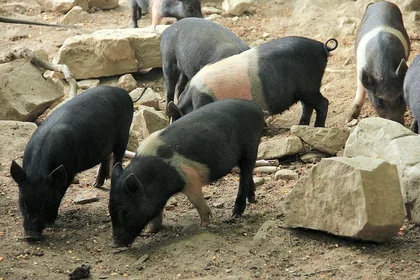 Cured meatsCinta Senese PorkCinta Senese is the black pig with a white belt across its shoulders, raised semi-wild in the oak woods south…
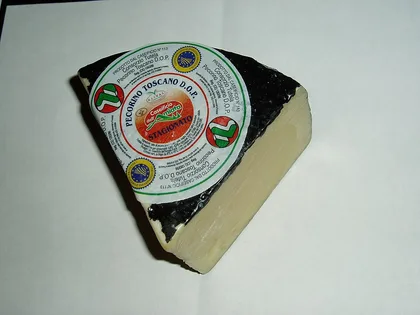 CheesePecorino ToscanoPecorino Toscano DOP is the mild one. Whole sheep's milk, calf rennet, a brief salting: soft-paste wheels…
 WineChianti ClassicoChianti Classico is the Black Rooster wine: at least 80 per cent Sangiovese from nine communes between…
 Oil and preservesExtra Virgin Olive OilTwo exams have to be passed, and one of them is carried out by people.
 Cured meatsFinocchionaFinocchiona is Tuscany's fennel salami: coarsely ground pork seasoned with wild fennel seeds and flowers…
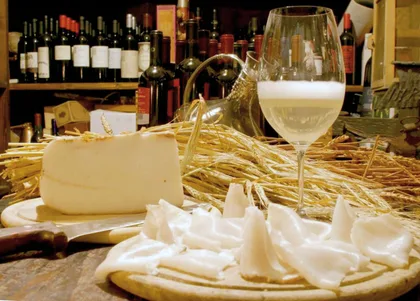 Cured meatsLardo di ColonnataLardo di Colonnata IGP is cured pork back fat, aged at least six months inside vats carved from Carrara…
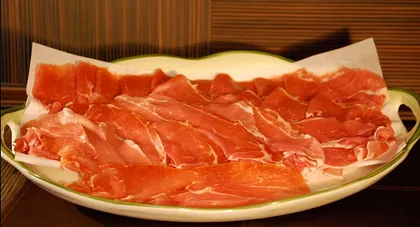 Cured meatsProsciutto ToscanoProsciutto Toscano DOP is the savoury one. It is salted harder than Parma ham and rubbed with pepper, garlic…
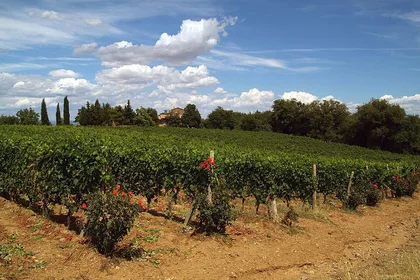 WineBrunello di MontalcinoBrunello di Montalcino is pure Sangiovese aged five years, at least two of them in oak, made only in the…