What is Salsiccia di Fegato?
Salsiccia di fegato is an offal sausage: thirty to fifty per cent pork liver, mixed with fat and fatty trimmings, seasoned and stuffed into natural casing in short links of ten to fifteen centimetres.
It is a product of the pista, the winter household slaughter. Liver does not keep. It has to be worked within hours, before it oxidises and turns bitter, so this sausage has always been made in December and January and at no other time. It is also why there has never been a convincing industrial version.
There are three ways to eat it: fresh, grilled or pan-fried within a few days; cured for twenty to forty days and sliced; or cooked and packed under lard in jars, which is how households made it last until summer.
The two schools are opposites. The sweet version is worked with honey, sugar, soaked raisins and sometimes orange zest; the hot version with chilli, black pepper and wild fennel. Both are solving the same problem, the metallic bitterness of liver, from opposite directions.
In the Valnerina valley of Umbria it is called mazzafegato. In Basilicata it is simply salsiccia di fegato, and both regions list it among their traditional food products.
What does it taste like?
Intensely savoury and mineral, with the iron note of liver at the centre and everything else arranged around it. It is not subtle, and it is not a sausage that eases anyone in.
The sweet version tastes like nothing else in Italian charcuterie. Honey and raisins arrive at the finish rather than the start, so the sequence is meat, iron, then a sweetness that closes the bitterness off. Anyone who has eaten liver with onions and found the onions essential will understand the logic immediately.
The hot version replaces that sweetness with chilli and wild fennel, which mask rather than balance. It reads as more conventionally Italian and considerably more aggressive.
The texture is coarse and grainy, deliberately so. Liver cut by knife or ground on a large plate stays in visible pieces, which is what separates this from the smooth, spreadable liverwurst of northern Europe. Cured for a month and sliced, it turns denser and closer to a very intense salami.
How to use it
Fresh, cook it over embers. Grill it whole, never pricked, at moderate heat and some distance from the coals: liver dries out fast, and rushing produces a link burnt outside and raw inside. Ten to twelve minutes, turned often.
In a pan, use the same logic with a finger of water in the bottom: it steams the inside through before you brown the outside.
In Basilicata it comes with peperoni cruschi, the dried sweet peppers of Senise flash-fried until they shatter, crumbled over the top, or with wild chicory and lampascioni. Liver, bitterness and chilli together is the signature of the Lucanian kitchen.
In Umbria the sweet mazzafegato is grilled and eaten with pane sciapo, the unsalted local bread, which exists precisely to sit under intensely flavoured food. Savoury versions go into a sauce for strangozzi.
Cured, slice it half a centimetre thick and eat it as it is, or spread it on toasted bread if the mix is soft.
One use worth reviving: crumbled into a tomato sauce for pasta, where liver gives a depth no ordinary sausage reaches. Two links feed four people.
How long it keeps
Fresh, it goes in the fridge covered but not sealed and is meant for about three days. This is an offal product and it changes faster than a sausage of meat alone: the surface darkens and the smell strengthens day by day. It freezes well from fresh, in portions, for a maximum of two months, and past that the liver develops a pronounced ferrous note.
The cured version hangs in a cool, ventilated place between 12 and 16 °C and is generally worked through over a couple of months. In the fridge, wrap it in paper and never in cling film pressed against the casing. Keeping them under lard is the traditional method: cooked, packed into a jar and covered completely with melted lard that sets and seals them from the air, they hold about six months in a cool larder, provided the lard covers everything, since any piece standing above the line meets air and dries out. A mix turning green or grey, or a sweetish pungent smell, is a change a well kept offal product does not normally show, and there the date and the seller are the reference.
Spot the real thing
Cut one across and the mix should show the liver in pieces, dark and nearly brown, standing out against white fat. If the inside is smooth and pasty, it is an emulsified industrial product rather than a traditional liver sausage, and the difference is the whole point. The colour is darker than any other sausage on the counter, reddish brown to almost black, and a pale pink mix means very little liver went in. On the nose the liver should be present without taking over; a sharp ferrous smell, close to blood, points to liver worked late or badly bled.
In the sweet version the honey or vincotto arrives at the end of the mouthful, and a sausage that tastes sweet before it tastes of meat has the balance wrong. In the hot version the chilli should come after the liver, not in front of it. Fresh strings are firm and moist, never slick to the touch; the cured ones are dry and slightly wrinkled with the casing sitting tight. Do not expect German liverwurst or a French pâté: this is a coarse, whole muscle sausage.
How to pronounce Salsiccia di Fegato
sal-SEE-chah dee FEH-gah-toh
Fegato takes the stress on the first syllable, FEH-gah-toh and not feh-GAH-toh, which is the mistake almost every English speaker makes. In salsiccia the 'cci' is a soft 'ch' as in 'chair', and the double 'c' is held slightly longer. The Umbrian name, mazzafegato, is mat-tsah-FEH-gah-toh.
Salsiccia di Fegato compared
vsSalsiccia (ordinary pork sausage)
Same casing, same region, entirely different food. Ordinary Italian salsiccia is lean pork and fat, seasoned with salt, pepper and sometimes fennel or wine, and it is mild enough to be an everyday ingredient: in ragù, with lentils, on pizza. Salsiccia di fegato replaces a third to a half of that meat with liver, which changes the colour to dark brown, the texture to grainy, and the flavour to something that has to be balanced with either sugar or chilli. One is a staple, the other is a seasonal speciality, and swapping them in a recipe is never neutral.
| This | Salsiccia (ordinary pork sausage) | |
|---|---|---|
| Main ingredient | 30-50% pork liver | Lean pork and fat |
| Colour | Dark brown to near black | Pink to pale red |
| Texture | Coarse, grainy | Even, meaty |
| Season | December to February only | All year |
| Balancing agent | Honey and raisins, or chilli | None needed |
| Quantity per person | One link is plenty | Two or three |
| Price | 12-18 EUR per kg fresh | 10-16 EUR per kg |
vsSweet version vs hot version
The most important choice at the counter, and the one nobody warns visitors about. The dolce is sweetened with chestnut or wildflower honey, sugar and soaked raisins, sometimes with pine nuts and grated orange zest. It is the older of the two, and the standard in the Valnerina. The piccante carries chilli powder, black pepper, garlic and wild fennel, and in Basilicata often the ground sweet pepper of Senise. Buying one when you expected the other is the single most common way this sausage disappoints a first-time eater, so always ask: dolce o forte?
| This | Sweet version vs hot version | |
|---|---|---|
| Sweetener | Honey, sugar, raisins | None |
| Heat | None | Chilli, moderate to strong |
| Aromatics | Orange zest, pine nuts | Wild fennel, garlic, Senise pepper |
| Heartland | Valnerina, Umbria | Basilicata, inland Potenza |
| Best cooked | Grilled over embers, whole | Grilled, or crumbled into sauce |
| Wine | Passito or Vin Santo | Young Aglianico del Vulture |
| For a first taste | Start here | Once you know you like liver |
vsLiverwurst and Braunschweiger
The comparison most American shoppers reach for, and it is misleading. German-style liverwurst is emulsified: the liver and fat are blended to a smooth paste, often smoked, and the result is spreadable and mild, meant for sandwiches. The Italian sausage is chopped coarse, kept in visible pieces, cooked over fire or air-dried, and eaten hot from a grill or sliced like salami. If you like liverwurst you will probably like this, but you should not expect the same thing.
| This | Liverwurst and Braunschweiger | |
|---|---|---|
| Texture | Coarse, distinct pieces | Smooth, emulsified, spreadable |
| Cooked or raw | Grilled fresh, or air-cured | Pre-cooked, eaten cold |
| Smoke | Only from hearth drying, if at all | Usually smoked |
| Sweetening | Honey and raisins, in the dolce | None |
| Served | Hot off the embers, or sliced thick | Spread on rye bread |
Salsiccia di Fegato substitutes
- Figatellu (Corsican)
By far the closest thing outside Italy: pork liver sausage, coarse, hearth-smoked, grilled fresh in winter. Sold across France and by French specialists in the UK. Smokier than the Italian versions and never sweetened.
1:1 - Botifarra de fetge (Catalan)
Catalan liver sausage, coarse-textured, sometimes sweetened, and closer in spirit to the dolce than anything German. Available from Spanish specialists in the US and UK. Grill it the same way.
1:1 - Liverwurst or Braunschweiger
Widely available and useful when the liver flavour is the point rather than the texture: crumbled into a sauce, for instance. Because it is emulsified and pre-cooked, it will not hold together on a grill. Add it at the end of cooking.
0.7:1, added off the heat - Ordinary Italian sausage plus chicken livers
The practical home workaround. Mix fresh coarse-ground pork sausage meat with roughly one part chopped chicken liver to three parts sausage, plus a spoon of honey or a good pinch of chilli depending on which style you are after.
3 parts sausage to 1 part liver - Halal or no-pork: lamb or beef liver sausage
Turkish and Levantine butchers make lamb-liver sausages that grill the same way and carry the same mineral intensity. Season toward the hot style: cumin and chilli suit lamb liver better than honey does.
1:1 - Mushroom and walnut, for a meat-free version
No substitute reproduces offal, but finely chopped chestnut mushrooms browned hard with walnuts, a splash of soy and a spoon of honey deliver the same combination of dark savouriness and sweetness in a pasta sauce or on toast.
Where to buy it
Realistically, in Italy. This is one of the least exported Italian cured products: production is seasonal, small-scale and tied to village butchers, and almost none of it travels. Neither the US nor the UK has a reliable retail source under this name.
What travels instead is the jarred version preserved under lard, sold by some Basilicata and Umbria producers online. It ships well and keeps for months, and it is the only practical way to try the real thing abroad.
In the US, the nearest equivalents on a shelf are Corsican figatellu at French specialists, Catalan botifarra de fetge at Spanish importers, and the liver sausages of central European butchers, which are a different texture entirely.
If you are buying in Italy, ask two questions at the counter. When was it made (anything other than "this winter" means frozen), and is it dolce or forte, because the two are unrecognisably different and shops rarely volunteer which is which.
Expect 12 to 18 euro per kilo fresh and 20 to 28 for cured, which makes it one of the cheapest intensely flavoured things in any Italian butcher's window.
Where to eat it in Italy
In Basilicata, the butchers and trattorie of the inland Potenza province and the Vulture (Cancellara, Picerno, Sasso di Castalda, Rionero in Vulture, Barile) between December and March, when the sausages are that year's.
Matera is the easiest base. Restaurants in the Sassi serve it regularly alongside pezzente, the poor-cuts sausage of the same mountains, and peperoni cruschi, without requiring a trip into the hills.
In Umbria the destination is the Valnerina. Norcia's arcaded square is lined with butchers' shops; Cascia, Preci and the villages along the Nera (Vallo di Nera, Sant'Anatolia di Narco, Scheggino) still make mazzafegati in both styles.
Winter festivals are the best single opportunity in both regions. Between January and February many villages hold events built around the household slaughter, where sausages are grilled in the square on the day they are made.
Further reading
Frequently asked questions
Why is there honey in some liver sausage?
To manage bitterness. Liver has a bitter, metallic undertone that sugar suppresses far more effectively than salt, and honey was the sweetener mountain households actually had. It is not a modern refinement: it is the original technique, and the sweet version is the older of the two.
What is the difference between salsiccia di fegato and normal Italian sausage?
The main ingredient. Ordinary salsiccia is lean pork and fat; this is thirty to fifty per cent liver, which makes it darker, grainier and far more intense. It also needs either sweetening or chilli to be balanced, which ordinary sausage does not.
Is it like liverwurst?
Related but not the same. Liverwurst is emulsified into a smooth, spreadable, usually smoked paste eaten cold. This is coarsely chopped, kept in visible pieces, and either grilled fresh or air-cured and sliced. Same raw material, opposite techniques.
Can you eat it raw?
Only the cured version, aged twenty to forty days. Fresh liver sausage must always be cooked through, because it is an offal product and the safety margin is narrower than with muscle meat.
How do you pronounce salsiccia di fegato?
sal-SEE-chah dee FEH-gah-toh. The stress in fegato falls on the first syllable, not the second, which is where most English speakers put it.
Related foods
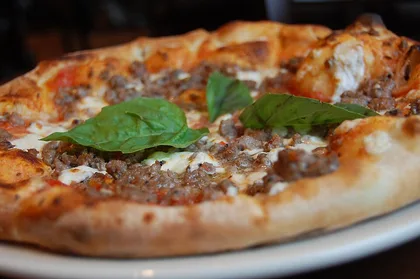 Cured meatsSalsicciaCoarsely ground pork, salt, pepper, wine and usually garlic, packed into natural hog casing and sold raw.Vegetables and fruitPeperone CruscoPeperone crusco is a sweet Basilicata pepper, sun-dried on strings and then flash-fried for two or three…
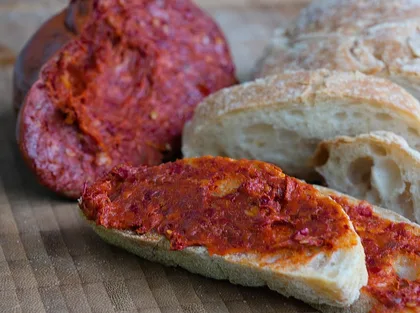 Cured meats'Nduja'Nduja is a soft, spreadable Calabrian pork salume that is up to 40% chilli.
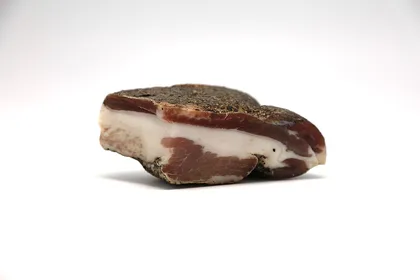 Cured meatsGuancialeGuanciale is cured pork jowl: unsmoked, rubbed with salt and pepper, aged for one to three months.
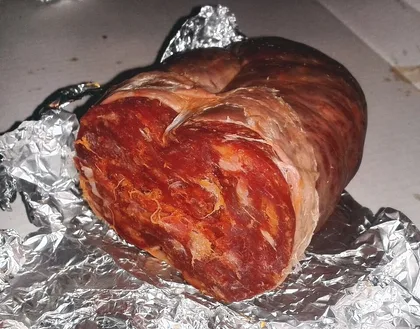 Cured meatsSoppressataSoppressata is a coarse-ground dry salami from southern Italy, pressed flat between boards while it dries…
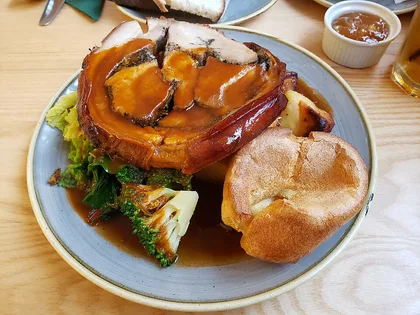 Cured meatsPorchettaSix to eight hours in a wood oven to reach two opposite textures in one piece of meat: skin that shatters…
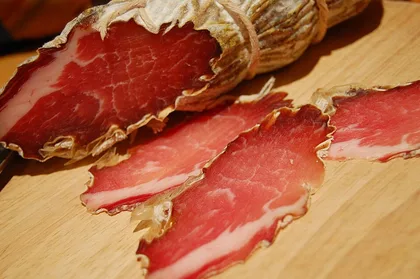 Cured meatsLonzinoLonzino is whole pork loin, dry-salted and air-cured for two to four months: the leanest cut on the animal…
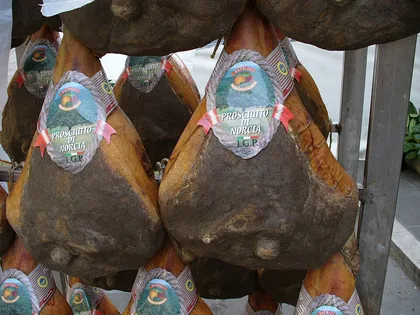 Cured meatsProsciutto di Norcia IGPProsciutto di Norcia IGP is Italy's mountain dry-cured ham, aged for at least twelve months between 400 and…