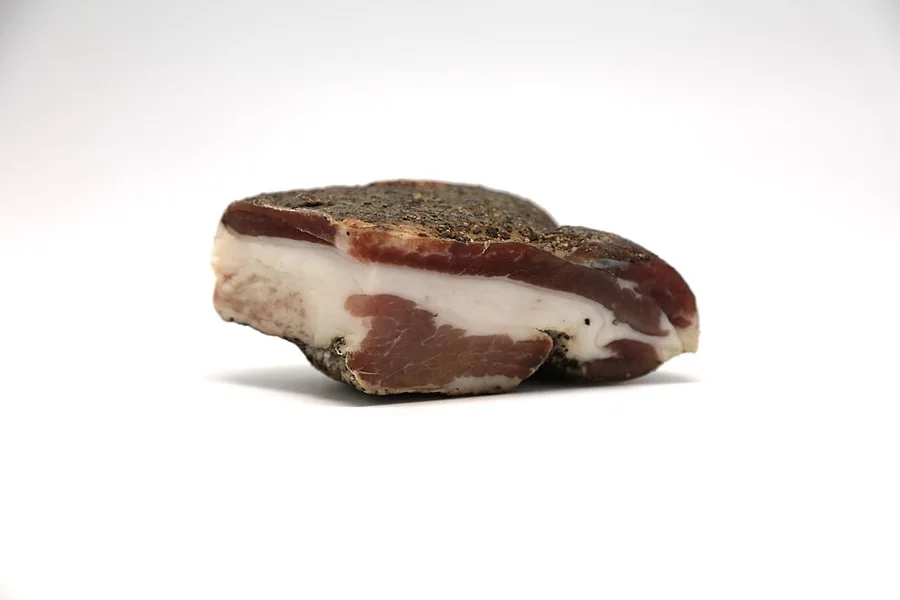
What is Guanciale?
Guanciale is made from the pig's cheek and jowl, a triangular cut running from the throat up to the cheekbone. It is dry-cured with salt, black pepper and sometimes garlic or herbs, then hung to age for anywhere from one to three months. It is never smoked and never stuffed into a casing: it stays a whole piece, easy to recognise by its triangular shape and the single seam of lean meat running through the fat.
In central Italy it is the fat behind three Roman pasta dishes: carbonara, amatriciana and gricia. The reason it cannot simply be swapped for bacon is structural. Jowl fat is denser and melts at a higher temperature, so it renders slowly and crisps at the edges instead of collapsing.
What does it taste like?
Intensely porky and clean, with none of the sweetness of American bacon and none of the smoke. The pepper crust gives the first bite a sharp edge, then the fat takes over: silky rather than greasy, closer to the flavour of really good lardo than to streaky bacon.
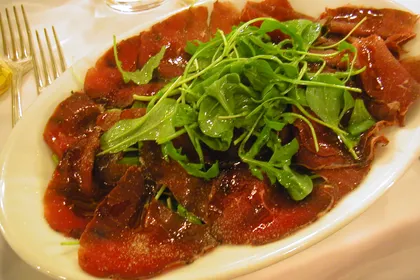
Cooked, it turns nutty and almost sweet at the crisp edges while staying soft in the middle. Raw and thinly sliced, it tastes like a firmer, more savoury prosciutto.
How to use it
Cut it into strips about half a centimetre thick, not thin slices. Put it in a cold, dry pan with no oil and bring it up over medium-low heat, so the fat renders slowly. Seven or eight minutes gets you golden, crisp edges and a soft centre.
That rendered fat is the sauce. For carbonara, pull the pan off the heat before the egg and cheese go in, or you will scramble them. For amatriciana, add the tomato straight into the fat. For gricia, nothing else goes in at all: just pecorino, pepper and pasta water.
Beyond the Roman three, it is excellent crisped over a bean or chickpea soup, folded into braised bitter greens, or scattered on burrata.
How long it keeps
Vacuum-sealed and whole, guanciale keeps in the refrigerator to the date on the pack, commonly around three months. Once the seal is broken or you cut into it, wrap the piece in a clean cotton cloth or in butcher paper and keep it in the coldest part of the fridge, around 2 to 4 degrees; plastic film pressed against the cut face traps moisture and the surface sweats. Cut into batons and frozen in portions, it holds for about six months, and you can take out only what you need.
An opened piece changes steadily over three or four weeks. The cut face dries, darkens and forms a hard rim that gets pared away before slicing. The fat oxidises slowly, shifting from white towards ivory and then yellow, and the smell moves from sweet and porky to something sharper and more nutty. The whole piece loses water, firms up and shrinks. A dry white bloom can appear on the rind, as it does on any air-dried cured meat. For anything past the printed date, that date and the producer are your reference.
Spot the real thing
Guanciale is a whole cured jowl, so the shape gives it away first: a firm triangular wedge, wider at one end, with the rind on one long side and a single seam of lean running through a broad field of fat. That fat should be white or faintly pink and dry to the touch, and the pepper crust should be dark, even and firmly attached rather than tacky. Cut across, the fat is compact and does not leave your fingers greasy.
Two things get sold in its place. Uncured pork jowl, common at American butcher counters, is the same cut before curing: pale, damp, soft to the press, no pepper crust, no firmness, and a fraction of the price. Pancetta is a different cut entirely, taken from the belly, rectangular or rolled, with many alternating stripes of lean and fat. Packets of thin pre-cut slices labelled guanciale are worth a second look, because guanciale is normally cut thick into batons. At a US Italian deli expect roughly 20 to 30 dollars a pound; raw jowl at 5 to 8 is telling you what it is.
How to pronounce Guanciale
gwan-CHAH-leh
Four syllables, stress on the third. The 'gua' is one sound, like the 'gua' in 'guava'; the 'ci' is soft, as in 'chair'. The final 'e' is pronounced, so never 'gwan-chah-lay' and never 'gwan-see-ale'.
Guanciale compared
vsPancetta
Different cut, different behaviour in the pan. Guanciale is the jowl and renders into a silky, intense fat; pancetta is pork belly and stays leaner and milder. For carbonara, guanciale is the traditional choice: pancetta is the acceptable substitute, not the equal.
| This | Pancetta | |
|---|---|---|
| Cut | Jowl and cheek | Pork belly |
| Fat | Dense, melts slowly, crisps | Softer, renders faster, wilts |
| Flavour | Deep, gamey, peppery | Milder, sweeter, rounder |
| Smoked | Never | Sometimes (affumicata) |
| Best for | Carbonara, amatriciana, gricia | Soffritto, soups, wrapping |
| Price | Higher: two per pig | Lower: larger cut |
vsBacon
Bacon is smoked and usually cured with sugar; guanciale is neither. Using bacon in a Roman pasta gives you a smoky, faintly sweet dish that is perfectly nice and tastes nothing like the original.
| This | Bacon | |
|---|---|---|
| Cut | Jowl | Belly (US) or back (UK) |
| Cure | Salt and pepper only | Salt, sugar, nitrates, smoke |
| Smoke | None | Central to the flavour |
| In carbonara | Traditional | Changes the dish entirely |
vsPork jowl (American)
The same cut, a different cure. Southern American hog jowl is typically smoked and sold for cooking with greens; guanciale is air-cured and peppered. If you find unsmoked cured jowl, you are very close to the real thing.
| This | Pork jowl (American) | |
|---|---|---|
| Cut | Identical | Identical |
| Cure | Dry salt, pepper, air-dried | Often smoked, sometimes wet-cured |
| Eaten raw | Yes, when well aged | No, needs cooking |
Guanciale substitutes
- Pancetta (unsmoked)
The closest easy substitute. Use a thicker cut than you would think, and render it more gently: it holds less fat, so the sauce will be leaner.
1:1, or 1.2:1 by weight for a richer sauce - Salt pork, unsmoked
Widely available in the US and structurally similar. Blanch it for two minutes first to pull out some salt, then treat it like guanciale.
1:1 - Lardo or fatback with prosciutto
A trick that gets surprisingly close: render lardo for the fat, add finely chopped prosciutto at the end for the savoury depth.
2 parts lardo to 1 part prosciutto - Smoked bacon
Works as food, not as carbonara. If it is all you have, blanch it briefly to strip some of the smoke and skip any added salt in the dish.
1:1 - Vegetarian: smoked mushrooms and olive oil
No substitute reproduces cured pork, but king oyster mushrooms sliced thick, seared hard in good olive oil with black pepper, give you the texture and the savoury hit.
- Halal: cured beef cheek or veal bresaola
Beef cheek cured the same way is made by a handful of Italian producers and behaves similarly. Bresaola is far leaner, so add a spoon of olive oil to compensate.
Where to buy it
In the US, Italian delis and online specialists such as Eataly, Gustiamo and Olio & Olive carry whole and half pieces; Whole Foods stocks it in some regions. In the UK, Ocado and Italian delicatessens carry it, and several Italian importers ship nationwide.
Buy a whole piece rather than pre-sliced whenever you can: guanciale wants to be cut thick, and pre-sliced packs are often pancetta by another name. Expect to pay roughly 18 to 30 dollars per pound in the US, or 20 to 28 pounds per kilo in the UK.
Check the fat is white or faintly pink and the pepper crust is dry. Yellowing fat means it has oxidised.
Where to eat it in Italy
Amatrice, in the province of Rieti, gave its name to the amatriciana and holds a festival for it every August. Rome is the obvious place, and the trattorie of Testaccio and Pigneto still cut it by hand, while the Sabina hills north of the city are where much of it is still made.
In Umbria, the town of Norcia has a butchery tradition old enough that 'norcino' became the Italian word for pork butcher.
Recipes with it
Further reading
Frequently asked questions
Is guanciale the same as pancetta?
No. Guanciale is cured pork jowl; pancetta is cured pork belly. Guanciale has denser fat, a stronger flavour and crisps rather than wilts. Roman pasta recipes traditionally call for guanciale.
Can you eat guanciale raw?
Yes, if it is properly aged. Sliced paper-thin it eats like a rich, peppery prosciutto. Its real purpose, though, is cooking, where the fat becomes the sauce.
Why is guanciale so expensive?
Each pig yields only two jowls of about a kilo each, against a much larger belly. The price reflects scarcity, not extra work.
Do you need oil to cook guanciale?
Never. Start it in a cold, dry pan: it releases plenty of its own fat, and added oil will make the sauce greasy.
How do you pronounce guanciale?
gwan-CHAH-leh, with the stress on the third syllable and the final 'e' clearly pronounced.
Related foods
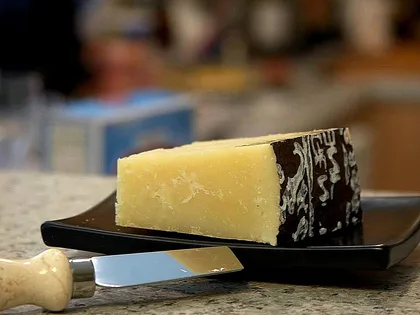 CheesePecorino RomanoPecorino Romano DOP is a hard, dry-salted sheep's milk cheese aged at least five months, made in Sardinia…
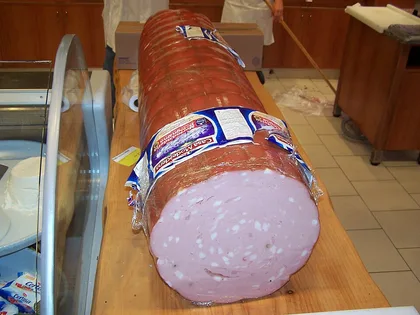 Cured meatsMortadellaThe white cubes are not just any fat: they are jowl, the firmest part of the pig, and they stay whole…
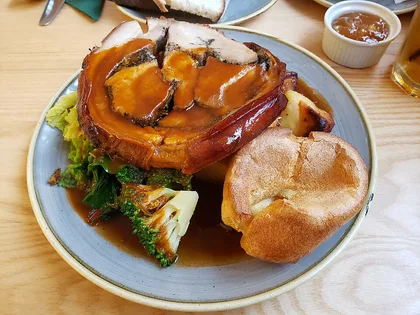 Cured meatsPorchettaSix to eight hours in a wood oven to reach two opposite textures in one piece of meat: skin that shatters…
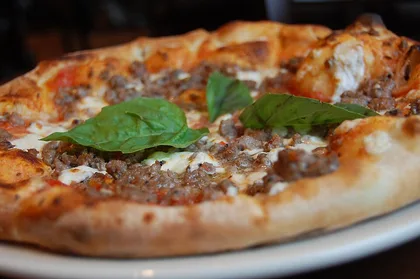 Cured meatsSalsicciaCoarsely ground pork, salt, pepper, wine and usually garlic, packed into natural hog casing and sold raw.
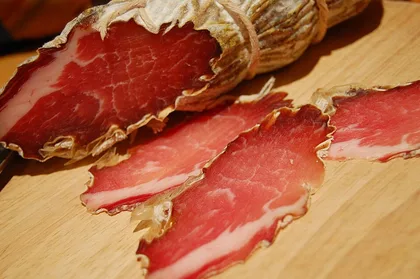 Cured meatsLonzinoLonzino is whole pork loin, dry-salted and air-cured for two to four months: the leanest cut on the animal…
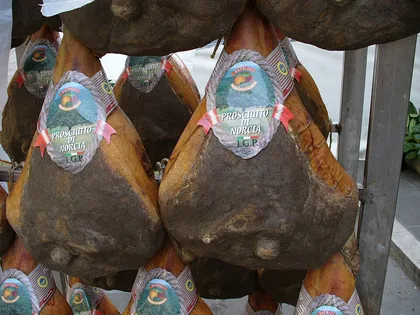 Cured meatsProsciutto di Norcia IGPProsciutto di Norcia IGP is Italy's mountain dry-cured ham, aged for at least twelve months between 400 and…Cured meatsSalsiccia di FegatoSalsiccia di fegato is Italian pork liver sausage: coarsely chopped liver, pork fat, salt and spices in…
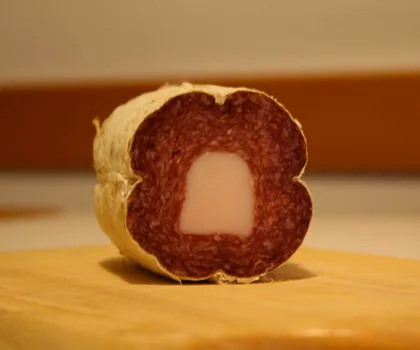 Cured meatsMortadella di CampotostoMortadella di Campotosto is a small, air-dried, lightly smoked salume from the Laga mountains of Abruzzo…