What is Mortadella di Campotosto?
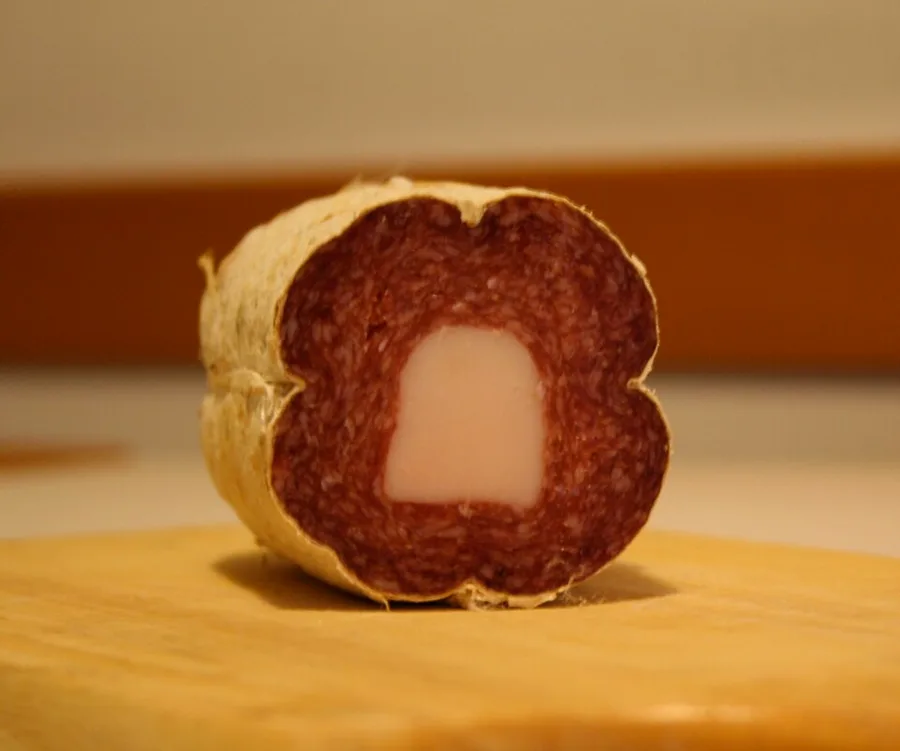
Mortadella di Campotosto is a raw, cured pork salume of 300 to 400 grams, made from finely ground lean pork with a stick of salted lard inserted lengthways through the middle. Cut across, every slice shows a white square eye at the centre of a dark red ring. It is lightly cold-smoked and aged for two to four months.
The name misleads and is worth correcting immediately. There is no relationship to mortadella from Bologna, which is cooked, enormous, finely emulsified and studded with fat cubes throughout. This one is raw, tiny, smoked and has a single central core of fat. The word mortadella originally meant nothing more than meat pounded in a mortar, and it ended up attached to very different products.
In Campotosto and across the surrounding mountains they are called coglioni di mulo (mule's testicles) for their shape and for the way they are sold, two pieces tied together and hung over a rod. The name is crude, universally used and printed on some producers' labels.
Production is tiny in every sense: a handful of makers, all in the municipality of Campotosto and its hamlets, working a tradition that the 2016–2017 earthquakes badly disrupted. It is listed among Abruzzo's traditional regional food products.
What does it taste like?
Lean, savoury and gently smoky, with a rush of soft fat in the middle of every bite. The outer ring of meat is dense and dry, closer in texture to a hard salami or to bresaola than to anything soft, and it carries black pepper and a restrained beechwood smoke.
The centre is the point. The bar of lard turns translucent during ageing and melts against the tongue, and the contrast between dry cured meat and pure soft fat is what the whole product is engineered to deliver. Slice it thin and you lose the effect entirely.
There is no chilli, which surprises people who associate Abruzzo with heat, and no sweetness. Well-made pieces taste of pork, pepper, mountain air and a little woodsmoke, in that order, with the smoke sitting behind rather than in front.
How to use it
Cut it by knife, across the axis, five to eight millimetres thick, so the bar of lard stays whole inside each slice. Thin slicing destroys the product: the contrast between dry smoked meat and melting fat is the entire experience.
Eat it raw at room temperature, with rustic sourdough bread. Do not trim the fat out: it carries the pepper and the smoke, and it is the reason the meat around it stays edible after four months of drying.
On a board it belongs with Abruzzo sheep's cheeses, caciocavallo, olives and pickled vegetables. It is rarely cooked, but a couple of slices diced into a soffritto make an excellent base for spaghetti alla chitarra or a lentil soup.
Take it out of the fridge twenty minutes before serving. Cold lard is waxy and tasteless, and that alone accounts for most disappointing first encounters with this salume.
How long it keeps
Whole, it hangs in a cool, ventilated place between about 8 and 15 °C, where it goes on drying slowly and the lean tightens. In the fridge it wants greaseproof paper or a tea towel: cling film against the casing makes it sweat and mutes the smoke. Once cut into, reckon on ten to fifteen days, covering only the cut face. The pieces are small enough that this rarely becomes a question.
Vacuum packs hold four to six months to the date printed on them, but open one and let it breathe for a day or two, because the vacuum compresses the smoke and leaves a shut in smell that clears in air. The lardo down the middle is the critical part, since fat oxidises well before lean meat does: a smell of paint or old walnuts, or a bar that has gone deep yellow, is that change under way, and at that point the date on the pack and the producer are the reference. Freezing whole for three months is possible and not advised: the lardo releases water as it thaws and loses the buttery texture the sausage exists for.
Spot the real thing
Forget everything the word mortadella means in English. This is not the pale pink Bologna deli meat: it is a small cured pork sausage, oval and elongated, sold in tied pairs, with a casing that clings tight, slightly wrinkled and amber brown from the smoke. The proof is the cut face, where a white bar of lardo, square or rectangular in section, sits exactly at the centre of a ring of dark red, compact lean. Lardo that is off centre, broken up or missing altogether means the piece was not made the traditional way.
On the nose the smoke should be light and stay behind the meat and the pepper; a pungent smoked smell points to hot smoke or too long in the smokehouse, both outside the tradition and both flattening everything else. The lean is firm without being hard and the lardo is yielding, almost buttery. Lardo turned yellow, or a nutty smell coming off the fat, is oxidation, and the fat is the part that changes first. On the label look for Campotosto itself or its hamlets, Mascioni, Poggio Cancelli, Ortolano, and treat Campotosto style made elsewhere as a different product.
How to pronounce Mortadella di Campotosto
mor-tah-DEL-lah dee kam-po-TOS-toh
Mortadella takes the stress on DEL, with the double l held slightly. Campotosto is four syllables with the stress on TOS (kam-po-TOS-toh) and the final o is a clean 'oh', not a schwa. The nickname, coglioni di mulo, is pronounced kol-YOH-nee dee MOO-loh.
Mortadella di Campotosto compared
vsMortadella di Bologna
Two entirely different foods sharing one word, and the confusion runs one way: everybody knows Bologna, almost nobody knows Campotosto. Bologna mortadella is a cooked emulsion of finely ground pork studded with cubes of fat and often pistachios, steamed for many hours in casings that can hold a hundred kilos, then sliced paper-thin. Campotosto mortadella is raw, air-dried, cold-smoked, weighs a third of a kilo, and contains one solid bar of lard down the middle. Bologna is soft, pink and mild; Campotosto is firm, dark and savoury.
| This | Mortadella di Bologna | |
|---|---|---|
| Cooked | No: raw, air-dried | Yes, steamed for hours |
| Weight | 300–400 g | Up to 100 kg |
| Fat | One central bar of lard | Cubes distributed throughout |
| Grind | Fine, but firm and dry | Emulsified, soft |
| Smoke | Light, cold, beech or oak | None |
| Ageing | 60–120 days | None: eaten fresh |
| Slice | 5–8 mm, by knife | Paper-thin, by machine |
vsAged dry sausage (salsiccia stagionata)
The nearest Italian relative and the fairest comparison. A dried sausage is coarsely ground pork with fat mixed through the mince, stuffed into a narrow casing and hung to dry, usually unsmoked. Campotosto separates the two elements instead of mixing them: very lean meat ground fine, and all the fat concentrated in one bar at the centre. That single decision changes texture, slicing thickness and the way the flavour arrives.
| This | Aged dry sausage (salsiccia stagionata) | |
|---|---|---|
| Fat | One bar in the centre | Mixed through the mince |
| Grind | Fine | Coarse |
| Smoke | Yes, light and cold | Usually none |
| Shape | Oval, 300–400 g, sold in pairs | Thin cylinder or link |
| Slice | Thick, across the axis | Thin, or bitten whole |
| Seasoning | Salt, pepper, sometimes wine | Often fennel, chilli or garlic |
vsAmerican deli bologna
Worth naming because the chain of confusion runs through it: US bologna is a distant industrial descendant of mortadella from Bologna, and neither has any connection to Campotosto. Deli bologna is a cooked, finely emulsified sausage of pork, beef or poultry, sold pre-sliced, mild and soft. Campotosto is an artisanal cured meat from a mountain village at 1,300 metres, aged for months and sold in pairs on a stick.
| This | American deli bologna | |
|---|---|---|
| Category | Raw cured salume | Cooked emulsified deli meat |
| Meat | Lean pork plus a lard core | Pork, beef or poultry blend |
| Production | Handmade, a few producers | Industrial, national brands |
| Price | 35–50 $/lb | 3–6 $/lb |
Mortadella di Campotosto substitutes
- Coarse dry salami with a slice of lardo
The closest thing you can assemble anywhere: lay a sliver of lardo or good back fat on a thick slice of firm, unspiced salami. It reproduces the dry-meat-and-melting-fat contrast that defines Campotosto, which no single product outside Abruzzo really matches.
1 part lardo to 4 parts salami by volume - Ventricina teramana or another Abruzzo cured meat
Same region, same mountain register, easier to find. Ventricina is softer and more paprika-driven, so expect more spice and less smoke, but it belongs to the same table.
1:1 - Speck Alto Adige
The best supermarket answer for the smoke. It is a whole muscle from the leg rather than a sausage, and it is smokier and juniper-scented, but sliced thickly it gives you the cured-and-smoked profile.
1:1 - Lonzino or cured pork loin
Very lean, finely textured cured pork, close to the outer ring of a Campotosto in flavour. Serve it with a little rendered fat or good olive oil to stand in for the missing core.
1:1 - Landjäger or other smoked dry sausage
Widely available in German and central European delis in the US and UK. Firm, smoky and lean, though the fat is mixed through rather than concentrated. Slice it thick rather than eating it in sticks.
1:1 - Pork-free: smoked beef salami or pastirma
No pork-free version of this product exists: the lard core is the whole idea. Smoked cured beef, or Turkish pastirma with its fenugreek crust, gives you the dry, smoky, savoury side; add olive oil to the plate for richness.
1:1
Where to buy it
In Italy, from producers in Campotosto and its hamlets, or from good delicatessens in L'Aquila and across Abruzzo. A pair weighs 600 to 800 grams and costs 30 to 50 euro, which works out at 45 to 65 euro per kilo: high, and a direct consequence of tiny pieces, entirely manual work and very few makers.
Outside Italy it is scarce. US specialist importers reach 35 to 50 dollars per pound when they have it; UK Italian delicatessens ask 50 to 70 pounds per kilo. Several Campotosto producers ship within Italy and the EU, which is the sensible route for European buyers.
Check two things before paying: that the label names Campotosto or one of its hamlets rather than describing a 'Campotosto-style' product made elsewhere, and that the lard core is white rather than deep yellow. Fat ages faster than lean meat, and yellowing is the first sign of a piece that has sat too long.
Where to eat it in Italy
Campotosto itself, at 1,300 metres inside the Gran Sasso and Monti della Laga national park, where the village shops and the restaurants around the lake serve it with sheep's cheese and mountain potatoes. The lake is one of the largest artificial basins in Europe, built for hydroelectric power in the 1930s and 40s, and it freezes along the shore in winter; the area is good for birdwatching and cross-country skiing.
The hamlets of Mascioni, Poggio Cancelli and Ortolano, and the Laga villages running north to Amatrice, twenty kilometres away across the regional border in Lazio. A summer festival in Campotosto puts all the producers in one place. The area was hit hard by the 2016 and 2017 earthquakes, and buying here still carries that weight.
L'Aquila is forty minutes by road, and the Gran Sasso begins immediately beyond it: Campo Imperatore, Santo Stefano di Sessanio, the ruined castle at Rocca Calascio. It is a circuit that takes in this salume, mountain lentils, L'Aquila saffron and sheep's cheeses, which is most of the reason to come.
Further reading
Frequently asked questions
Is this related to mortadella from Bologna?
No, beyond the word. Bologna mortadella is a cooked, finely emulsified sausage weighing up to a hundred kilos, with fat cubes throughout. Campotosto mortadella is raw, air-dried, smoked, weighs 300 to 400 grams and has one bar of lard through the middle. Mortadella originally just meant meat pounded in a mortar.
Why are they called mule's balls?
Coglioni di mulo is the local name, earned by the oval shape and by the way they are sold: two pieces tied together and hung over a rod. It is used universally in the area and appears on some producers' labels.
What is the bar of lard for?
It keeps the salume edible. The meat used is extremely lean and would dry out on its own; the lard releases fat inward during ageing. It also creates the defining mouthful: dry smoked meat around the outside, soft fat melting at the centre.
Is it smoked?
Lightly, and cold, over beech or oak: traditionally in the chimney of the house, for a few hours a day over several days. The smoke should sit behind the meat and pepper rather than dominate them.
How do you pronounce Campotosto?
kam-po-TOS-toh, with the stress on the third syllable and a clean final 'oh'. The full name is mor-tah-DEL-lah dee kam-po-TOS-toh.
Related foods
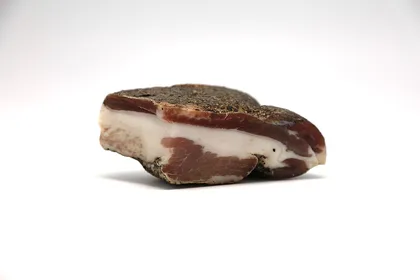 Cured meatsGuancialeGuanciale is cured pork jowl: unsmoked, rubbed with salt and pepper, aged for one to three months.
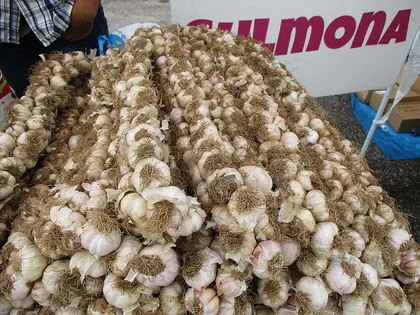 Vegetables and fruitSulmona Red GarlicSulmona red garlic is white on the outside and red underneath: the colour is in the skins wrapping each…
 SweetsPizzellePizzelle are thin anise-scented Italian waffle cookies pressed between two engraved iron plates.
 CheeseScamorzaScamorza is cow's-milk pasta filata that has been tied off into a pear shape and hung to dry for one to two…
 Oil and preservesSaffronOne kilo takes between 150,000 and 200,000 flowers, and every flower gives up three stigmas that have to be…
 Pasta and breadMaccheroniThe most misunderstood name in Italian pasta. In Naples it means dried semolina pasta in general, in Abruzzo…
 SweetsConfetti di SulmonaA whole Pizzuta d'Avola almond coated in nothing but sugar and water: no starch, no flour, no gelatine.