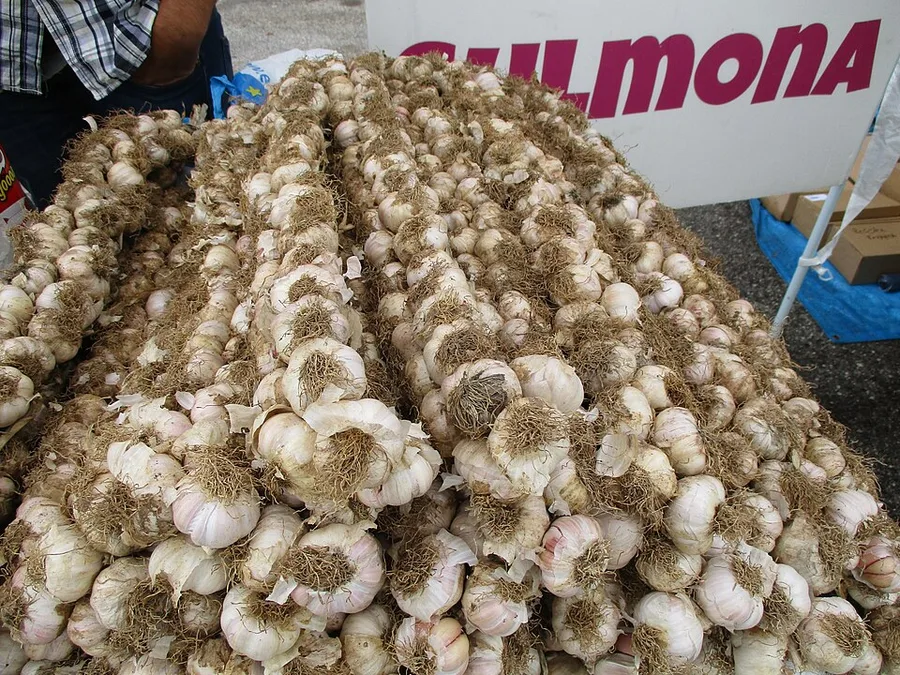
What is Sulmona Red Garlic?
This is a local ecotype of Allium sativum grown in the Valle Peligna, in the province of L'Aquila, around the town of Sulmona. It has no EU designation: it is on Abruzzo's list of traditional agri-food products, and an application for IGP status has been running for years without yet concluding.
The name misleads anyone who has not seen one. The whole bulb is white: the outer wrappers are pale, and from the outside it looks like ordinary garlic. The red is underneath, in the skins that wrap each individual clove, a bright purple-red. You find it only by opening the head, and that is the first authenticity check.
The bulb runs four to seven centimetres across, with eight to twelve large, regular cloves in one or two ranks. The flesh is firm, white and crisp.
What sets it apart in the kitchen is concentration. Essential oil content is above average, around 0.5 to 0.6 per cent against 0.3 to 0.4 for ordinary garlic, which means a fuller aroma, a sharper heat and a longer finish. You need less of it, not more.
One more feature, agronomic but with practical consequences: this is a hardneck garlic, so it throws a flower stalk. The scape has to be cut in June for the bulb to fill out, and the cut scapes are sold in bunches and eaten as a vegetable.
What does it taste like?
Sharper and rounder than supermarket garlic, with a clean heat rather than a dull acrid one. Raw, it hits hard and then fades cleanly instead of lingering as a stale note; the aroma is closer to a French rose garlic or a Spanish Roja than to the soft white bulbs sold in nets.
Cooked gently in oil it turns sweet and nutty within a couple of minutes and perfumes the whole pan. Roasted whole in its skin it collapses into something creamy and mild enough to spread on bread, the preparation that shows the difference most clearly.
The practical consequence of the higher oil content is dosage. One clove does the work of one and a half supermarket cloves, and it burns faster too: the compounds that carry the flavour turn bitter sooner over heat.
How to use it
Use less. That is the first adjustment when switching from ordinary garlic: one Sulmona clove does the work of one and a half supermarket cloves, because there is more essential oil in it.
Raw, it belongs in preparations where garlic is the point: rubbed on grilled bread with new olive oil, in a green sauce, emulsified into an oil-and-garlic dressing. If there is a green germ in the middle of the clove, take it out: that is the bitter, hard-to-digest part.
Cooking follows the usual rule for good garlic, but with less margin for error. Start it in cold oil over low heat and pull it out or kill the heat the moment it turns blond. Burnt garlic is bitter, and with something this aromatic the mistake is twice as loud.
Abruzzo uses: spaghetti alla chitarra with garlic, oil and chilli; roast lamb with garlic and rosemary under the skin; a base of garlic and dried sweet pepper for sauces; pallotte cacio e ova, where the garlic goes into the tomato. And the June scapes, boiled with oil and lemon or fried with eggs.
Worth doing once: a whole head, skin on, roasted at 180 degrees for forty minutes. It comes out creamy and sweet enough to squeeze onto bread, and in that form the intensity becomes an advantage rather than a hazard.
How long it keeps
A braid hung in a cool, dark, airy room is the method, not decoration: air moving between the bulbs keeps the tunics dry and slows sprouting. It wants 10 to 15 C and low humidity, and it will hold eight or nine months, so a July harvest reaches March or April in condition. That is shorter than the twelve months claimed for industrial keeping varieties, because bolting garlics sprout earlier. From about April the cloves push a green shoot up the centre, the head goes soft and hollow as the clove feeds it, and the flavour turns bitter.
A whole head does not go in the fridge, because damp cold triggers exactly the sprouting you are trying to postpone, and not in a sealed plastic bag, where it sweats. Around March, when the braid begins to give, the rest converts: peeled cloves under oil in a jar kept in the fridge and used within the month, raw cloves frozen whole for six months, or slices dried in a low oven and ground to powder. June scapes hold a few days chilled and freeze after two minutes in boiling water.
Spot the real thing
There is one decisive check and it means opening a head. The outer tunics are white or barely streaked, so nothing shows from outside, which catches out anyone expecting the purple-skinned garlic sold in France and Spain. The colour is underneath: each clove should be wrapped in a bright purple-red tunic, and pale pink or white cloves are not Sulmona. Then count them. Eight to twelve large, regular cloves in one or two rows, not twenty small uneven ones. Then feel the neck: this variety bolts, so the centre carries the stub of the cut scape as a small rigid cylinder, and a head soft all through with no central core came from a braiding variety.
The head should be hard, with no hollow give under the fingers. Unbroken, it should barely smell at all, and the smell should arrive only when you cut it: a braid you can smell across the room has bulbs releasing sulphur compounds through damaged tissue. On the tag, look for the farm and the comune. Italian red garlic and Abruzzo garlic mean nothing, and braids assembled from mixed bulbs circulate even in the valley.
How to pronounce Sulmona Red Garlic
AH-lyoh ROS-soh dee sool-MOH-nah
The 'gli' in aglio is the sound in 'million', not a hard g: AH-lyoh, two syllables. Rosso holds the double 's'. Sulmona is stressed on the second syllable, sool-MOH-nah, with the 'u' as in 'pool'.
Sulmona Red Garlic compared
vsOrdinary white garlic
The garlic sold in nets everywhere, usually softneck varieties from China, Spain or Argentina, bred for yield and shelf life. It keeps far longer and costs a quarter as much. It is also blander, and the cloves are smaller and more numerous.
| This | Ordinary white garlic | |
|---|---|---|
| Clove skins | Bright purple-red | White or pale cream |
| Cloves per head | 8-12, large and regular | 12-20, uneven, some tiny |
| Essential oil | About 0.5-0.6% | About 0.3-0.4% |
| Flower stalk | Yes: hardneck, scape cut in June | No: softneck |
| Keeps | 8-9 months braided | 10-12 months |
| Dosage | 1 clove does the work of 1.5 | Baseline |
| Price | 12-20 euro per kilo | 4-8 euro per kilo |
vsBlack garlic
Not a variety at all but a process, which is the point people usually miss. Whole heads are held for weeks at controlled warmth and humidity until sugars and amino acids react, turning the cloves black, soft and sweet with no pungency left. Some Abruzzo producers make theirs from Sulmona garlic.
| This | Black garlic | |
|---|---|---|
| What it is | A cultivated ecotype | A process applied to any garlic |
| Colour | White outside, red clove skins | Jet black, sticky cloves |
| Flavour | Sharp, aromatic, pungent | Sweet, balsamic, like tamarind or prune |
| Pungency | High | None |
| Use | Cooking base, raw sauces, roasting | Spread, finishing, desserts and sauces |
| Substitutable | No: they do opposite jobs | No |
vsAglio Bianco Polesano DOP
Italy's best-known protected garlic, grown on the alluvial plain of the Po delta in the Veneto. Pure white throughout, softneck, milder and a much better keeper. Where Polesano is the elegant, delicate choice, Sulmona is the concentrated one.
| This | Aglio Bianco Polesano DOP | |
|---|---|---|
| Colour | White outside, red clove skins | Pure white throughout |
| Type | Hardneck: produces a scape | Softneck: no scape |
| Flavour | Intense, persistent | Delicate, sweeter, less persistent |
| Protection | Regional PAT, IGP application pending | DOP since 2009 |
| Keeps | 8-9 months | Up to 12 months |
| Harvest | Late June to mid-July | June to July |
Sulmona Red Garlic substitutes
- Hardneck garlic: Spanish Roja, German Red, Music, Rocambole
The closest match anywhere and easy to find at farmers' markets. Same clove structure, same concentration, same tendency to burn fast.
1:1 by clove - Ail rose de Lautrec (France)
Pink-skinned, aromatic and braided the same way. Slightly milder and sweeter, so add a little more if garlic is the main flavour.
1:1, or 5 cloves for every 4 - Aglio Bianco Polesano DOP or Aglio di Voghiera DOP
The Italian alternatives, both softneck and both gentler. Excellent garlic, but you will need more of it to reach the same intensity.
3 cloves for every 2 - Ordinary supermarket garlic
Works as a base, just quieter. Increase the quantity by half and take the green germ out of the centre of each clove.
3 cloves for every 2 - Garlic scapes
Only for the June dishes, when fresh scapes are on the market. Green, mild and vegetal: boiled with oil and lemon, or fried with eggs. Not a stand-in for the bulb.
Not interchangeable with cloves - Garlic powder
A last resort, never for a raw sauce. Fine in a rub or marinade, useless where you need gently cooked garlic.
Half a teaspoon per clove
Where to buy it
In Abruzzo, from the growers and at the Sulmona market, at 12 to 20 euro per kilo. A twenty-bulb braid weighs about a kilo and a half and costs 18 to 30 euro; hundred-bulb braids are sold for a year's supply. Elsewhere in Italy specialist grocers charge 20 to 30 euro per kilo, with a real risk of braids assembled from bulbs of other origins.
Abroad it is rare. Italian specialists occasionally list it at 14 to 25 dollars per pound in the US or 18 to 30 pounds per kilo in the UK. What travels more easily is planting stock, sold by Italian seed suppliers, this garlic is straightforward to grow in any climate with a cold winter.
The test when buying is always the same: break a head open. The outer wrappers are white on every bulb and tell you nothing; the skins around the individual cloves must be bright purple-red. Eight to twelve large cloves, not twenty small ones, and a firm woody stub in the centre where the scape was cut. The head should be hard with no give under the fingers, and should barely smell until you cut it: a braid that carries at a distance is fermenting.
Where to eat it in Italy
Sulmona, where the market under the arches of the medieval aqueduct in Piazza Garibaldi is the most direct place to see and buy the braids, especially from July onwards.
Mid-July, right after the harvest, is the moment: new braids fill the stalls and the town holds its garlic fair, though dates shift from year to year and are worth checking.
In the valley villages (Pratola Peligna, Raiano, Vittorito, Introdacqua) you can buy straight from the growers, and several farms also sell scapes in June, the only weeks of the year they exist.
The most Sulmonese afternoon available is also the simplest: a braid of garlic and a box of the town's famous sugared almonds, bought a few hundred metres apart.
Around it, the Majella massif, the hermitage of Celestine V on Monte Morrone and the Sagittario gorges fill the rest of the day. Local trattorie serve lamb with garlic and spaghetti alla chitarra: two dishes that would be something else without this garlic.
Frequently asked questions
Why is it called red when the bulb looks white?
Because the red is inside. The outer wrappers around the whole head are white, so from the outside it looks like any other garlic; it is the skins around each individual clove that are bright purple-red. You see it only when you break the head open, and that is the first check of authenticity.
When is it planted and harvested?
Planted in autumn, October to November, with cloves broken from the head just before they go in the ground. Lifted between late June and mid-July, once about two thirds of the leaves have yellowed. In between, in June, the flower scapes are cut: they are sold in bunches and eaten.
How is it different from ordinary garlic?
Concentration. Essential oil content is around 0.5 to 0.6 per cent against 0.3 to 0.4 for standard garlic, so the aroma is fuller and the heat sharper. In practice you use less: one clove of Sulmona does the work of one and a half supermarket cloves.
How long does it keep?
Eight or nine months braided in a cool, dark, airy place, from July through to March or April. Not the twelve months of industrial storage varieties, because this is a hardneck garlic and hardnecks sprout sooner. From April the cloves push a green germ and the flavour turns bitter.
Is black garlic made from this?
It can be, and some Abruzzo producers do exactly that. Black garlic is not a variety but a process: whole heads held for weeks at controlled warmth and humidity until the cloves turn black, soft and sweet with no pungency left. Starting from a more concentrated garlic gives a more aromatic result.
Related foods
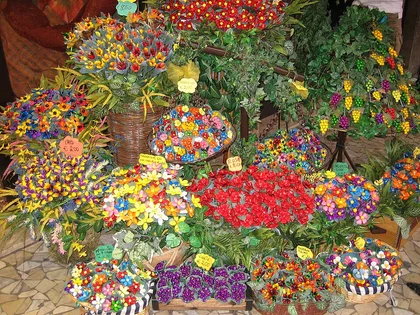 SweetsConfetti di SulmonaA whole Pizzuta d'Avola almond coated in nothing but sugar and water: no starch, no flour, no gelatine.
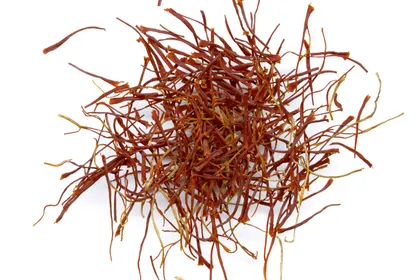 Oil and preservesSaffronOne kilo takes between 150,000 and 200,000 flowers, and every flower gives up three stigmas that have to be…
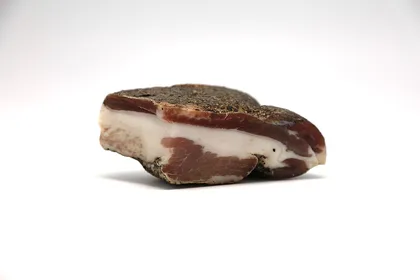 Cured meatsGuancialeGuanciale is cured pork jowl: unsmoked, rubbed with salt and pepper, aged for one to three months.
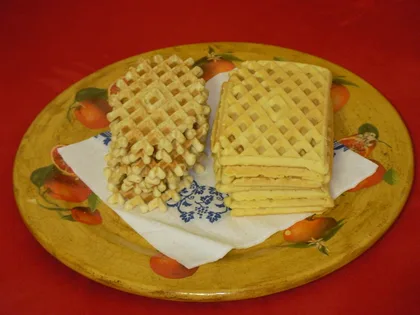 SweetsPizzellePizzelle are thin anise-scented Italian waffle cookies pressed between two engraved iron plates.
 CheeseScamorzaScamorza is cow's-milk pasta filata that has been tied off into a pear shape and hung to dry for one to two…
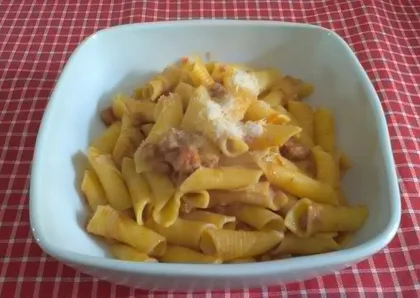 Pasta and breadMaccheroniThe most misunderstood name in Italian pasta. In Naples it means dried semolina pasta in general, in Abruzzo…SweetsParrozzoA dome of ground almonds and semolina under a shell of dark chocolate, invented in Pescara in 1920 by the…
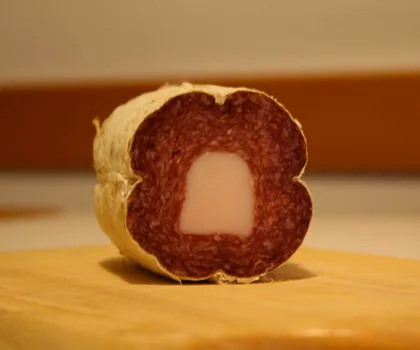 Cured meatsMortadella di CampotostoMortadella di Campotosto is a small, air-dried, lightly smoked salume from the Laga mountains of Abruzzo…