What is Parrozzo?
Parrozzo is a dome of almond-and-semolina cake, eight or nine centimetres high, entirely coated in dark chocolate. Inside it is deep yellow, moist and close-textured; outside it is dark and snaps.
The ingredient list is short and every item shows in the result: eggs, and above all yolks, which supply the colour; finely ground sweet almonds with a small proportion of bitter almonds for the marzipan perfume; semolina, which gives a faint grain; sugar and butter. There is no wheat flour, no yeast and no candied fruit.
The shape is a quotation. Parrozzo was built to echo pane rozzo, the rough maize loaf Abruzzese farmers baked in wood ovens: domed, yellow inside from the cornmeal, with a crust blackened by the fire. The pastry chef who invented it rebuilt the yellow with egg yolks and semolina, and the burnt crust with chocolate.
It is an authored cake with a precise birth date, 1920, which makes it an outlier in a category otherwise made up of recipes with no parent. And unlike almost every Italian celebration sweet, it is not tied to a single feast: it is eaten year-round, with a sharp peak at Christmas, when it becomes the standard gift from Abruzzo.
What does it taste like?
Almond first and almond last. The base flavour is the same as good marzipan or a French financier (rich, toasted, slightly bitter at the edges) lifted by the small dose of bitter almonds that gives it an amaretto perfume without any of the sweetness of amaretto liqueur.
The chocolate arrives before the crumb does, since you bite through it: dark, mildly bitter, thin enough to snap rather than to chew. It is doing a job beyond flavour, cutting the richness of the almonds and keeping the cake from reading as one-note.
Texture is where the semolina shows. The crumb is moist and dense, with a faint sandy grain that separates it from any sponge cake. It is closer to a very good almond torte than to layer cake, and there is no leavened lightness at all.
Sweetness is moderate. What lingers is the almond oil and the bitterness of the chocolate, which is why a small slice satisfies.
How to use it
Cut it into wedges like a cake, using a smooth blade warmed under hot water and dried, or the chocolate shell cracks. Sixty or seventy grams is a portion.
Serve it at room temperature. Cold from the fridge the crumb tightens and the almond flavour goes quiet; twenty minutes out puts it right.
It works at both ends of the day. In Abruzzo a morning slice gets dunked in milk, and an evening slice comes with a glass of sweet wine or a spirit.
It makes an excellent base for something else. Crumbled into a glass with sweetened ricotta and grated orange zest it becomes a spoon dessert; sliced thin and warmed for a moment it holds a scoop of almond gelato.
One thing to avoid: never reheat it in the oven. The coating melts, runs and recrystallises dull, and the cake loses its only decorative surface.
How long it keeps
It keeps at room temperature, somewhere cool and dry, for two or three weeks while it is still in its wrapper, and the wrapper is doing real work. Once you cut it, press film against the cut face and finish it over five or six days, because the exposed crumb dries very fast: semolina holds less water than flour, so the surface goes sandy within a day or two and the almond aroma fades with it. The date on a boxed one belongs to the producer.
The fridge is the wrong place. Cold tightens the crumb, mutes the almond and brings the cocoa butter to the surface of the coating as white streaks, which is a permanent cosmetic change once it has happened. Above 25 C the chocolate softens and takes fingerprints, so in summer it wants the coolest spot in the house rather than the fridge. It freezes whole and well wrapped for three months, and it should thaw slowly at room temperature still in its wrapping: unwrapped cold, condensation settles on the chocolate and dulls it.
Spot the real thing
Cut it and look at the crumb: it should be a full yellow verging on orange, which is what a lot of yolks look like. A pale parrozzo was made with fewer eggs and more semolina. The bite has to carry a grain, a barely perceptible roughness from the semolina that is exactly what separates this from a sponge cake; smooth and velvety means the recipe was lightened with flour or starch. Bitter almond should be there and stay in the background, and when it leads and smells synthetic, almond flavouring has replaced the bitter almonds themselves, which is the usual shortcut.
The coating is real dark chocolate, thin and glossy. A thick dull layer that marks under your thumb at room temperature points to a compound coating with vegetable fats in place of cocoa butter. Shape settles the rest: a clean dome, not a truncated cone and not a loaf. The rectangular parrozzo that turns up in some supermarkets is a chocolate cake that borrowed the name, and outside Italy the cake is essentially only found in Abruzzese food shops or shipped from the producers in Pescara.
How to pronounce Parrozzo
pahr-ROT-tsoh
Three syllables, stress on the second. The double 'r' is rolled and held slightly; the double 'z' is a hard 'ts' as in 'cats', never a soft 'z'. So pahr-ROT-tsoh, not 'pa-ROH-zo'. D'Amico is dah-MEE-koh.
Parrozzo compared
vsChocolate sponge cake
The thing a parrozzo is mistaken for by anyone who only sees the outside, and the comparison worth making because the two are built on opposite principles. A chocolate sponge (pan di Spagna al cioccolato) gets its structure from wheat flour and whipped eggs, its flavour from cocoa in the batter, and is usually layered with cream or ganache. A parrozzo has no wheat flour, no cocoa inside at all, and no filling: the chocolate is entirely on the outside, and the interior is an almond cake. One is light, layered and cocoa-flavoured; the other is dense, single-piece and almond-flavoured.
| This | Chocolate sponge cake | |
|---|---|---|
| Flour | None; ground almonds and semolina | Wheat flour, the structural base |
| Chocolate | Coating only | Cocoa in the batter, often filling too |
| Lead flavour | Almond, with bitter almond | Cocoa |
| Structure | Single dome, no layers | Layered, filled, often frosted |
| Crumb | Dense, moist, faintly grainy | Light, airy, open |
| Keeps | Two to three weeks wrapped | Two or three days |
vsTorta caprese
The closest relative in the Italian repertoire and the substitute most people land on. Both are almond cakes without wheat flour, both are dense and moist, both belong to the same family of nut-based tortes. But the caprese, from Capri, has melted dark chocolate worked into the batter, so it is chocolate all the way through and darker inside than out; it is also flatter, cracked on top and dusted with icing sugar rather than enrobed. Parrozzo keeps the chocolate strictly on the surface, which is the whole point of the recipe: yellow inside, dark outside, exactly like the bread it imitates.
| This | Torta caprese | |
|---|---|---|
| Chocolate | Coating only | Melted into the batter |
| Interior colour | Deep yellow | Dark brown, almost black |
| Shape | Tall dome | Flat round, cracked surface |
| Finish | Tempered chocolate shell | Dusted icing sugar |
| Other starch | Semolina | None; naturally gluten-free |
| Origin | Pescara, 1920 | Capri, early twentieth century |
vsPane rozzo
Not a rival but the original: the peasant loaf the cake was designed to quote, and knowing it explains everything about the parrozzo's appearance. Pane rozzo was a domed maize-flour bread baked in a communal wood oven: coarse, yellow inside from the cornmeal, with a crust burnt almost black by direct fire. The joke of the parrozzo is that every element of that poor loaf is rebuilt with expensive ingredients: cornmeal yellow becomes egg yolk, the coarse crumb becomes semolina, the scorched crust becomes couverture chocolate. It is a rustic bread rendered in luxury materials, which is also why the name is a dialect contraction of the bread's.
| This | Pane rozzo | |
|---|---|---|
| Yellow interior | Egg yolks and semolina | Maize flour |
| Dark crust | Tempered dark chocolate | Scorched by the wood oven |
| Texture | Fine grain from semolina | Coarse, rustic crumb |
| Cost | Almonds, eggs, couverture | The cheapest flour available |
| Eaten | Dessert, gift box | Daily bread, field food |
Parrozzo substitutes
- Torta caprese
The nearest thing on any Italian menu and widely available. Same almond density, but the chocolate is in the batter rather than on the outside, so it reads darker and more bitter throughout. Naturally gluten-free, which the classic parrozzo is not.
1:1 - Bitter almond extract for bitter almonds
Whole bitter almonds are restricted or hard to find in the US and UK. A few drops of good bitter almond extract reproduce the perfume, but the dose is unforgiving: too much and the cake tastes of cheap marzipan. Add it to the yolks, never to the hot butter.
2-3 drops per 100 g ground almonds - Fine durum semolina for semolino
Italian semolino is finely milled durum wheat and gives the cake its characteristic slight grain. Fine semolina sold for puddings is the same thing under another name. Cornmeal is not a substitute: it swells differently and turns the crumb gritty.
1:1 - Potato starch for a gluten-free version
Several Abruzzese pastry shops make a gluten-free parrozzo by replacing the semolina with potato starch or cornflour. The crumb loses some of its grain and gains a little softness, but the almond character is untouched. This is the one substitution that changes the cake least.
0.8:1 by weight - Good marzipan cake or a financier loaf
If you cannot get a parrozzo at all, a dense almond cake glazed with tempered dark chocolate gets you most of the way. Keep the glaze thin and the cake underweight on sugar; the parrozzo's balance depends on the coating being bitter and the crumb being moist.
1:1
Where to buy it
Artisan parrozzo runs 18 to 30 euro a kilo in Italy. The standard 500 g dome costs 12 to 18 euro in a pastry shop, with Christmas gift boxes adding three or four euro for packaging.
Almost all of the price is almonds (a correct recipe runs to well over a third of the weight) and couverture chocolate. Industrial versions below twelve euro a kilo cut both: less almond, more semolina, flavouring instead of bitter almonds, and a compound coating made with vegetable fat rather than cocoa butter. You can feel the difference in the coating with your fingers before you taste anything.
Abroad, Italian delis and online grocers list it at roughly 16 to 26 dollars a pound in the US and 25 to 40 pounds a kilo in the UK, with the widest availability in December. It ships well: the chocolate shell protects the crumb and the cake keeps for weeks.
Check the shape before you buy. A rectangular loaf sold as parrozzo is a chocolate cake wearing the name; the real thing is always a dome.
Where to eat it in Italy
Pescara, where it was invented and where every pastry shop in the centre makes one. The firm founded by Luigi D'Amico is still trading and is the historic reference point, but tasting two or three versions side by side is the best way to understand how much the almond percentage matters.
Pescara takes a day: the seafront, the Ponte del Mare, and above all the house where Gabriele D'Annunzio was born, now a museum, which closes the loop with the cake's own story.
Chieti and the Teatina coast south of the city have their own versions, some with a higher almond content and a thinner coating.
December is when parrozzo fills every window in Abruzzo, because it is the regional Christmas gift by default: you will find it in motorway service stations and railway kiosks in gift boxes.
While in the region, line it up against the other two Abruzzese sweets that define the place: the sugared almonds of Sulmona, in the Peligna valley, and ferratelle, the iron-pressed wafers made in every inland village.
Further reading
Frequently asked questions
Why is it called parrozzo?
From pane rozzo, the rough maize loaf baked in wood ovens across rural Abruzzo: yellow inside, crust blackened by the fire. Luigi D'Amico rebuilt the yellow with egg yolks and semolina and the crust with dark chocolate, and contracted the bread's name.
What is the connection with Gabriele D'Annunzio?
D'Annunzio was born in Pescara. Having tasted the new cake, he wrote it a madrigal in Abruzzese dialect, the Canzone del Parrozzo, which D'Amico immediately used to promote it. It is one of the earliest Italian examples of a confectionery product launched on a literary endorsement.
Is parrozzo gluten-free?
The classic recipe is not. There is no wheat flour, but the semolina is milled durum wheat and contains gluten. Several Abruzzese pastry shops make a gluten-free version using potato starch instead, and it is the substitution that changes the cake least.
When do Italians eat parrozzo?
All year, with a sharp peak at Christmas, when it is the standard gift from Abruzzo. Unlike most Italian celebration sweets it is not attached to a religious date: it was conceived in 1920 as a product, and the Christmas association came later.
How do you pronounce parrozzo?
pahr-ROT-tsoh, stress on the second syllable, with a rolled double 'r' and the 'zz' pronounced as a hard 'ts'.
Related foods
 SweetsConfetti di SulmonaA whole Pizzuta d'Avola almond coated in nothing but sugar and water: no starch, no flour, no gelatine.
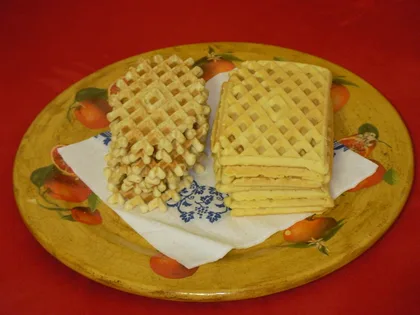 SweetsPizzellePizzelle are thin anise-scented Italian waffle cookies pressed between two engraved iron plates.SweetsTorroneHoney and sugar go over a water bath and stay there for hours, sometimes twelve, while someone keeps stirring.
 Cured meatsGuancialeGuanciale is cured pork jowl: unsmoked, rubbed with salt and pepper, aged for one to three months.
 CheeseScamorzaScamorza is cow's-milk pasta filata that has been tied off into a pear shape and hung to dry for one to two…
 Oil and preservesSaffronOne kilo takes between 150,000 and 200,000 flowers, and every flower gives up three stigmas that have to be…
 Pasta and breadMaccheroniThe most misunderstood name in Italian pasta. In Naples it means dried semolina pasta in general, in Abruzzo…
 Vegetables and fruitSulmona Red GarlicSulmona red garlic is white on the outside and red underneath: the colour is in the skins wrapping each…