What is Scamorza?
Scamorza starts exactly like mozzarella: cow's milk, rennet, curd ripened to the right acidity, then stretched in near-boiling water. The difference is what happens next. The stretched curd is shaped into a ball, tied with string about two thirds of the way up to make the little head, and hung in pairs over a pole to dry for seven to fifteen days.
That drying is the entire cheese. It loses around fifteen percent of its weight, develops a thin elastic straw-coloured skin, and concentrates in flavour and salt. Where fresh mozzarella weeps whey into whatever you cook it with, scamorza melts into long strands and stays put.
It comes white (bianca) or smoked (affumicata). Real smoking is done cold, under 30C, over damp straw or beechwood, and leaves an uneven hazel to amber skin. A great deal of industrial scamorza is instead dipped in smoke flavouring, which gives a suspiciously even mahogany colour and a flat, sweetish smoke.
What does it taste like?
Milkier and gentler than you expect from something that looks like a small smoked cheese. The white version tastes like a firmer, saltier mozzarella with a little more depth: clean milk, a touch of butter, a lactic finish. There is no sharpness and no funk at all.
The smoked version tastes of woodsmoke over that same mild milk. In good examples the milk is still clearly there under the smoke; in cheap ones the smoke is all you get, sweet and slightly artificial, like a smoked processed cheese slice.
Melted, both turn sweeter and stringier, with the browned edges going nutty. Grilled in thick slices it develops a crust and a molten centre, which is the best argument for the cheese.
How to use it
The dish that explains the cheese is scamorza alla piastra. Cut slices a centimetre thick, put them on a screaming-hot dry pan or griddle with no fat at all, and leave them for about two minutes a side until a golden crust forms and the middle goes molten. Eat immediately, with black pepper, olive oil and bread.
On pizza, use it instead of or alongside fresh mozzarella when you want stringy melt without a wet centre. In baked pasta, lasagne and gratins it does the same job. On crostini it survives the broiler.
Use the smoked version with restraint. In a dish with several ingredients it will take over, so a common trick is to mix half smoked and half white. It goes best with things that can stand up to it: mushrooms, potatoes, sausage, roasted peppers, bitter greens.
A scamorza that has dried out too far in the fridge is not wasted: grate it into soup or over baked vegetables, where it behaves like a mild aged cheese.
How long it keeps
It goes in the fridge wrapped in cheese paper or a clean tea towel, never in cling film pressed against it, because the skin has to breathe. In the vegetable drawer at 6 to 8 °C a whole one holds two to three weeks and dries slowly the entire time: it firms up, the salt concentrates and it drifts from a melting cheese towards a grating one. The smoked version holds a few days longer and passes its aroma to everything around it, so it belongs in a closed box.
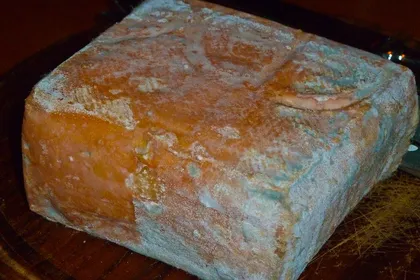
Once cut, cover the cut face and expect that surface to harden first. A tacky film can appear on the skin as the cheese gives up whey, and a damp cloth takes it off; anything coloured growing on the surface is a question for the shop or the producer, not for guesswork. It freezes better than any other pasta filata, but only when it is headed for the oven: cube it, freeze the cubes spread on a tray, then bag them for up to two months and use without thawing.
Spot the real thing
The shape is a clean pear with a distinct little head above the string, and the surface is smooth and slightly glossy. Bianca is pale straw; the smoked version runs from hazel to dark amber, and a colour that is perfectly even and glassy usually points to an aromatised dip rather than time over smouldering straw. Press it: a whole one gives a little, like a soft tennis ball. Rock hard means it was dried too far and will not string in the pan; slack and wet means it was sold too young and is still closer to mozzarella. Cut it and the paste is white and compact with a faint leafy structure and no eyes, and it should peel into sheets when you pull it.
At a deli counter abroad the neighbours are smoked provolone, which is larger, aged longer and sharper, and caciocavallo, which is bigger again. Low moisture mozzarella has no head and comes as a block. If smoke completely buries the smell of milk, it was almost certainly added as flavouring.
How to pronounce Scamorza
skah-MOR-tsah
Three syllables, stress on the middle one. The 'z' is a 'ts' sound, so the ending is 'tsah', not the English 'zah'. The 'sc' before an 'a' is a hard 'sk', as in 'skate', never the 'sh' of 'scampi' as English speakers say it. Common errors: 'ska-MOR-zuh' with a buzzing z, and 'sha-MOR-cha'.
Scamorza compared
vsProvola
Very close relatives and often used interchangeably, but provola is generally softer, younger and more southern. Provola is Campanian in origin, sometimes made with buffalo milk, usually smoked, and eaten within days; scamorza is Abruzzese and Molisano, always cow's milk, dried longer and firmer. On a pizza, provola melts softer and creamier; scamorza holds its structure better.
| This | Provola | |
|---|---|---|
| Home region | Abruzzo, Molise | Campania |
| Milk | Cow only | Cow, sometimes buffalo |
| Drying | 7-15 days | 1-5 days, often less |
| Texture | Firm, springy, sliceable | Softer, wetter, more yielding |
| Smoked | White and smoked both common | Usually smoked (provola affumicata) |
| On pizza | Melts in strands, holds shape | Melts creamier, spreads more |
| Shelf life | 2-3 weeks | 5-10 days |
vsCaciocavallo
Same family, different ambition. Caciocavallo is pasta filata aged properly, three months to two years, until it turns firm, savoury and sharp, and it is hung in pairs over a pole, which is where the name comes from (a cavallo, astride). Scamorza is the same shape stopped after two weeks. Think of caciocavallo as the aged cheese for the board and the grater, scamorza as the fresh one for the pan.
| This | Caciocavallo | |
|---|---|---|
| Ageing | 7-15 days | 3 months to 2 years |
| Texture | Semi-soft, springy | Firm to hard, flaky when very aged |
| Flavour | Mild, milky, lightly salted | Savoury, sharp, piquant with age |
| Rind | Thin, edible skin | Thick, waxy, not eaten |
| Best use | Grilling, melting, pizza | Cheese board, grating, shaved |
| Price (US) | $8-14 per lb | $14-24 per lb |
| Milk | Cow | Cow, sometimes podolica breed |
vsLow-moisture mozzarella
The American pizza block is the closest thing on a US supermarket shelf, and structurally they are cousins: both are pasta filata dried down to melt well. Scamorza is dried in the air as a whole hung form, so it develops a skin and a faint rind flavour; low-moisture mozzarella is pressed and packed as a block. Scamorza is more savoury and more interesting; low-moisture is cheaper and more neutral.
| This | Low-moisture mozzarella | |
|---|---|---|
| Form | Hung pear with a tied head | Rectangular block or shreds |
| Drying | Air-dried whole, 1-2 weeks | Drained and pressed, then packed |
| Rind | Thin natural skin | None |
| Flavour | Milky with a savoury edge | Mild, salty, neutral |
| Smoked version | Standard and widely sold | Rare |
| Melt | Long strands, browns well | Even melt, browns well |
| Price (US) | $8-14 per lb | $4-7 per lb |
Scamorza substitutes
- Provola or provolone dolce
The nearest match in flavour and behaviour. Young provolone dolce is milder and a little more elastic; provola affumicata stands in perfectly for smoked scamorza. Both melt cleanly without releasing water.
1:1 by weight - Low-moisture whole-milk mozzarella
The practical American substitute for scamorza bianca in any cooked dish. It is more neutral, so season a little harder. Buy the block and grate it yourself rather than using bagged shreds, which are coated in starch.
1:1 - Smoked gouda or smoked Oaxaca
For smoked scamorza, smoked gouda gets the aroma right but is denser and sweeter, and it melts greasier. Smoked queso Oaxaca, where you can find it, is much closer because it is the same pasta filata family.
1:1, using about 20% less if it is gouda - Fresh mozzarella, drained hard
Workable only if you deal with the water. Slice it, salt it lightly, and leave it on a rack in the fridge uncovered for a few hours or overnight. It will never get the skin or the savoury edge, but it will stop flooding your dish.
1.2:1 by weight, since it loses water - Caciocavallo, young
A three-month caciocavallo, sliced thin, grills beautifully and is arguably better than scamorza for the pan: sharper, more savoury. Not a substitute where you need a mild background cheese.
1:1, but expect a much stronger flavour - Vegetarian and halal note
Most Italian scamorza is made with calf rennet and is therefore not vegetarian. Some Abruzzese and Molisano dairies produce microbial-rennet versions for export; among widely available substitutes, US and UK low-moisture mozzarella is usually vegetarian. Check for 'caglio microbico' or 'vegetarian rennet' on the label.
Where to buy it
In the US, Italian delis and cheese counters carry both bianca and affumicata; BelGioioso makes a domestic version sold widely, and importers such as Eataly and Murray's carry Abruzzese producers. Expect $8 to $14 per pound. Whole forms weigh 250 to 400 grams, which is one or two meals.
In the UK, scamorza is a deli and Italian-importer item rather than a supermarket one, though Ocado and Waitrose stock it intermittently at roughly £14 to £20 per kilo. Independent Italian shops in London and Manchester usually have both versions.
For the smoked one, look at the colour before the label: real cold smoking leaves an uneven hazel-to-amber skin, while a perfectly even glossy mahogany means a dip in smoke flavouring. The ingredient list will say 'aroma' or 'smoke flavouring' if that is what happened.
Where to eat it in Italy
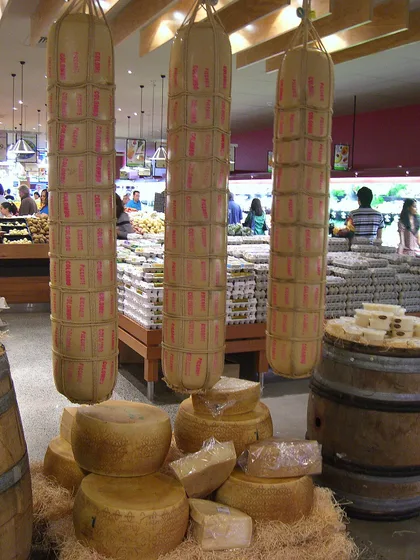
The Abruzzo highlands (Rivisondoli, Roccaraso, Pescocostanzo, Scanno) where dairies sell straight from the counter and every mountain restaurant grills it. In L'Aquila and its provincial markets you will see it hanging in pairs above the counter, which is how it is meant to be displayed.
In Molise, head for Agnone and Capracotta in the Alto Molise, where the same small dairies make scamorza and caciocavallo side by side.
In Rome the smoked version has become a trattoria staple, on crostini or melted into meatballs and baked pasta. Naples is provola country rather than scamorza country, but the family resemblance is obvious once you have eaten both.
Further reading
 ExplainerWhich Italian cheeses contain no lactoseItaly sets a legal threshold, and long-aged cheeses clear it on their own, with no treatment involved.
 GuideCan you eat cheese rind?On some wheels the rind is the same paste, dried out. On others it is paraffin.
 GuideHow long food keeps once openedThe date on the label describes the sealed package. After that, four things govern everything: water, salt…
Frequently asked questions
What is the difference between scamorza and mozzarella?
Scamorza is mozzarella curd that has been tied into a pear shape and hung to dry for one to two weeks. It loses water, gains a thin skin, and becomes firmer and saltier. The practical result is that it melts into strands without releasing whey, so it cooks far better than fresh mozzarella.
Is scamorza smoked?
Both versions exist. Scamorza bianca is unsmoked; scamorza affumicata is cold-smoked over straw or beechwood. Watch the colour: real smoking leaves an uneven hazel skin, while a uniform glossy brown usually means a dip in smoke flavouring.
How do you pronounce scamorza?
skah-MOR-tsah, with the stress in the middle and a 'ts' at the end rather than an English z. The 'sc' is hard, as in 'skate'.
Can you eat scamorza raw?
Yes: sliced thin on a board with bread it is very good, mild and milky. But it was invented for cooking, and grilling or melting it is where it beats every other pasta filata cheese.
Can you freeze scamorza?
Yes, better than most fresh cheeses, as long as it is destined for cooking. Cube it, freeze it spread out on a tray, then bag it. It keeps two months and goes straight from the freezer onto a pizza or into a bake.
Related foods
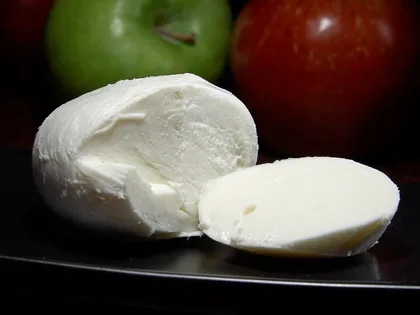 CheeseMozzarellaThe name is a verb before it is a cheese: mozzare means to lop off, which is what the cheesemaker does by…
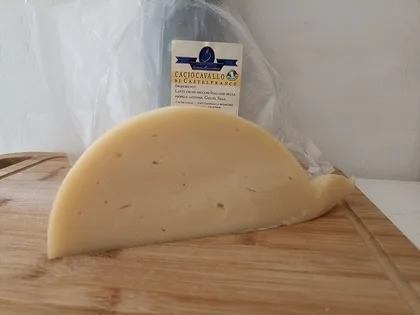 CheeseCaciocavalloCaciocavallo is a stretched-curd cow's milk cheese from southern Italy, aged in a distinctive gourd shape…
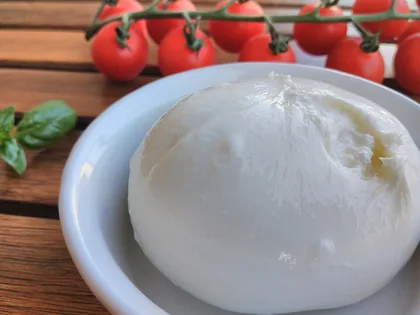 CheeseBurrataIt began as a way of using offcuts: leftover shreds of pasta filata, drowned in cream and sealed inside a…
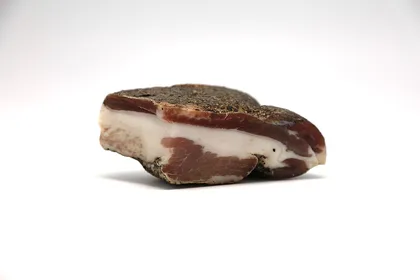 Cured meatsGuancialeGuanciale is cured pork jowl: unsmoked, rubbed with salt and pepper, aged for one to three months.
 Pasta and breadFusilliTwo different pastas share this name. The industrial spiral is solid and holds sauce on its outside surface…
 SweetsPizzellePizzelle are thin anise-scented Italian waffle cookies pressed between two engraved iron plates.
 Oil and preservesSaffronOne kilo takes between 150,000 and 200,000 flowers, and every flower gives up three stigmas that have to be…
 Pasta and breadMaccheroniThe most misunderstood name in Italian pasta. In Naples it means dried semolina pasta in general, in Abruzzo…