What pasta filata means
Pasta filata (PAH-stah fee-LAH-tah, literally spun paste) is not a cheese but a technique: the curd is left to acidify, plunged into near-boiling water and stretched until it turns glossy and elastic. Mozzarella, provolone, caciocavallo, scamorza and burrata all come from that one gesture.
Menus and cheese counters outside Italy often list pasta filata as if it were a variety, next to cheddar and brie. It is not. It is a family defined by a single processing step, and its members have almost nothing else in common: one is eaten within 48 hours and weeps milky whey, another is hung from a beam for a year and burns the back of your throat.
The technique turns on a narrow window of acidity. After coagulation, the curd is left to ripen for several hours until its pH falls to roughly 5.0-5.2. In that range calcium progressively leaves the paracasein network and the protein matrix becomes thermoplastic: dropped into water at 85-95°C it softens, and when pulled, the proteins align into parallel fibres instead of tearing. Cheesemakers do not rely on a meter alone. They run the stretch test, dipping a piece of curd into hot water and pulling it: if it draws out into a shiny ribbon without breaking, the batch is ready; if it crumbles or dissolves, the window has been missed and there is no way back. The hot paste is then gathered into a rope and cut off in pieces with thumb and forefinger: mozzare, to lop off, which is where mozzarella gets its name.
The fresh branch of the family lasts days. Mozzarella di Bufala Campana DOP, protected since 1996, is made only from water buffalo milk in a defined area spanning Caserta, Salerno, parts of Naples, Benevento, Latina, Frosinone and Rome, one municipality in Molise and part of the Foggia province. Fior di latte is the identical technique using cow's milk, and it is a different product, not a cheaper mozzarella di bufala. Mozzarella STG, registered in 1998, protects the method rather than the place: it says how, not where. Burrata di Andria IGP is a pouch of pasta filata filled with shredded curd and cream, a cheese container holding more cheese. A good fresh mozzarella separates into concentric leaves when you tear it and releases cloudy whey; if it does neither, it was either made with citric acid rather than lactic fermentation, or it is no longer fresh.
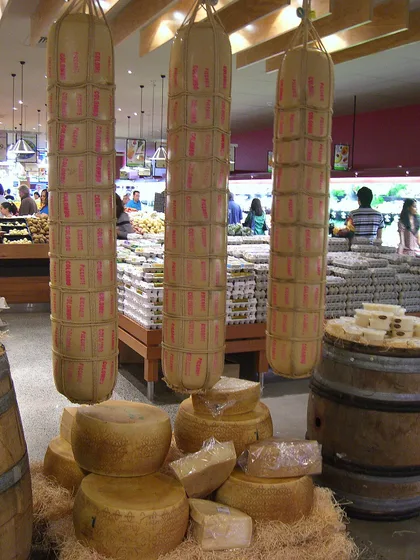
The aged branch takes the same stretched curd, brines it and hangs it up. Provolone Valpadana DOP exists in two versions that behave like two cheeses: dolce, made with calf rennet, stays gentle; piccante, made with kid or lamb rennet paste, carries lipase enzymes that release short-chain fatty acids over months of ageing, which is where that peppery bite at the back of the throat comes from. Provolone del Monaco DOP comes from the Monti Lattari above Sorrento; Caciocavallo Silano DOP from Calabria, Basilicata, Campania, Molise and Puglia, its name from being tied in pairs and slung a cavallo, astride a pole; Ragusano DOP is a Sicilian block; Vastedda della valle del Belìce DOP is the outlier, the only Italian stretched-curd cheese made from sheep's milk, born as a way of rescuing flawed pecorino wheels by melting and stretching them.
A few things follow for anyone buying outside Italy. The shredded or block mozzarella sold for pizza in the United States and the UK is also pasta filata, but it is low-moisture mozzarella: salted, aged briefly, drier and higher in fat and protein, engineered to melt, brown and stretch. Fresh mozzarella has 55-60% moisture and will flood a pizza unless you slice it and drain it for a few hours. String cheese is the same family again, its fibres deliberately aligned. Deli provolone in North America is usually a mild domestic style with little relation to an aged Provolone Valpadana piccante. And fresh mozzarella should be bought the day you eat it, kept in its own liquid, and taken out of the fridge half an hour before serving: at 4°C it tastes of nothing at all.
Guides that cover this
Frequently asked questions
Is pasta filata a type of cheese?
No, it is a processing technique. The family it defines runs from fresh mozzarella eaten within two days to provolone aged for a year. They share a method, not a flavour, a texture or a shelf life.
What is the difference between fresh mozzarella and the pizza kind?
Both are pasta filata. Fresh mozzarella holds 55-60% moisture and is eaten within days. Low-moisture mozzarella is salted, briefly aged and much drier, which is why it melts and browns instead of releasing water onto the crust.
Why is my mozzarella making the pizza watery?
Because fresh mozzarella releases whey as it heats. Slice it and let it drain on paper for a few hours before baking, or use a drier fior di latte. Buffalo mozzarella in particular is best added after baking.
Is provolone pasta filata?
Yes. Provolone is stretched curd that has been brined and hung to age for months. Provolone Valpadana DOP piccante uses kid or lamb rennet paste, whose lipases develop the sharp, peppery finish that mild provolone lacks.