What is Ragusano?
Ragusano DOP is a semi-hard stretched-curd cheese made from raw cow's milk across the whole province of Ragusa plus three towns in Siracusa province: Noto, Palazzolo Acreide and Rosolini. It has been protected since 1996 and is the oldest documented cheese in Sicily.
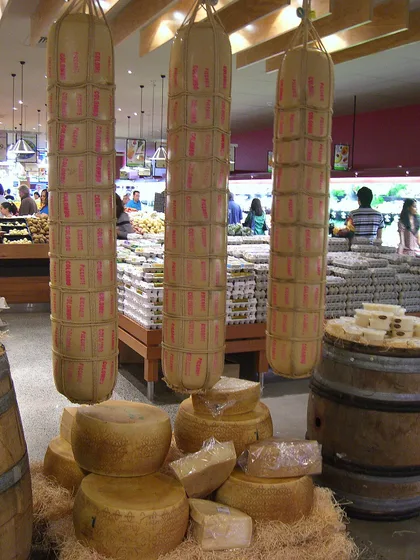
The shape is unmistakable. It is a rectangular block with a square base, 43 to 53 centimetres long and 15 to 18 across, weighing between ten and sixteen kilos. The geometry comes from the process: the hot curd is pressed into a wooden form, then the cooled blocks are tied in pairs with plant-fibre cord and hung astride a beam, where they stay for months. Seen from the doorway of a farm store-room, those hanging rows resemble a staircase, hence scaluni.
The milk is raw and comes from cows grazing the Ibleo plateau, with the Modicana breed as the historic reference: a dark red, hardy, unproductive animal perfectly suited to thin, stony pasture. The rennet is paste rennet from lamb or kid, and that is a large part of why aged Ragusano develops a peppery bite that liquid-rennet cheeses never reach.
Minimum ageing is three months. At four to six months it is a table cheese, springy and sweet with a peppery finish; past a year it turns hard and flaky and becomes a grating cheese, standing in for pecorino across Sicilian cooking.
What does it taste like?
Young Ragusano tastes of grass and warm milk, with a buttery sweetness up front and a slow prickle of pepper at the back of the throat that arrives several seconds after you swallow. The texture is dense and slightly springy, layered rather than uniform: pull at a piece and it separates into thin sheets, the signature of stretched curd.
Aged past a year it becomes something else. The sweetness concentrates into a nutty, almost caramelised depth, the paste dries into brittle flakes like a young Parmigiano, and the lamb-rennet pepper moves from a background tingle to a defining feature. There are notes of hazelnut, hay, leather and, in the best raw-milk versions from spring milk, a distinct herbal edge that comes from the wild thyme and clover of the plateau.
What it is not is bland. Supermarket caciocavallo is mild and pleasant; Ragusano from a good dairy is closer in intensity to an aged Manchego.
How to use it
At four to six months, treat it as a table cheese: break it into thick shards with a short, stout knife rather than slicing it thin, and eat it with durum wheat bread and olives. It is also the cheese for pane cunzatu, the Sicilian dressed loaf, with tomato, anchovy and oregano.
It griddles beautifully. Cut centimetre-thick slabs, put them in a dry, very hot pan, let a crust form on both sides, then finish with a splash of wine vinegar and dried oregano off the heat. That dish is home cooking across the Iblei. The same cheese goes inside scacce, the stuffed flatbreads of Ragusa and Modica, baked until the filling bubbles.
Past a year it becomes a grating cheese and takes pecorino's place: over pasta 'ncasciata, over macaroni with pork ragù, over baked aubergine. It is sweeter and less salty than Pecorino Romano, so you can be more generous with it.
One caveat worth stating: raw milk and lamb rennet mean the flavour survives cooking. This is not a neutral filler cheese. In a dish with delicate ingredients, measure it or it will take over.
How long it keeps
It is a robust cheese and does not need a fridge if the house is cool: a cellar at 12 to 15°C (54 to 59°F) suits a large piece well. In a flat, use the least cold shelf of the fridge, wrapped in greaseproof paper or in a barely damp cotton cloth.
Never film pressed against the rind. The rind has to breathe, and under plastic moisture collects on it and surface growth follows. When the cut face dries and hardens, scrape off a millimetre and the paste behind it is unchanged. A half-kilo piece handled this way holds a good month; a hard grating piece runs three or four months, and what happens over that time is drying, nothing more dramatic.
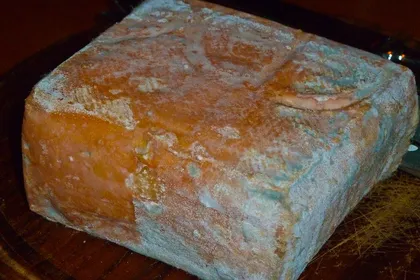
White or greyish bloom on the rind comes off with a cloth dipped in vinegar, and if the rind cracks, rub it with a film of olive oil, the way they do in the ageing rooms. Grated cheese freezes in portions for cooking. A whole piece does not: on thawing the stretched curd flakes apart and loses its elasticity.
Spot the real thing
Shape is the first check and the simplest: if it is not a rectangular block on a square base, it is not Ragusano. Pear-shaped caciocavalli, cylinders and round wheels are something else, however Sicilian they may be.
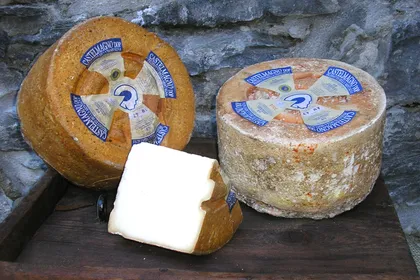
The rind should carry the branded denomination mark and the cord lines, two parallel grooves left by the ropes, which stay visible for the life of the wheel. The rind itself is smooth, thin and compact, golden yellow when young and dark brown when old, often shiny with oil. Cut it and the paste is dense, ivory to straw yellow, with few holes or none at all. Young wheels show the layering of stretched curd, thin sheets that peel apart when you pull a piece; aged ones turn grainy and flake like a grana.
Young, it smells of milk, butter and fresh grass; aged, of dried fruit, leather and pasture, with the sharpness of kid rennet arriving before the taste does. Delis often sell any caciocavallo made in the province as ragusano: the place name means nothing here, the DOP mark does.
How to pronounce Ragusano
rah-goo-ZAH-noh
Four syllables, stress on the third. The 'g' is hard, as in 'goose', never soft as in 'gem'. The single 's' between vowels is voiced like 'rose' in northern Italy and sharp like 'sun' in Sicily; both pass. Never 'ra-GOO-sa-no' with the stress pulled forward.
Ragusano compared
vsCaciocavallo
Ragusano belongs to the caciocavallo family and was called caciocavallo ragusano for four centuries, so the question is fair. The difference is that caciocavallo is a generic name used from Molise to Calabria for any gourd- or pear-shaped stretched-curd cheese, with no shared standard, no breed requirement and pasteurised milk in most industrial versions. Ragusano is a specific DOP: one shape, raw milk only, lamb or kid paste rennet, cows from one plateau. Every Ragusano is a caciocavallo; almost no caciocavallo is a Ragusano.
| This | Caciocavallo | |
|---|---|---|
| Shape | Rectangular block, square base | Pear or gourd with a neck |
| Weight | 10-16 kg | Usually 1-3 kg |
| Milk | Raw, by law | Usually pasteurised |
| Rennet | Lamb or kid paste | Commonly liquid calf rennet |
| Protection | DOP since 1996 | Generic name, unprotected |
| Flavour | Grassy, then distinctly peppery | Mild, milky, sweet |
| Price | EUR 13-30 per kg | EUR 9-16 per kg |
vsProvolone
Same family, opposite industrial history. Provolone was born in the south but industrialised in the Po valley, where Provolone Valpadana DOP is now made from pasteurised milk in huge volumes; its piccante version gets its bite from added lipase enzymes. Ragusano stayed small, raw and southern, and its bite comes from the paste rennet and the ageing, not from an additive. Provolone is a reliable everyday melting cheese; Ragusano is a cheese with an address.
| This | Provolone | |
|---|---|---|
| Where made | Ragusa province, Sicily | Lombardy and Veneto, mostly |
| Milk | Raw, from one plateau | Pasteurised, pooled |
| Source of piquancy | Lamb or kid paste rennet | Added lipase in the piccante type |
| Scale | A few hundred tonnes a year | Tens of thousands of tonnes |
| Shape | Rectangular block | Salami, pear or giant cylinder |
| Best use | Table, griddled, grated when aged | Melting, sandwiches, cooking |
vsCaciocavallo Silano DOP
The comparison that settles the naming confusion, because this is the other protected caciocavallo. Caciocavallo Silano covers five southern regions (Calabria, Campania, Basilicata, Molise, Puglia) and keeps the classic pear shape and a modest 1 to 2.5 kilos, with a minimum ageing of just 30 days. Ragusano is one province, one geometry, six times the weight and three times the minimum age. Silano is the everyday southern table cheese; Ragusano is the one you age.
| This | Caciocavallo Silano DOP | |
|---|---|---|
| Area | One province plus three towns | Five regions |
| Shape | Rectangular block | Pear with a head |
| Weight | 10-16 kg | 1-2.5 kg |
| Minimum ageing | 3 months | 30 days |
| Milk | Raw | Raw or thermised |
Ragusano substitutes
- Caciocavallo Silano DOP
The closest realistic swap and far easier to find outside Italy. Milder and younger, so it will melt more readily and taste sweeter; add a grind of black pepper if you are chasing Ragusano's finish.
1:1 - Provolone piccante
Gets you the pasta filata texture and a comparable sharpness, though the sharpness is lipase-derived and reads as tangier rather than peppery. Use slightly less, since it is saltier.
0.8:1 - Aged pecorino siciliano or pecorino toscano stagionato
For grating over pasta 'ncasciata or baked vegetables, where the aged Ragusano's job is savoury depth. Sheep's milk brings more salt and less butter, so taste before you add extra salt to the dish.
0.8:1 - Aged Gouda (24 months) or a mature farmhouse Cheddar
An unorthodox but honest stand-in for well-aged Ragusano on a board: same brittle flake, same nutty concentration. Neither has the lamb-rennet pepper, so serve with something spicy or with a drop of chilli honey.
1:1 - Vegetarian: none within the DOP
Ragusano requires lamb or kid paste rennet, dried stomach from a milk-fed animal, so it is further from vegetarian than most cheeses, which use liquid calf rennet. As with every Sicilian cheese DOP, there is no microbial-rennet version. Look instead to vegetarian-rennet aged Goudas or Cheddars for the texture, accepting that the flavour will not follow.
Where to buy it
This is a specialist purchase everywhere outside Sicily. In the US, Italian importers and a handful of online specialists list it at roughly 22 to 34 dollars per pound, usually in the aged version, which travels better. In the UK, Italian delicatessens and cheese specialists carry it at about 28 to 42 pounds per kilo, though stock is intermittent.
In Sicily the young cheese runs 13 to 18 euros a kilo at the dairy and 16 to 22 in a gastronomia; aged over a year climbs to 22 to 30, and pure Modicana-breed production reaches 32 to 38.
Buy it cut from a whole block if you can: long-stored vacuum packs lose aroma and pick up a plastic note. Look for the branded DOP mark on the rind and the two parallel grooves left by the hanging cords, which never disappear, because plenty of generic pasta filata is made in the province, and a geographical name without the mark means nothing.
Where to eat it in Italy
Ragusa Ibla and Modica are the obvious bases, and both are UNESCO baroque towns worth the trip regardless. The shops around Modica's San Giorgio staircase sell the cheese alongside the town's cold-worked chocolate, and most will cut from a whole block.
The real experience is inland. Working farms between Chiaramonte Gulfi, Giarratana and Monterosso Almo still use the wooden vat, and several take visitors first thing in the morning when the curd is stretched by hand in boiling water. Chiaramonte Gulfi is also the town of Monti Iblei DOP olive oil and of some serious pork cooking, which makes for a coherent day.
Vittoria, on the western edge of the province, is where the cheese meets Cerasuolo di Vittoria, Sicily's only DOCG wine. The weekly markets in Modica and Scicli are where the small producers sell. When you order, ask how many months: between a four-month Ragusano and a fourteen-month one the difference is not a matter of degree.
Recipes with it
Further reading
 InvestigationItalian raw milk cheeses: the full listWe counted: 19 of 43 declare raw milk, and 16 of those 19 carry a protected designation.
 GuideCan you eat cheese rind?On some wheels the rind is the same paste, dried out. On others it is paraffin.
 ExplainerWhich Italian cheeses contain no lactoseItaly sets a legal threshold, and long-aged cheeses clear it on their own, with no treatment involved.
Frequently asked questions
Why is Ragusano shaped like a brick?
Because the hot stretched curd was pressed into a rectangular wooden form called the mastredda, then the cooled blocks were tied in pairs and hung over a beam to age. The flat sides made them stack and hang efficiently, and the rows of hanging pairs looked like steps, scaluni in the local dialect, which became the cheese's nickname.
Is Ragusano the same as caciocavallo?
It belongs to the caciocavallo family and was called caciocavallo ragusano for centuries. But caciocavallo is an unprotected generic name for pear-shaped stretched-curd cheeses made all over southern Italy, usually from pasteurised milk. Ragusano is a DOP with one shape, raw milk by law, lamb or kid paste rennet and a single production area.
What does Ragusano taste like compared to provolone?
Deeper and grassier. Provolone piccante gets its sharpness from added lipase enzymes, which reads as tangy; Ragusano's peppery finish comes from lamb or kid paste rennet and long ageing, and arrives slowly rather than immediately. Ragusano also tastes of pasture, because the milk is raw and comes from one plateau.
Is Ragusano vegetarian?
No. The specification requires paste rennet from lamb or kid, the dried stomach of a milk-fed animal, which puts it further from vegetarian than cheeses made with liquid calf rennet. No Sicilian cheese DOP permits microbial rennet.
How do you pronounce Ragusano?
rah-goo-ZAH-noh, with a hard 'g' and the stress on the third syllable. In Sicily the 's' is pronounced sharply, as in 'sun'; in northern Italy it is voiced, as in 'rose'. Both are accepted.
Sources
Where to check what you just read.
- 1
Il regolamento del 1° luglio 1996 che registra Ragusano come DOP.
- 2
I numeri della forma a parallelepipedo (12-16 chili, lati da 15 a 18 cm), la stagionatura minima di tre mesi, i limiti di grasso e umidità e l'obbligo del latte crudo.
Related foods
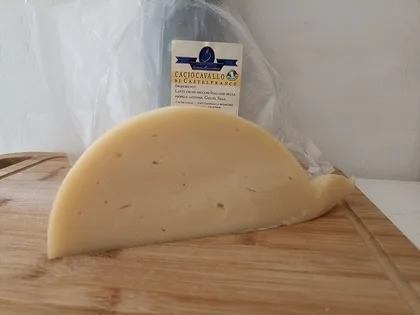 CheeseCaciocavalloCaciocavallo is a stretched-curd cow's milk cheese from southern Italy, aged in a distinctive gourd shape…
 CheeseProvola dei NebrodiProvola dei Nebrodi is a raw cow's milk pasta filata cheese from the mountains of north-eastern Sicily…
 CheeseProvoloneProvolone is a stretched-curd cow's milk cheese from northern Italy, rope-tied and hung to age in shapes from…
 Vegetables and fruitBronte PistachioBronte pistachios grow on the lava fields of Etna, are picked by hand in odd-numbered years only, and have a…
 CheeseRicottaRicotta is not a cheese. It is a dairy product made from whey, the liquid left over after cheese has been…
 CheeseRicotta SalataRicotta salata is sheep's milk ricotta that has been salted, pressed and aged for at least three months…
 CheeseGirgentana Goat CheeseThe Girgentana is the corkscrew-horned goat of Agrigento, in south-western Sicily: white, spiral-horned…
 CheesePiacentinu EnnesePiacentinu Ennese is the only Italian cheese whose specification requires saffron: the paste is egg-yolk…