What is Piacentinu Ennese?
Piacentinu Ennese DOP is made from raw sheep's milk in a handful of towns in the province of Enna, in the middle of Sicily: Enna itself, Aidone, Assoro, Barrafranca, Calascibetta, Piazza Armerina, Pietraperzia, Valguarnera Caropepe and Villarosa. It was protected in 2011.
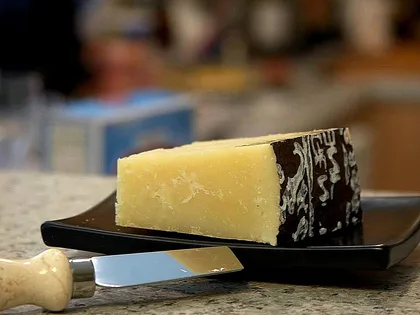
The form is a flat-faced cylinder, 20 to 21 centimetres across and 14 to 15 tall, weighing around four kilos. The rind carries the woven imprint of the rush basket it was pressed in: it is a canestrato cheese, like most Sicilian pecorini.
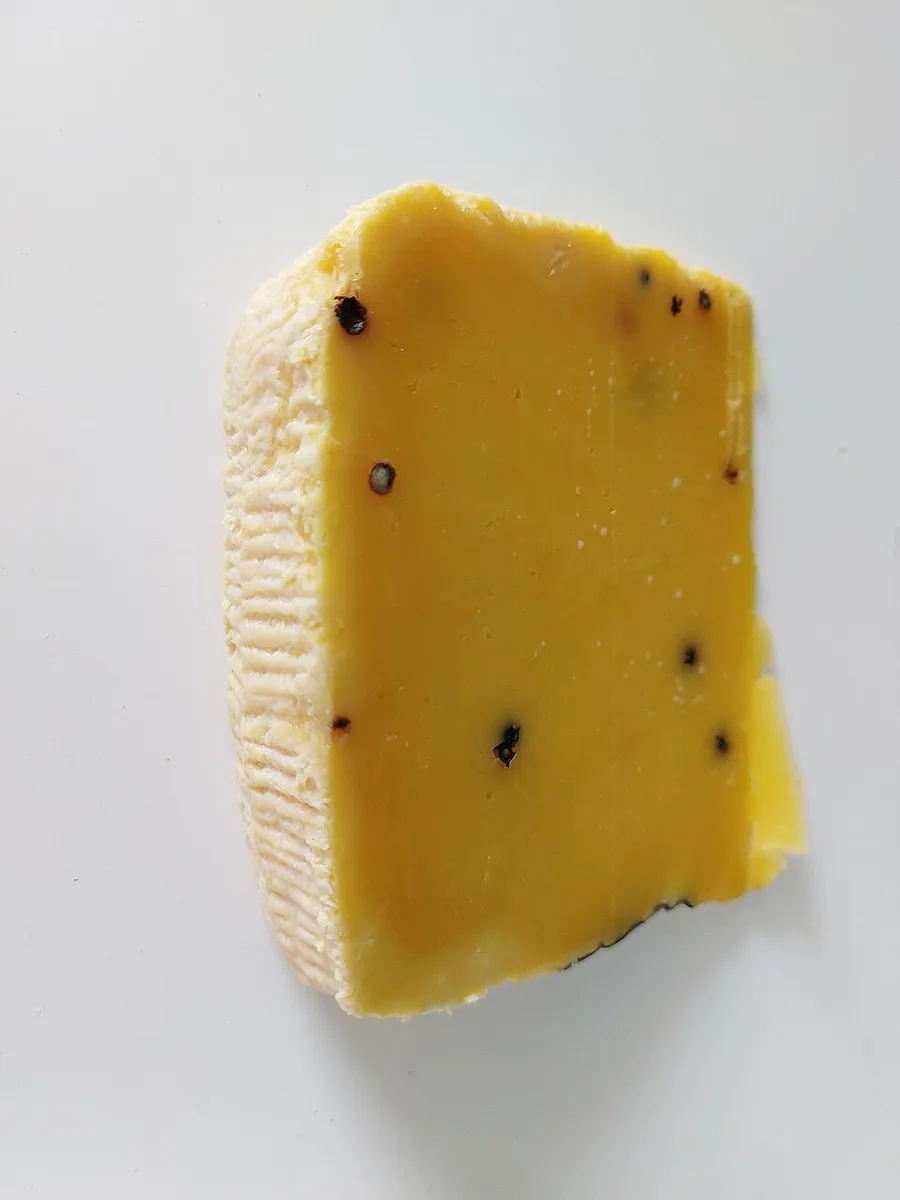
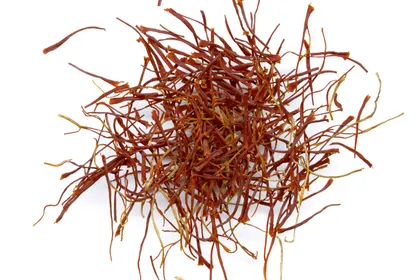
Two things make it unmistakable. First the colour: saffron, dissolved in milk before the curd sets, turns the paste a deep, even yellow that no sheep's cheese reaches on its own. Second the peppercorns, added whole to the curd and left whole in the finished cheese, appearing as black dots across every cut face.
The milk comes from Comisana, Pinzirita and Valle del Belice sheep grazing the interior. The rennet is lamb paste. Minimum ageing is 60 days, but the best wheels go to six months and beyond, at which point the saffron stops reading as a perfume and becomes part of the structure of the flavour.
What does it taste like?
Sheep's milk first: warm, lanolin-rich, faintly sweet, with the clean savoury weight of a young pecorino. Then the saffron arrives, and it is not what most people expect. Saffron in a cheese does not taste floral or perfumed; it tastes of hay, bitter honey and something metallic and medicinal, and against sheep's milk that bitterness works as a counterweight rather than a decoration.
The pepper is intermittent by design. Because the corns are whole and scattered, you eat several mouthfuls of buttery, saffron-scented cheese and then bite into one, and it flares. This is a cheese with a rhythm rather than a constant level of heat.
Aged past six months the texture dries and becomes granular, the sheep's milk concentrates towards nuts and browned butter, and the lamb paste rennet adds a peppery bite of its own, separate from the corns. Young, it is a table cheese anyone will like. Old, it is a serious, slightly difficult cheese that rewards attention.
How to use it
At two or three months it is a table cheese, and in Sicily that is where it stays: thick slices with semolina bread and green olives, sometimes with a piece of sun-dried tomato underneath. It is also the cheese for the local pane cunzatu, where the heat of a fresh loaf just softens it.
Past six months it turns into a grating cheese and does something no other cheese does: it colours the dish. Grated over pasta with sardines, over macaroni with mutton ragù, over baked vegetables, it leaves a yellow cast along with the flavour.
It does not melt well, as no hard pecorino does, so keep it away from toasties and pizza. Instead shave it over something already hot, where the residual heat releases the saffron without the cheese stringing or splitting.
One local use worth stealing: stirred off the heat into a purée of fava beans or chickpeas. The pepper and the saffron do exactly the job you would otherwise do with added spices, and they do it more elegantly.
How long it keeps
Like any hard pecorino, it keeps in the fridge on the least cold shelf, between 6 and 8°C (43 and 46°F), wrapped in greaseproof paper or a lightly dampened cotton cloth. Never film against the paste: the cheese sweats under it and the surface turns slippery.
A half-kilo piece handled that way holds six to eight weeks, and what happens across that time is drying. The cut face dries and darkens, so scrape off a thin veil before serving and the paste behind it is unchanged. Surface bloom on the rind comes off with a cloth dipped in vinegar or white wine.
One detail specific to this cheese: saffron is light sensitive. A piece left in direct light loses colour and aroma within days, which is why producers age in the dark and why the wheels stay covered. Freezing is not the route for a whole piece, since the paste turns grainy, but it works well on cheese already grated, in small portions.
Spot the real thing
Colour settles most of it. The paste should be evenly yellow, a warm full yellow that runs right up to within a millimetre of the rind. Yellow gathered into veins or blotches means the saffron was mixed in badly or, worse, replaced with a dye.
The peppercorns should be whole and spread across the whole cut face, neither lined up nor clustered. A cheese with ground pepper, or with a few corns in one spot, is a coloured peppered pecorino under a borrowed name. On the rind you should see the basket weave and the denomination mark. Rind colour runs from deep yellow to golden brown on older wheels, and it is not treated with wax or varnish.
Young, the nose leads with sheep milk and follows with saffron, carrying that hay and bitter honey note the spice has; with age the order reverses. In the mouth the pepper is not a constant heat: you meet it grain by grain, each one a small isolated burst. Most people notice on the second bite rather than the first.
How to pronounce Piacentinu Ennese
pyah-chen-TEE-noo en-NEH-zeh
Two words, four syllables each side of the pause. 'Pia' is one sound, 'pyah', not 'pee-ah'; 'ce' is soft, as in 'chest'. Stress falls on TEE. 'Ennese' simply means 'from Enna': hold the double 'n' for a beat, stress the NEH, and pronounce the final 'e'. Never 'pee-a-SEN-tin-you'.
Piacentinu Ennese compared
vsPecorino Siciliano DOP
The island's other great sheep's cheese and the one Piacentinu is descended from. Pecorino Siciliano is made across most of Sicily, in much bigger wheels, with no saffron and no whole peppercorns, although a peppered variant exists locally. Piacentinu is a single small province, two extra ingredients written into law, and a shorter minimum age. Think of Pecorino Siciliano as the regional standard and Piacentinu as one town's answer to it, made permanent by a legend.
| This | Pecorino Siciliano DOP | |
|---|---|---|
| Area | Nine towns, province of Enna | Most of Sicily |
| Saffron | Required by the specification | Never |
| Pepper | Whole corns in the paste | Only in the pepato variant |
| Weight | About 4 kg | 4-12 kg |
| Minimum ageing | 60 days | 4 months |
| Colour | Deep yellow throughout | White to pale straw |
| Price | EUR 18-38 per kg | EUR 14-24 per kg |
vsPecorino Pepato
The closest thing on a Sicilian counter, and the comparison that isolates what saffron actually does. Pepato is Sicilian pecorino with peppercorns worked into the curd: same island, same sheep, same whole-corn technique, no saffron. Set the two side by side and the pepper is a constant while everything around it changes: pepato tastes white, sharp and direct; Piacentinu tastes yellow, rounder and faintly bitter, with the saffron softening the sheep's milk edge.
| This | Pecorino Pepato | |
|---|---|---|
| Pepper | Whole corns | Whole corns |
| Saffron | Yes | No |
| Protected | DOP since 2011 | Generic, unprotected name |
| Flavour | Bittersweet, hay, honey | Sharper, saltier, more direct |
| Availability | Rare even in Sicily | Every Sicilian cheese counter |
vsOther spiced cheeses
Cheeses with things in them are a global habit: Dutch nagelkaas with cloves and cumin, Cornish yarg in nettles, saffron-tinted Cheddars, chilli Goudas. Almost all of them are additions to a mild base, designed as novelty or as a way to lift a plain cheese. Piacentinu belongs to a different logic: the saffron was medicinal in origin, it is dissolved in the milk rather than folded into a finished curd, and the base cheese is already strong enough to stand without it. The spice is structural, not decorative.
| This | Other spiced cheeses | |
|---|---|---|
| How the spice enters | Saffron dissolved in the milk | Usually mixed into curd or rind |
| Base cheese | Full-flavoured raw sheep's milk | Typically mild cow's milk |
| Origin of the idea | Medieval medicine and legend | Mostly commercial or novelty |
| Legal status | Spice mandated by DOP rules | Free choice of the producer |
Piacentinu Ennese substitutes
- Pecorino pepato (Sicilian peppered pecorino)
The nearest real substitute: same sheep, same whole peppercorns, no saffron. Where the recipe leans on the pepper it works exactly; where it leans on the colour and the bitter-honey note it does not.
1:1 - Pecorino Siciliano DOP plus saffron and peppercorns
The honest workaround. Infuse a pinch of saffron threads in the warm liquid of the dish rather than trying to put it on the cheese, crack a few whole corns over the plate, and grate the pecorino as normal.
1:1 cheese, 2-3 saffron threads per serving - Manchego semi-curado
For a cheeseboard rather than for cooking. Sheep's milk, similar density, similar sweetness, none of the spice. Serve it with a little saffron honey and the effect is closer than you would guess.
1:1 - Aged Pecorino Toscano or Sardo maturo
When the dish just needs a firm, savoury grating sheep's cheese and the saffron is incidental. Both are milder and less peppery, so add black pepper at the table.
1:1 - Vegetarian: no version exists
The specification requires lamb paste rennet (the dried stomach of a milk-fed lamb) which also supplies the piquancy of the aged cheese. No Sicilian cheese DOP permits microbial rennet, so a vegetarian cook has to leave the category entirely: a vegetarian-rennet aged sheep's cheese plus saffron and pepper is the only route.
Where to buy it
Outside Sicily this is a hunt. In the US a few Italian importers list it at roughly 28 to 45 dollars per pound, usually in vacuum-packed wedges. In the UK expect 36 to 52 pounds per kilo from specialist Italian cheesemongers, with irregular availability. In continental Europe, north Italian cheese shops carry it at 34 to 45 euros a kilo.
In Enna province itself it costs 18 to 25 euros a kilo at the dairy, 22 to 30 in a good shop, and 32 to 38 for wheels aged past eight months.
The arithmetic behind the price is not negotiable: total production runs to a few dozen tonnes a year, fewer than ten dairies are certified, sheep's milk yields a fraction of what cow's milk does, and saffron is the most expensive spice on earth.
So treat a cheap yellow pecorino with suspicion. At 12 euros a kilo it is a coloured cheese, not Piacentinu. Look for the DOP mark and the dairy number branded on the rind, the basket weave pattern, and (crucially) whole peppercorns rather than ground pepper.
Where to eat it in Italy
Upper Enna is the place to start. The shops around the Castello di Lombardia and the cathedral stock several producers and cut to order, usually alongside ricotta infornata and pecorino pepato. Tasting the three together settles what this cheese actually is in about five minutes.
Piazza Armerina, half an hour away, has the Villa Romana del Casale and its mosaics, plus a Saturday market where local dairies bring wheels. Aidone, just beyond, holds the Venus of Morgantina in its archaeological museum. It makes a day that runs from the Neolithic to the Romans to a piece of yellow cheese.
In the countryside around Calascibetta, Villarosa and Valguarnera, several farms run morning dairy visits timed to the milking. A few grow their own saffron and will show you the crocus in flower in late October and early November, which is the best window for a visit.
Palermo and Catania both have historic delis and covered markets that carry it at a fair mark-up. Off the island, order it rather than hoping to stumble on it.
Recipes with it
Further reading
 GuideCan you eat cheese rind?On some wheels the rind is the same paste, dried out. On others it is paraffin.
 ExplainerParmesan vs Parmigiano Reggiano: the differenceIn Europe «parmesan» evokes a protected designation and cannot be used for anything else.
 InvestigationItalian raw milk cheeses: the full listWe counted: 19 of 43 declare raw milk, and 16 of those 19 carry a protected designation.
Frequently asked questions
Is Piacentinu Ennese from Piacenza?
No, and the two have nothing in common. The name comes from the Sicilian word piacintinu, meaning pleasing or agreeable: the cheese that pleases. The resemblance to the adjective for Piacenza, 800 kilometres north, is a coincidence that confuses shoppers constantly.
Why is it yellow?
Saffron, dissolved in the milk before coagulation. It is the only Italian cheese whose legal specification requires the spice. The colour is a side effect of a flavour decision: saffron brings a bitter, hay-like, faintly medicinal note that balances the richness of sheep's milk.
Is the story about the Norman queen true?
Almost certainly not, but it is not baseless either. The legend says Roger I of Hauteville had saffron put into cheese to treat his wife's melancholy after she refused to take the spice on its own. What is historically solid is that saffron reached Sicily with the Arabs and has been grown around Enna for centuries.
Is it spicy?
Intermittently, which is the whole idea. The peppercorns are whole and scattered, so the cheese is mild for several bites and then flares when you hit one. Aged wheels add a second, different heat from the lamb paste rennet, which builds slowly at the back of the throat.
Is Piacentinu Ennese vegetarian?
No. Lamb paste rennet is required by the specification, as it is for every Sicilian cheese DOP. There is no microbial-rennet version, and the rennet is not incidental: it supplies much of the piquancy of the aged cheese.
Sources
Where to check what you just read.
- 1
Il regolamento del 14 febbraio 2011 che registra «Piacentinu Ennese» come DOP nella classe dei formaggi.
- 2
Le razze ovine autoctone ammesse (Comisana, Pinzirita, Valle del Belice), l'obbligo del latte crudo, lo zafferano aggiunto prima della coagulazione e la forma da 3,5 a 4,5 chili impressa dal canestro di giunco.
Related foods
 Oil and preservesSaffronOne kilo takes between 150,000 and 200,000 flowers, and every flower gives up three stigmas that have to be…CheeseRagusanoRagusano is a ten-to-sixteen-kilo rectangular block of raw-milk pasta filata cheese from the Iblei plateau in…
 CheesePecorino RomanoPecorino Romano DOP is a hard, dry-salted sheep's milk cheese aged at least five months, made in Sardinia…
 CheeseProvola dei NebrodiProvola dei Nebrodi is a raw cow's milk pasta filata cheese from the mountains of north-eastern Sicily…
 CheeseRicottaRicotta is not a cheese. It is a dairy product made from whey, the liquid left over after cheese has been…
 CheeseRicotta SalataRicotta salata is sheep's milk ricotta that has been salted, pressed and aged for at least three months…
 CheeseGirgentana Goat CheeseThe Girgentana is the corkscrew-horned goat of Agrigento, in south-western Sicily: white, spiral-horned…
 CheeseVastedda del BeliceVastedda della Valle del Belìce is the only stretched-curd sheep's milk cheese in the world.