Parmesan and Parmigiano Reggiano are not the same thing, but it depends where you are
In Europe «parmesan» evokes a protected designation and cannot be used for anything else. In the United States it is a generic name anyone may print on a label. One word, two opposite legal statuses.
By the Agrofood.it editorial team · 9 August 2026 · 3 min read · 4 sources
What the name actually protects
Parmigiano Reggiano is a protected designation of origin, registered at European level. That means the name does not describe a style of cheese but one specific product, made in a defined area to a filed specification: raw milk from cows raised in that area, no additives, no preservatives, a minimum of twelve months' ageing.
This is a difference of category, not of quality. «Gruyère-style» is a kind of cheese; Parmigiano Reggiano is a product with an address. Someone making it outside that area, or inside it without following the specification, is not making a worse Parmigiano Reggiano. They are making a different thing, which may well be excellent, but has to be called something else.
In Europe: what the Court of Justice decided
In 2008 the Court of Justice of the European Union ruled on case C-132/05, brought by the Commission against Germany. The question was whether «parmesan» could be used on the German market for cheeses that had nothing to do with the Parmigiano Reggiano specification.
The Court held that «parmesan» constitutes an evocation of the protected designation: there is phonetic and visual similarity, and conceptual proximity, both being hard cheeses for grating. Using it for a different product is therefore prohibited within the Union.
The part almost nobody reports is the operative one: the Commission's action against Germany was nonetheless dismissed, because a member state is not obliged to prosecute infringements of its own motion. The protection exists, but it has to be enforced by whoever owns the name. It is one reason consortia keep legal departments.
In the United States: «parmesan» is a common name
Outside the Union the story changes completely. In the United States «parmesan» is a generic term and even has a federal standard of identity setting out its minimum requirements: it is a product category, not an origin. A cheese made in Wisconsin can lawfully be called parmesan while having nothing to do with Emilia.
This is why the same question gets opposite answers depending on where you ask it. An American shopper comparing «parmesan» with «Parmigiano Reggiano» is not comparing a fake with an original. They are comparing a domestic category with a protected foreign designation, and in their country both are perfectly legal.
Trade agreements follow the same line. Under CETA, Canada agreed to protect a number of Italian designations, but «parmesan» stayed free. That was the price of the deal.
How to tell a genuine wheel
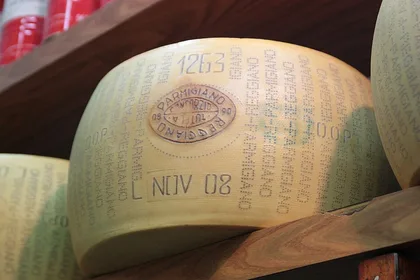
The rind of a Parmigiano Reggiano carries a pin-dot marking that repeats the name in full all the way round the side, together with the dairy's registration number and the month and year of production. It is not printed on: it is pressed into the wheel while the cheese is still fresh, using a marking band, and it stays legible for the life of the cheese.
On a pre-cut wedge that marking appears along the rind edge. If the rind has been trimmed off, or if the cheese is already grated, the check is no longer available and only the label remains.
The paste of an aged wheel is granular and flakes into shards rather than slicing cleanly, and it carries the white crystals that form over time. Those are useful signs, not proof. The proof is on the rind.
And the price? The question everyone asks and nobody answers
Look at what people actually discuss and the recurring question under this comparison is not technical but economic: «I paid this much for this piece, was that fair?» It is worth setting out where the cost comes from instead of answering with an adjective.
Around sixteen litres of milk go into one kilo of Parmigiano Reggiano. On top of that come at least twelve months of ageing, during which the wheel occupies space, has to be turned and brushed, and loses weight to evaporation. The capital sits still for a year before the product can be sold at all, and for two or three in the long agings.
An industrial hard cheese can be ready in a few months, from pasteurised milk collected anywhere. The price gap does not measure how much better one is than the other: it measures milk, time and idle capital. Whether that is worth paying is the buyer's call.
The short of it
- Parmigiano Reggiano is a protected designation with a written specification and at least twelve months' ageing.
- In the EU the Court of Justice found «parmesan» evokes the PDO, so it cannot be used for other cheeses.
- In the United States «parmesan» is instead a generic name with its own federal standard.
- Under CETA, Canada protects several Italian designations, but «parmesan» stayed free.
- Proof of authenticity is the pin-dot marking on the rind, not the texture of the paste.
- The price reflects sixteen litres of milk per kilo and a year of capital standing still.
Frequently asked questions
Is parmesan a fake Parmigiano Reggiano?
It depends on the country. In the European Union, using «parmesan» for a cheese that does not meet the specification is prohibited, because the Court of Justice found it evokes the protected designation. In the United States it is a lawful generic name with its own federal standard.
What is the difference between Parmigiano Reggiano and Grana Padano?
They are two distinct protected designations with different areas and specifications. Grana Padano has a minimum ageing of nine months against twelve, a much larger production zone, and different rules on cattle feed and on the use of lysozyme.
How can I tell whether a wedge is genuine?
Look along the rind edge: a Parmigiano Reggiano carries a pin-dot marking repeating the name in full, with the dairy number and the month and year of production. On grated cheese, or a wedge with the rind trimmed off, that check is not available.
Why is Parmigiano Reggiano so expensive?
It takes roughly sixteen litres of milk to make a kilo, and at least twelve months of ageing during which the wheel must be tended, loses weight and ties up capital. An industrial hard cheese is ready in a few months.
Is Parmigiano Reggiano vegetarian?
No: the specification requires animal rennet. It is one of the cases where the protected designation locks in a choice the producer cannot change.
Sources
Where to check what you just read.
- 1
La sentenza che riconosce «parmesan» come evocazione della DOP, e che allo stesso tempo respinge il ricorso contro la Germania sull'obbligo di perseguire d'ufficio.
- 2
L'atto che registra Parmigiano Reggiano e Grana Padano come denominazioni protette.
- 3
Il registro ministeriale da cui risalire al disciplinare e alle stagionature minime.
- 4
Come funziona la tutela europea e cosa cambia fuori dai confini dell'Unione.
The foods behind this
 CheeseParmigiano ReggianoThree ingredients and no additives of any kind are permitted: raw cow's milk, salt and calf rennet, from five…
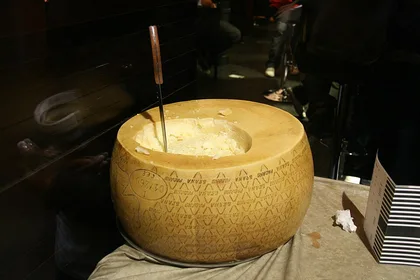 CheeseGrana PadanoNine months is the floor the specification sets before a wheel may carry the name.
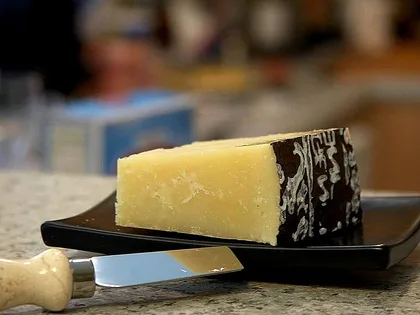 CheesePecorino RomanoPecorino Romano DOP is a hard, dry-salted sheep's milk cheese aged at least five months, made in Sardinia…