Real San Marzano DOP grows on 350 hectares. Everything else is a different thing
«San Marzano» is at once the name of a cultivar anyone may plant anywhere, and a protected designation that covered 350 hectares in 2024. Two different things, and the label tells them apart.
By the Agrofood.it editorial team · 29 August 2026 · 3 min read · 4 sources
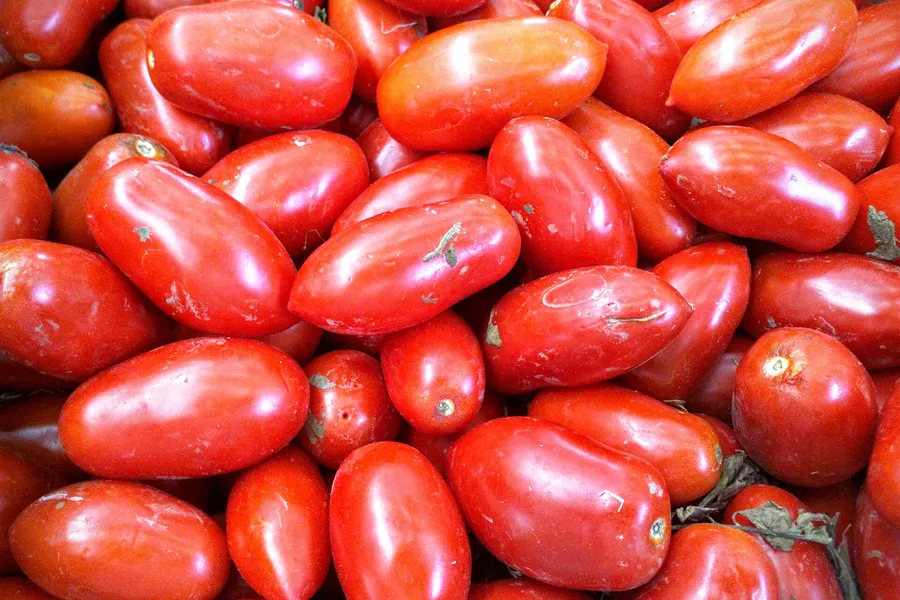
Two things carrying the same name
San Marzano began as a cultivar: an elongated tomato with little water, few seeds and flesh that holds its shape through cooking. Like every plant variety, the cultivar name belongs to nobody in particular. Someone growing San Marzano in California, China or Puglia is growing San Marzano, and printing it on the tin is legitimate.
The protected designation is another matter, and its full name is «Pomodoro San Marzano dell'Agro Sarnese-Nocerino». That long name is what is registered, not the two short words, and it is exactly the mechanism that protects «Bresaola della Valtellina» rather than bresaola.
Everything else follows from that: the same words can point to a product with a written specification behind it or to a tomato grown ten thousand kilometres away, and neither party is lying.
How small the designation really is
The figures tell a story the shelves do not suggest. In 2024 the area under the designation was 350 hectares, delivering 22,444,844 kilos of raw material for processing. The estimate for 2025 is around 320 hectares and nineteen million kilos.
The area has grown over time, and it helps to see from where: in 2004 the crop destined for the designation covered 102 hectares; by 2017 the registered area was 200. Meanwhile the theoretically suitable land across the Agro Sarnese-Nocerino runs beyond 16,000 hectares.
Three hundred and fifty hectares is, to give it a shape, a little over three and a half square kilometres. Every tin of genuine San Marzano DOP in the world, in a given year, comes out of that.
| Year | Area and yield under the designation |
|---|---|
| 2004 | 102 hectares destined for the DOP |
| 2017 | 200 hectares registered under the designation |
| 2024 | 350 hectares, 22,444,844 kg delivered for processing |
| 2025 (estimate) | about 320 hectares, about 19,000,000 kg |
| Theoretically suitable area | over 16,000 hectares across the Agro Sarnese-Nocerino |
What the specification demands, beyond geography
The zone is the first condition but not the only one. The specification requires open-field cultivation with stakes, and staggered hand picking: the tomatoes do not ripen together, so the same plant is worked over several times.
It forbids irrigation in the final phase, which would swell the fruit with water and dilute the concentration. And it requires processing within a tight window of harvest, in plants located inside the zone. The tomato does not travel.
The only finished products admitted are peeled tomatoes, whole or in fillets, in a covering liquid that must be tomato juice. There is no such thing as San Marzano DOP passata or polpa. If you see one, that claim does not hold.
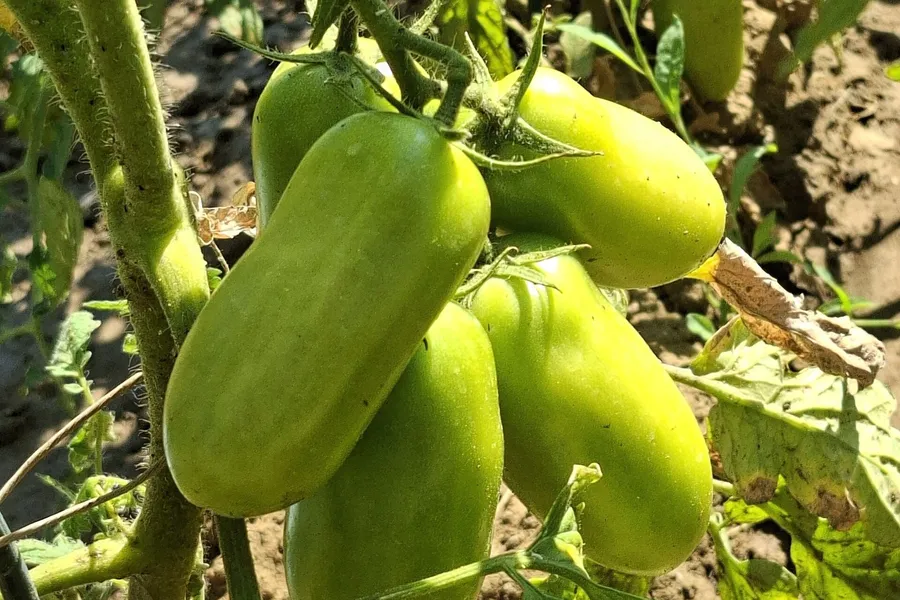
How to tell them apart on the shelf, in three seconds
The first check is the full name. The tin must read «Pomodoro San Marzano dell'Agro Sarnese-Nocerino DOP», not «San Marzano tomatoes» and certainly not «San Marzano style».
The second is the European protected designation logo, the red and yellow one, alongside the name of the certifying body. It is not a decorative graphic anyone may add: printing it without entitlement is an offence.
The third, for anyone who wants to go further, is the sequential tin number. The consortium numbers the containers, and that number traces back to the batch. It is the level of traceability that separates a designation from a statement of intent.
A fourth signal, indirect but reliable, is price. Three and a half square kilometres of land do not produce a value-line product, and a tin costing the same as an ordinary pelato almost certainly is not the thing.
An unprotected tomato is not a counterfeit
Worth saying, because a good deal of misplaced indignation circulates around this product. A tin of San Marzano grown in Puglia or the United States, correctly declared, is a legitimate product. It can be excellent: the cultivar is the cultivar, and the hands working it count.
What it cannot do is take the long name or the logo. And what the shopper should not do is pay the designation's price for a product that does not carry it.
The useful distinction is not between good and bad. It is between a product with a specification and an inspection behind it, and a product resting on the word of whoever is selling it. Those are two different guarantees, and they cost differently.
The short of it
- «San Marzano» is a cultivar name, growable anywhere, and nobody can prevent that.
- The protected designation is «Pomodoro San Marzano dell'Agro Sarnese-Nocerino DOP», long name included.
- In 2024 the designation covered 350 hectares for 22,444,844 kg: a little over three and a half square kilometres.
- In 2004 it was 102 hectares, in 2017 two hundred. The theoretically suitable land runs past 16,000.
- The specification admits only peeled tomatoes, whole or in fillets, in tomato juice. DOP passata does not exist.
- A correctly declared non-DOP San Marzano is a legitimate product. It is simply not the same thing.
Frequently asked questions
Are all San Marzano tomatoes DOP?
No, and the gap is enormous. The protected designation covered 350 hectares in 2024. «San Marzano» without further qualification is a variety name, legally grown worldwide.
How do I spot a real San Marzano DOP in a shop?
The full name must appear, «Pomodoro San Marzano dell'Agro Sarnese-Nocerino DOP», together with the European logo and the certifying body. Tins also carry a sequential number that traces back to the batch.
Is there such a thing as San Marzano DOP passata?
No. The specification admits whole peeled tomatoes and fillets, in a covering liquid that must be tomato juice. A passata or polpa claiming the designation is not using it correctly.
Where exactly is it grown?
In the Agro Sarnese-Nocerino, a zone straddling the provinces of Salerno, Naples and Avellino. The specification lists the eligible municipalities, and processing must happen in the same area.
Is a San Marzano grown elsewhere a fake?
Not if it says what it is. The cultivar is not protected and anyone may plant it. It becomes a problem when it takes the long name or the designation logo.
Why does it cost so much more than an ordinary tin?
Staggered hand picking, staked open-field cultivation, a ban on irrigation in the final phase, and processing within a tight window inside the zone. All costs an industrial pelato does not carry.
Sources
Where to check what you just read.
- 1
Il registro ministeriale da cui risalire al disciplinare del Pomodoro San Marzano dell'Agro Sarnese-Nocerino, con la zona e i comuni ammessi.
- 2
La descrizione istituzionale della zona di produzione e delle pratiche colturali imposte dal disciplinare.
- 3
Da qui vengono gli ettari e i chili conferiti citati in tabella, campagna per campagna.
- 4
Il regolamento applicabile dal 13 maggio 2024, che ha sostituito il 1151/2012: stabilisce cosa protegge una denominazione registrata e contro quali usi.
The foods behind this
 Vegetables and fruitSan Marzano TomatoesSan Marzano is a long, thin-skinned plum tomato grown in the volcanic plain between Naples and Salerno, and…Vegetables and fruitPiennolo TomatoPiennolo tomatoes grow on the volcanic ash of Vesuvius with no irrigation at all, are cut in whole bunches in…
 CheeseBuffalo MozzarellaMozzarella di Bufala Campana DOP is made from the whole raw milk of Italian Mediterranean water buffalo…