Grana Padano and Parmigiano Reggiano look alike, but their rulebooks do not
Same family, same rennet, raw milk in both. The real differences are written in the rules: the zone, silage, lysozyme and the months of ageing.
By the Agrofood.it editorial team · 20 September 2026 · 6 min read · 12 sources
Close relatives, different rules
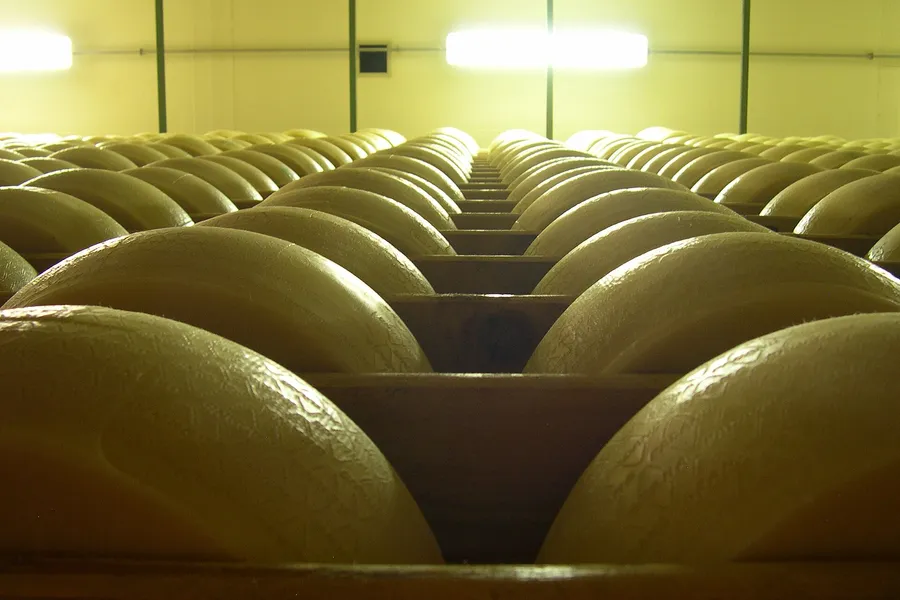
The two cheeses share a great deal, and that is worth saying before the differences. Both are hard, cooked cheeses made from raw cow's milk, partly skimmed by letting the cream rise, with a natural whey starter and calf rennet, in copper vats. Both have been protected designations since 1996, registered under the same EU regulation.
One myth can go straight away: it is not true that one uses skimmed milk and the other whole milk. Both use milk partly skimmed by natural creaming, and both have the same minimum fat content on dry matter, 32%.
So the differences are not in the family but in the rules. The specifications in force are recent: Parmigiano Reggiano's was amended by an EU regulation applied from 24 April 2025, and Grana Padano's was published as a consolidated text in Italy's Official Journal on 26 May 2026.
Two zones split by two rivers
Parmigiano Reggiano is made in five provinces: Parma, Reggio Emilia, Modena, the part of Bologna west of the Reno and the part of Mantua south of the Po. Grana Padano is made in 33 provinces across Piedmont, Lombardy, Trentino, Veneto and Emilia-Romagna, plus five municipalities in the province of Bolzano.
The curious detail is that two provinces straddle both designations. In Bologna and Mantua a river decides which cheese may be made: Parmigiano on one bank of the Reno and the Po, Grana Padano on the other.
The difference that starts in the barn
The biggest gap between the two specifications is what the cows eat. Parmigiano Reggiano bans silage, to the point that farms may not even keep it on site. It requires at least half the dry matter of the forage to come from hay, forage to weigh at least as much as concentrate feed, and at least 75% of the forage to come from the zone, half of it from the farm's own land.
Grana Padano allows silage, such as maize silage, and also requires at least 75% of the forage dry matter to come from the zone. Silage is excluded only for Trentingrana, a type of Grana Padano with stricter rules.
A myth runs the other way too: Parmigiano cows do not eat only grass and hay. The specification allows concentrate feed, up to a one-to-one ratio with forage, and freshly chopped maize. What it bans is fermentation, not everything else.
Lysozyme, and how it reached Italy's highest administrative court
The most debated difference follows from the barn. Silage can carry clostridia spores into the milk, and during ageing they cause late blowing of the wheels. To prevent it, the Grana Padano specification allows lysozyme, an enzyme taken from egg white, up to 2.5 g per 100 kg of milk; Trentingrana does not allow it. Parmigiano Reggiano, which bans silage, allows no additives at all.
Lysozyme's status went to court. In 2018 a Health Ministry circular classed it as a processing aid, a category with different labelling rules. The Parmigiano Reggiano consortium appealed, the Lazio regional administrative court sided with it in December 2023, and on 4 November 2025 the Council of State dismissed the appeals of the ministry and of the Grana Padano consortium: lysozyme remains food additive E1105, and changing its classification is a matter for the EU.
On the label, egg lysozyme must be declared, and egg appears among the allergens. In Parmigiano Reggiano, by definition, it is absent.
Milk, dairy and salt: the other rules
For Parmigiano Reggiano, milk reaches the dairy within two hours of the end of milking and may not be cooled below 18 °C; centrifuges, bactofugation and microfiltration are banned, and each vat makes at most two wheels. The whey starter is natural, and corrective cultures are not allowed. Brining time is not fixed: in practice it runs to about three weeks.
For Grana Padano, milk may come from two milkings or from free-access milking robots, must be collected within 24 hours, extended to 26 if kept at 12 °C or below, and may not drop below 8 °C. Creaming happens between 8 and 20 °C. Alongside the natural whey starter, native lactic bacteria are allowed up to 12 times a year. Cooking may not exceed 56 °C, wheels stay in their moulds for at least 36 hours, and brining lasts 12 to 25 days.
Some of these Grana Padano rules are new: the 2026 text moved brining from 14-30 to 12-25 days, extended collection of chilled milk to 26 hours, and provided for the logo to be embossed by the mould.
| Requirement | Parmigiano Reggiano | Grana Padano |
|---|---|---|
| Zone | Parma, Reggio Emilia, Modena, Bologna west of the Reno, Mantua south of the Po | 33 provinces across Piedmont, Lombardy, Trentino, Veneto and Emilia-Romagna, plus 5 municipalities in Bolzano |
| Milk | Raw, from two milkings; at the dairy within 2 hours; never below 18 °C | Raw, from two milkings or robots; collected within 24 hours (26 below 12 °C); never below 8 °C |
| Skimming | Natural creaming; centrifuges, bactofugation and microfiltration banned | Natural creaming at 8-20 °C; any physical, mechanical or heat treatment banned |
| Feed | Silage banned; at least 75% of forage from the zone | Silage allowed, except for Trentingrana; at least 75% of forage from the zone |
| Additives | None | Lysozyme up to 2.5 g per 100 kg of milk, not in Trentingrana |
| Starter and rennet | Natural whey starter; calf rennet | Natural whey starter, native lactic bacteria up to 12 times a year; calf rennet |
| Salting | Not fixed; about three weeks in practice | Brine for 12 to 25 days |
| Minimum age | 12 months | 9 months; Riserva from 20 |
| Wheel | At least 30 kg | 24 to 40 kg |
Months of ageing and marks on the rind
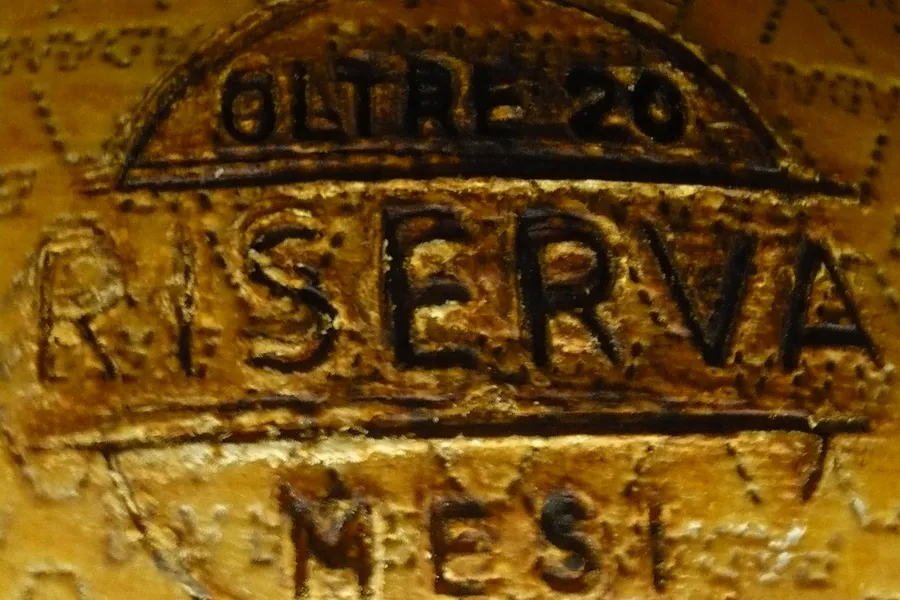
Parmigiano Reggiano can be sold as a protected cheese only after 12 months, with extra Export marks from 18 months and Premium from 24; portions over 15 g must state the age. Grana Padano is inspected from the eighth month and sold from the ninth; Riserva starts at 20 months, labelled «Riserva Oltre 20 Mesi» or «Riserva Oltre 24 Mesi». «Oltre 16 mesi», which many still remember as a category, has not been one since 2022: from 12 months, the age may optionally be stated as «over» a number of months.
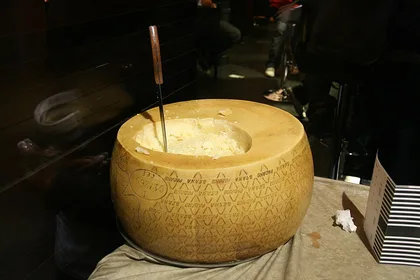
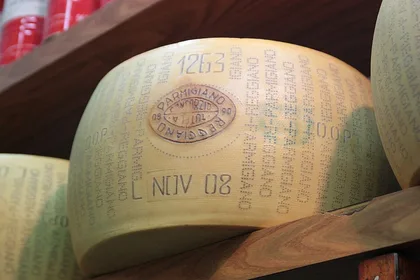
On the rind the two cheeses are easy to tell apart. Parmigiano carries its name in pin dots all the way round, the dairy's number, the month and year of production, a casein plaque with the wheel's code and, after inspection, the oval brand. Grana Padano carries diamond shapes with the words GRANA and PADANO, a four-leaf clover with the province code and dairy number, its own casein plaque and its logo. Trentingrana has its own bands, reading TRENTINO with the code TN.
How much is made, and what it costs
Grana Padano is the larger of the two: 6,053,690 wheels in 2025, up from 5,635,153 in 2024. Parmigiano Reggiano reached 4,189,945 wheels, up from 4,079,248. Parmigiano sold 50.5% of its output abroad, 74,980 tonnes; Grana Padano exported 2,757,930 wheels. In 2024, according to the Ismea-Qualivita report, production value was €2.185 billion for Grana Padano and €1.760 billion for Parmigiano Reggiano.
Wholesale prices recorded by the Milan chamber of commerce show a clear gap. In 2025, 9-month Grana Padano averaged €10.67 a kilo, over-16-month €11.98 and Riserva €12.49; 12-month Parmigiano Reggiano averaged €13.26 and 24-month €15.90. At retail, sold by weight, the 2025 averages were €15.82 a kilo for Grana Padano and €21.20 for Parmigiano, roughly €7.20 and €9.60 a pound.
2026 is widening the gap. In the first nine months of the year, 9-month Grana Padano fell to an average of €9.45 a kilo, while 12-month Parmigiano Reggiano rose to €14.77.
Can a cheese that is not Grana Padano be called «grana»?
The question has reached the courts more than once, and the answers point the same way. In 2007 the EU General Court annulled a decision by the EU trademark office that had treated «grana» as a generic term, in the case over the «Grana Biraghi» trademark: the evidence of genericness was insufficient, and Italian law pointed the other way. It was the General Court, not the Court of Justice, as is often written.
More recently, the Venice court barred the use of the word «grana» in the marketing of a cheese made abroad by an Italian company, ruling in 2022 that it evoked the designation and amounted to unfair competition. In 2025 the Venice court of appeal confirmed that «grana» is not a generic term, while ruling out compensable damage to the consortium.
For Parmigiano the story is similar and better known: in 2008 the EU Court of Justice held that within the EU, «parmesan» evokes Parmigiano Reggiano.
The short of it
- Both use raw milk partly skimmed by natural creaming, and calf rennet: neither is made with whole milk.
- Parmigiano Reggiano comes from five provinces; Grana Padano from 33 provinces plus five municipalities in the province of Bolzano.
- Parmigiano bans silage and all additives; Grana Padano allows silage and lysozyme, up to 2.5 g per 100 kg of milk.
- On 4 November 2025 Italy's Council of State confirmed that lysozyme is food additive E1105.
- Minimum ageing: 12 months for Parmigiano, 9 for Grana Padano, 20 for Grana Padano Riserva.
- In 2025: 6,053,690 wheels of Grana Padano and 4,189,945 of Parmigiano Reggiano.
- Wholesale in 2025, 9-month Grana Padano averaged €10.67 a kilo and 12-month Parmigiano €13.26.
Frequently asked questions
What is the difference between Grana Padano and Parmigiano Reggiano?
It is in the rules: Parmigiano Reggiano comes from five provinces, bans silage and additives and ages for at least 12 months; Grana Padano comes from 33 provinces plus five municipalities in South Tyrol, allows silage and lysozyme and ages for at least 9 months.
Is Grana Padano the same as Parmesan?
No. Within the EU, «parmesan» evokes Parmigiano Reggiano, and using it for other cheeses infringes that designation. Grana Padano is a separate protected cheese with its own specification.
Does Grana Padano contain preservatives?
Its specification allows lysozyme, food additive E1105 taken from egg white, up to 2.5 g per 100 kg of milk. Trentingrana does not allow it, and Parmigiano Reggiano allows no additives.
Are they made with whole or skimmed milk?
Both with raw milk partly skimmed by natural creaming: the cream of the evening milk rises and is removed. Saying that Parmigiano uses whole milk is a common mistake.
How long are they aged?
Parmigiano Reggiano for at least 12 months, Grana Padano for at least 9. Grana Padano Riserva starts at 20 months.
Are Grana Padano and Parmigiano Reggiano vegetarian?
No: both specifications require calf rennet, which is of animal origin.
Sources
Where to check what you just read.
- 1
Il testo approvato, pubblicato dal consorzio: zona, latte, alimentazione, divieto di additivi, stagionatura e marchi.
- 2
Il testo consolidato allegato al decreto del 19 maggio 2026, con le modifiche su salamoia, raccolta del latte, lisozima e marchiatura.
- 3
La modifica applicata dal 24 aprile 2025.
- 4
L'atto del 1996 che registra entrambe le denominazioni.
- 5
Le medie annue per stagionatura, dai listini della Camera di commercio di Milano Monza Brianza Lodi.
- 6
Le medie annue per stagionatura, stessa rilevazione.
- 7ReferenceCLAL, forme prodotte di Grana Padano
La produzione annua in forme, su dati del consorzio.
- 8
La produzione annua in forme, su dati del consorzio.
- 9
La sentenza del 4 novembre 2025 che conferma il lisozima come additivo E1105.
- 10
La sentenza del 12 settembre 2007 sulla genericità della parola «grana».
- 11
La conferma del 2025 che «grana» non è un termine generico.
- 12
Il valore alla produzione 2024 delle due denominazioni.