Twelve years against sixty days: what separates traditional balsamic from balsamic vinegar of Modena
Traditional balsamic vinegar (DOP) ages for at least 12 years; balsamic vinegar of Modena (IGP) for at least 60 days. «Balsamic vinegar» on its own is not a protected name.
By the Agrofood.it editorial team · 23 September 2026 · 7 min read · 12 sources
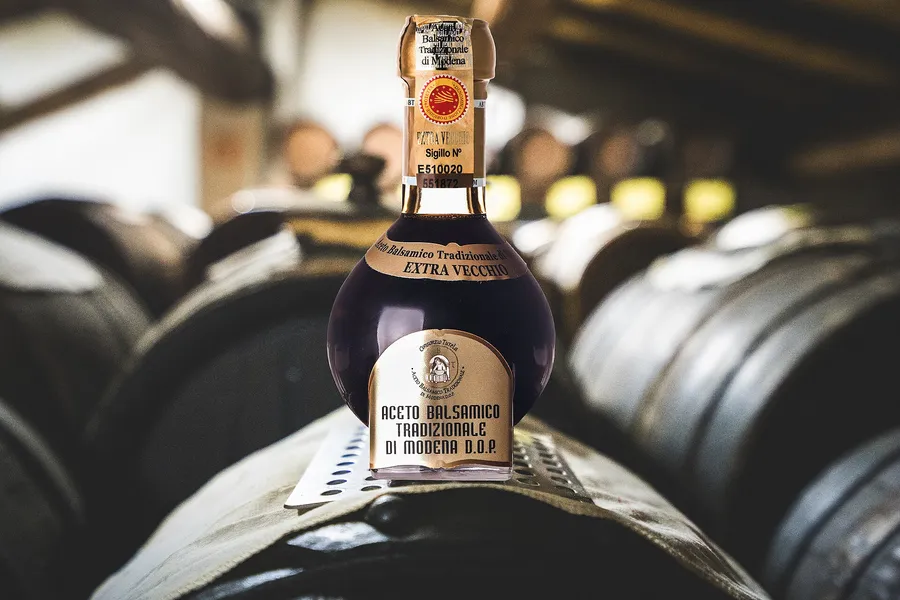
Traditional balsamic from Modena: cooked must only, and at least 12 years
Council Regulation (EC) 813/2000 of 17 April 2000 registered both traditional balsamic vinegars, from Modena and from Reggio Emilia, in a single act. Each is a DOP, the Italian initials for a Protected Designation of Origin (PDO).
Modena's rulebook, from 2000, starts with the grapes: Lambrusco, Ancellotta, Trebbiano, Sauvignon, Sgavetta, Berzemino and Occhio di Gatta, or grapes from DOC vineyards, from the traditional growing area of the province of Modena. The must needs at least 15 saccharometric degrees, the must yield is capped at 70% of the grapes, and muted must (with its fermentation stopped) or must with any additive is banned.
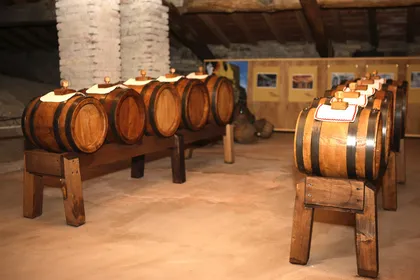
The must is cooked in open vessels over a direct flame for at least 30 minutes at 80 °C (176 °F) or more. It then ages for no less than 12 years, racked between small numbered casks of different woods, and the only addition allowed is the «madre».
As sold, it needs an acidity of at least 4.5 g per 100 g and a density of at least 1.240 at 20 °C. Before bottling, according to the Emilia-Romagna regional government, it goes before «five expert tasters». As for age, Modena's consortium is explicit: the vinegar in the bottle is not 100 or 200 years old; at most, the casks are.
Reggio Emilia: casks in batteries, and labels by score
Reggio Emilia's rulebook, amended in 2013 by Implementing Regulation (EU) 1279/2013, uses the same seven grape varieties and the same 12-year minimum. It also names the woods (oak, chestnut, cherry, juniper, mulberry, ash and black locust) and groups the casks into «batterie», batteries, a word Modena's text never uses. As sold, the vinegar needs at least 5 g of acidity per 100 ml, measured by volume rather than by weight as in Modena, and a density of at least 1.200.
The text adds a grading system based on the median score of a panel: below 240 points the vinegar cannot be bottled, 240 to 269 earns an «aragosta» (lobster-red) label, 270 a silver one, and gold requires at least 300 points and at least 25 years. According to the consortium, which counts 61 certified producers, the judging falls to a commission of five master tasters.
Modena IGP: must, wine vinegar and at least 60 days in wood
Balsamic Vinegar of Modena became an IGP, the Italian initials for a Protected Geographical Indication (PGI), under Regulation (EC) 583/2009 of 3 July 2009. In 2023 Implementing Regulation (EU) 2023/512 lowered the minimum acidity of the «invecchiato» (aged) category from 6% to 5.5% and added formats and isotopic parameters; in 2025 a standard amendment, published in the EU Official Journal on 24 July, created a «Riserva» category.
The current text sets an area for the work, the provinces of Modena and Reggio Emilia, and a list of grape varieties (Lambruschi, Sangiovese, Trebbiani, Albana, Ancellotta, Fortana, Montuni), but it does not say where the grapes must come from. The recipe works by thresholds: cooked or concentrated must at least 20% of the mass, brought to a density of at least 1.240; wine vinegar at least 10%; and an unquantified share of vinegar aged at least 10 years. Caramel is allowed up to 2% of the volume to stabilise the colour; beyond that, «the addition of any other substance is prohibited».
The minimum time in wood is 60 days. After at least 3 years the vinegar may be called «invecchiato», after at least 5 «Riserva», and the minimum density rises with each category: 1.06, 1.15 and 1.25. One oddity in the text: the article that creates the «Riserva» category is the same one that bans the adjective «riserva».
| Requirement | DOP (PDO), Modena and Reggio Emilia | IGP (PGI), Modena |
|---|---|---|
| Grapes and area | Seven varieties in both; in Modena also grapes from DOC vineyards, from the traditional area of the province | Varieties listed, grape origin not set; processing in the provinces of Modena and Reggio Emilia |
| Ingredients | Modena: cooked must, at least 15 saccharometric degrees, must yield capped at 70% | Cooked or concentrated must at least 20%, wine vinegar at least 10%, a share of vinegar aged at least 10 years |
| Additions | Modena: none, except the vinegar «mother» | Caramel up to 2% of volume; any other substance banned |
| Ageing | At least 12 years; 25 for Modena's «extra vecchio» and for Reggio's gold label | At least 60 days in wood; «invecchiato» 3 years, «Riserva» 5 |
| Minimum density | Modena 1.240 at 20 °C; Reggio 1.200 | 1.06; invecchiato 1.15; Riserva 1.25 |
| Minimum acidity | Modena 4.5 g/100 g; Reggio 5 g/100 ml | 6%; invecchiato and Riserva 5.5% |
| Containers | Modena: solid spherical glass, 10, 20 or 40 cl; Reggio: 100, 250 and 50 ml, single-serve 5-10 ml | 100 ml to 5 litres, single-serve up to 25 ml; no spherical bottles from 100 to 200 ml |
| Label | Modena: no vintage; «extra», «riserva», «classico» and similar terms banned | No qualifying terms, numerical ones included, and no «senza caramello»; «Modena» at least as large as «Aceto» and «Balsamico» |
«Balsamic» on its own: what the EU Court of Justice decided
On 4 December 2019, in case C-432/18, the Court of Justice of the European Union spelled out what the IGP registration protects: the name «Aceto Balsamico di Modena» as a whole. The words «aceto» (vinegar) and «balsamico» (balsamic) are not protected, even when combined or translated. According to the Court, «aceto» is a common term and «balsamico» an adjective in common use for a sweet-and-sour vinegar; the Court also notes that the same words appear in the names of the two DOPs.
The court of Bologna went the same way in judgment 2303 of 8 August 2024: according to a summary by a legal publisher, it held that «aceto» and «balsamico» used on condiments are generic terms. On a label, then, the full name is what counts.
Glazes and condiments, and the IGP as an ingredient
«Balsamic condiment» and «glaze» do not correspond to any legal designation, and glaze has no compositional standard. In a test of 11 balsamic creams published on 23 May 2024 by the Italian consumer magazine Il Salvagente, the recurring thickeners were corn starch, xanthan gum and guar, followed by glucose syrup, sugar, concentrated grape juice and caramel E150d. The IGP bans any addition other than caramel, so a thickened cream can contain Balsamic Vinegar of Modena IGP but cannot be sold under that name.
For processed products, article 27 of Regulation (EU) 2024/1143 has applied since 13 May 2024: the IGP name may appear in their name only if they contain no comparable ingredient, the quantity is enough to give an essential characteristic, the percentage is on the label, and the producer notifies the consortium. According to a Qualivita study reported by the farming magazine Terra e Vita in June 2017, 21% of the IGP, about 20 million litres, went into processed products.
Slovenia's 2021 rule and the dispute with Italy
The Slovenian rule at the centre of the dispute dates from 2021. Ljubljana notified the draft to the Commission on 2 December 2020 (TRIS procedure 2020/0749/SI), and Italy responded with a detailed opinion. The rules on the quality of vinegar were published in Slovenia's Official Gazette on 9 July 2021, with a one-year transition.
Article 7(b) allows fruit juices and musts in vinegar in general, and article 14 lets such products be called «balzamični kis», balsamic vinegar. The Slovenian government says the term is generic, cites case C-432/18 and points out that the rule mirrors one from 2004.
Italy moved in August 2022: the cabinet was briefed on the 4th, and on the 5th Italy started the procedure between member states under article 259 of the Treaty on the Functioning of the EU. That month, according to the Slovenian public broadcaster RTV SLO, the Commission had not issued a binding opinion; since 2022 there has been no public trace of a reasoned opinion from the Commission or of a case before the Court of Justice.
According to the IGP consortium, an authoritative but interested source, in 2026 Greece, Spain, Slovenia, Cyprus and Hungary still allow «balsamic vinegar» for other products, and the consortium is backing an amendment in the European Parliament.
How much is made, source by source
For the IGP, the figures change with the source. For 2020 the Italian news agency ANSA reported 90 million litres, 92% of it exported. For 2024 the trade publication Great Italian Food Trade, citing the Ismea-Qualivita report, gives 94.4 million litres, up 7.8%, with 93% exported. For 2025 the consortium, on 21 May 2026, spoke of 93-95 million litres a year (roughly 25 million US gallons), over 93% exported to more than 130 countries and 83% of certified output made by members; Il Sole 24 Ore reported a 3% drop in volumes for the same year. An undated data page from the same consortium gives 95-100 million instead, so the two figures do not match.
For Modena's traditional balsamic, Efanews reports 165,653 bottles of 100 ml (3.4 US fl oz) produced in 2024, just over 16,500 litres in all and 16.43% more than the year before: 91,346 of «affinato 12 anni» (refined, 12 years), a consortium term absent from the 2000 rulebook, and 74,307 of extra vecchio, 25 years. We found no volume figures for the Reggio Emilia DOP.
How to read the label, and the bottle
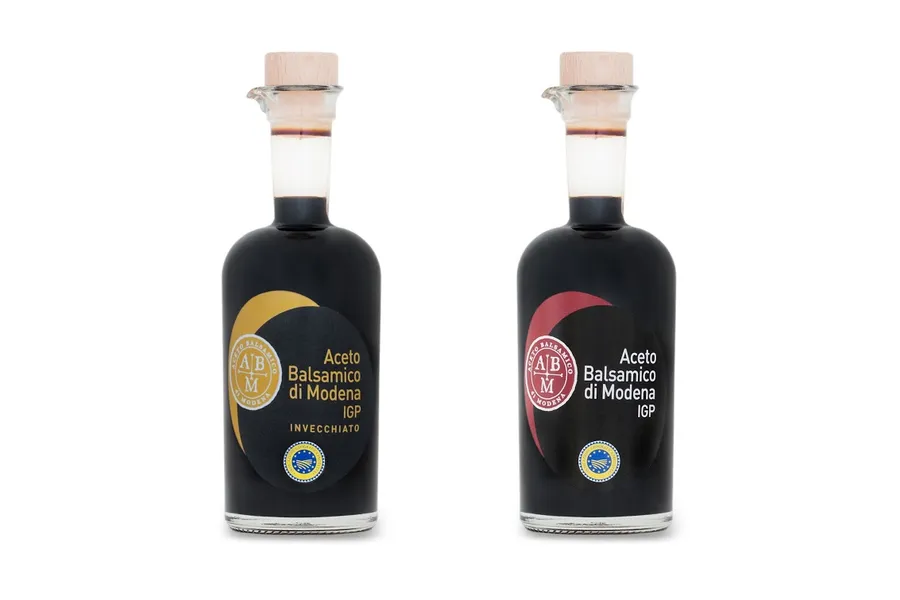
Start with the full name and its initials, DOP or IGP. On the IGP, «Modena» must be printed at least as large as «Aceto» and «Balsamico», and «senza caramello» (no caramel) is banned, even on a vinegar that contains none.
On Modena's traditional balsamic a vintage year is banned, «extra vecchio» (extra old) requires at least 25 years, and qualifiers such as «extra», «riserva» and «classico» are banned: 12 and 25 years are minimums, not birth dates. On the IGP, qualifying terms are banned, numerical ones included, and age is signalled by the categories «invecchiato» and «Riserva».
Then the bottle. Modena's rulebook calls for solid glass, a spherical shape on a rectangular base, a capacity of 10, 20 or 40 cl and a non-reusable, serially numbered seal, and it never names Giugiaro. The single 100 ml format is what the consortium declares, with the 1987 Giugiaro bottle «used by all producers» and a seal number that starts with «A» for the 12-year or «E» for the extra vecchio. In Reggio Emilia the 100 ml bottle is «similar to an upside-down tulip», with sealing wax and an «ABTRE DOP» seal.
The short of it
- Traditional balsamic has two DOPs, Modena and Reggio Emilia, registered together in 2000; both require at least 12 years of ageing.
- Modena's DOP rulebook allows only cooked must: the only addition is the vinegar mother.
- Balsamic Vinegar of Modena IGP combines at least 20% cooked or concentrated must with at least 10% wine vinegar, allows caramel up to 2% and needs at least 60 days in wood.
- The IGP rulebook lists grape varieties but not where the grapes come from, and it bans the words «senza caramello» (no caramel).
- Modena's DOP text allows 10, 20 or 40 cl bottles and never names Giugiaro: the single 100 ml format is what the consortium declares.
- Since case C-432/18 in 2019, «aceto» and «balsamico» on their own are not protected, and glazes and condiments have no legal designation.
- Slovenia's «balzamični kis» rule dates from 2021; since 2022 there has been no public trace of a reasoned opinion from the Commission or of a court case.
Frequently asked questions
What is the difference between traditional balsamic vinegar and balsamic vinegar of Modena?
They follow different rules. The two traditional DOPs, Modena and Reggio Emilia, require at least 12 years of ageing, and Modena allows only cooked grape must. The IGP blends cooked or concentrated must with wine vinegar, allows caramel up to 2% and needs at least 60 days in wood.
What does IGP mean on balsamic vinegar?
IGP is the Italian form of PGI, Protected Geographical Indication. For Balsamic Vinegar of Modena it means blending, processing and maturing in the provinces of Modena and Reggio Emilia, under a rulebook registered in 2009. The rulebook lists grape varieties but does not say where the grapes must be grown.
Is balsamic glaze the same as balsamic vinegar?
No. Glaze has no compositional standard and cannot be sold as IGP: in a test of 11 balsamic creams by the Italian magazine Il Salvagente, the recurring thickeners were corn starch, xanthan gum and guar, which the IGP does not allow.
Why is traditional balsamic vinegar so expensive?
Because of what its rulebook requires. In Modena: listed grape varieties, a must yield capped at 70%, cooking over a direct flame, at least 12 years of racking between wooden casks, nothing added but the vinegar mother, an assessment by five expert tasters before bottling, and bottles of 10, 20 or 40 cl.
What do 12 and 25 years mean on traditional balsamic?
They are minimum ages, not vintages. Modena's rulebook requires at least 12 years of ageing, keeps «extra vecchio» for vinegar aged at least 25 and bans a vintage year on the label. In Reggio Emilia, 25 years plus at least 300 points earn the gold label.
Is «balsamic vinegar» a protected name?
Not on its own. In case C-432/18, in 2019, the EU Court of Justice ruled that protection covers the name «Aceto Balsamico di Modena» as a whole, not the words «aceto» and «balsamico», even when combined or translated.
Sources
Where to check what you just read.
- 1
L'atto del Consiglio del 17 aprile 2000 che registra insieme le due DOP.
- 2
L'atto della Commissione del 3 luglio 2009 che iscrive l'IGP nel registro europeo.
- 3
La categoria «Riserva», il divieto della dicitura «senza caramello» e la regola sulla dimensione della parola «Modena».
- 4InstitutionMasaf, elenco dei disciplinari DOP e IGP
I collegamenti ai disciplinari delle due DOP e dell'IGP, da cui vengono i requisiti della tabella.
- 5Consortium · interested partyConsorzio dell'Aceto Balsamico Tradizionale di Modena, la bottiglia e il sigillo
La bottiglia di Giugiaro del 1987 da 100 ml e le lettere A ed E prima del numero del sigillo, secondo il consorzio.
- 6InstitutionCorte di giustizia dell'Unione europea, comunicato stampa sulla sentenza C-432/18 (in inglese)
La tutela copre il nome «Aceto Balsamico di Modena» nel suo insieme, non i termini «aceto» e «balsamico».
- 7
L'articolo 27 e le quattro condizioni per citare un'indicazione geografica nel nome di un prodotto trasformato.
- 8
Il testo del 2021: articolo 7 b) su succhi di frutta e mosti, articolo 14 sul «balzamični kis», entrata in vigore e transizione.
- 9
La posizione di Lubiana: termine generico, richiamo alla sentenza C-432/18, regola che ricalca quella del 2004.
- 10Consortium · interested partyConsorzio Tutela Aceto Balsamico di Modena, «A sostegno della filiera del vino italiano»
I cinque paesi che, secondo il consorzio, permettono ancora «aceto balsamico» per altri prodotti, e l'emendamento sostenuto al Parlamento europeo.
- 11Consortium · interested partyConsorzio Tutela Aceto Balsamico di Modena, produzione ed export dell'IGP (21 maggio 2026)
I volumi dichiarati dal consorzio: 93-95 milioni di litri l'anno, oltre il 93% esportato in più di 130 paesi, l'83% prodotto dai soci.
- 12
Le 165.653 bottiglie del 2024 e la loro divisione fra le due categorie di età.