Nine Italian wine names left the EU register in 2026, and the people who held them asked for it
Between March and May the Commission cancelled nine Italian geographical indications, seven of them from Abruzzo. Nobody objected, and six requests carry a consortium's name.
By the Agrofood.it editorial team · 31 October 2026 · 6 min read · 8 sources
Nine acts in two months, seven with the same stamp
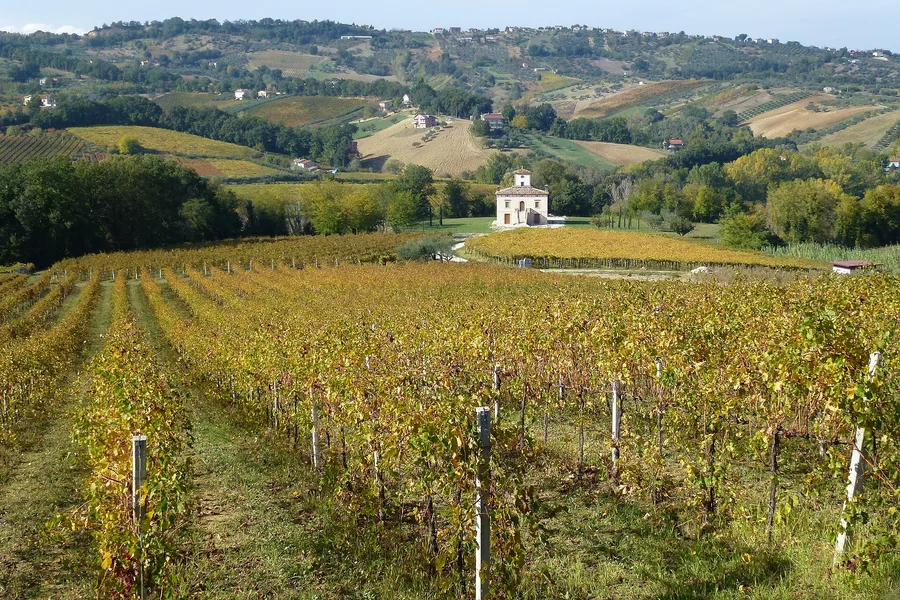
Between 16 March and 12 May 2026 the Official Journal of the European Union published nine implementing regulations cancelling nine Italian geographical indications. All of them are wine names: seven from Abruzzo (Colli Aprutini, Colli del Sangro, Colline Frentane, Colline Pescaresi, Colline Teatine, del Vastese or Histonium, Terre di Chieti), Valtènesi in Lombardy and Salemi in Sicily.
Seven of those names also share the date of the request: 23 May 2025, the same day. Valtènesi came eleven days earlier, on 12 May; Salemi on 28 July. The requests were published in the EU Official Journal between September and December 2025, and the acts closing them landed six to ten months later.
One point of vocabulary helps here. In Italy these names are known as IGT, indicazione geografica tipica, while the European register lists them as PGI. Valtènesi, a PDO, corresponds to an Italian DOC. The initials change, the thing does not.
We read all nine acts one by one in the Italian text published by the EU Publications Office. All nine carry the same legal basis and the same sentence about oppositions.
| Name cancelled | Who filed the request | Act of cancellation |
|---|---|---|
| Colli Aprutini (PGI) | The producers, 23 May 2025 | Reg. 2026/558 of 16 March 2026 |
| Valtènesi (PDO) | Consorzio Valtènesi, 12 May 2025 | Reg. 2026/572 of 17 March 2026 |
| Colli del Sangro (PGI) | The producers, 23 May 2025 | Reg. 2026/573 of 17 March 2026 |
| Colline Frentane (PGI) | Consorzio Tutela Vini d'Abruzzo, 23 May 2025 | Reg. 2026/604 of 19 March 2026 |
| Colline Pescaresi (PGI) | Consorzio Tutela Vini d'Abruzzo, 23 May 2025 | Reg. 2026/615 of 19 March 2026 |
| del Vastese / Histonium (PGI) | Consorzio Tutela Vini d'Abruzzo, 23 May 2025 | Reg. 2026/703 of 23 March 2026 |
| Colline Teatine (PGI) | Consorzio Tutela Vini d'Abruzzo, 23 May 2025 | Reg. 2026/707 of 24 March 2026 |
| Terre di Chieti (PGI) | Consorzio Tutela Vini d'Abruzzo, 23 May 2025 | Reg. 2026/708 of 24 March 2026 |
| Salemi (PGI) | The producers, 28 July 2025 | Reg. 2026/1043 of 12 May 2026 |
Who asked for the cancellation, name by name
The legal basis is always article 25(2) of regulation (EU) 2024/1143: cancellation «at the request of the producers of the product marketed under the registered name». This is not the Commission tidying the register from above. It is the holders of a name asking for it to go.
The form published in the EU Official Journal, though, does not say the same thing every time, and we have not seen that difference reported anywhere. In six cases out of nine the box ticked is «request transmitted by the recognised producer group», with a name and an address: Consorzio Tutela Vini d'Abruzzo, based in Ortona, for Colline Frentane, Colline Pescaresi, Colline Teatine, del Vastese and Terre di Chieti; Consorzio Valtènesi, in Puegnago del Garda, for the Lombard name.
In the other three, Colli Aprutini, Colli del Sangro and Salemi, the other box is ticked, «request submitted by the producers», and the line for the recognised group is left empty.
The distinction matters because paragraph 2 adds a flat rule: «Where a recognised producer group exists, that producer group shall be the only one entitled to submit such a request». Where the group box is not ticked, the form says that step was taken by the producers; what the position of each name is inside the Italian stage of the procedure cannot be read off the form.
How a protected name is cancelled
Article 25 sets out two routes. The first, in paragraph 1, is cancellation decided by the Commission on its own initiative or on a duly reasoned request from a member state, a third country or anyone with a legitimate interest, and it applies in two situations: when compliance with the specification can no longer be guaranteed, or when no product under that name has been placed on the market for seven consecutive years.
The second route is the one used for the nine Italian names, paragraph 2: the request comes from the producers. Before deciding, the Commission consults the authorities of the member state for at least a month, unless the cancellation is requested by the same applicants who sought the registration in the first place.
In all nine cases the path is therefore long and orderly: a request in spring or summer 2025, publication of that request in the C series of the EU Official Journal between September and December, three months in which to object, a cancelling regulation in spring 2026, entry into force twenty days after publication.
No oppositions, and a filter that helps explain it
All nine acts carry the same line: no statement of opposition was submitted to the Commission. Nine names, a three-month window each, zero oppositions.
Part of the explanation sits in paragraph 4 of the same article 25, the least discussed novelty of the 2024 regulation: «Oppositions shall be admissible only if they show continued commercial use of the registered name by an interested natural or legal person».
Having a view on the cancellation is not enough, and neither is a local interest: an objector has to show commercial use of the name, and continued use at that. On names that had reached the point of a cancellation request, that proof is hard to produce almost by definition.
One thing the regulation does not explain, and none of the acts mention, is why nobody tried anyway. The answer is not in the European files.
The name is locked for a year
There is a tail to this that concerns anyone who might want to use those names, and it expires soon. Paragraph 3 of article 25 says that registering the name «as an intellectual property right other than a geographical indication, in particular as a trade mark, shall be prohibited for one year after the cancellation».
The exception covers rights that already existed: a trade mark registered before the geographical indication was registered stays where it is.
For the seven Abruzzo names, cancelled between 16 and 24 March 2026, the lock runs to spring 2027. For Salemi, cancelled on 12 May, to May 2027. After that the name returns to the ordinary world of trade marks.
That is the point where a cancellation stops being trade news and becomes commercial information: a place name protected for years as a geographical indication can, twelve months later, be registered by a private company.
Nine of the thirteen European cancellations are Italian
To see whether nine is a large number we looked for every cancellation act published since 2025, querying the index of EU acts on their Italian titles. Thirteen come back.
Three fall in 2025: the Spanish Aceite de la Comunitat Valenciana in October, the French Coteaux de Narbonne and Cité de Carcassonne in December. Ten fall in 2026: the nine Italian names and the Dutch Ambt Delden, cancelled on 18 May following a request submitted by the Netherlands in October 2024.
So in less than two years of the new regulation, nine of the thirteen European cancellations concern Italy, and seven of those nine a single region. The European register holds thousands of names: thirteen cancellations remain an exception, which is exactly why the Italian concentration stands out.
The figure of nine is worth what it is: the result of a search on the titles of the acts. An act worded differently could escape that filter, in which case the names would be more than nine, not fewer.
What the acts do not say
The acts say who asked and under which rule. They do not say why. The form published in the EU Official Journal has no field for the reasons, and those sit in the national stage of the procedure, in the ministerial and regional papers that set the requests in motion. We have not read those documents, so we stop here.
Nor did we find, in the European register, a new name registered in the same period that gathers up the cancelled Abruzzo denominations. So it cannot be written that the seven names were merged into one: it can be written that they were cancelled, and that where those vineyards now sit has to be looked for in the Italian papers.
One last thing deserves to be said plainly, because it is the easiest thing to get wrong. A cancellation concerns the name, not the wine: the vines are still there, the wineries carry on, and those grapes can be claimed under other denominations or sold with no geographical indication at all. What disappears is the right to put that name on a label as a protected geographical indication.
The short of it
- Between March and May 2026 the Commission cancelled nine Italian geographical indications, all of them wine names.
- Seven are from Abruzzo, and seven requests carry the same date: 23 May 2025.
- In six cases out of nine the request was transmitted by the recognised producer group, that is a consortium; in the other three by the producers.
- All nine acts rest on article 25(2) of regulation (EU) 2024/1143.
- No opposition was filed in any of the nine: since 2024 an opposition is admissible only if it shows continued commercial use of the name.
- For one year after cancellation the name cannot be registered as a trade mark, unless the right already existed.
- Since 2025 there have been thirteen European cancellations: nine of them Italian.
Frequently asked questions
What does it mean when a geographical indication is cancelled?
The name leaves the European register of geographical indications and can no longer be used on a label as a protected name. It concerns the name, not production: the vines and wineries remain, and the grapes can be claimed under other denominations or sold with no geographical indication.
Which Italian names were cancelled in 2026?
Colli Aprutini, Colli del Sangro, Colline Frentane, Colline Pescaresi, Colline Teatine, del Vastese or Histonium and Terre di Chieti in Abruzzo; Valtènesi in Lombardy; Salemi in Sicily. All of them are wine names.
Who can ask for a PDO or PGI to be cancelled?
Article 25 of regulation (EU) 2024/1143 sets two routes. The Commission can act on its own initiative or on a reasoned request, including where no product under the name has been marketed for seven years; or the request comes from the producers, and where a recognised producer group exists that group is the only one entitled to file it.
Why did nobody oppose the cancellations?
The acts do not say. What is known is that since 2024 oppositions are admissible only if they show continued commercial use of the registered name by the objector: a narrow filter, hard to clear on names that had reached a cancellation request.
Can a cancelled name become a trade mark?
Not straight away. For one year after cancellation it cannot be registered as a trade mark or any other intellectual property right, unless that right existed before the geographical indication was registered. For the Abruzzo names the year runs out in spring 2027.
How many geographical indications have been cancelled in Europe?
Since January 2025 there are thirteen cancellation acts: three in 2025 (one Spanish and two French) and ten in 2026, nine Italian and one Dutch. The count comes from a search on the titles of the published acts.
Sources
Where to check what you just read.
- 1
I cinque paragrafi che contano: cancellazione d'ufficio e i sette anni senza commercializzazione, la richiesta dei produttori con l'esclusiva del gruppo riconosciuto, il divieto di marchio per un anno, l'ammissibilità delle opposizioni solo con uso commerciale continuato, la consultazione di almeno un mese.
- 2RegisterReg. di esecuzione (UE) 2026/708 del 24 marzo 2026, cancellazione di «Terre di Chieti» (IGP)
L'atto tipo: base giuridica all'articolo 25, paragrafo 2, data della richiesta italiana (23 maggio 2025), assenza di opposizioni, entrata in vigore venti giorni dopo la pubblicazione.
- 3
Il modulo con la casella «richiesta trasmessa dal gruppo di produttori riconosciuto» barrata e l'indirizzo del Consorzio Tutela Vini d'Abruzzo, il fascicolo PGI-IT-A0901-CANCEL e il settore vini.
- 4
Il modulo del Consorzio Valtènesi, fascicolo PDO-IT-A1188-CANCEL del 12 maggio 2025.
- 5
Il caso opposto: qui è barrata la casella «richiesta presentata dai produttori» e la riga del gruppo riconosciuto resta vuota. Fascicolo PGI-IT-A0884-CANCEL.
- 6
L'ultimo dei nove atti italiani, su richiesta del 28 luglio 2025.
- 7
L'unica cancellazione non italiana del 2026, su richiesta presentata dai Paesi Bassi il 22 ottobre 2024: serve da termine di paragone.
- 8
Colli Aprutini (2026/558), Valtènesi (2026/572), Colli del Sangro (2026/573), Colline Frentane (2026/604), Colline Pescaresi (2026/615), del Vastese (2026/703), Colline Teatine (2026/707): stessa base giuridica e stessa formula sulle opposizioni in tutti.