Investigation
White truffles are found, not farmed, and that is where the price comes from
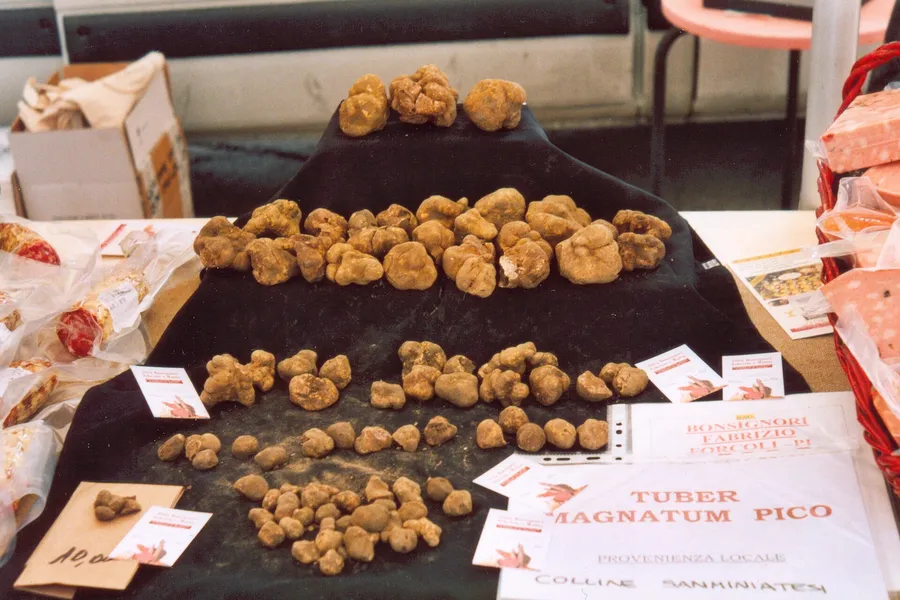
In early November 2025 the Alba truffle bourse quoted white truffles at €5,000 a kilo, about €2,270 a pound. In the same weeks, hunters near Asti were paid €1,800-2,700 a kilo.
 01
01A fungus that is found, not farmed
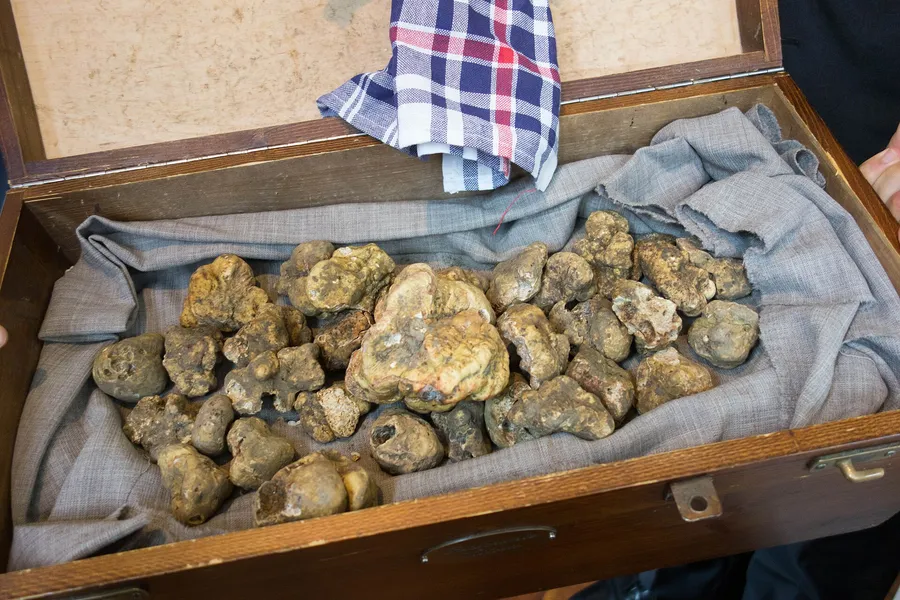
The white truffle, Tuber magnatum, lives underground in partnership with the roots of certain trees, and it has never really let itself be domesticated. Italy's national truffle plan, written by the agriculture ministry for 2017-2020, described it as the only prized truffle not yet successfully cultivated.
Something has moved since. In February 2021 the French research institute INRAE announced that a four-year-old orchard in Nouvelle-Aquitaine had produced three white truffles in 2019 and four in 2020, the first ever grown outside the species' natural range. That is a handful, and there is still no commercial supply of cultivated white truffles. In Italy, an experimental plot of about one hectare and 450 trees was planted at Acqualagna in 2025, with the first harvest expected in 2033.
The contrast with the black winter truffle, Tuber melanosporum, explains a great deal. The black one is farmed: in the 2013-2018 averages Spain produced about 47 tonnes a year, France 43 and Italy 19, and the government of Aragon claims more than 10,400 hectares of truffle orchards for the province of Teruel alone. The white one arrives only when, and as much as, the woods decide.
What it costs, and how much reaches the hunter
Two price series can be followed year after year. The first is the weekly bourse of Italy's National Truffle Study Centre in Alba, which quotes 15-20 g pieces. The second is published by the Alessandria-Asti chamber of commerce from figures supplied by the local association of trifolau, as truffle hunters are called in Piedmont: it is the price paid to hunters, by size class.
Side by side, the two series show a gap that keeps recurring. In November 2023 the Alba bourse quoted €4,500 a kilo, while hunters were paid €1,000-1,500 for 10-40 g pieces. In early November 2025 Alba quoted €5,000, about €2,270 a pound, and hunters received €1,800-2,700, roughly €820-1,220 a pound.
It is worth being clear about what this comparison is not. The two lists cover different markets and size classes, and the bourse does not say who pays the price it quotes. The two-to-fourfold gap between the columns is an order of magnitude, not a calculated margin.
The third price is the one on the plate. In 2022, when hunters were quoting about €3,000 a kilo, a shaving of 8-10 g in a restaurant cost €40-50: between €4,000 and €6,250 a kilo, service included. Geography matters too. In autumn 2025, while Alba talked of €4,000-4,500 a kilo, white truffles in the Crete Senesi south of Siena sold for €1,300-3,000.
| Season | Alba bourse, 15-20 g pieces | Paid to hunters, Asti, 10-40 g pieces |
|---|---|---|
| 2017 | €4,500/kg, €6,000 on 3 November | not recorded |
| 2020 | €2,800-3,000/kg | not recorded |
| 2021 | not published | €1,500-2,500/kg (3 November) |
| 2022 | €4,000, then €5,000 on 29 October, then €4,500/kg | €1,800-2,800/kg (2 November) |
| 2023 | €4,300-4,500/kg | €1,000-1,500/kg (22 November) |
| 2024 | €4,000, then €6,000 on 8 December | €1,700-2,200/kg (20 November) |
| 2025 | €4,000, then €5,000 on 1 November | €1,800-2,700/kg (3 November) |
Why the price jumps from year to year
Supply depends on the weather, and the weather is never the same twice. 2017 is remembered as the worst season on record because of drought, and on 3 November the Alba bourse reached €6,000 a kilo. In 2021 a long drought pushed prices at Acqualagna, according to the farmers' union Coldiretti, to €4,000 a kilo for pieces over 50 g. In 2022 drought hit the Langhe and Roero, and at Acqualagna large pieces went from €4,000 to €6,280 a kilo in a single year.
Lack of water is not the only trouble. The 2024 season opened poorly for the opposite reason, too much rain, and on 8 December the bourse climbed to €6,000. Calmer years exist: in 2023 the director of the study centre spoke of prices returning to reason after the spike of the year before.
Within a single season, weight matters. The price per kilo rises with the size of the piece, and on the hunters' lists 50-100 g pieces are consistently worth more than 10-40 g ones: in early November 2025, €2,800-3,600 a kilo against €1,800-2,700. A large, regular truffle is rare, and priced accordingly.
 02
02Who may hunt it, when and how
Truffle hunting in Italy is governed by a national law of 1985, Law 752, and by regional laws. Hunters need a permit, obtained by passing an exam, and must be at least 14. They must search with a trained dog and dig with a small spade, and both night searching and the harvesting of unripe truffles are banned.
The pig, which the popular imagination still pairs with truffles, does not appear in the 1985 law at all: by requiring a dog, the law rules it out. The previous law, from 1970, allowed hunting «with a dog or a pig», and it was repealed by Law 752.
The national season for white truffles runs from 1 October to 31 December, and regions may change it after consulting research centres. Since 2024 Piedmont opens on 1 October, citing climate change, and closes on 31 January. Outside those windows white truffles may not be harvested.
One detail causes endless confusion: «Alba truffle» is not a protected designation. It is a common name, listed in the law's annex next to the scientific one. Since 2021, on the other hand, «Truffle hunting and extraction in Italy» has been on UNESCO's list of intangible cultural heritage.
The sum nobody can do
For saffron you can work out how many hours of labour go into a gram, because the flowers, the stigmas and the picking time are all known. For white truffles that sum cannot be done, and it is better to say why than to invent a number.
There is no reliable data on how many hours of searching a kilo takes, how much a dog or a hunter yields, or what it costs to train and keep a dog. Italy's national plan says it plainly: there are no firm figures on the number of hunters, on production or on turnover. The only national estimate it cites, about one hundred tonnes a year for all truffle species, dates from 2004 and is described as a serious underestimate.
Even the number of hunters is uncertain: published estimates range from about 70,000 to 200,000, depending on the source and the year. The firmest figure concerns a single region: Molise has 4,601 licensed hunters, 1.46% of its population, the highest share in Italy. The claim that 40% of Italian truffles come from Molise, often repeated, comes from a promotional survey that does not even say which species it means.
What can be said is the direction of travel. The national plan describes wild production in steep decline for a century, and in the Langhe the 34 hunters interviewed for a scientific study describe harvests roughly halved over forty to fifty years. Those are perceptions, not measurements, but they all point the same way.
An aroma that changes within days
White truffles are used raw, and what people pay for is above all the scent. Laboratory measurements show how quickly that profile moves: stored at 4 °C it changes within the first three days, and at 23 °C compounds foreign to the typical aroma appear between the third and ninth day.
That weighs on the price in two ways. White truffles cannot be stockpiled to wait for a better moment: they are sold in the weeks they are found. And reaching a distant buyer costs money, because shipping has to be fast. There is no such thing as a warehouse-fresh white truffle, and the buyer pays for that too.
Auctions are not the market
Every November the World White Truffle Auction at Grinzane Cavour castle produces the headline of the season. In 2022 the top lot, two truffles weighing 950 g together, sold for €184,000, the auction's record: almost €194 a gram. In 2024 twin truffles weighing 905 g went for €140,000, and in 2025 a triple truffle of 1,009 g for €110,000. From 2021 to 2025 the top lot always went to buyers in Hong Kong.
These are charity auctions, and their prices say nothing about the market: in 2025 the top lot cost about €109,000 a kilo, while the bourse was quoting €5,000.
The most quoted record needs placing correctly too. The $330,000 paid in 2007 by Stanley Ho for a truffle of about 1.3 kg, according to Guinness World Records, did not come from the Alba auction but from a simultaneous sale linking Macau, London and Florence.
Bianchetto, Chinese truffles and «truffle» oil
Wherever something costs this much, the temptation to substitute it never goes away, and the record shows it. In 2012 Italy's food-safety police in Bologna seized more than 300 kg of Tuber oligospermum flavoured with synthetic aroma and sold as bianchetto, that is Tuber borchii, a different truffle from the white and perfectly legitimate when it is what the label says. In 2019, in Macerata, forestry police inspected about fifty companies and reported eleven people: the condiments contained bis(methylthio)methane and no truffle at all. For black truffles, cases of Chinese Tuber indicum sold as the prized black have been documented, and DNA testing can detect blends down to 0.5%.
Truffle oil deserves its own paragraph. Bis(methylthio)methane, also called 2,4-dithiapentane, is a molecule typical of the white truffle's aroma and is produced synthetically; a review from the University of Camerino states that commercial truffle oils are made with synthetic molecules, and a study of eighteen oils on the Italian market found twelve compounds of doubtful origin. In processed products, real truffle often makes up 0.5% of the weight.
On an EU label the difference is easy to miss, because a synthetic flavouring appears simply as «flavouring». In front of a jar, the useful question is how much truffle it contains, and at what percentage: the rest of the scent comes from a flavouring.
The short of it
- White truffles grow only in the wild: the first harvests from a planted orchard, in France, came to a handful of truffles in 2019 and 2020.
- In 2025 the Alba bourse quoted 15-20 g pieces at €4,000-5,000 a kilo, about €1,810-2,270 a pound.
- In the same weeks, hunters near Asti were paid €1,800-2,700 a kilo for 10-40 g pieces.
- Italian Law 752 of 1985 requires a dog, bans night searching and sets the national season from 1 October to 31 December.
- There is no reliable data on production, hunter numbers or search hours, so the cost of a white truffle cannot be rebuilt the way saffron's can.
- The Grinzane Cavour auctions are charity events: in 2025 the top lot cost about €109,000 a kilo, the bourse €5,000.
- Much «truffle» oil is flavoured with a synthetic molecule, which appears on the label simply as flavouring.
Frequently asked questions
How much does white truffle cost per pound?
It depends on the season and the size of the piece. In 2025 the Alba bourse quoted 15-20 g pieces at €4,000-5,000 a kilo, roughly €1,810-2,270 a pound; in the same weeks hunters near Asti were paid €1,800-2,700 a kilo for 10-40 g pieces.
Why are white truffles more expensive than black truffles?
The prized black truffle is farmed, and Spain, France and Italy produce tens of tonnes a year. The white grows only in the wild: supply depends on woods and weather and cannot be increased on demand.
Can white truffles be farmed?
Not yet on a commercial scale. In France a four-year-old orchard produced three white truffles in 2019 and four in 2020, the first grown outside the natural range. An experimental plot planted at Acqualagna in 2025 expects its first harvest in 2033.
When is white truffle season in Italy?
Italian law sets it from 1 October to 31 December, and regions may change it. In Piedmont, since 2024, it runs from 1 October to 31 January.
Do Italians still hunt truffles with pigs?
No. Law 752 of 1985 requires a trained dog. Pigs were allowed under the 1970 law, which Law 752 repealed.
Does truffle oil contain truffle?
Often little or none. Studies and inspections document the use of synthetic bis(methylthio)methane in oils and condiments, and in processed products truffle often makes up 0.5% of the weight. Look for the declared percentage of truffle on the label.
Sources
Where to check what you just read.
Tesserino, obbligo del cane, divieto di ricerca notturna e calendario nazionale del bianco, dal 1° ottobre al 31 dicembre.
Il bianco come unico tartufo pregiato non ancora coltivato, la mancanza di dati certi su produzione e tartufai, i 4.601 tartufai del Molise, «tartufo d'Alba» come nome volgare.
Tre tartufi bianchi nel 2019 e quattro nel 2020 in un impianto di quattro anni in Nouvelle-Aquitaine.
Areale, storia dei tentativi di coltivazione e rese degli impianti italiani 1986-1993.
Le quotazioni settimanali del bianco di Alba per i pezzi da 15-20 grammi, da cui viene la seconda colonna della tabella.
L'archivio dei prezzi pagati al cercatore, per pezzatura, da cui viene la terza colonna della tabella.
L'apertura della raccolta del bianco al 1° ottobre, dal 2024.
L'iscrizione del 2021 nella lista rappresentativa del patrimonio culturale immateriale.
La siccità del 2021 e i prezzi di Acqualagna per i pezzi sopra i 50 grammi.
I prezzi di Acqualagna per pezzatura nel 2021 e nel 2022 e il costo di una lamellata al ristorante.
I prezzi dell'autunno 2025 ad Alba e nelle Crete Senesi.
Il record del 2007 e l'asta in collegamento fra Macao, Londra e Firenze.
L'analisi di diciotto oli e l'uso del bis(metiltio)metano negli aromi.
The foods behind this
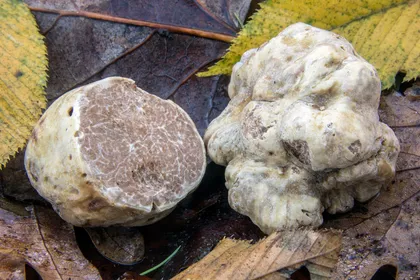 Vegetables and fruitWhite truffleThe Italian white truffle, Tuber magnatum Pico, is the most expensive of Italy's truffles: in 2025 the Alba…
 Pasta and breadTajarinTajarin are the Piedmontese answer to tagliolini: hand-cut egg noodles barely a millimetre and a half wide…
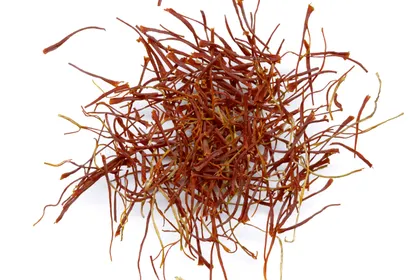 Oil and preservesSaffronOne kilo takes between 150,000 and 200,000 flowers, and every flower gives up three stigmas that have to be…