Alba Truffle Hunting
The Alba white truffle season runs from late September to the end of January, and everything sold outside it is a different species at a tenth of the price. Real hunters work at night, which is the fastest way to tell a hunt from a demonstration.
What you'll actually do
You meet a trifolao (the local word for the hunter, trifulau in Piedmontese) and his dog, and you walk into a wood in the Langhe, the Roero or the Monferrato for 90 minutes to two and a half hours. The dog is usually a Lagotto Romagnolo or a nondescript mixed breed chosen for nose and biddability; pigs have been illegal for truffle hunting in Italy since 1985 because they tear up the mycelium. The ground is oak, poplar, willow, linden and hazel on the damp north-facing slopes and along stream beds. When the dog marks, the hunter digs with a narrow spade called a vanghetto, working sideways so as not to cut the truffle, and closes the hole afterwards: leaving it open kills the spot.
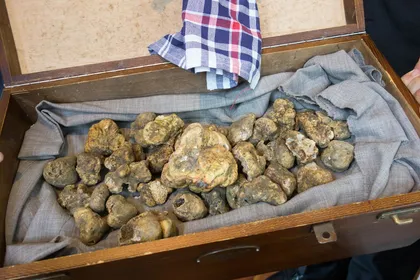
What you learn, if the hunter is good, is why this cannot be industrialised. Tuber magnatum Pico, the Alba white truffle, has never been reliably cultivated. Black Périgord truffle is farmed on inoculated oak plantations at scale; the white one is not, which is why it costs what it costs and why there is no such thing as a white truffle farm in Piedmont. Hunting requires a regional licence obtained by examination, so you cannot legally go alone, and the productive spots are family knowledge passed down and never disclosed.
Now the two uncomfortable truths. The first is seasonal. White truffle season in Piedmont runs roughly from 21 September to 31 January by regional law, with the peak from late October to early December. Outside that window what a dog finds is Tuber aestivum, the summer scorzone: a dark, warty, pale-veined truffle with a mild nutty smell that sells for €150 to €400 a kilo against the €2,000 to €4,500 a kilo of decent white truffle, and far more in a bad year. Scorzone is a perfectly pleasant ingredient. It is not what people fly to Alba for, and a July hunt that presents it as the Alba truffle is being economical with the truth.
The second truth is about staging. A significant share of the daytime tourist hunts are run on prepared ground: a truffle, sometimes bought at market, sometimes a cheaper species, is placed or buried in a known spot so the dog performs and everyone gets a photograph. The tells are consistent. It happens at 10am or 3pm, when a working hunter is asleep, because the real work is done between midnight and dawn: cooler and damper for the dog's nose, no other hunters watching where you go, and nobody able to follow you. The find is guaranteed, or the listing implies it is. The walk is fifteen minutes to the same clearing every group visits. The truffle comes out clean and dry rather than caked in wet soil. The dog goes straight to it without quartering the ground. None of this makes a demonstration worthless: you still learn how a dog works, how to smell and grade a truffle, and how the digging is done, but you should book it knowing what it is, and you should not pay hunt prices for it.
A real outing has no guaranteed find, starts before dawn or after dusk in high season, involves mud, brambles and slopes, takes two to six people at most, and ends with the truffle belonging to the hunter. You do not keep what you find unless you buy it.
What it costs
A hunt with a hunter and dog runs $85 to $165 (roughly €80 to €155) per person for 90 minutes to two and a half hours, often with a glass of Nebbiolo and a slice of something truffled afterwards. Add a full truffle lunch and it is $165 to $270 (€155 to €250). Private outings for a family or small group are $270 to $500 (€250 to €470) per group. November weekends cost at the top of every range and sell out weeks ahead.
The truffle itself is the real expense. Fresh white truffle at the Alba market or from a hunter is priced per gram at retail: reckon €2 to €4.50 per gram in a normal year, so a modest 20-gram specimen is €40 to €90 and a dinner-party-sized 60-gram one is €120 to €270. Restaurants charge €8 to €15 per gram shaved at the table, which makes a standard 5 to 8 gram shaving on a plate of tajarin a €50 to €100 supplement on top of the pasta. Ask for the shaving to be weighed in front of you; most serious places do it as a matter of course.
Scorzone, in summer, is €0.15 to €0.40 per gram. If you are quoted white truffle prices for a summer find, you are being sold the wrong species.
Best time to go
Mid-October to early December, without much argument. The season opens around 21 September and closes 31 January, but September truffles are small and thin-smelling, and by mid-January the finds have dwindled and prices have risen. The peak weeks are the ones when autumn rain has soaked the ground and the frosts have not started.
Those weeks are also the Alba truffle fair, which runs on weekends from early or mid-October to early December in the Cortile della Maddalena, with the international charity auction held at the castle of Grinzane Cavour in November. The fair means the town is full, hotel rates in Alba roughly double on Saturdays, and the hills are busy, which is the trade-off for going when there are actually truffles.
Going in summer is a reasonable holiday and a poor truffle trip: what you will find is scorzone, the woods are dry, and the hunt is a demonstration. Late January and February are quiet, cheap and thin. Spring has no white truffle at all; the bianchetto, Tuber borchii, appears from January to April, smells sharply of garlic and gas, and is a fraction of the price: it is a real truffle and it is not the Alba truffle.
How to book
GetYourGuide and Viator both list Langhe truffle hunts, mostly the daytime demonstration format, which is fine if that is what you want. Read the listing for the words guaranteed find, family farm, or truffle park: all three indicate a controlled experience rather than a hunt.
For something closer to the real thing, two better channels. The Alba tourist office and the local trifolao association maintain lists of licensed hunters who take visitors, and booking through them puts you with someone whose licence and reputation are checkable. And most Langhe agriturismi and wine estates can arrange a hunt with a hunter they know, often at a better price than a marketplace listing and always with better context. Email the place you are staying two or three weeks before you arrive.
Questions worth asking before you pay. What time does it start, and if the answer is mid-morning in November, ask why. Which species will we be looking for, by name. What happens if we find nothing. How many people are in the group. Is the truffle for sale afterwards and at what price per gram. A hunter who answers all five plainly is a hunter worth booking.
Book four to six weeks ahead for October and November weekends, which genuinely sell out. Bring waterproof boots with ankle support and clothes you do not mind ruining: the good ground is wet clay on a slope, and no operator supplies boots in your size.
Some booking links on this page are affiliate links: if you book through them we earn a commission, at no extra cost to you. It never changes what we recommend.
Where to stay nearby
Alba is the practical base: a working town of 30,000 with the market, the fair, the best concentration of restaurants and rail and bus links to Turin. It also fills completely on autumn weekends, when rates double and single-night stays are often refused.
The hill villages give you the views and the wine. Barolo, La Morra, Monforte d'Alba and Serralunga sit in the Barolo zone south-west of Alba; Barbaresco, Neive and Treiso in the Barbaresco zone to the north-east. All are small, expensive in season, and require a car. The Roero, on the north bank of the Tanaro around Canale, Montà and Govone, has the same landscape at 30 to 40 percent less money and fewer visitors, and it is also excellent truffle ground.
Bra, 20 minutes west, is a real town with real prices and is the home of the Slow Food movement; it hosts the Cheese festival in September of even-numbered years. Asti and Cherasco are further out and cheaper still.
Alba is about 70 kilometres from Turin and 150 from Milan. Trains from Turin Porta Nuova take 80 minutes to two hours with a change at Bra or Asti. Once you are there, the hills are not walkable between villages in any practical sense (the roads are steep, narrow and without pavements) so budget for a car or a driver.
What to eat while you're there
The canonical vehicle for white truffle is tajarin: thin egg noodles made with a great many yolks, dressed in butter and nothing else, so the truffle has an unobstructed surface. The other three classics are a fried or poached egg, a fonduta of Fontina, and carne cruda all'albese, hand-chopped raw veal with oil and lemon. All four exist to be neutral, fatty and warm, because white truffle aroma is volatile and needs heat from below and no competition.
Without truffle, the Langhe menu is agnolotti del plin, the pinched parcels served in jus or on a napkin; brasato al Barolo; bollito misto with bagnet verd and bagnet ross; vitello tonnato; and bagna cauda from October to March. Cherasco does snails. Cheeses: Castelmagno DOP, Robiola di Roccaverano DOP, Bra DOP, Murazzano DOP, Toma Piemontese DOP.
Sweets run on hazelnut (Nocciola Piemonte IGP, the Tonda Gentile Trilobata) in torta di nocciole served with zabaione, and in bonet, the cocoa and amaretti pudding. Wines: Barolo and Barbaresco from Nebbiolo, Barbera d'Alba, Dolcetto d'Alba, Nebbiolo d'Alba, Roero Arneis white, Moscato d'Asti to finish.
One thing not to buy. Truffle oil is, in the overwhelming majority of cases, a neutral oil flavoured with 2,4-dithiapentane, a synthetic aroma compound, with no truffle in it at all, sometimes with a decorative shaving in the bottle. It smells of truffle in a one-note, insistent way that real truffle does not. If you want to take the aroma home, buy the truffle itself and use it within a week, or buy a jar of preserved black truffle and accept that it is a different, quieter product.
Read before you go
Frequently asked questions
Can you hunt white truffles in summer?
No. The Piedmont season for Tuber magnatum, the Alba white truffle, runs roughly 21 September to 31 January by regional law, and hunting it outside those dates is illegal. Summer outings look for Tuber aestivum, the scorzone: dark-skinned, pale-veined, mildly nutty, and worth €150 to €400 a kilo against €2,000 to €4,500 for white truffle. It is a genuine truffle and an enjoyable morning in the woods, but it is a different species at roughly a tenth of the price, and it should be described that way.
How can I tell whether a truffle hunt is staged?
The strongest signal is the clock. A working trifolao hunts between midnight and dawn (better scenting conditions, and nobody watching where he goes) so a hunt scheduled for 10am in peak season is a demonstration. Other tells: a guaranteed find, a fifteen-minute walk to the same clearing every group visits, a truffle that emerges clean and dry rather than packed in wet clay, and a dog that goes straight to the spot without quartering the ground. A demonstration still teaches you something. It just should not cost what a hunt costs.
Do I get to keep the truffle we find?
Almost never. The truffle belongs to the licensed hunter, and it is the actual income from the outing: a single good specimen can be worth more than your ticket. Most hunters will sell it to you on the spot at a price per gram, weighed in front of you, which is usually fair and always cheaper than a shop. A few operators include a small truffle in a premium package, and if that matters to you, confirm the weight in writing before booking rather than assuming.
What is worth buying to take home?
Fresh white truffle if you are flying home within a few days: wrap it in kitchen paper, keep it in a sealed jar in the fridge, change the paper daily, and use it inside a week. Declare it at customs, since some countries restrict fresh fungi and the United States generally permits cleaned truffles but the officer decides. Skip truffle oil, which is nearly always synthetic aroma rather than truffle. Preserved black truffle in a jar, truffle-studded salami and truffled cheeses are honest products that travel, provided you check meat import rules for your country.