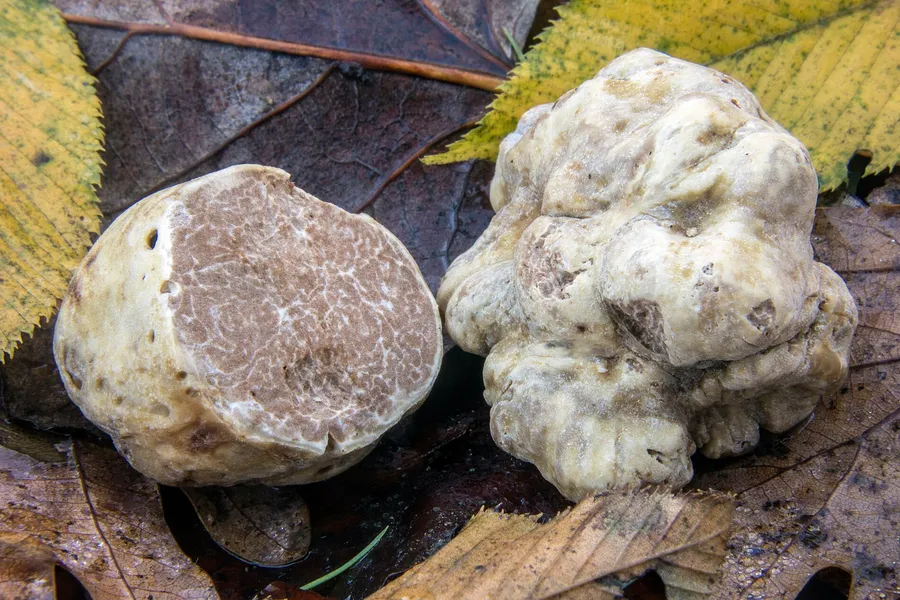
What is White truffle?
The white truffle is the fruiting body of a fungus that lives symbiotically on the roots of oak, poplar, willow and lime, underground, anywhere from a few centimetres to half a metre down. There is only one species and no commercial varieties. What varies is the soil, the host tree and the year.
What makes it unique is that nobody has managed to farm it at scale. The prized black truffle has been cultivated since the late nineteenth century using inoculated saplings; the white one has resisted every attempt. Managed truffle grounds exist, where natural production is encouraged, but the harvest is still a hunt rather than a crop.
Everything else follows from that: the price, the four-month season, the way quotations swing by a factor of two between vintages, and the fact that the white truffle trade is one of the most fraud-prone corners of Italian food.
What does it taste like?
Overwhelming and not conventionally pleasant up close: garlic, aged cheese, wet hay, methane, and something animal underneath. It is a smell more than a flavour: the actual taste on the tongue is mild and faintly earthy, and almost all of the experience happens in your nose.
On a warm plate the aroma rises in a wave that fills the room within seconds and fades within minutes. That decay is the whole reason for the ritual around it: shaved at the table, eaten immediately, never held.
If you have only met truffle through truffle oil, truffle fries or truffle mayonnaise, prepare for a shock. Those products taste of one loud synthetic molecule; the real thing is layered, shifting and far less aggressive, and it does not leave the metallic aftertaste that manufactured truffle flavour does.
How to use it
Never apply heat. Shave the truffle raw, with a proper truffle slicer set thin, over a plate that is already hot: the residual warmth is all that is needed to release the aroma. Do it at the table, and eat within a minute or two.
The four traditional dishes are all deliberately bland underneath. Tajarin, the thirty-yolk Piedmontese egg pasta, dressed with nothing but butter. A fried or coddled egg. Fonduta, the Valle d'Aosta fontina custard. Carne cruda all'albese, hand-chopped raw veal with oil and lemon. In every case the dish exists to provide fat and heat, nothing else.
Budget 5 to 8 grams per person. A 40-gram truffle serves five or six. That is why restaurants price by the gram, and why an honest portion runs 20 to 40 dollars.
Strip the plate of competing aromatics: no garlic, no fresh herbs, no lemon, no vinegar, no pepper. And if you are making risotto, shave the truffle over the finished plate, never stir it into the pan.
How long it keeps
A white truffle is at its peak the day it comes out of the ground and loses aroma from then on: dealers reckon on roughly 5 percent of its weight lost per day to evaporation, and the perfume goes with it. Plan to use it within three to five days of buying, which is why it is bought by the gram for a specific dinner rather than kept. Store it in the fridge, in a sealed glass jar lined with kitchen paper, and change that paper every day as it takes up moisture.
Never wash it before storing: brush the soil off dry, only at the moment of use. Rice is the classic container and a poor one, because rice pulls water out of the truffle and dries it while flavouring the rice. Over a few days the surface shrinks and wrinkles, the flesh softens, and the aroma flattens from pungent to faintly mushroomy. Freezing preserves nothing worth having: the texture collapses on thawing and the volatile compounds are gone. Eggs stored beside it in the same jar do absorb the perfume through the shell.
Spot the real thing
Tuber magnatum pico is irregular and lumpy rather than round, with a smooth, thin, pale skin somewhere between cream and ochre, and it should feel firm and heavy for its size when you press it. Cut, the interior is pale beige to pinkish brown, marbled with fine white veins. The aroma does the identifying: it carries across a room, garlic and cheese and damp hay all at once, and it is nothing like the single dimensional smell of truffle oil, which is a synthetic molecule and contains no truffle.
Season is the cheapest test available. The Alba truffle runs from late September to the end of January; anything sold as white truffle in June is bianchetto, Tuber borchii, a different and far cheaper species that is smaller, harsher and more aggressively garlicky. Price is the other test: magnatum trades at roughly $2 to $6 per gram depending on the year, so a whole one is weighed in front of you on a certified scale and comes with its harvest area stated. Anything offered at supermarket money is a different species with a borrowed name.
How to pronounce White truffle
tar-TOO-foh BYAHN-koh
Stress on TOO and on BYAHN. 'Bianco' is two syllables, not three: the 'bia' is a single glide, BYAHN, never 'bee-AHN-koh'. Tuber magnatum is pronounced as Latin, TOO-behr mag-NAH-toom. If you are in Piedmont, the local word for the hunter is trifolau, tree-foh-LAOW, and using it correctly will get you a better price than almost anything else you can say.
White truffle compared
vsBlack winter truffle (Tuber melanosporum)
Different species, different rules. The black Périgord truffle is farmed, is in season when the white is finishing, and improves with gentle heat and fat. The white is wild, autumn-only, and must never see a pan. They are not grades of the same product.
| This | Black winter truffle (Tuber melanosporum) | |
|---|---|---|
| Species | Tuber magnatum Pico | Tuber melanosporum |
| Farmed | No: every attempt has failed | Yes, since the 1800s |
| Season | Late September to end of January | December to mid-March |
| Cooked | Never: shaved raw | Yes, benefits from warmth and fat |
| Aroma | Garlic, cheese, hay; explosive, fleeting | Cocoa, earth, forest floor; deeper, steadier |
| Price per kilo | 2,000-4,500 euro | 600-1,200 euro |
vsSummer truffle / scorzone (Tuber aestivum)
The one you have probably eaten without knowing. Cheap, abundant, harvested May to August, with a rough black warty skin and a pale hazelnut interior. It is a decent ingredient in its own right and a catastrophic impostor when sold as something it is not.
| This | Summer truffle / scorzone (Tuber aestivum) | |
|---|---|---|
| Season | Autumn and early winter | May to August |
| Skin | Smooth, pale ochre | Black, warty, pyramidal scales |
| Interior | Beige-pink with fine white veins | Pale hazelnut with coarse veins |
| Aroma | Intense, carries across a room | Faint, mushroomy, close to the nose |
| Price per kilo | 2,000-4,500 euro | 150-300 euro |
| Honest use | Shaved raw over neutral, fatty dishes | Truffle butter, sauces, where it can be cooked |
vsChinese truffle (Tuber indicum)
The fraud you should actually worry about. Tuber indicum looks close enough to melanosporum to fool a photograph and has almost no aroma of its own, which makes it the perfect carrier for added synthetic flavouring. It is legal to sell, illegal to mislabel, and routinely found where it should not be.
| This | Chinese truffle (Tuber indicum) | |
|---|---|---|
| Origin | Italy, Istria, the Balkans | Yunnan and Sichuan, China |
| Aroma | Overwhelming | Almost none, unless dosed |
| Sold as | Itself | Often passed off as black Périgord |
| Price per kilo | 2,000-4,500 euro | 30-120 euro |
| How to spot it | Not applicable | Veins coarser and darker, smell weak, price improbably low |
vsTruffle oil
Almost all truffle oil contains no truffle. The flavour comes from 2,4-dithiapentane, an industrially synthesised molecule. It does occur naturally in real white truffle, which is why the fake is recognisable, but real truffle has over a hundred aromatic compounds and the oil has one, delivered at maximum volume.
| This | Truffle oil | |
|---|---|---|
| Contains truffle | It is truffle | Usually none, or a decorative sliver |
| Aroma source | 100+ natural volatile compounds | One synthetic molecule, 2,4-dithiapentane |
| Behaviour | Fades within minutes | Persists for hours, coats the palate |
| Cost per portion | 15-35 euro | A few cents |
| Label tell | Weight, species, origin, date | 'Aroma' or 'flavouring' with no truffle percentage |
White truffle substitutes
- Fresh black winter truffle
The only substitute that is genuinely a truffle experience rather than an imitation of one. It is a different flavour, so do not shave it raw on tajarin expecting the same thing: warm it gently in butter and build the dish around it.
1.5:1 by weight, and change the dish rather than the technique - Fresh summer truffle plus aged Parmigiano
Scorzone at 150-300 euro a kilo is affordable enough to be generous with. Shaved thickly over a dish finished with a lot of 36-month Parmigiano, it gets you a credible umami-and-earth register for a twentieth of the cost.
3:1 by weight, plus 20g grated Parmigiano per portion - Dried porcini, rehydrated and reduced
Not truffle, but the same family of aromatics done honestly. Soak 20g dried porcini, reduce the soaking liquid to a syrup, and fold it into the butter or the risotto. Deep, woodsy, and nobody will accuse you of faking anything.
20g dried porcini per four portions - Truffle butter with a declared truffle percentage
Worth buying only if the label states a truffle percentage and a species. Anything above three per cent of real Tuber magnatum or melanosporum will taste of truffle; anything relying on 'aroma' will taste of the oil.
15-20g per portion, stirred in off the heat - Truffle-scented eggs
The cheapest real-truffle trick there is. Shells are porous: put a truffle in a sealed box with a dozen eggs for 48 hours and every yolk takes on the aroma. Then use the eggs and still have the truffle.
One 30g truffle scents a dozen eggs - What not to use: truffle oil
It is included here only to be ruled out. It will not make a dish taste like white truffle; it will make it taste like every airport pasta you have ever regretted, and the flavour lingers for hours.
Where to buy it
In the US, fresh white truffle arrives by air freight between late October and December from a small number of importers (Urbani, Sabatino, Gustiamo and a handful of specialists) at roughly 150 to 350 dollars per ounce depending on the vintage and the size of the piece. Order it timed to a specific dinner: it is five or six days from dug to worthless.
In the UK, the Italian delicatessens of Soho and Clerkenwell and the specialist fungi suppliers who serve restaurants sell to the public in season, at around 3 to 6 pounds per gram. Some will hold a piece for a named date, which is the right way to buy it.
Buy by weight, in person if you can, with the truffle on the scale in front of you. Ask for the species in writing, the region and the harvest date, and ask them to brush the soil off before weighing. Firm as a raw potato, heavy for its size, smooth ochre skin, beige-pink interior with fine white veins, and an aroma that reaches you across the counter. If any of those fail, walk away. A suspiciously low price is not a bargain but a different species.
Where to eat it in Italy
Alba, in the Langhe, from mid-October to early December. The World Truffle Market in the Cortile della Maddalena runs at weekends and is the only place where you can see a hundred truffles side by side and learn to tell them apart. Trattorie in Alba and in the wine villages (La Morra, Barolo, Serralunga, Monforte) post the per-gram price on the menu.
Acqualagna, in the Marche, holds its national fair from late October into November and is far less touristed. The truffles are the same species and often the same quality; the bill is not.
San Miniato in Tuscany runs market weekends through November and has produced some of the largest specimens on record. San Pietro Avellana in Molise and Savigno in the Bolognese Apennines offer the same thing without the crowds.
The experience worth paying for anywhere is a dawn hunt with a trifolau and his Lagotto Romagnolo: two hours, 40 to 120 euro per person, and more education than any fair provides.
Further reading
Frequently asked questions
Why are white truffles so expensive?
Because they are not farmed. Black truffles are grown commercially in orchards; the white has so far produced only a handful of truffles in a single French orchard, in 2019 and 2020. Supply is whatever the woods yield in a season fixed by law, and it swings with the weather: drought years such as 2017 and 2022 brought high prices, and so did the rain-soaked start of 2024.
How much white truffle do I need per person?
Five to eight grams, shaved raw at the table. A 40-gram truffle serves five or six people. Restaurants price by the gram for exactly this reason, and a fair portion costs roughly 20 to 40 dollars.
Can you cook white truffle?
No. Its aromatic compounds are volatile and heat destroys them within seconds. Shave it raw onto an already hot plate at the last possible moment. Even truffle butter should be taken off the heat before the truffle goes in.
Is truffle oil made from truffles?
Almost never. Most truffle oil is seed or olive oil dosed with synthetic 2,4-dithiapentane. That molecule does exist in real white truffle, but real truffle carries over a hundred aromatic compounds while the oil carries one, at full volume. If the label says 'aroma' with no truffle percentage, that is what is inside.
How do you store a fresh white truffle?
In a sealed glass container in the least cold part of the fridge, wrapped in dry kitchen paper changed every single day. It will keep five or six days and lose about five per cent of its weight daily. Do not store it in rice, which dries it out, and do not freeze it.
Related foods
 Pasta and breadTajarinTajarin are the Piedmontese answer to tagliolini: hand-cut egg noodles barely a millimetre and a half wide…
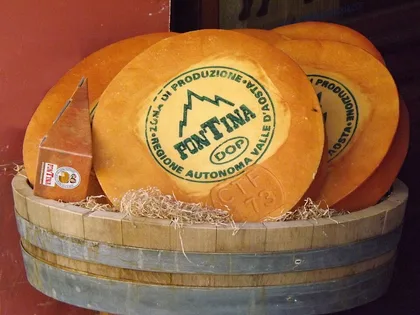 CheeseFontinaFontina is the DOP mountain cheese of Italy's Aosta Valley: raw whole milk from a single milking, wheels of…
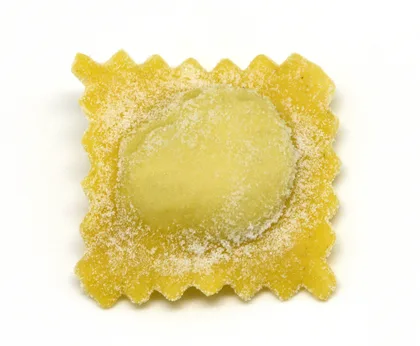 Pasta and breadAgnolottiAgnolotti are Piedmont's stuffed pasta: thin egg dough around a filling of roasted meat, not ricotta.
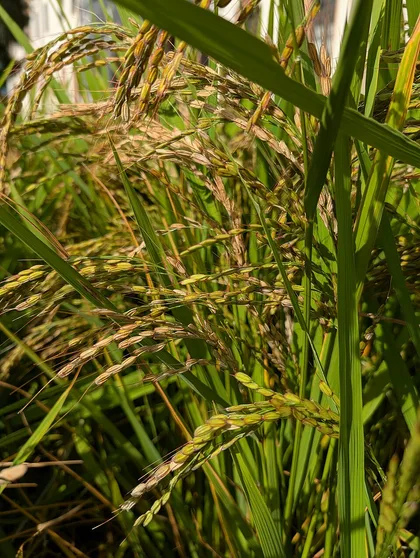 Vegetables and fruitCarnaroli RiceCarnaroli is the risotto rice with the highest amylose content: it sheds enough starch to build a creamy…
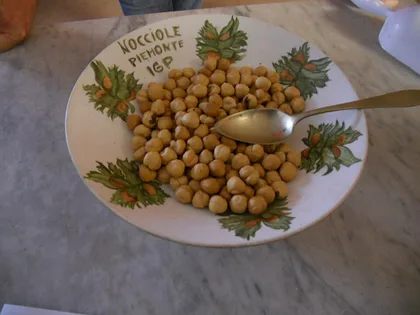 Vegetables and fruitPiedmont HazelnutNocciola Piemonte IGP is a single cultivar, the Tonda Gentile Trilobata of the Langhe hills: round, yielding…Vegetables and fruitCicerchia (Grass Pea)The grass pea is the oldest and most awkward legume in Italy.
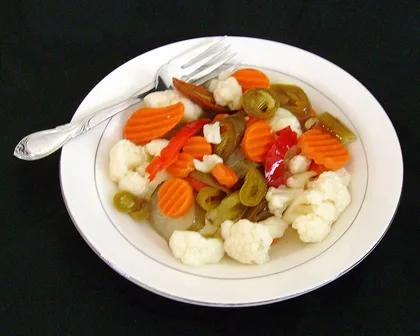 Oil and preservesGiardinieraGiardiniera means two very different jars. In Italy it is a mild mix of vegetables pickled in wine vinegar…
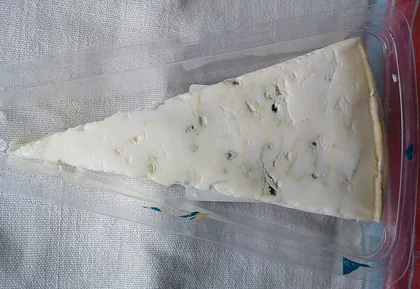 CheeseGorgonzolaThe green veining is the product, not a flaw anyone tolerates: it grows from a mould added to the milk and…