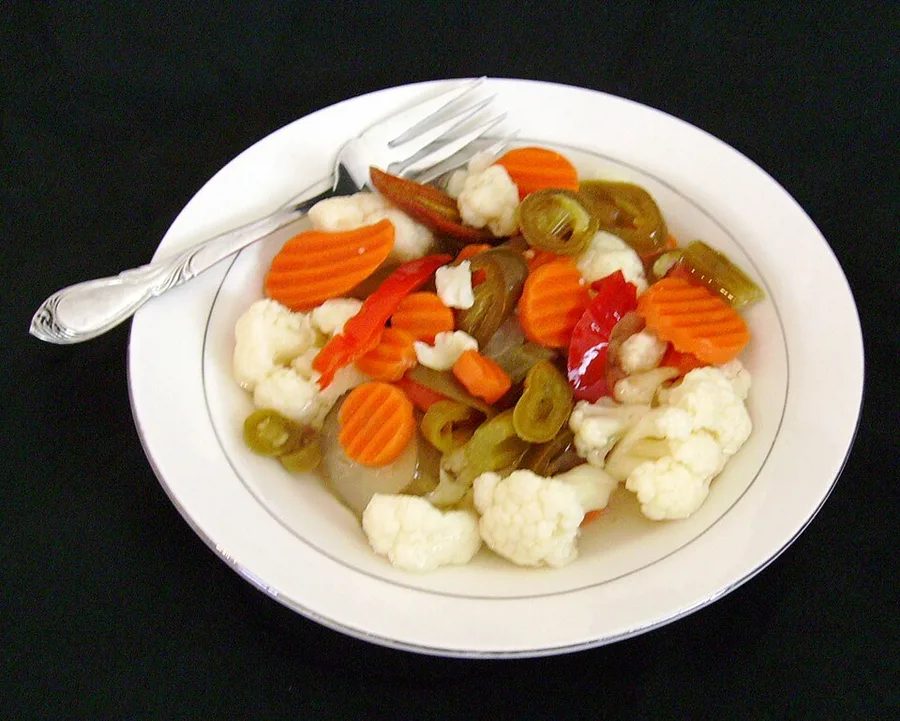
What is Giardiniera?
Giardiniera is an Italian mixed-vegetable pickle: cauliflower, carrot, celery, sweet pepper and pearl onions cut small, blanched in vinegar and packed in jars. The name comes from the garden: it is the preserve made at the end of summer from whatever the plot produced at once.
It carries no DOP or IGP, no legal definition and no fixed recipe. Its home ground is northern Italy, Lombardy and Piedmont above all, where the boiled-meat traditions demand something sharp on the side. The two big commercial names are Piedmontese: Ponti, founded at Ghemme in 1867, and Saclà, founded in Asti in 1939.
The American version diverged so far that it is effectively a separate food. In Chicago, giardiniera is packed in oil rather than vinegar, built on hot sport peppers and celery, and used as a condiment by the spoonful: mostly on Italian beef, sausage and pizza. Both are called giardiniera; only one of them will set your mouth on fire.
What does it taste like?
Italian giardiniera is sharp and clean, with the vinegar arriving first and a mild sweetness behind it. The vegetables stay crunchy, each one keeping its own flavour: cauliflower nutty, carrot sweet, celery grassy, pepper faintly bitter. Heat is absent, or a single chilli's worth. It refreshes the mouth rather than filling it.
Chicago giardiniera is a different sensation entirely: oily rather than watery, with a slow-building capsaicin heat, a heavy hit of celery and oregano, and a much softer texture. The vinegar is there but muted by the oil, so it coats instead of cutting.
Both are salty, both are meant to be eaten in small amounts against something rich, and neither is meant to be eaten cold from the fridge: let either come to room temperature and the flavours open up.
How to use it
For Italian giardiniera, think side dish. Serve it at room temperature next to boiled or braised meat, on a salumi board, with hard cheeses, or in a mortadella sandwich. Small quantities: it is a counterweight, not a salad.
Chop it fine with parsley, an anchovy and olive oil and it becomes a fast sauce for poached meat, a shortcut cousin of salsa verde. The vinegar in the jar is worth keeping too: two spoons in a vinaigrette outperform straight vinegar.
For Chicago giardiniera, treat it as a condiment. Spoon it over an Italian beef sandwich, a sausage roll, a slice of pizza, scrambled eggs or a bowl of beans. The oil it sits in is flavoured: use it.
Neither type should be cooked. Heat collapses the vegetables and drives off the vinegar, leaving the dull half of the flavour behind.
How long it keeps
Sealed pasteurised jars sit in a dark, cool cupboard for twelve to eighteen months, and the date printed on the lid is the reference, not the look of the glass. Jars sold from the chilled cabinet are usually unpasteurised: those stay in the fridge and carry a much shorter window, often around two months. Either way the pickle keeps changing inside the sealed jar. The vegetables go on drinking the brine, the crunch softens month by month, and the separate colours fade towards a common yellow.
Once open, the jar lives in the fridge and is generally given three to four weeks. Keep everything below the liquid line, because pieces that stand above it dry out and darken. Use a clean fork rather than fingers, and do not put back what has already been on a plate. If the level drops, top up with white wine vinegar rather than water, or with oil in the oil packed versions, tapping the jar to release trapped air. It does not freeze: thawed pickled vegetables go limp and lose the snap that is the whole point.
Spot the real thing
The first thing to sort out in an American shop is which giardiniera you are holding. Chicago style is finely chopped and packed in oil, built on sport peppers and celery, and it is made for an Italian beef sandwich. The Italian jar is a vinegar pickle of whole, nameable pieces: cauliflower florets, carrot batons, strips of red and yellow pepper, small onions, celery ribs. Both are good, neither replaces the other. In Britain the thing to keep separate is piccalilli, a mustard and turmeric sauce with vegetables suspended in it.
In the Italian jar the colours stay distinct: ivory cauliflower, bright carrot, clean red and yellow pepper. When it all drifts towards a uniform grey yellow, the vegetables were boiled hard or the jar has sat a long time. It should be audible to bite, and cauliflower that crumbles or carrot that bends means a long blanching. On the label, wine vinegar reads better than a generic vinegar, and in oil packed versions the oil sets the price: sunflower in most, extra virgin in the artisan jars, which can cost three times as much.
How to pronounce Giardiniera
jar-di-NYEH-rah
Four syllables, stress on the third. The 'gi' is a soft j as in 'jar', not a hard g: 'gar-di-nee-air-a' is the most common miss. The 'ie' is one gliding sound, 'nyeh', not 'nee-eh'. In Chicago you will hear 'jar-din-AIR-uh', which is a local pronunciation with its own long history and nobody there will thank you for correcting it.
Giardiniera compared
vsChicago-style giardiniera
The same word for two products that share ancestry and almost nothing else. Italian giardiniera is packed in wine vinegar, mild, crunchy and served as a side dish with boiled meat and cured pork. Chicago giardiniera is packed in oil, built on hot sport peppers and celery with oregano, and used as a condiment: spooned onto Italian beef sandwiches, sausage rolls and pizza. It was developed by Italian immigrants in Chicago in the first half of the twentieth century, when oil packing and local peppers replaced the vinegar-heavy original. If a recipe says giardiniera and you are cooking American food, it means the hot oil-packed kind; if the recipe is Italian, it does not.
| This | Chicago-style giardiniera | |
|---|---|---|
| Packing medium | Wine vinegar, sometimes light brine | Soybean or olive oil |
| Heat | Mild: one chilli at most | Medium to very hot (sport or serrano peppers) |
| Core vegetables | Cauliflower, carrot, celery, pepper, pearl onion | Sport peppers, celery, carrot, olives, cauliflower |
| Texture | Crunchy, distinct pieces | Softer, chopped finer, coats the food |
| Role | Side dish, eaten alongside | Condiment, spooned on top |
| Classic use | Bollito misto, salumi board, cheese | Italian beef, sausage, pizza, muffuletta |
| Sold as | Sott'aceto / sottaceti misti | Hot or mild giardiniera |
vsMuffuletta olive salad
New Orleans' Sicilian-descended cousin to Chicago giardiniera, and the two are often used interchangeably. Olive salad leads with green and black olives and is bound in olive oil; giardiniera leads with peppers and celery. Olive salad is briny, giardiniera is hot. Watch for anchovy in some olive salad brands if you are cooking vegetarian.
| This | Muffuletta olive salad | |
|---|---|---|
| Dominant ingredient | Peppers and celery | Green and black olives |
| Heat | Central (hot versions) | Mild |
| Origin | Chicago and northern Italy | New Orleans, Sicilian community |
| Signature use | Italian beef sandwich | Muffuletta sandwich |
vsPiccalilli
The British pickle that occupies the same seat at the table: sharp, vegetable-based, served with cold cuts and pork pies. The difference is the sauce: piccalilli binds its cauliflower and onion in a thick mustard-and-turmeric sauce, so it is a spreadable relish. Giardiniera keeps its vegetables loose in clear vinegar and stays crunchy.
| This | Piccalilli | |
|---|---|---|
| Binder | Clear vinegar, no sauce | Mustard and turmeric sauce |
| Colour | Natural vegetable colours | Bright yellow |
| Texture | Crunchy, loose pieces | Soft pieces in thick relish |
| Flavour | Vinegar-forward, clean | Mustard-forward, spiced |
| Served with | Boiled meats, salumi, cheese | Cold cuts, pork pie, cheddar |
Giardiniera substitutes
- Jalapeños en escabeche
The closest widely available substitute for hot giardiniera, and a genuine relative: Mexican escabeche carries the same carrot, onion, jalapeño and vinegar profile. Drain, chop coarsely and toss with a spoon of olive oil and a pinch of dried oregano to bridge the gap.
1:1 - Quick 24-hour giardiniera
Faster than shopping for it. Chop cauliflower, carrot, celery and pepper small, salt heavily and leave two hours, rinse, then cover with a boiled mix of two parts white wine vinegar to one part water plus a spoon of sugar. Ready overnight, keeps two weeks in the fridge. For the Chicago version, drain after 24 hours and cover with oil, chilli flakes and oregano.
Makes about 700 g from 600 g of vegetables - Piccalilli (UK)
Works where giardiniera is playing the sharp-side role next to cold meats or cheese. It will not work as a Chicago-style condiment: the mustard takes over completely.
1:1 as a side, not as a topping - Muffuletta olive salad
A good stand-in on sandwiches, especially for mild giardiniera. Saltier and brinier, so cut back the salt elsewhere. Check the label for anchovy if it matters.
1:1, minus added salt - Torshi or Middle Eastern mixed pickles
Turnip, cauliflower and carrot in vinegar, sold in every Middle Eastern grocer and often cheaper than Italian imports. Sharper and sometimes beet-dyed pink, but structurally the same thing.
1:1 - Cornichons plus pickled peppers
The improvised version when you need something sharp on a cheese board tonight. Chop them together with a little celery for crunch.
2 parts cornichons to 1 part pickled peppers
Where to buy it
In the US, the hot Chicago style is everywhere: Marconi, Vienna Beef and Dell'Alpe are the classic Chicago labels, 6 to 10 dollars for a 16 oz jar in supermarkets and online. For the Italian vinegar-packed kind, look in the imported aisle or at an Italian deli for jars labelled sottaceti or giardiniera in aceto: roughly 7 to 12 dollars for a 500 g jar.
In the UK, Italian giardiniera is the default: Ocado, Waitrose and Italian delicatessens carry it at 3 to 5 pounds for a 280 g jar, and Ponti and Saclà are the two names you will see most. Chicago-style is a specialist import, usually 8 to 12 pounds a jar from American food shops.
In Italy, 2.50 to 5 euros for a supermarket jar, 6 to 9 for an artisan one packed in extra virgin olive oil.
Read the label for the packing medium: 'in oil' versus 'in vinegar' tells you more about how it will taste than the brand does.
Where to eat it in Italy
Chicago, obviously, and specifically at an Italian beef counter: the sandwich is ordered wet or dipped, hot or sweet, and hot means giardiniera. Al's Beef, Johnnie's in Elmwood Park and Portillo's are the reference points, and every one of them will let you add more.
In Italy, the place to meet the original is a Piedmontese trattoria in bollito season, October to February, when the trolley arrives with boiled meats, green sauce, horseradish and a bowl of giardiniera. Asti, Alba and the Monferrato do this best; the Fiera del Bollito at Carrù, near Cuneo, is the annual event built around it.
In Lombardy it turns up on Valtellina salumi boards and next to cassoeula in winter, and Milan's older salumerie still sell it loose by weight from large glass jars.
Further reading
Frequently asked questions
What is the difference between Italian and Chicago giardiniera?
Italian giardiniera is vegetables pickled in wine vinegar: mild, crunchy, eaten as a side dish. Chicago giardiniera is packed in oil, built on hot sport peppers and celery, and used as a spooned-on condiment, most famously on Italian beef sandwiches. Same name, different food.
How do you pronounce giardiniera?
jar-di-NYEH-rah, with a soft j and the stress on the third syllable. The Chicago pronunciation, 'jar-din-AIR-uh', is standard in that city and nobody there considers it wrong.
Is giardiniera spicy?
The Italian version is not: at most it contains a single chilli. The Chicago version usually is, and is sold in hot and mild grades. If a jar says 'hot giardiniera', assume real heat.
Is giardiniera vegan?
Almost always. It is vegetables, vinegar, salt, oil and spices. The exceptions to check are olive-salad-style blends that may contain anchovy, and a few artisan jars that use honey rather than sugar.
How long does giardiniera keep once opened?
Three to four weeks in the fridge, as long as the vegetables stay submerged in their liquid. Anything sticking above the surface will spoil first. Use a clean fork, and top up with vinegar or oil rather than water.
Related foods
 Cured meatsMortadellaThe white cubes are not just any fat: they are jowl, the firmest part of the pig, and they stay whole…
 Vegetables and fruitSan Marzano TomatoesSan Marzano is a long, thin-skinned plum tomato grown in the volcanic plain between Naples and Salerno, and…
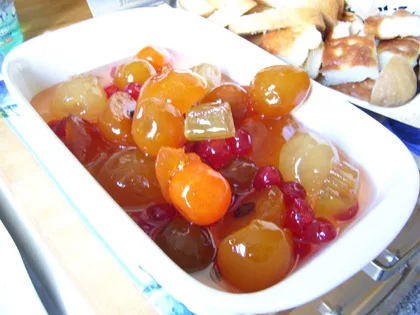 Oil and preservesMostardaMostarda is candied fruit suspended in sugar syrup and spiked with mustard essence.
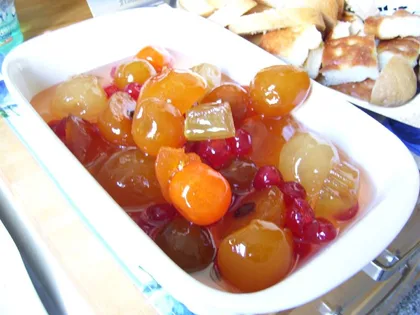 Oil and preservesMostarda di CremonaWhole candied fruit suspended in clear syrup and charged with mustard essence.Pasta and breadGnocchiGnocchi are small boiled dumplings, in their modern form made of potato bound with a little flour.Cured meatsPancettaPancetta is Italian cured pork belly: salt, pepper and warm spices, dried for months, never smoked.
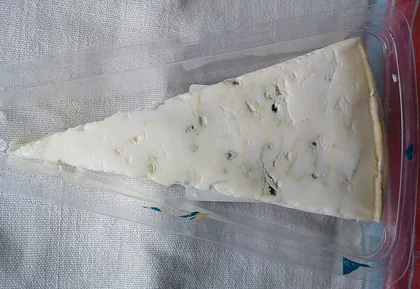 CheeseGorgonzolaThe green veining is the product, not a flaw anyone tolerates: it grows from a mould added to the milk and…
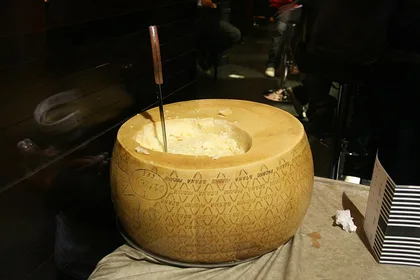 CheeseGrana PadanoNine months is the floor the specification sets before a wheel may carry the name.