What is Gnocchi?
A potato gnocco is a two-to-three-centimetre piece of dough made from boiled, riced potato, flour and salt, usually ridged on one side with a fork. It goes into boiling salted water and is done when it floats: two to three minutes. The word is already plural (one is a gnocco, several are gnocchi), which makes 'a gnocchi' impossible in Italian and 'gnocchis' doubly so.
Gnocchi is a family rather than a single recipe. Gnocchi alla romana are semolina discs baked with butter and cheese that never touch water. Canederli, in the Alps, are bread dumplings the size of golf balls. Gnudi, in Tuscany, are ricotta and spinach with barely any flour at all. Gnocchi di zucca use squash; gnocchi di susine, around Trieste, hide a whole plum inside. What holds the family together is the method, soft dough portioned into pieces and cooked in liquid, not the ingredient.
Potato is the newcomer. It reached Europe from the Americas in the sixteenth century but only entered Italian cooking in any quantity during the nineteenth, which makes potato gnocchi considerably younger than most people assume. Before that, gnocchi were made with stale bread, plain wheat flour, chestnut flour or squash.
What does it taste like?
Mild, faintly sweet and mostly of potato, which is the point. Gnocchi are a vehicle: the flavour comes from what dresses them, and the dough's job is texture. A good one is soft to the edge of collapse: dense but weightless, closer to the inside of a well-baked potato than to anything made of flour.
Bad ones announce themselves on the first bite. Too much flour and they bounce: a springy, chewy resistance that never goes away, with a raw floury coating in the mouth. Long-life vacuum-packed gnocchi have that bounce by design, plus a faint sourness from the preservative. They are a different food, and they are much better fried than boiled.
Fresh from a good pastificio, dressed with butter browned with sage and a heavy fall of Parmigiano, a gnocco should almost dissolve by the second chew. That is the benchmark to judge everything else against.
How to use it
Boil them in plenty of well-salted water at a lively simmer, in batches. They are done when they rise to the surface, which takes two to three minutes; count another twenty seconds and lift them out with a slotted spoon straight into the pan with the sauce. Do not tip them into a colander, where they crush each other, and do not cook them in advance. Test one first: if it falls apart, the dough needs a spoonful more flour.
Three dressings cover most of Italy. Butter browned with sage and a heavy fall of Parmigiano, which exposes the dough completely and forgives nothing. Tomato and basil, optionally finished in the oven with mozzarella in the Sorrento style. And gorgonzola melted over low heat with a splash of milk, which becomes a sauce on its own and needs no cream, the Lombard default. In the Veneto, duck ragù and melted butter with grated smoked ricotta are the local answers, and in Verona gnocchi arrive with pastissada de caval, a long-braised horsemeat stew.
Pan-frying is the underrated method. No boiling at all: hot pan, butter or olive oil, gnocchi spread in a single layer and left alone for four or five minutes a side until blistered and crisp outside, soft within. It is the best possible use for a supermarket packet.
Portion at 200 to 250 g of fresh gnocchi per person: they weigh more than dried pasta and fill you sooner. Keep sauces on the thick side, because thin, watery ones soak straight in and soften the dough on the plate.
How long it keeps
An unopened shelf-stable vacuum pack sits in the cupboard until the date printed on it, usually several months out. Once you cut it open, move it to the refrigerator and use it within about two days. Chilled supermarket packs run to the date on the sleeve, generally one to two weeks, and a day or two after opening. Loose fresh gnocchi from a deli counter, and any you make yourself, carry a two-to-three-day date and are meant for the same day: keep them in a single layer on a floured tray or board, lightly covered, never sealed airtight in a tub.
Left in the refrigerator, fresh dough pushes out water, the pieces stick to each other and to whatever they sit on, and the surface turns tacky and dull grey. Freezing avoids that: spread them raw and separated on a floured tray, freeze for two hours until firm, then bag them for up to two months. Drop them into boiling water straight from frozen, allowing an extra minute; thawed at room temperature they slump and lose their shape. Beyond the printed date, that date and the maker are the reference.
Spot the real thing
Three different things sit under the same name abroad. Shelf-stable vacuum packs in the dry pasta aisle are dense, glossy and perfectly uniform, with a date months away. Chilled packs in the fresh pasta case are softer and dated within a week or two. Real fresh gnocchi, sold loose at Italian delis, come dusted with flour, matte and off-white to ivory rather than bright white, they give under a fingertip without gumming it, and they smell of potato. A date two or three days out is the usual marker of that third category.
Read the ingredient list before you look at the price. Potatoes at the top, ideally declared above seventy per cent, is the mark of the real thing; potato flakes, potato starch and wheat flour at the top mean reconstituted dough. Long-life packs almost always list sorbic acid or potassium sorbate. Cauliflower gnocchi are a separate product altogether, and gnocchi alla romana are semolina discs that share nothing but the name. Price tracks all this closely: roughly 3 to 5 dollars a pound for shelf-stable, 8 to 14 for deli fresh.
How to pronounce Gnocchi
NYOH-kee
Two syllables, stress on the first. The 'gn' is one single Italian sound, the 'ny' of canyon or the Spanish ñ, and the g is never pronounced on its own. The 'h' is not silent decoration: it is there to keep the c hard, so 'chi' comes out as 'kee', not 'chee'. The two standard English attempts are 'gnocky', with an audible hard g, and 'guh-NOH-chee', with three syllables; both are wrong. Remember too that the word is already plural: a single dumpling is a gnocco, 'NYOK-koh'.
Gnocchi compared
vsGnocchi alla romana
Same word, entirely different dish. Gnocchi alla romana are semolina cooked in milk, spread out to set, cut into discs with a glass and baked under butter and Parmigiano until browned. Nothing is boiled and no potato is involved. Despite the name, the dish is documented well beyond Rome and its origin is disputed.
| This | Gnocchi alla romana | |
|---|---|---|
| Main ingredient | Boiled potato and wheat flour | Semolina cooked in milk with butter |
| Shape | Ridged lumps of 2–3 cm | Flat discs of 5–6 cm, cut with a glass |
| Cooking | Boiled 2–3 minutes, until they float | Baked about 20 minutes, gratinated on top |
| Egg | Optional: one per kilo of potato | Yolks stirred into the semolina off the heat |
| Dressing | Any sauce: tomato, butter and sage, gorgonzola, duck ragù | Butter and Parmigiano only, browned in the oven |
| Texture | Soft, pillowy, faintly springy | Firm and custardy inside, crusted on top |
| Make-ahead | Freeze raw, cook from frozen | The semolina slab keeps a day in the fridge |
vsCanederli (Knödel)
The Alpine cousin. Canederli are bread dumplings from Trentino-Alto Adige and the wider Tyrolean world: stale bread soaked in milk, bound with egg and flour, flavoured with speck and parsley, and usually served floating in beef broth. Far bigger, far more savoury in themselves, and cooked five times longer.
| This | Canederli (Knödel) | |
|---|---|---|
| Base | Boiled potato | Stale bread cubes soaked in milk |
| Size | 2–3 cm, dozens per portion | 5–6 cm balls, two or three per portion |
| Where | Veneto, Lombardy and most of Italy | Trentino-Alto Adige, into Austria and Bohemia |
| Flavour in the dough | None: salt, sometimes nutmeg | Speck, sausage, onion, parsley, sometimes cheese or liver |
| Egg | Optional | Essential: it is what holds the bread together |
| Cooking | 2–3 minutes at a lively boil | 12–15 minutes at a gentle simmer |
| Served | Drained and tossed in a sauce | In beef broth, or dry with melted butter and chives |
| Name from | nocchio, a knot in wood | German Knödel, related to Knoten, a knot |
vsShelf-stable packaged gnocchi
The vacuum packs in the dry pasta aisle and fresh gnocchi from a counter are not the same product. One is boiled potato and flour with a three-day life; the other is largely rehydrated potato flake and starch, pasteurised and preserved to last a year. Both have their uses, and the uses are different.
| This | Shelf-stable packaged gnocchi | |
|---|---|---|
| Potato | Whole boiled potatoes, 70–80% of the dough | Often potato flakes and potato starch, sometimes under 60% |
| Preservatives | None | Usually sorbic acid or potassium sorbate (E200, E202) |
| Shelf life | 2–3 days, chilled | 6–12 months at room temperature |
| Cooking | 2–3 minutes, they rise to the surface | 1–2 minutes; many never float convincingly |
| Texture | Soft, nearly dissolving | Chewy and springy, faintly rubbery |
| Taste | Clearly of potato | Neutral, sometimes slightly sour |
| Price in Italy | 6–10 euro per kilo | 2.50–4.50 euro per kilo |
| Best use | Delicate sauces: butter and sage, gorgonzola | Pan-fried or baked, where the bounce matters less |
Gnocchi substitutes
- Ricotta gnocchi
The fastest route to a decent plate: no potatoes to boil, twenty minutes start to finish, and a lighter, softer result. Drain the ricotta overnight in a sieve or the dough will demand too much flour. Cook them in water that is barely trembling, never at a rolling boil: they are much more fragile than potato gnocchi.
500 g drained ricotta : 1 egg : 120–150 g flour, serves 4 - Gnudi (Tuscan)
Ricotta and spinach with almost no flour: literally a ravioli filling without the pasta. Roll them in coarse semolina and rest them uncovered in the fridge overnight so a thin skin forms, then poach gently. Serve with butter and sage only: they will not survive a hot tomato sauce or vigorous tossing.
1:1 by weight, but count 5 or 6 per person - Gnocchi alla romana (semolina)
Use this when you need to cook ahead, because the semolina slab can be made a day in advance and the discs baked at the last minute. It is a different dish rather than a swap: oven not pot, butter and Parmigiano rather than a sauce. It feeds a table with far less work.
250 g semolina : 1 litre milk, serves 4 - Pumpkin or squash gnocchi
Roast the squash, never boil it: it holds much more water than potato and boiling makes the dough impossible. Expect a softer, stickier mixture and more flour than you would use for potato. The result is distinctly sweet, so pair it the Mantuan way: butter and sage, grated smoked ricotta, or crushed amaretti.
1 kg roasted squash flesh : 300–400 g flour - Gluten-free gnocchi
More convincing than gluten-free pasta, because the dough is mostly potato anyway. Replace the wheat with rice flour plus a little potato starch and add an egg, since there is no gluten to bind. The dough is more fragile: shape it slightly larger, cook fewer at a time, and lift them out the moment they float.
1 kg potato : 200–250 g rice flour : 50 g potato starch : 1 egg - Shelf-stable packaged gnocchi
Fine as a weeknight substitute, provided you fry or bake them rather than boiling them. Straight into a hot pan with butter or olive oil, in one layer, four or five minutes a side, and the bounce becomes a crisp shell instead of a fault. Under a delicate butter sauce they are exposed for what they are.
1:1 by weight
Where to buy it
In the US, shelf-stable vacuum packs sit in the dry pasta aisle of most supermarkets at roughly $3 to $5 a pound, and chilled fresh gnocchi appear in the refrigerated pasta case. Italian delis and Eataly stores carry proper fresh gnocchi at $8 to $14 a pound. Trader Joe's cauliflower gnocchi are a genuinely separate product: not potato, not Italian, and reasonable enough judged on their own terms.
In the UK, every large supermarket stocks the long-life version at about £1.20 to £2.20 for 500 g, chilled fresh runs £5 to £9 a kilo, and Italian delicatessens and specialist online grocers sell fresh gnocchi at £10 to £16 a kilo.
Read the ingredients before you look at the price. Potatoes should be first on the list and above 70% of the total; if the list opens with potato flakes, potato starch and wheat flour, you are buying reconstituted dough. Long-life packs almost always carry sorbic acid or potassium sorbate. Genuinely fresh gnocchi have a two-to-three-day date on them, so a long date on a pack labelled fresh tells you what you need to know.
Making them beats all of it on cost. A kilo of floury potatoes and 250 g of flour produce about 1.3 kg of gnocchi for two or three dollars of ingredients, and after the first attempt the whole job takes under an hour.
Where to eat it in Italy
Verona is the place to go. Venerdì Gnocolar, the last Friday of Carnival, a moving date between late January and early March, turns the San Zeno district into an open-air kitchen, with floats, a costumed parade and the Papa del Gnoco, an elected figure who leads it carrying an oversized fork with a single gnocco on the tines. The rest of the year, order gnocchi with pastissada de caval in the osterie of the centro storico or across the river in Veronetta. It is horsemeat, it is the local benchmark, and it is better to know that before the plate arrives.
Rome runs on a timetable. Thursday is gnocchi day in the traditional trattorie of Testaccio, Pigneto and San Giovanni, and on any other day of the week you will not find them on the board: the habit comes from the old Friday fast, with the substantial dish landing the day before. While you are there, order gnocchi alla romana at least once as well, purely to see how little the two dishes share beyond a name.
Beyond those two: the Veneto plain between Padua and Vicenza for duck ragù, best at the late-summer sagre; Lombardy for gorgonzola, in the belt between Milan, Lodi and Novara where the cheese is made; and Trieste and Friuli in summer for gnocchi di susine, sweet-savoury plum dumplings rolled in buttered breadcrumbs, an Austro-Hungarian survival that catches most visitors off guard.
Frequently asked questions
Why did my gnocchi turn out gummy?
Almost always too much flour, which develops gluten, and gluten makes dough elastic. The other two causes are boiling the potatoes peeled or chopped, so they soak up water and force you to add more flour, and kneading for longer than about thirty seconds. Stay between 200 and 300 g of flour per kilo of potatoes and stop mixing the moment the dough stops sticking.
Are gnocchi pasta?
No. Pasta is a flour dough, with water or egg, that is extruded or rolled and often dried; gnocchi are dumplings that are mostly potato, with flour acting only as a binder. The confusion comes from the menu: in Italy gnocchi are served as a primo, in the same slot as pasta.
Can you freeze gnocchi?
Yes, raw, never cooked. Spread them out on a floured tray so they do not touch, freeze until solid, then bag them. Drop them into boiling water straight from the freezer with an extra minute of cooking, because thawing collapses them. Two months is a sensible limit.
How long do you cook gnocchi?
Two to three minutes. They are ready when they float, plus about twenty seconds for safety, so watch the pot rather than a timer. Shelf-stable packet gnocchi often never float convincingly, so for those follow the time on the pack, usually one to two minutes.
How do you pronounce gnocchi?
NYOH-kee, two syllables with the stress on the first. The 'gn' is a single sound, like the 'ny' in canyon, and the 'h' keeps the c hard so the ending is 'kee'. Not 'gnocky' with a hard g, and not 'guh-NOH-chee'.
Related foods
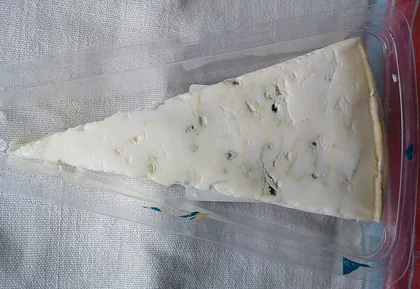 CheeseGorgonzolaThe green veining is the product, not a flaw anyone tolerates: it grows from a mould added to the milk and…
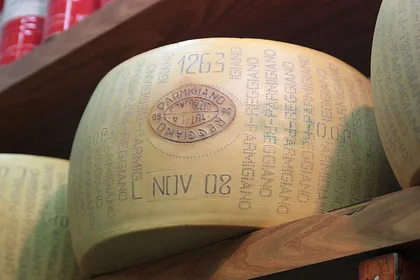 CheeseParmigiano ReggianoThree ingredients and no additives of any kind are permitted: raw cow's milk, salt and calf rennet, from five…
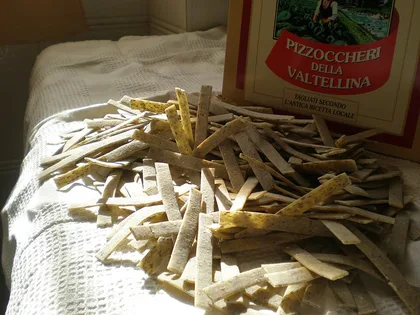 Pasta and breadPizzoccheriBuckwheat rather than wheat, which is where the dark colour and the nutty taste come from.Pasta and breadPolenta TaragnaPolenta taragna is the dark alpine polenta of Lombardy: cornmeal cut with buckwheat flour, stirred for the…
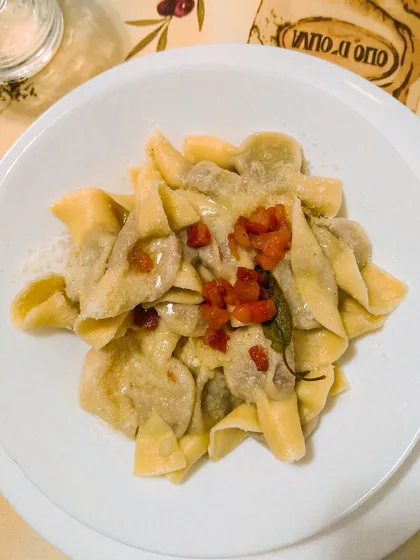 Pasta and breadCasoncelliCasoncelli are Bergamo's stuffed pasta: beef and salami filling laced with crushed amaretti and raisins…Pasta and breadMichetta (Rosetta Roll)The michetta is Milan's hollow bread roll: five petals around a small central dome, and nothing at all inside.
 SweetsTiramisuNothing here goes near an oven. Savoiardi dipped in cold espresso, raw egg yolk whipped with mascarpone…Cured meatsPancettaPancetta is Italian cured pork belly: salt, pepper and warm spices, dried for months, never smoked.