What is Michetta (Rosetta Roll)?
A michetta is a 70 to 90 gram soft-wheat roll with five petals opening around a raised centre. Its defining feature is invisible from outside: it is hollow. Tear one open and you find an empty chamber with a paper-thin film of crumb clinging to the crust, and nothing else.
That void is engineered. The dough is deliberately dry, refined between rollers until it is smooth and tough, stamped with a five-pointed iron and then proved upside down. In a steam-injected oven the trapped moisture inflates the roll, the stiff dough cannot follow the expansion, and it pulls away from the middle.
In Milan the michetta is simply what bread means: bought by weight at the prestinaio, the local word for baker, and eaten with anything. Elsewhere in Italy the same roll goes by the name rosetta. In 2007 the city of Milan granted it a Denominazione Comunale, a municipal mark with no legal force outside the city but a clear statement of ownership.
What does it taste like?
Mild, clean and almost neutral: this is not a bread with a flavour agenda. There is no sourness, no discernible fat and only a whisper of malt sweetness. What you taste is toasted wheat crust, because crust is nearly all there is.
The pleasure is structural. Fresh from the oven the shell shatters under your teeth with a dry crack, and then there is simply nothing to chew: the roll disappears. It is closer to eating a very thin, very fresh cracker shaped like a ball than to eating bread.
The hollow also changes what a filled roll tastes like. With no crumb to absorb, the salami or mortadella inside stays entirely itself, and the bread reads as texture rather than flavour. This is why Milanese fillings are dry and fatty: the bread contributes crunch and nothing more.
Three hours after baking that crack is gone, the shell has softened and the roll tastes of very little. There is no salvaging it beyond a spell in a hot oven.
How to use it
Treat it as a container. Split it, fill it, close it: the hollow exists so that you do not have to hollow it out yourself, which is what people do to ordinary rolls before making a sandwich.
In Milan the filling comes from the salumeria next door: salame Milano, mortadella, cooked ham, coppa, with or without butter. Gorgonzola with walnuts is equally local. Keep the filling dry and fatty; tomato, wet mozzarella or any generous sauce will go straight through the shell within minutes, because there is no crumb to absorb it.
At the table it can be torn and used to mop a plate, but it is not the best tool for the job. Milanese braises (ossobuco, cassoeula, tripe) want a denser bread with crumb to soak.
Stale michette earn their keep. Halve them, pull out the film of crumb, toast the shells and use them as edible bowls for a baked egg or a soup. Ground up, they give an unusually fine breadcrumb, which is exactly what you want for breading a Milanese veal cutlet.
One rule above all others: buy it within a couple of hours of when you plan to eat it. This is not a bread you shop for in advance.
How long it keeps
Almost all crust and almost no crumb means almost no water reserve, and that governs everything. A michetta is at its crispest for perhaps three to five hours after baking, which is exactly why Milanese bakeries fire several batches through the day rather than one in the morning. Left in a paper bag on the counter it holds up for half a day, the crust gradually softening as the little moisture in the shell migrates outward. Sealed in plastic the same shift takes about an hour and the crust turns leathery. By the following morning the shell has dried through and gone hard and brittle.
The fridge makes it worse, since bread firms fastest at temperatures just above freezing. Three to five minutes in a 200°C oven, with a quick spray of water, brings the crackle back for maybe half an hour before it toughens again. Freezing on the day of baking works better than keeping one overnight: bagged, it holds a month and comes back from frozen in a hot oven in six to eight minutes. Filled rolls soften quickly as the filling wets the shell.
Spot the real thing
Pick one up before you look at it. A real michetta weighs 60 to 90 grams and feels startlingly light, because the inside is very nearly empty: a thin shell of crumb, a papery crust and a hollow chamber in the middle. The top is stamped into five lobes around a raised central button, and the crust is pale gold and matte rather than shiny, thin enough to shatter under a thumb. That hollow comes from a stiff low hydration dough with a long biga and from proving the stamped rolls upside down.
The rosetta sold in Rome is the same roll under a different name. The Austrian kaiser roll shares the five lobed stamp but is full of crumb and often seeded and glazed. Most bakeries abroad that sell something called michetta produce a solid roll with the right shape and none of the void, which is the whole difference. Generic Italian rolls in supermarket bags are denser again and softer throughout. In Milan they cost 30 to 60 cents each and are usually sold by weight at 4 to 6 euro a kilo.
How to pronounce Michetta (Rosetta Roll)
mee-KET-tah
Three syllables, stress on the middle one. The 'ch' is a hard 'k' as in 'chemistry', never the English 'ch' of 'cheese', so mee-KET-tah and never 'mi-CHET-ta'. The double 't' is held slightly longer than a single one. The final 'a' is a clear open vowel, not a schwa. Plural: michette, mee-KET-teh. The alternative name is rosetta, roh-ZET-tah, with a voiced 's' as in 'rose'.
Michetta (Rosetta Roll) compared
vsRosetta (the Roman name)
The same bread with two passports. Michetta is what Lombardy and Piedmont call it; rosetta is the name in Rome and most of central and southern Italy, taken from the rose-like shape. The dough, the five-petal stamp and the hollow interior are the same. In practice Roman rosette are often slightly larger and a little less thoroughly hollow, and they are used differently: in Rome the rosetta is above all the ham roll of the neighbourhood salumeria.
| This | Rosetta (the Roman name) | |
|---|---|---|
| Name used in | Milan, Lombardy, Piedmont | Rome, central and southern Italy |
| Origin of the name | Micca, a small loaf | Rosetta, a little rose |
| Typical weight | 70-90g | 80-110g |
| Hollow | Fully hollow | Hollow, sometimes with more crumb |
| Classic filling | Salame Milano, mortadella, gorgonzola | Prosciutto crudo, porchetta |
vsKaisersemmel (Austrian kaiser roll)
The ancestor and the descendant, and the difference is the climate they were built for. The Viennese Kaisersemmel has the same five-lobed top but a soft, substantial crumb throughout. Milanese bakers copied the shape under Habsburg rule and then re-engineered the interior: less water, a refining pass through rollers, and a bake that empties the roll. In damp Milan a soft crumb went limp by lunchtime; a hollow one had nothing to go limp.
| This | Kaisersemmel (Austrian kaiser roll) | |
|---|---|---|
| Interior | Hollow chamber | Full, soft crumb |
| Hydration | Low, around 45-50% | Higher, softer dough |
| Dough handling | Passed through refining rollers | Conventionally mixed |
| Shaping | Stamped, proved upside down | Hand-folded or stamped |
| Weight for size | Very light | Substantial |
| Eaten with | Dry, fatty fillings | Butter, jam, cold cuts, soup |
vsAmerican kaiser roll / hard roll
The kaiser roll on a New York deli counter is the same Viennese bread that reached Milan, carried instead by central European immigrants to the United States. It kept the crumb the michetta lost, gained a poppy or sesame topping the Italian version never had, and grew considerably in size to hold a sandwich. If you want to imagine a michetta from an American starting point, picture a kaiser roll with the inside removed.
| This | American kaiser roll / hard roll | |
|---|---|---|
| Size | 70-90g | 100-140g |
| Interior | Empty | Dense, chewy crumb |
| Topping | None | Often poppy or sesame seeds |
| Fat or sugar in dough | None | Frequently a little of both |
| Shelf life | 3-4 hours | A day or more |
Michetta (Rosetta Roll) substitutes
- Kaiser roll or deli hard roll
The nearest thing on any American or Austrian counter, and a genuine relative rather than an approximation. Pull out most of the crumb with your fingers before filling and you are surprisingly close to the real experience.
1 kaiser roll per 1 michetta, crumb removed - Portuguese papo-seco or carcaça
Small, crisp-shelled, minimal crumb, sold everywhere in Portugal and in Portuguese bakeries abroad. The shape is wrong and the crust is thinner, but the eating is remarkably similar.
1:1 - A crusty ciabatta roll
Widely available and already full of holes. Far wetter and chewier than a michetta, so the crunch fades faster, but it takes the same dry fillings without collapsing.
1 roll per michetta, expect a heavier sandwich - Home-made with a michetta stamp
The only faithful route. Make a 45-50% hydration type 0 dough with malt and a small amount of yeast, sheet it repeatedly, stamp it, prove it stamped-side down for an hour, invert and bake at 230C with steam. Stamps cost a few euros online and are the one piece of kit you cannot improvise.
80g of dough per roll - Vietnamese banh mi roll
An unexpected but effective stand-in: thin shell, very little crumb, engineered light. It is a French colonial descendant with rice flour in the mix, and like the michetta it is best within hours of baking.
Half a banh mi roll per michetta
Where to buy it
Any neighbourhood bakery in Milan, and the timing matters more than the address: aim for mid-morning or around five in the afternoon, when fresh batches come out. Bread is sold by weight, so expect 4 to 6 euros per kilo, which works out at 25 to 40 cents per roll since a kilo holds twelve or thirteen. In the historic centre it climbs to 7 euros per kilo.
Supermarket versions run cheaper, at 3 to 4.50 euros per kilo, but they are usually part-baked and finished in store: the shape survives, the hollow generally does not.
Outside Lombardy, ask for rosetta and expect similar prices. Outside Italy, be realistic: no importer can build a supply chain around a three-hour product, and rolls sold abroad as michette are solid bread in the right shape.
For reference when shopping elsewhere: a New York deli hard roll costs roughly 1 to 2 dollars each; a Portuguese papo-seco in a UK Portuguese bakery is usually 40 to 70 pence. Both are better substitutes than a bad imported michetta.
Where to eat it in Italy
Milan, and specifically the bakeries of Porta Romana, Isola, Brera and the streets around Porta Venezia, where small independent prestinai still bake several times a day. The full ritual involves two shops: the roll from the baker, the filling from the delicatessen.
Peck, on via Spadari a minute from the Duomo, has been the city's grand food shop since 1883 and is the place to understand the range of what goes inside a Milanese roll. The covered municipal markets (Wagner, Isola, Santa Chiara) put a bakery and a salumeria under one roof, which is more efficient.
Milan is not a city that makes a spectacle of its bread, and that is part of the appeal: the michetta is an everyday object bought in seconds and eaten standing up. Watching the lunchtime queue at any decent bakery near an office district tells you more than any tasting.
If you are travelling further, the same roll appears across Lombardy and Piedmont under the same name, and across Rome and central Italy as the rosetta: in the delicatessens of Prati and around the Trionfale market, a rosetta with prosciutto is an institution in its own right.
Frequently asked questions
Why is a michetta hollow inside?
By design. The dough is low in water and refined between rollers until it is stiff, then stamped and proved upside down. In a steam oven the interior moisture inflates the roll while the tough dough cannot stretch with it, so it separates from the centre and leaves an empty chamber.
Are michetta and rosetta the same bread?
Essentially yes: same dough, same five-petal stamp, same hollow structure. Michetta is the name in Milan, Lombardy and Piedmont; rosetta is used in Rome and most of central and southern Italy. Roman rosette are often a little larger and sometimes retain more crumb.
How long does a michetta stay good?
Three to four hours. After that the shell softens, the hollow collapses inward and the roll tastes of almost nothing. Milanese bakeries bake several times a day for exactly this reason, and it is why the bread is never exported.
Where does the michetta come from?
From the Austrian Kaisersemmel, which arrived in Milan during Habsburg rule of Lombardy. Local bakers copied the five-lobed shape but rebuilt the interior, cutting the water and emptying the roll, because the Viennese version's soft crumb went limp in the damp Po valley air.
What do you put in a michetta?
Dry, savoury, fatty fillings: salame Milano, mortadella, cooked ham, coppa, or gorgonzola with walnuts. Avoid anything wet: with no crumb to soak it up, tomato or a sauce will soften the shell and break it within minutes.
Related foods
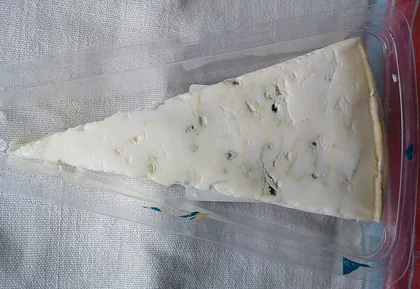 CheeseGorgonzolaThe green veining is the product, not a flaw anyone tolerates: it grows from a mould added to the milk and…
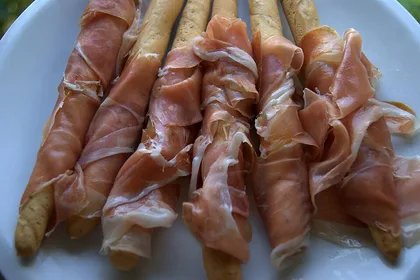 Pasta and breadGrissiniGrissini are Turin's breadsticks: bread reduced to almost pure crust, dried in the oven until it snaps.Pasta and breadGnocchiGnocchi are small boiled dumplings, in their modern form made of potato bound with a little flour.
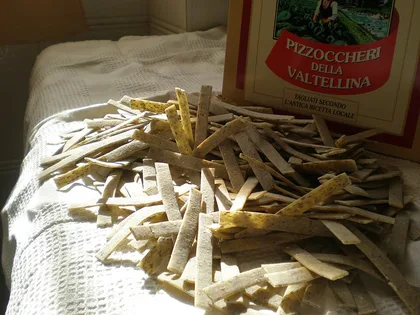 Pasta and breadPizzoccheriBuckwheat rather than wheat, which is where the dark colour and the nutty taste come from.Pasta and breadPolenta TaragnaPolenta taragna is the dark alpine polenta of Lombardy: cornmeal cut with buckwheat flour, stirred for the…
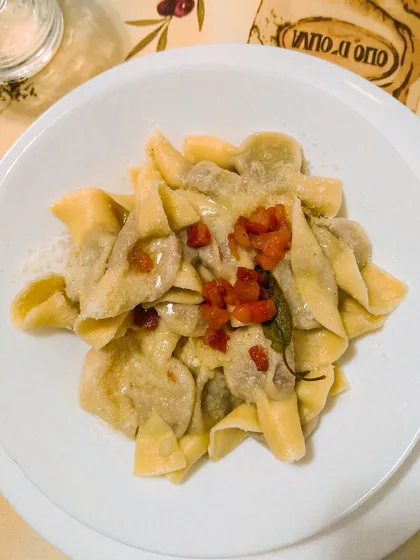 Pasta and breadCasoncelliCasoncelli are Bergamo's stuffed pasta: beef and salami filling laced with crushed amaretti and raisins…Cured meatsPancettaPancetta is Italian cured pork belly: salt, pepper and warm spices, dried for months, never smoked.